


1. Background
Mutations in the cystic fibrosis (CF) transmembrane regulator gene in CF patients lead to recurrent and chronic respiratory tract infections, which serve as an important cause of mortality and morbidity. Treatment with appropriate drugs can improve the quality of life of CF patients. Knowledge of the etiological agents and their antibacterial susceptibility can help in planning appropriate drug therapy in CF patients. Infection due to Pseudomonas aeruginosa has been implicated as a major cause of mortality and morbidity in patients with CF (1). Enzymes are the most commonly encountered mechanism of resistance of P. aeruginosa to β-lactam drugs. Some enzymes have been detected, encoded by chromosomal or by genes located on plasmids and transposons. The classification of β-lactamases is based on their functional similarities (Bush-Jacoby-Medeiros classification) or molecular structure (Ambler classification) (2). Antibiotic resistance due to acquired metallo-β-lactamase (MBL)-associated serine proteases and extended-spectrum β-lactamase enzymes (ESBLs) is considered more serious than other resistance mechanisms because they can hydrolyze almost all β-lactam drugs, except monobactams. Furthermore, ESBL and MBL genes located on plasmids or integrons can be easily disseminated from one bacterium to another (3). Since the first report of MBL-producing bacteria in the 1990s, MBL-producing bacteria have been identified in different parts of the world. The appearance of MBL enzymes and their spread among P. aeruginosa strains are a major concern (4). Many MBLs have been detected in P. aeruginosa, including imipenemase (IMP), Sao Paolo metallo-β-lactamase, Verona integron-encoded metallo-β-lactamase (VIM), Seoul imipenemase, Kyorin University hospital imipenemase, German imipenemase, New-Delhi metallo-β-lactamase-1, and Australian imipenemase. The appearance of enzymes and their spread among P. aeruginosa strains are of great concern for the future of antibacterial chemotherapy.
2. Objectives
The aim of this study was detection of MBL and KPC genes among P. aeruginosa isolates from pediatric patients with CF who were referred to Mofid Children’s hospital, Tehran, Iran during 2012 - 2013.
3. Patients and Methods
3.1. Isolation and Clinical Identification
From September to January 2012 - 2013, 30 sputum samples were collected from children with CF who were referred to Mofid Children’s hospital in Tehran, Iran. Samples were transferred to Stuart media, consequently cultured on MacConkey agar and Cetrimide agar, and incubated at 37°C for 24 hours. Suspected pigmented and odorous colonies were studied using biochemical tests, such as the oxidase test, catalase test, and sugar fermentation test. Growth ability at 42°C was also studied. The isolates were stored at -20°C in brain heart broth containing 20% glycerol.
3.2. Antimicrobial Susceptibility Testing
Antimicrobial susceptibility testing to IMP (10 μg), meropenem (MEM, 10 μg), ceftazidime (CAZ, 30 μg), piperacillin (PIP, 30 μg), ciprofloxacin (CIP, 5 μg), aztreonam (ATM, 30 μg), and gentamicin (GEN,10 μg) (Mast Group, Merseyside, UK) was performed using the Kirby–Bauer disk diffusion method on Mueller-Hinton agar (Merck, Germany), based on the guidelines of the clinical laboratory standards institute (CLSI) (5) and those of Roodsari et al. (6). P. aeruginosa ATCC27853 was used as a control strain.
3.3. Phenotypic Detection of MBLs
MBL was detected using the combination disk diffusion test (CDDT). MEM and MEM + EDTA, imipenem and imipenem + EDTA discs were used to detect MBL-producing P. aeruginosa isolates. A zone diameter difference between the discs alone and the discs plus EDTA of ≥ 7 mm was interpreted as a positive result as regards MBL production.
3.4. Phenotypic Detection of KPC by the Modified Hodge Test (MHT)
All the isolates were tested using the MHT according to the CLSI 2014 quality control recommendations (5). Using this method, a standard Escherichia coli ATCC 25922 was cultured on Mueller-Hinton agar. A disk of MEM was then placed in the center, and a streak of each tested P. aeruginosa isolates was cultured around the antibiotic disk. The plates were incubated at 37°C for 24 hours. The results of the MHT were categorized according to the CLSI recommendations as follows: negative when there was no distortion of the inhibition zone around the MEM disk, positive when any distortion of the E. coli ATCC 25922 (strain indicator) inhibition zone was noted around the MEM disk, and indeterminate when the inhibition of E. coli ATCC 25922 growth around the streak (tested strain) was evidenced by a clear area (5).
3.5. Detection of Resistance Genes by PCR and Sequencing
DNA was extracted by the boiling method. First, 3 - 4 bacterial colonies were picked and suspended in 200 µL of sterile distilled water. The water was boiled for 10 minutes, followed by centrifugation at 12,000 rpm for 5 minutes. The frequency of IMP, VIM, and KPC genes was determined by the PCR method, using ready to use Master mix (Bioneer Company, Korea) and appropriate primers (7, 8). Amplification was carried out under the following thermal cycling conditions: 5 minutes at 94°C and 36 cycles of amplification consisting of 1 minutes at 94°C, 1 minute at 55°C, and 1 minutes at 72°C, with 5 minutes at 72°C for the final extension. P. aeruginosa KP780165 was used as a control strain. The PCR products were analyzed by electrophoresis in a 1% agarose gel at 95 V for 45 minutes in 1X TBE-containing ethidium bromide. The sequencing of the PCR products was done by Bioneer, Korea. The nucleotide sequences were analyzed using Chromas 1.45 software and BLAST in NCBI.
3.6. Statistical Analysis
This was a descriptive study. All the data were input into an Excel file, and the statistical analysis was done by MINITAB 16.
4. Results
Based on the results of the antimicrobial susceptibility testing, the resistant patterns of P. aeruginosa isolates from the 30 CF pediatric patients were as follows: ATM (26.6%), MEM (10%), GEN (43.3%), CIP (16.6%), cefepime (16.6%), CAZ (33.3%), imipenem (10%), and PIP (10%) (Figure 1). Based on the CDDT results, 43.3% of the isolates were MBLs producers (Figure 2). According to the MHT, no KPC-producing P. aeruginosa isolates was identified in any of the patients (Figure 3). IMP, VIM, and KPC genes were detected in 2 (6.66%), 2 (6.66%), and 0 (0%) cases, respectively. All the PCR products were confirmed after the sequence analysis.
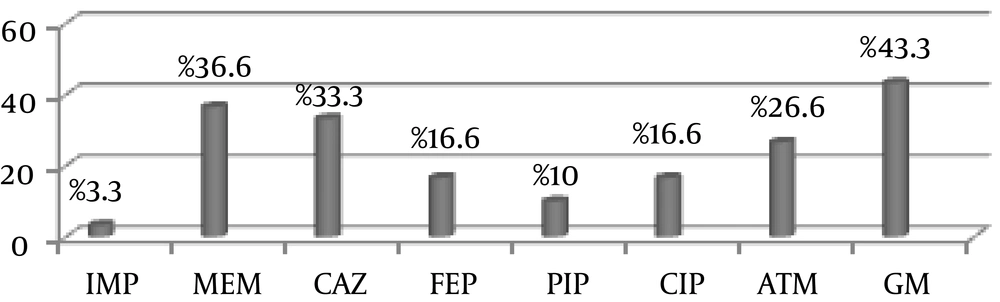
Figure 1.
IMP, imipenem; MEM, meropenem; CAZ, ceftazidime; FEP, cefepime; PIP, piperacillin; CIP, ciprofloxacin; ATM, aztreonam; GM, gentamicin.
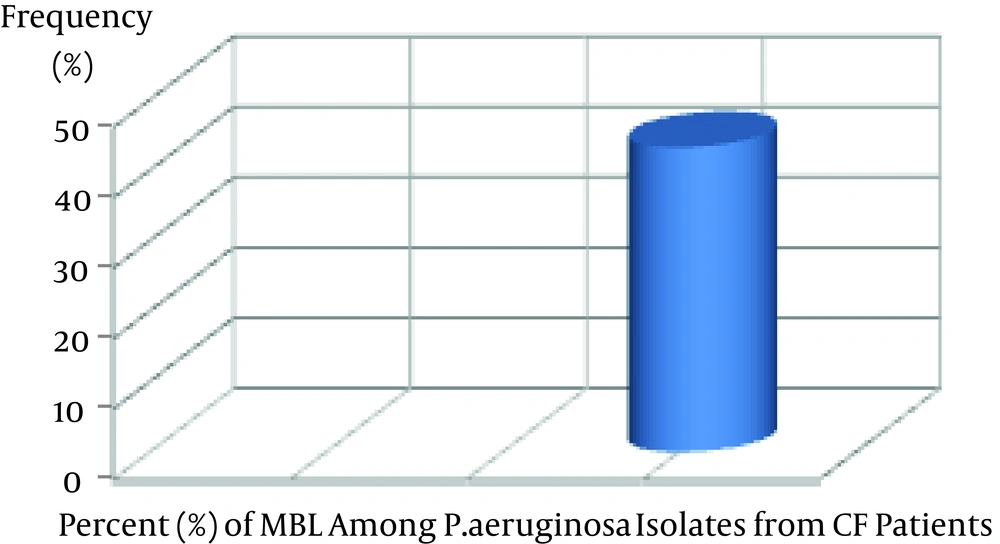
Figure 2.
Frequency of MBL Production (Expressed as a Percentage) Among P. aeruginosa Isolates From CF Patients at Mofid Children’s Hospital
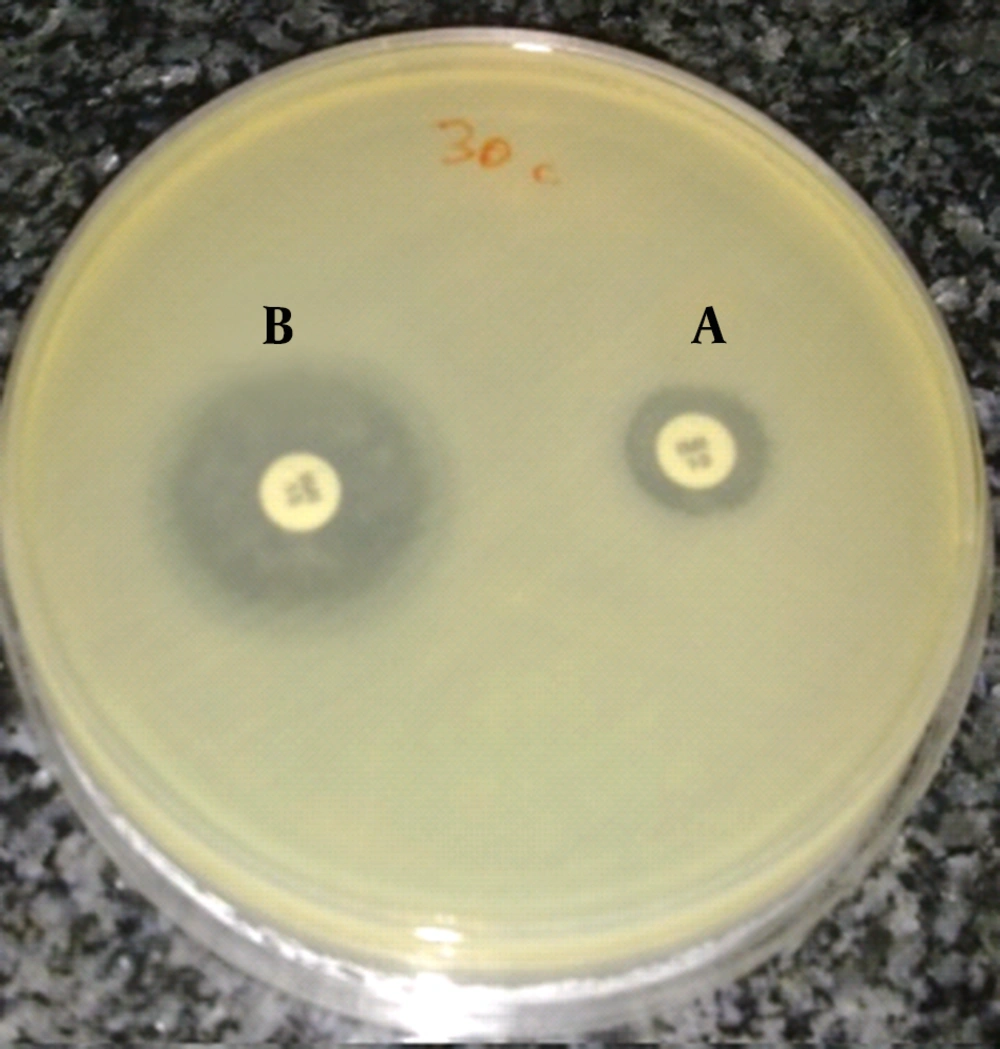
Figure 3.
A, IMP (10 μg) disc alone; B, disk of IMP (10 μg) plus EDTA.
5. Discussion
CF is a recessive autosomal genetic disorder. Colonization by pathogenic bacteria, especially P. aeruginosa, in the respiratory tract occurs at a young age in patients with CF and represents a major health problem because it is considered a serious cause of mortality and morbidity. A previous study of the prevalence and antibacterial susceptibility of bacterial isolates from CF patients in Germany, the U.S., and South America reported that P. aeruginosa isolates were the most frequent pathogens of CF patients (9). The educational level of mothers of CF children and family awareness were reported to play important roles in the spread of infection with P. aeruginosa.
In this research, three isolates were resistant to the carbapenems imipenem and MEM. P. aeruginosa has developed various antibiotic-resistant mechanisms, such as the loss of OprD porin expression, a high level of expression of AmpC enzymes, increased expression of several efflux pumps (e.g., MexA-MexB-OprM), and the production of class A, B, and D β-lactamases.
In a recent study, 90% of P. aeruginosa isolates were susceptible to imipenem, and 43.3% of the isolates were identified as MBLs producers. A study in 2003 in Tehran by Eftekhar et al. (cited in Forozsh et al.) did not detect any imipenem-resistant strains among P. aeruginosa isolates from CF patients (10). The same study reported that the rate of susceptibility to CAZ, CIP, PIP, tobramycin, and ticarcillin was 85.9%, 7.5%, 81%, 85.7%, and 76%, respectively.
In a study by Bagheri Bejestani et al. 3.3% of P. aeruginosa isolates from pediatric patients at the Children’s medical centre of Tehran were MBL producers, and the frequency of IMP and VIM genes was 3.3% and 0%, respectively (11). The difference between the frequency of MBL production between the recent study 43.3% to 3.3% in Bagheri Bejestani et al. study is related to the origin of the P. aeruginosa isolates and the duration of the diseases in the two groups of patients, urinary tract infection Vs. CF, Despite the difference in MBL production, the frequency of the IMP gene among the P. aeruginosa isolates was low in both studies (3.3% and 6.66%) in Tehran. Similarly, neither study detected the VIM gene.
Another study showed that of 146 P. aeruginosa isolates from CF patients, none of the isolates were ESBL or MBL producers (12). In addition, using the PCR method, a study in Spain did not detect any genes encoding TEM, SHV, or MBL genes (13).
In the study by Forozsh et al. in Isfahan, 27.8% of P. aeruginosa isolates from CF patients were CAZ resistant, but 100% were susceptible to imipenem, ticarcillin, CIP, and PIP (10). In another study in Isfahan, based on antimicrobial susceptibility testing during 2003 - 2008, Fazeli et al. reported that the resistance rate of P. aeruginosa isolates from CF patients to amikacin and GEN, CIP, and CAZ were 9.5%, 14.2%, and 86%, respectively (14). Despite the geographic and time differences between the study by Forozsh et al. (10) study and the recent study, there was little variation between the antibiotic resistance and susceptibility patterns. In contrast, mentioned factors cause discrepancy among the results of the recent study and Fazeli et al. study (14). Furthermore, it seems that hospital stay, age of the patients, and contact with CF cases might be risk factors for the acquisition of antibiotic resistant among strains of P. aeruginosa (10). In addition, the aforementioned factors may increase the rate of resistance to carbapenemases among P. aeruginosa isolates in Iran.
In a study conducted in Kermanshah, Abiri et al. reported that 33.7% and 18.1% of P. aeruginosa isolates from different origins were resistant to imipenem and MEM respectively (15). The same study showed that 59.2% of isolates were MBLs producers and that 75% carried the IMP-1 gene. In the present study, 10% of P. aeruginosa isolates from CF pediatric patients were resistant to imipenem and MEM, 43.3% were MBLs producers, and only 6.6% carried the IMP gene. These differences are another example of the influence of time and geographic distance and the difference in the origin of the bacterial isolation. In another study, we found that P. aeruginosa isolates from burn patients were more invasive than those from CF patients (unpublished data). This can be caused by being more aggressive factors they are armed. The other extract of this comparison is related to the difference in the frequency of the IMP gene (6.6% vs. 75%) in contrast to the close rate of MBLs production (43.3% vs. 59.2%). This difference is expressing the role of other resistant mechanisms other than bla IMP.
Based on the results of the present study, carbapenems and cephalosporins remain effective drugs against P. aeruginosa isolates from children with CF in Tehran, Iran.
In conclusion, the present study suggests that MBL-producing P. aeruginosa strains represent an emerging threat to CF patients that should be averted by implementation of timely identification and strict isolation methods.
