
1. Background
Obesity, meat consumption, sedentary lifestyle, and physical inactivity are one of the problems of societies, which are the cause of urinary tract cancers, especially prostate cancer. These factors are also effective in hyperuricemia and stone formation (1). Therefore, exercise should always be considered as an important and inseparable part of daily life activities (2).
Urinary stones are among the ancient health problems that have been concerning humankind for more than three thousand years (3). The prevalence of kidney stones in developed and developing countries has been estimated as 2 - 3% and 0.5 - 1%, respectively (4, 5). Nevertheless, the incidence of kidney stones is influenced by lifestyle, geographical location, physical activity, race, ethnicity, and many other factors (6). In general, the global incidence of kidney stones is increasing, especially in women and the elderly. People with a sedentary lifestyle are more likely to develop urinary stones, especially calcium ones (7, 8), in the kidneys, ureter, urethra, and urinary tracts. About 5 to 10 % of people experience kidney stones in life. The highest incidence of kidney stones in men and women is observed in the fourth and fifth decades of life, respectively. The accumulation of crystals from dietary minerals is the major contributor to the formation of kidney stones (1, 2, 9, 10)
Diet modification and weight loss through physical activity are among the most effective preventive measures reducing the formation of kidney stones (11). The treatment of kidney stones is based on the watchful waiting approach, and if there is no indication for therapeutic interventions, supportive care such as the administration of analgesic drugs and also medications for relaxing ureteral smooth muscles, as well as encouraging patients to exercise and drink lots of fluids will be the main actions (12). However, in the case of persistent pain and stones or the emergence of renal complications, therapeutic interventions, based on patients’ clinical condition and available instruments, are indicated to accelerate the excretion of stones. These interventions include extracorporeal shock wave lithotripsy (ESWL) using supersonic waves, open surgery, laparoscopy, trans-ureteral lithotripsy (TUL), and percutaneous nephrolithotomy (PCNL). From the complications of these methods are ureteral stenosis, bladder-ureteral urinary reflux, bleeding, inaccessible stones, ureter rupture, a need for a second surgery, and even nephrectomy in severe cases (13, 14). Kidney stones are associated with serious health problems, and without treatment and follow up, the recurrence rate can reach more than 50% within a few years.
Ultrasonic wave-assisted ESWL is used to break large stones and transform them into excretable small ones (15). In this procedure, after the extracorporeal lithotripsy, patients are encouraged to consume 2 to 3 liters of fluids (diluted tea and especially water) and to adequately exercise (walking, climbing mountains and stairs, rope jumping, and playing soccer) to increase urine output. They are also advised to take diuretics and muscle relaxing medications and sleep on the side opposite the target kidney (16).
The beneficial effects of exercise in preventing and treating many diseases have been known for decades. Rope jumping and jogging have been shown to be effective in improving cardiovascular function (17). On the other hand, immobility and insufficient consumption of fluids are triggers of renal stone formation (17). Aerobic exercises such as running and rope jumping have been described as complementary non-pharmaceutical interventions for renal stone disposal. Despite multiple notions about the contributing effects of heavy exercise on renal stone formation, light exercise can prevent formation or accelerate stone disposal (18). Studies have also shown that exercises affect the amount of urinary stones excreted following lithotripsy (19). Based on the above-mentioned, rope jumping and treadmill running exercises seem to be effective in accelerating the expulsion of kidney stones.
2. Objectives
The purpose of this study was to compare the effects of treadmill running and rope jumping exercises on the excretion of mass-like urinary stones following ESWL in the patients referred to the Asia clinic in the city of Ilam in 2019.
3. Methods
This was a quasi-experimental study conducted on the patients referred to the Asia clinic in the city of Ilam. The clinic was equipped with sports equipment, including a treadmill. The patients were selected by the convenience sampling method, and the required sample size was estimated using the below formula.
The values were considered as P1 = P2 = 0.05, a confidence interval of 95%, the power of 80%, and a maximum error rate of 15%. The sample size was estimated at 150 individuals who were randomly categorized into three groups (n = 50 per group), including treadmill running, rope jumping, and control. For this purpose, we used the method of six random blocks. In this way, we prepared six sheets of paper. On two sheets, the letter I1 meant Intervention1 (treadmill running), on two sheets of the letter I2 meant Intervention 2 (rope jumping), and on another two sheets of the letter C meant Control (without intervention). We mixed the sheets together and put them in the desk drawer. When referring to each of the eligible patients, one of the sheets was randomly taken out, and based on it, it was assigned to one of the three groups. This method continued until the samples were completed.
3.1. Inclusion Criteria
No history of previous lithotripsy, age of > 18 and < 60 years, having writing and reading skills, ability to perform required exercises based on the approval of a cardiologist, a definitive diagnosis of kidney stones (only in the kidney calyx or pelvis) by a urologist, and the stone’s diameter of 5 to 20 mm were the inclusion criteria.
3.2. Exclusion Criteria
A worsening clinical condition, reduced consciousness, and loss of follow up were exclusion criteria. However, in this study, all participants were present until the end.
3.3. Data Collection Tool
In this study, a five-part researcher-made checklist was used to gather the required information. The checklist’s first part included demographic and health characteristics (age, gender, marital status, occupation, education, and histories of diseases, doing exercises, and smoking). Parts two and three each consisted of eight questions about the ultrasonographic characteristics of the stones before lithotripsy and the features of the stones collected by patients. The patients collected and delivered the stones every week for 4 weeks after the procedure. The checklist’s forth part included five questions about the features of the stones excreted after lithotripsy and those collected by the patients. The last part of the checklist consisted of two questions addressing the size of the stones (mm and %) based on ultrasonography reports pre- and post-lithotripsy (20).
In this study, a comparison was made between the two groups with rope jumping and treadmill running methods based on the recommendation of the American College of Sports Medicine (ACSM) with the control group. This study was performed in the Asia clinic. This center is equipped with the required space, instruments, and treadmills. Researchers properly educated the participants on how to run on a treadmill or perform the rope jumping exercise. The researcher supervised all the procedures during the study.
3.4. Treadmill Running Exercise
This was performed every other day for one month (15 sessions, one hour per session). Each session included four 10-minute running cycles on a treadmill with 5-minute rest intervals. The treadmill protocol was set at 10% slope. The exercise included 1-minute running at the speed of 1.5 miles per hour (warming up) and 9 -minute running at the speed of 5 miles per hour. The participants were asked to drink two glasses of fluids, preferably water, 30 minutes before the exercise.
3.5. Rope Jumping Exercise
In the rope jumping exercise group, the participants performed the intended protocol every other day for one month (15 sessions, 1 hour per session). The protocol included four cycles of rope jumping (100 jumps per cycle) with 5-minute rest intervals. The participants were asked to drink two glasses of fluids, preferably water, 30 minutes before the exercise.
All the stones received up to 4,000 shocks (SLK instrument, STORZ Co, Germany) with a fixed protocol. All the patients were given 50 mg hydrochlorothiazide for daily consumption (along with two to three liters of fluids) for one month after the procedure. They were also requested to urinate into a bowl and to gather the stones, and deliver them every week. Then the excreted stones’ features were recorded into the checklist. The control group did not receive any intervention but were under observation and preferable treatment according to their physician.
The collected data was analyzed using SPSS software version 24. Descriptive statistics, frequency distribution tables, means and standard deviations, and inferential statistics including the Chi-square test, unpaired t-test, and analysis of variance (ANOVA) were used to analyze the data. The significance level was considered as P < 0.05.
4. Results
In this study, 150 patients were divided into three, including one control and two intervention (treadmill running and rope jumping) groups. The participants’ demographic characteristics have been presented in Table 1.
Table 1.
Demographic Features of the Studied Participants
| Variables | Control (Number) | Treadmill Running (Number) | Rope Jumping (Number) | Mean ± SD |
|---|---|---|---|---|
| Age (y) | 43.5±5.5 | |||
| < 40 | 15 | 21 | 16 | |
| 40 - 50 | 12 | 26 | 31 | |
| > 50 | 23 | 3 | 3 | |
| Sex | ||||
| Male | 29 | 26 | 29 | |
| Female | 21 | 24 | 21 | |
| Marital status | ||||
| Married | 44 | 43 | 42 | |
| Single | 6 | 7 | 8 | |
| Weight (kg) | 67.5 ± 6.5 | |||
| < 60 | 4 | 8 | 4 | |
| 61 - 70 | 12 | 18 | 15 | |
| 71 - 80 | 16 | 14 | 20 | |
| > 80 | 18 | 10 | 11 | |
| Height (cm) | 165.5± 9.8 | |||
| < 170 | 35 | 41 | 45 | |
| 171 - 180 | 14 | 9 | 5 | |
| > 180 | 1 | 0 | 0 | |
| BMI (Kg/m2) | 23.7± 3.7 | |||
| < 20 | 7 | 6 | 0 | |
| 20 - 25 | 14 | 21 | 12 | |
| > 25 | 29 | 23 | 38 |
Overall, patients with higher BMIs had more kidney stones. There was a significant difference in the number of excreted mass-like stones among the groups (F = 8.851, P = 0.002). There was also a significant difference in the rate of excretion considering the location of stones (upper, middle, or lower calix or pelvis) (F = 19.064, P = 0.002). In all the studied groups, the most and least common sites of stones were the pelvis and lower calix, respectively.
Table 2 shows the location of stones in the upper, middle, and lower calyxes and the pelvis of the kidney. Matching has also been done in this table.
Table 2.
Location of Stones
| Group | Mean | Std. Deviation | N (Patients) |
|---|---|---|---|
| Control | |||
| Upper calyx | 48.6667 | 50.05330 | 3 |
| Middle calyx | 49.3333 | 43.32147 | 9 |
| Lower calyx | 34.1875 | 39.61855 | 16 |
| Pelvis | 79.4091 | 36.82734 | 22 |
| Total | 57.6800 | 43.36341 | 50 |
| Treadmill | |||
| Upper calyx | 1.0000E2 | 0.00000 | 3 |
| Middle calyx | 78.2222 | 35.96449 | 9 |
| Lower calyx | 47.0000 | 42.78317 | 16 |
| Pelvis | 88.6364 | 30.59652 | 22 |
| Total | 74.1200 | 39.39006 | 50 |
| Roping | |||
| Upper calyx | 1.0000E2 | 0.00000 | 3 |
| Middle calyx | 83.8889 | 34.80102 | 9 |
| Lower calyx | 63.1250 | 42.70968 | 16 |
| Pelvis | 93.4091 | 22.95888 | 22 |
| Total | 82.4000 | 34.30952 | 50 |
| Total | |||
| Upper calyx | 82.8889 | 35.84845 | 9 |
| Middle calyx | 70.4815 | 39.82304 | 27 |
| Lower calyx | 48.1042 | 42.54922 | 48 |
| Pelvis | 87.1515 | 30.74423 | 66 |
| Total | 71.4000 | 40.27406 | 150 |
Table 3 shows the size of stones after ESWL in millimeters in three groups.
Table 3.
Comparison of Stone Sizes in Millimeters in 3 Groups after ESWL
| Group | Stone Sizes in Millimeters | |||||
|---|---|---|---|---|---|---|
| 1 mm | 2 mm | 3 mm | 4 mm | 5 mm | 6 mm | |
| Control, n = 50 | ||||||
| Mean | 23.5000 | 15.9200 | 4.1800 | 0.7400 | 0.0800 | 0.0400 |
| Std. Deviation | 1.68804E1 | 1.25191E1 | 3.81024 | 1.15723 | 0.27405 | 0.19795 |
| Treadmill, n = 50 | ||||||
| Mean | 19.4000 | 14.8600 | 10.6400 | 3.7600 | 0.7400 | 0.0200 |
| Std. Deviation | 1.39108E1 | 8.34709 | 7.47174 | 3.37191 | 1.57545 | 0.14142 |
| Roping, n = 50 | ||||||
| Mean | 16.5600 | 16.3000 | 13.8600 | 9.9000 | 1.4400 | 0.0800 |
| Std. Deviation | 1.07041E1 | 8.89221 | 6.88094 | 7.35472 | 1.69224 | 0.27405 |
| Total, n = 150 | ||||||
| Mean | 19.8200 | 15.6933 | 9.5600 | 4.8000 | 0.7533 | 0.0467 |
| Std. Deviation | 1.42547E1 | 1.00415E1 | 7.41709 | 6.04902 | 1.44676 | 0.21163 |
There was a significant difference in the rate of stone excretion between the control and both treadmill running (P = 0.038) and rope jumping (P = 0.002) groups. However, there was no significant difference between the treadmill running and rope jumping groups regarding stone excretion rate (P = 0.293).
In addition, significant differences were observed in terms of stone excretion rates comparing the three groups at different times after lithotripsy (F = 58.78, P = 0.0001). Stone expulsion rates were 85%, 73%, and 57% in the rope jumping, treadmill running, and control groups, respectively (Figure 1).
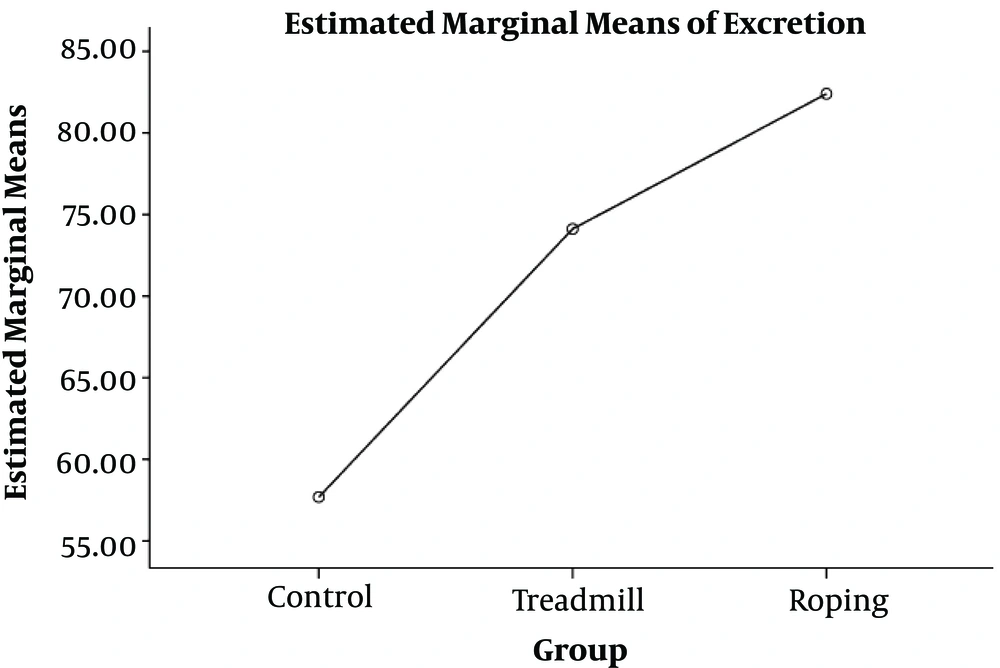
Figure 1.
The percentage of excretion of mass-like kidney stones in the studied groups
In the treadmill-running group, the highest excretion rate was observed for the stones in the upper calix, and in the rope jumping group, the highest rate was related to the stones in the lower and middle calyx and pelvis (Figure 2). As well, the shortest excretion time was observed in the rope jumping compared with the other two groups (Figure 3).
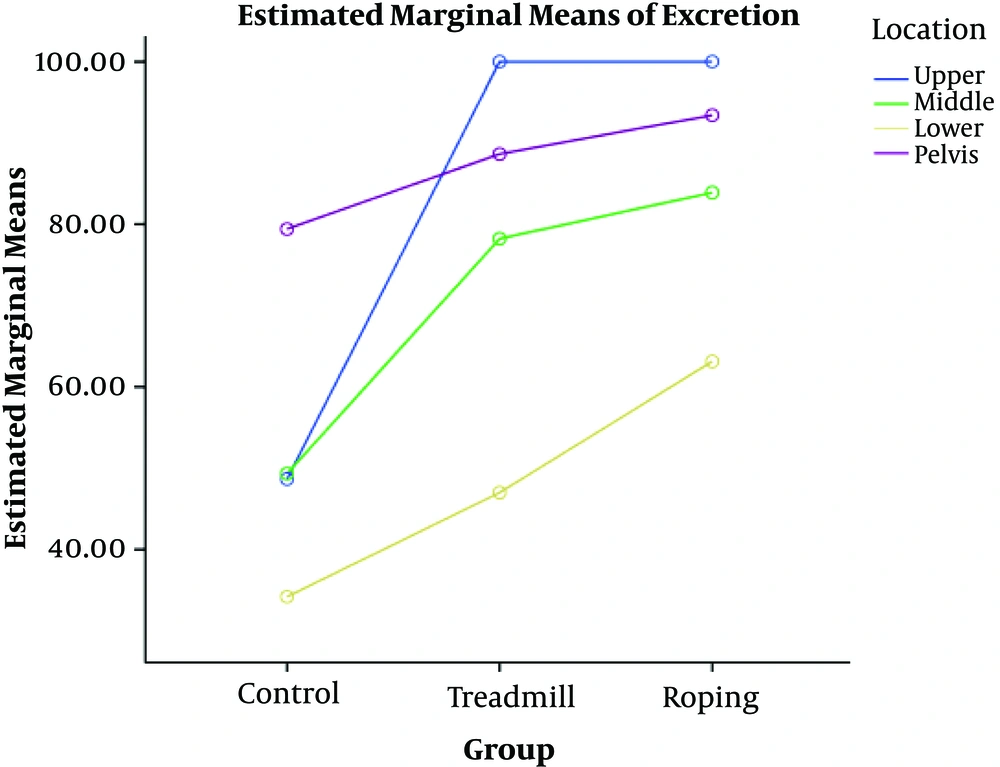
Figure 2.
The comparison of excretion of mass-like kidney stones in different locations in the studied groups
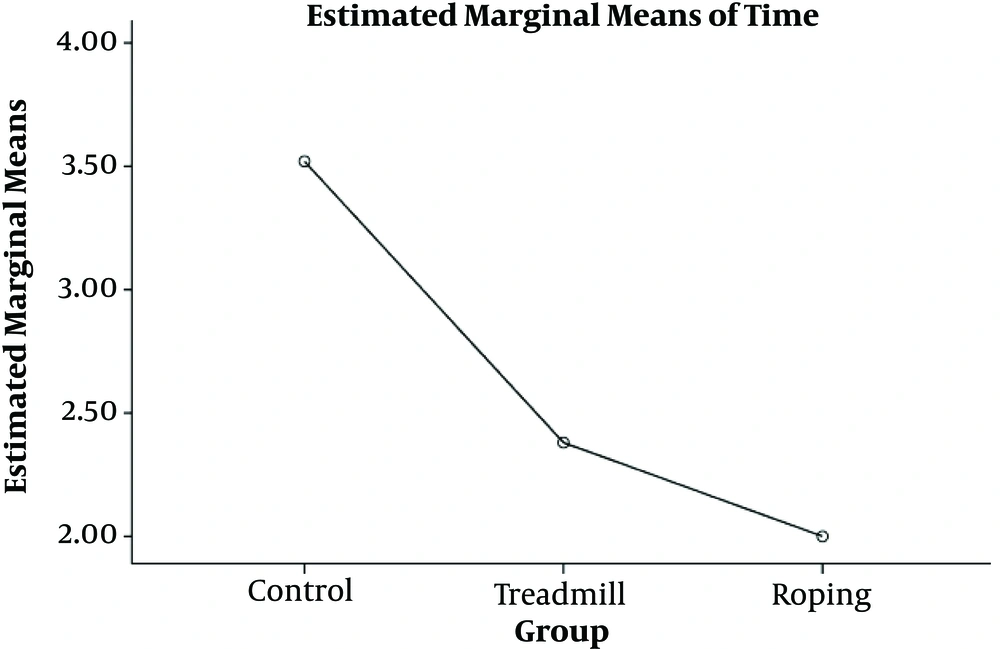
Figure 3.
Kidney stones excretion at different days (weeks) after lithotripsy in the studied groups
5. Discussion
The aim of this study was to compare the effects of treadmill running and rope jumping exercises on the excretion of mass-like kidney stones after ESWL procedure in the patients referred to the Asia clinic in the city of Ilam in 2019. According to our findings, people with higher BMIs were more likely to develop kidney stones. There was a significant difference comparing the rate of kidney stone excretion between the control, treadmill running, and rope jumping exercise groups. Rope jumping was more effective than treadmill running to accelerate the disposal of kidney stones in a relatively shorter period.
The results of this study showed that rope-jumping exercise was more effective than treadmill running in accelerating the disposal of mass-like kidney stones. The pelvis was the most common, while the lower kidney areas were the least common locations of kidney stone disposal.
Several factors such as overweightness, immobility, and insufficient taking of fluids can contribute to the formation of kidney stones. Studies have shown that prolonged rest and inactivity increase the level of urine calcium and lead to the formation of calcium oxalate and calcium phosphate crystals (9). This can be effectively prevented by diet modification and weight loss through physical activity, which markedly reduces the secretion of the main constituents of kidney stones in urine. The results of studies show that one of the main reasons for renal stone formation is the accumulation of calcium oxalate in kidneys, so any factor such as exercise that prevents the accumulation of these minerals can also prevent kidney stone formation (21).
The results of this study showed that rope jumping was more effective than treadmill running to accelerate the disposal of mass-like kidney stones. In the study of Razavi et al. (2015), they assessed the effects of aerobic exercise and BMI on the excretion of mass-like urinary stones following ESWL. In the current study, the researchers reported a significant difference between the experimental and control groups at pre- and post-ESWL, indicating the beneficial effects of exercise on the excretion of mass-like urinary tract stones. Furthermore, low to moderate intensity aerobic exercise significantly reduced the size of the stones and accelerated their disposal following ESWL. In contrast, the immobility of patients delayed the excretion process in the control group (16). These were in agreement with the results of our study, highlighting the beneficial role of exercise in accelerating the excretion of kidney stones.
The results of a cohort study by Ferraro et al. showed inverse relationships between both physical activity and fluid intake and the rate of formation of kidney stones (22). The results of a study by Sorensen et al. also showed that physical activity with an intensity of greater than 10 METs per week was associated with a 30% reduction in the risk of renal stone development (23).
Mokhtarnejad et al. (19) assessed the therapeutic effects of ladder climbing resistance exercise in mice with kidney stones. The results of the current study showed that this exercise, either active, inactive, or along with ethylene glycol consumption, accelerated and facilitated stone excretion and prevented the crystallization of calcium oxalate stones. However, the results of another study by Abreu et al. (24) demonstrated that physical activity and exercise along with drinking isotonic fluids did not change urine or plasma metabolic parameters.
5.1. Limitations
Few studies have been conducted on the therapeutic effects of physical activity and exercise in patients with kidney stones, and most of them have either focused on animals or addressed the preventive effects of exercise or its influence on the patients’ metabolic condition. To our knowledge, this is the first report on this subject, and no similar studies have been performed to compare the effects of these two interventions on kidney stone disposal. Therefore, we were unable to compare our findings with the literature, which was one of our limitations. In addition, matching of groups was not conducted
5.2. Conclusions
Depending on the location, rope jumping exercise can help patients in the better and faster disposal of kidney stones after lithotripsy. It is recommended to conduct studies with larger samples and consider the impact of other influencing variables.