
1. Context
One of the most critical problems of professional sports is the use of prohibited substances and methods by athletes. In 2018 the share of adverse analytical findings -more commonly known as positive tests- comprised 0.75% of Olympic sports drug tests and 2.62% of non-olympic sport drug tests (1).
The total number of doping tests has been increasing. In 2018 there were a total of 344,177 tests, which was 6.9% more than that of 2017 (1).
However, the actual prevalence of prohibited substance use among elite professional athletes could be much higher. Based on data collected from an anonymous survey asking if participating athletes used a prohibited substance at least once during the recent year, Ulrich et al. determined that the estimated prevalence of past-year doping to be 43.6% (95% confidence interval 39.4 - 47.9) at the 2011 world championships in athletics in Daegu, South Korea, and 57.1% (52.4 - 61.8) at the 2011 Pan Arab games in Doha, Qatar (2).
This shows the importance of anti-doping measures in professional sports and also raises the issue that sometimes strong evidence is lacking for the inclusion of substances and methods on the World Anti-Doping Agency (WADA) prohibited list. For instance, according to Heuberger et al., only five of 23 substance classes on the WADA prohibited list have robust evidence of actually having the ability to enhance sports performance in athletes (3).
So why have these substances and methods been prohibited? According to existing rules, all aspects of anti-doping regulation are defined in the WADA "Code," which is the fundamental and universal document defining the World Anti-Doping Program in sports (4). How does a substance or method make it to the prohibited list? The WADA prohibited list may include any substance and methods that satisfy any two of the following three criteria; 1- It has the potential to enhance or enhances sport performance; 2- It represents an actual or potential health risk to the athlete; 3- It violates the spirit of sport (this definition is outlined in the Code) (4).
The third criterion is somewhat subjective, which opens space for different interpretations (3).
The WADA prohibited list consists of three main sections, each divided into several subsections: Prohibited substances and methods, which are prohibited as doping at all times both in-competition and out-of-competition (9 subsections); Substances and methods prohibited in-competition (4 subsections), including substances prohibited in a certain concentration, such as pseudoephedrine; Substances prohibited for a particular sport (1 Subsection) (5).
Some substances are placed on the WADA monitoring program. The World Anti-Doping code (Article 4.5) states: “WADA, in consultation with signatories and governments, shall establish a monitoring program regarding substances which are not on the prohibited list, but which WADA wishes to monitor in order to detect patterns of misuse in sport.” (4).
However, we failed to find an exact definition for the term “misuse in sport”. To be placed on the monitoring program, the studied substance has to be tested for in all analyzed samples. Thus, the WADA gains information about substance use prevalence among athletes active in different sports and living in different regions of the world. Subsequently, a substance is either put on the prohibited list or excluded from monitoring. From 2015 to 2019, more than 15 substances, as well as substance classes like glucocorticoids or beta-2-agonists, have been placed on the WADA monitoring program. For instance, meldonium was placed on the program prior to being prohibited. In 2019, bemethyl was placed on the program, and ecdysterone was added to the 2020 program (6, 7).
Based on data obtained during consultations with science, medicine, and anti-doping experts, the WADA special commission can make changes to the prohibited list. Participating experts are members of the established prohibited list expert group (8).
The prohibited list expert group comprises 13 experts, including medicine, doping, and pharmacology professionals. The prohibited list expert group is responsible for providing expert advice, recommendations, and guidance to the health, medical, and research committee on the overall publication, management, and maintenance of its annual international standard of the prohibited list (9).
Furthermore, WADA supports research in the following topics: 1- Substances and methods that influence health and performance in athletes; 2- Substance and metabolite detection in biological fluids. The results of this research are available on the WADA official website. From 2001 to 2018, the agency has funded about 500 different projects; an amount totaling $73 million (10).
Ideally, the decision to ban a substance should be made based upon the results of high-quality research published in peer-reviewed and indexed journals and according to WADA’s own research and expert consultations. The typical hierarchy of evidence value implies that randomized clinical trials (RCT’s) and high-quality meta-analyses have the highest evidence value (11-13). It is known that an expert opinion does not have the highest evidence value because it is often biased based on the personal experience and subjectivity of the expert’s opinion (11).
Moreover, evidence based on low-quality studies often lacks control of confounding factors (14).
2. Objectives
The aim of the present review was to find and analyze scientific studies that could be used by the WADA health, medical, and research committee to identify specific substances that are eligible for inclusion on the prohibited list. We also evaluated the quality of studies that confirmed different substances' potential influences on performance and health in athletes. The review was done based on five illustrative substances and one method. Four of these are listed in section S2 (peptide hormones, growth factors, related substances, and mimetics) of the prohibited list. Athletes using these substances may face disqualification for up to four years, which in most cases leads to the end of their careers. Trimetazidine (since 2014), xenon inhalations (since 2014), and cobalt (since 2018) were put on the prohibited list without prior analysis of how they fulfill the inclusion term “misuse in sport” as part of the WADA monitoring program. Meldonium, which became one of the most disputable prohibited substances in the sports world, was put on the list in 2016 after prior monitoring that was conducted in 2015.
Moreover, we also included bemethyl and ecdysterone in our review. There is a lot of public attention on these substances because of the meldonium case, which was fully prohibited just one year after it was included in the monitoring program.
3. Evidence Acquisition
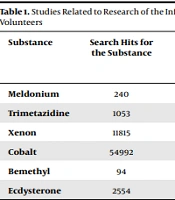
To find out which studies led to the prohibition of the substances mentioned, we searched the PubMed database using keywords including the substances’ or methods’ names, as well as phrases related to various aspects of sports activities and health assessments of athletes. Therefore, we utilized the keywords that were previously applied by Heuberger et al. in a similar review: ‘athletes’, ‘performance’, ‘sport’, ‘doping’, ‘trained’ in combination with the international nonproprietary name of the substance, for example, ‘meldonium’ (3). We also used the phrases “adverse event” and “safety,” which could reveal texts describing adverse effects of substances on health in athletes. The results of this search are summarized in Table 1 and later presented in this paper. After the search was completed, all queried studies were independently reviewed by two sports medicine physicians for their compliance with the keywords. The study was performed in December 2019.
Table 1.
Studies Related to Research of the Influence of Analyzed Substances and Methods on Athletic Performance and Possible Negative Health Effects in Athletes and Healthy Volunteers
| Substance | Search Hits for the Substance | Search Hits for Studies Published in English | Articles Found with the Keywords | Meta-analyses or Systematic Reviews | Narrative Reviews | Randomized Clinical Trials | Studies Performed by WADA |
|---|---|---|---|---|---|---|---|
| Meldonium | 240 | 127 | 6 | - | 2 | - | - |
| Trimetazidine | 1053 | 836 | 2 | - | - | - | - |
| Xenon | 11815 | 10116 | 3 | - | - | 1 | - |
| Cobalt | 54992 | 46060 | 3 | - | - | - | - |
| Bemethyl | 94 | 14 | 4 | - | 1 | - | - |
| Ecdysterone | 2554 | 2389 | 4 | - | 1 | 1 | 1 |
As we can see, the studies done with professional athlete participants are sporadic; meta-analyses or systematic reviews are absent. We could only find 2 RCT’s in the PubMed-database that studied the ecdysterone and xenon influence on various performance aspects. Later in the article, we will examine the existing evidence for each of the analyzed substances and the methods.
4. Results
4.1. Meldonium
Meldonium was synthesized at the end of the 1970s at the Latvian Institute of organic synthesis. Its generation was originally related to the process of recycling of rocket fuel, 1,1-dimethylhydrazine. Meldonium was initially considered a growth stimulator of fowl and animals (15-17). Nowadays, meldonium is widely available on the pharmaceutical markets of former USSR-countries. It is most commonly marketed in Latvia and the Russian federation under the trade name Mildronate (18).
Meldonium is available without prescription in pharmacies in Russia and several other eastern European countries. It is most commonly used to treat coronary heart disease and ischemic stroke, but it has several other registered indications, namely tiredness and “physical and psycho-emotional overexertion”. These indications are drawn from the manufacturer’s instructions (19, 20).
In Russia, meldonium is included on the official list of essential pharmaceuticals, so its price and market turnover are administered by the state in order to make it affordable for all income groups (21). In 2015, meldonium was put on the WADA monitoring program (22), and in 2016, it was added to the prohibited list. Since its prohibition, positive meldonium tests have led to the disqualification of 498 competing athletes, the majority of them representing former USSR-countries (23).
In 2017, 25% of all punished athletes were suspended due to meldonium use, which was categorized as substance use under section S4 of the prohibited list (1). Widespread use of meldonium among athletes from a particular region of the world is considered to be the reason for its prohibition. Stuart et al. reported the widespread use of this drug by athletes competing at the Baku 2015 European Games. Many athletes from former USSR-countries took part in European Games, and 8.7% of doping tests showed positive findings for meldonium (22). Nonetheless, a clear definition of “widespread use” does not exist. For example, one may wonder why confirmation of meldonium presence in 8.7% of tests is a sufficient reason for its prohibition, but the detection of nicotine and its metabolites in 15% of tests, as described by Mundel et al. and quoted in the research section of WADA, is not (24, 25).
The same research section of WADA contains studies demonstrating positive effects from administering snus (smokeless tobacco) on sports performance as well as health risks associated with dermal nicotine administration during exercise at higher ambient temperatures (25, 26). There is data supporting that nicotine fulfills all three inclusion criteria for the prohibited list. Nonetheless, nicotine is still not on the list. Commenting on the disqualification of Maria Sharapova for meldonium usage, WADA has stated that “meldonium was added [to the prohibited list] because of evidence of its use by athletes to enhance performance.” However, the agency has shown no scientific evidence that this substance has any effect on athletic performance (27).
Generally, the scientific bulk of data regarding meldonium use in patients is quite large. Our PubMed Search request yielded 240 articles regarding meldonium use in patients, including 12 reviews and 33 clinical trials. The vast majority of studies aimed at investigating the clinical efficacy of meldonium have been performed with sick persons. It must be noted that only 127 (53%) of articles from our literature search were available in English. Likewise, Greenblatt et al. have noted that there is a lack of English-language publications providing data regarding the safety and efficacy of meldonium as a therapeutic agent in patients or as a performance-enhancing drug in healthy individuals. There is only minimal evidence from North America and Western Europe regarding the role of meldonium in the treatment of disease or whether it can produce meaningful performance enhancement in highly trained athletes (19).
We can note only two works published in English regarding the possible ability of meldonium to enhance athletic performance, one of which is a narrative review (28, 29). Both studies were published after the prohibition of meldonium by WADA and contain references from several low-quality studies. In the first study, Arduini et al. commented on the Maria Sharapova-case by making an assumption that WADA may have banned meldonium because it can lower intracellular carnitine to pathological levels when overdosed (28). They quote Lienpiesch et al. who demonstrated that oral meldonium administration to healthy volunteers (500 mg, twice daily) for four weeks leads to a significant 18% reduction of plasma L-carnitine. However, Lienpiesch et al. did not address how reduced plasma L-carnitine levels could influence athletic performance or adversely affect health (30). Arduini et al. also noted that they did not find any evidence that meldonium could enhance athletic performance, and the only study they could find focused on a small cohort of older adults (> 60 years old) suffering from angina pectoris, in which it was demonstrated that meldonium led to better exercise tolerance.
In the second work, a narrative review by Schoberberger et al., the authors also assessed the possible role of meldonium on performance enhancement (29). Schoberberger et al. quoted Kakhabrishvili et al.'s study, which claimed "that meldonium can be used as an agent for increasing the physical capacity in the practice of sports pharmacology for combat sports," but Schoberberger et al. also immediately pointed out the methodological flaws of Kakhabrishvili et al.'s study (30, 31). For example, Kakhabrishvili et al.'s study was published in a non-indexed journal, and it was performed on seven judo fighters with non-athlete volunteers, whose weight varied by ~ 23 kg, as the reference group. Schoberberger et al. also stated that there was no reliable study examining the efficacy of meldonium in terms of exercise performance, either in healthy volunteers or in highly trained athletes. Moreover, there is an overall lack of studies performed with highly trained athletes that have been published in peer-reviewed journals that prove that meldonium improves exercise performance (29). Despite Schoberberger et al.’s earlier critique, they maintained that among athletes, meldonium is used to increase recovery rate or exercise performance, but they did not corroborate this notion citing any reference.
Schoberberger et al.’s article stated that meldonium is a prescription drug. However, meldonium can be purchased prescription-free in any pharmacy in Russia, the country with the largest number of athletes disqualified for meldonium use.
In a study by Gorgens et al., the authors stated that “studies demonstrated an increase in endurance performance of athletes, improved rehabilitation after exercise, protection against stress, and enhanced activations of central nervous system (CNS) functions [due to meldonium administration]” (32). To corroborate this notion, they quoted the previously mentioned study by Kakhabrishvili et al. (31) and a local conference-thesis by Dzintare et al., which has never been published in any peer-reviewed journal (33).
In other research works focused on studying the effects of meldonium on athletic performance, authors have not shown any data regarding the influence of meldonium on the athletes’ performance or health. Moreover, these articles were published after meldonium was added to the prohibited list (18, 19, 34).
We should also notice that the research articles studying meldonium pharmacokinetics and detection time in biological fluids were published after it was added to the prohibited list (35-44).
Meldonium traces can be detected several months after regular intake of it has stopped. This is probably the reason why meldonium was detected in some doping tests, resulting in the disqualification of several athletes in 2016 even though the athletes themselves claimed they stopped taking meldonium in 2015 (35).
Moreover, it is important to emphasize the fact that meldonium pharmacokinetics described by Rabin et al. (35) are completely different from the pharmacokinetics data in the official manufacturer’s instructions. The manufacturer’s instructions state that meldonium is quickly metabolized and eliminated as two metabolites while Rabin et al. demonstrated that there was a long second phase of elimination and urine excretion of parental entity in healthy volunteers.
Thus, based upon open-source data, it can be concluded that there is no high-quality published scientific evidence that supports the notion that meldonium enhances athletic performance or has any adverse effects on health in athletes.
4.2. Trimetazidine
Trimetazidine was developed in 1963 at Servier laboratories, France. It is known under the trade names Vastarel and Preductal (45). The drug has a similar mechanism of action as meldonium; it induces myocytes to switches their primary energy metabolism from fatty acid oxidation to glycolysis. Meldonium exhibits anti-L-carnitine activity by inhibiting gamma-butyrobetaine via suppression of gamma-butyrobetaine dehydrogenase. Trimetazidine interferes with beta-oxidation by inhibiting 3-ketoacyl-CoA thiolase. Initially, trimetazidine was used to treat angina pectoris and several vestibular disorders (46).
Later clinical studies have demonstrated its efficacy in treating heart failure with different etiologies (47, 48). Trimetazidine is formally a prescription drug in Russia. According to Jarek et al., trimetazidine was identified in 0.23% of samples collected from athletes between 2008 and 2013 in the WADA-accredited lab in Warsaw, Poland (49). Siegmund et al., detected trimetazidine in 0.1% of all studied samples, predominantly originating from elite athletes actively competing in endurance and strength sports, at the Cologne doping control laboratory between 1999 and 2013 (50). Although these low detection rates hardly suggest "widespread use" among athletes, trimetazidine has been on the prohibited list since 2014.
In 2017, 2% of athletes that were disqualified for substance use under section S4 of the prohibited list were specifically punished for trimetazidine use (1). Our literature search using the keyword “Trimetazidine” on PubMed yielded 1,055 results, including 836 articles in English, which included 182 reviews, 215 clinical trials. However, there were only two research works related to sports medicine. In the RCT conducted by Al-Kuraishy et al., the authors showed that trimetazidine enhances psychomotor parameters in non-athletic volunteers. This work was published in 2017, three years after the WADA trimetazidine ban (51). Vitale et al. demonstrated that trimetazidine improves exercise performance in patients with peripheral arterial disease, but they did not examine healthy volunteers or athletes (52).
Adverse effects of trimetazidine in the general population have been described; there has been an increasing number of case reports concerning drug-induced parkinsonism, gait disorders, and tremors (50, 53-55). We could not find any study that investigated the effects of various trimetazidine concentrations on health or exercise performance in athletes or healthy volunteers. Thus, it can be concluded that there currently is no high-quality published scientific evidence supporting the notion that trimetazidine enhances athletic performance or has any adverse health effects on athletes. It is possible, though, that the results demonstrating adverse effects of trimetazidine in the general population may be why this substance was included in the prohibited list.
4.3. Hypoxia-Inducible Factor (HIF) Activating Agents: Xenon and Cobalt
Xenon is an inhalation anesthetic, which presumably stimulates erythropoiesis and hence raises erythrocyte and hemoglobin concentration in blood, subsequently increasing blood oxygen saturation. Xenon was put on the prohibited list in 2014 (56). In 2019, 5 years after xenon inhalations were prohibited; Dias et al. tested the acute and chronic effects of various xenon concentrations on non-athletic volunteers and found that xenon inhalations lead to a slight, but long-lasting increase in endogenous erythropoietin production. Nonetheless, the authors concluded that xenon inhalations did not enhance fitness or performance (57).
In another study from 2016, Stoppe et al. concluded that xenon indeed increases erythropoietin levels in healthy volunteers (58). However, after intense scientific dispute on that topic, Stoppe et al. later admitted that “observed findings should receive more careful investigation in following confirmatory studies” (59, 60). It has to be taken into account these isolated research works studying xenon influence on non-athletic volunteers were published after xenon-inhalation was prohibited by the WADA (57-60). The WADA President Sir Craig Reedie stated in 2014 that xenon was put on the prohibited list because “studies have shown that xenon can stimulate the production of erythropoietin (EPO) and testosterone and therefore has the potential to enhance athletic performance.” We could not find any published studies, dated before 2017 that were able to confirm this statement. Currently, there still is no data in any peer-reviewed journal regarding the effect of xenon on testosterone secretion in athletes (61).
Cobalt was added to the prohibited list in 2018 as a substance that affects erythropoiesis. However, in a meta-analysis published by Hefferman et al. in 2019, the authors failed to provide any relevant, high-quality evidence supporting that cobalt affects athletic performance after extensively researching the topic using various databases (62). To date, the only studies connecting cobalt to sports are studies that have been conducted by Lippi et al. in 2005 - 2006. However, they have not described cobalt effects on performance. They have only made assumptions that cobalt might be used for boosting erythropoiesis to gain performance advantages, and they expressed concern regarding possible adverse effects (63, 64). Adverse effects due to cobalt intake are either associated with long-term intake in significant amounts or with cobalt-poisoning. Lippi et al.’s studies do not contain any data regarding adverse effects associated with cobalt intake in athletes.
4.4. Bemethyl
Our PubMed search for "bemethyl" or "bemitil" yielded 94 articles, which did not include any reviews. Of the 94 articles, only 14 articles were published in English. Bemethyl was developed in the 1970s by the department of pharmacology at the St. Petersburg State Military Medical Academy. It was used as an "adaptogen" in Soviet cosmonauts and military personnel and to improve physical performance in athletes (65). The substance is registered in some former USSR countries under the name "Ethylthiobenzimidazole hydrobromide”. The manufacturer's instructions contain the following indications for use: "Fatigue, asthenic conditions, recovery after stroke and traumatic brain injury" (66). The drug has over-the-counter status in Russia. According to unofficial information, bemethyl is widely used by athletes from former USSR countries. The substance was put on the WADA Monitoring List in 2019. We could not find any data regarding positive bemethyl tests, probably because methods to detect it in biological fluids were developed only recently (67). Hence, it is not possible to argue that bemethyl is widely used. We could not identify high-quality scientific studies regarding the possible positive effects of bemethyl on athletic performance, but performance enhancement has been demonstrated in animal studies (68, 69). Several publications in Russian have described the positive effects of bemethyl on athletic performance, including a review by Oliynyk et al. (65). However, all studies quoted in this review are published in Russian, contain serious methodological flaws, and do not comply with modern scientific practice standards (65).
4.5. 20-Hydroxyecdysone
20-Hydroxyecdysone (Ecdysterone) is a hormone-like substance, which has a steroid ring at the core of its structure. It is widely present throughout the plant and animal world. By interacting with chitin, it promotes exuviation in arthropods. Plants synthesize ecdysterone presumably for protection against insects. We performed a PubMed search for “20-Hydroxyecdysone” that yielded 2554 hits, of which 2389 publications were in English. We could not identify any information regarding ecdysterone identification in doping tests in neither open-source data nor the WADA special section. Nutritional supplements containing ecdysterone are widespread. Ecdysterone was first extracted and studied in the USSR in 1976, and at that time, it was hypothesized that this substance could have anabolic activity (70). An experimental animal-study performed in 1988 demonstrated that ecdysterone has a similar effect on contractile muscle-proteins as methandrostenolone (71).
In the USSR, applications of this substance were studied in various sports, but the results were published only in Russian non-indexed journals. Moreover, the quality of these experiments did not comply with scientific standards (no reference groups, open nonrandomized study design).
Results of a comprehensive study designed to determine if ecdysterone (20-Beta-Hydroxyecdysterone) improves strength or athletic ability were published by Wilborn et al. in 2006. The study examined if ecdysterone improved the subjects' ability to perform specific exercises and tested for changes in chemical indicators of athletic ability such as body composition and free non-binded testosterone. Wilborn et al. concluded that daily oral intake of 30 mg of 20-hydroxyecdysone did not significantly affect anabolic or catabolic responses to resistance training, body composition, or training adaptation (72). In a different study by Isenman et al. (73), they provided a detailed review of ecdysterone, but the majority of tests they performed were done on animals. In contrast to experiments performed by Wilborn et al. (72), Isenman et al. observed that daily doses of 5mg/kg/BW ecdysterone (i.e., several times more concentrated than the doses administered by Wilborn et al.) induced anabolic effects (73). The atypical hallmark of ecdysterone that distinguishes it from androgen-derived anabolics, is muscle growth stimulation via estrogen receptors, not androgen activation. Recent studies by Parr et al. in 2015 and 2019 have described possible ecdysterone effects in animals and humans. However, the 2019 study was funded by WADA. Ecdysterone and conventional anabolic steroids’ impact on plantar muscle thickness in rats were studied in 2015. In the 2015 study, by Parr et al. observed that 5 mg/kg doses of ecdysterone had positive anabolic effects on rat muscle thickness. Parr et al. considered that this evidence was sufficient for placing ecdysterone in section S2 of the WADA’s prohibited list (74). In the 2019 study, which was published in the special section of the WADA website, ecdysterone was prescribed for 10 weeks in two different doses to healthy non-athletic individuals to evaluate its influence on athletic performance, including back squats, bench presses, and counter-movement jumps. Although the supplements they administered to the subjects were labeled to contain 100 mg of ecdysterone, extraction analysis determined that the real dosage was only 6 mg of ecdysterone.
Depending on the treatment group, volunteers received either two (12 mg) or eight (48 mg) capsules per day. The reference groups consisted of volunteers that exercised during the study period, volunteers receiving placebo, and a control group of non-exercising volunteers. The study showed that ecdysterone had a positive effect on anthropometric and performance parameters (73).
Out of all the other substances reviewed herein (i.e., meldonium, trimetazidine, xenon, cobalt, and bemethyl), WADAs’ approach to studying ecdysterone has been the most compliant with modern scientific standards.
5. Conclusions
The results obtained during our systematic literature search clearly indicate that there is a lack of scientific evidence supporting the impact of several substances prohibited by WADA (i.e., meldonium, trimetazidine, xenon, and cobalt) on athletic performance or on health in athletes. According to the principles of modern evidence-based medicine, expert opinion can be subjective or biased and therefore has low evidence value. However, it is possible that the WADA might have some data that is, for some reason, not accessible to the public. Therefore, we believe that publishing data that justify the decision of the WADA as well as local anti-doping agencies to ban certain drugs will promote the trust of the sports community.
Regular and timely publication of studies that are used by the WADA health, medical, and research committee to identify specific substances for putting them on the prohibited list, would promote process transparency and reduce the opportunity for speculation.
There is insufficient evidence that the previously mentioned substances have any performance enhancing potential. If left on the list, meldonium may be classified as a “specified substance” because of its wide availability and due to the fact that this drug can be bought over the counter without a prescription.
The wide prevalence of particular substance or methods use seems to be inadequate for placing the substance or method on the prohibited list.
Trimetazidine may have been placed on the prohibited list due to its adverse health effects; WADA’s approach to ecdysterone is the most consistent with basic scientific standards as there is data supporting that ecdysterone may improve performance.
