


1. Background
Soccer is the one of the most popular sports in the world, and there are more than 265 million players globally, which is equal to 4% of the world’s population. This sport carries with it the risk of a wide variety of injuries and illness. Irrespective of the game level or geographical location, the injuries and illnesses the players sustain cause playing time losses as well as economic burdens to both the individual athletes and sports organizations (1). Several previous studies have addressed the epidemiology and traumatology of soccer players (2-6).
In the literature, the injury prevalence patterns differ based on where the data was obtained (4, 7); moreover, these differences could be due to the variations in the athletes’ physical profiles, training methods, environmental conditions, match loads, playing styles, referee judgments, and medical staff techniques (8). In order to understand sports injury processes, it is important to consider the place where the sport is being played (3). Therefore, it is important to have country-specific data about the injury patterns in a particular population. For example, Walden et al. (4) reported a higher incidence of sports injuries among the English and Dutch teams than the teams from France, Italy, Spain, and Holland (41.8 vs. 24.0 per one thousand hours of exposure, P = 0.04). Moreover, a higher injury incidence was reported among Danish soccer players when compared to Swedish players during training (11.8 vs. 6.0 per one thousand hours of exposure, P ≤ 0.01), but there was no significant difference between the injury rates during competition (28.2 vs. 26.2 per one thousand hours of exposure) (7). However, there is limited soccer injury-specific data available regarding the soccer players in Saudi Arabia. Sadat-Ali and Sankaran-Kutty (9) investigated the soccer injury cases presenting to the emergency department of one of the hospitals in Saudi Arabia, but this data alone is not suitable for demonstrating the extent of the sports injuries sustained by Saudi soccer players. A more comprehensive study was done by Drust et al. (10), who evaluated the incidence and severity of injuries among soccer players during two consecutive soccer seasons (2010 - 2012). Nevertheless, this research did not represent the total injury load of the professional players, because the study included only six out of the 14 Saudi Professional League clubs; moreover, the study did not investigate the incidences and severities of the player illnesses (10).
In 1998, the Federation Internationale de Football Association (FIFA) began documenting the player injuries incurred during competition, with other sports federations following their lead in subsequent years. Based on the FIFA injury surveillance system, the International Olympic Committee (IOC) developed an injury surveillance system for their multi-sport events, which was first implemented during the 2008 Beijing Olympics. Again, this system recorded only the injuries, not the illnesses affecting the competitors. This system was modified for the 2010 Vancouver games, and it was further developed and optimized during the 2012 London games.
The systematic recording and monitoring of injuries and illnesses over a longer period of time results in reliable epidemiological data, which is crucial for the identification and prevention of sports injuries and illnesses (11). This is helpful for athletes, medics, and rehabilitation professionals attempting to minimize the injury risks and adopt proper prevention strategies. According to Bahr and Krosshaug (12), the documentation of the injury prevalences, severities, and natures of professional sports is the first stage in the development of prevention strategies.
2. Objectives
The aim of this study was to identify the injury and illness incidences, severities, and risk factors during a Saudi Professional League season (2015 - 2016), with the long-term goal of helping both national associations and international federations to safeguard of their athletes’ health. Developing an injury and illness database for Saudi soccer players can serve as a valuable reference that allows the medical staff to review the injury and illness histories of their soccer players and assess emerging injury trends, as well as the causative and predisposing factors. This will further promote the implementation of effective preventative strategies.
3. Methods
The injury and illness documentation of the current study was conducted according to the guidelines of the FIFA Medical Assessment and Research Centre (F-MARC) and the IOC (13, 14). The physicians and physical therapists from each team were trained to use the injury and illness report form at the beginning of the season, and they were asked to report the daily injury and illness occurrences in the prescribed format.
Written permission was obtained from the Saudi Arabian Football Federation and the Saudi Federation of Sports Medicine six months prior to the 2015 - 2016 football season. Prior to the beginning of the season, the researcher conducted individual meetings with the medical and paramedical staff members of all 14 clubs in order to explain the details of this study. The physicians and physical therapists from each team were given training sessions to on how to fill out the injury and illness report form. The report forms and illustration booklets were distributed during this training session. The researcher visited the training and competition sites frequently in order to encourage continuous injury and illness reporting throughout the season.
Following the F-MARC and IOC approaches, all of the injuries and illnesses (both new and recurring) incurred during competition or training that required medical attention (regardless of the consequences with respect to absences from competition or training) were reported (13, 14). An injury was defined as any musculoskeletal complaint or concussion that was newly incurred during the 2015 - 2016 Saudi Professional League season. An illness was defined as any other physical complaint that was newly incurred during the 2015 - 2016 Saudi Professional League season. Chronic pre-existing injuries and illness were not recorded, unless there was an exacerbation that required medical attention during the study period. Whenever a single incidence caused multiple injuries, only the most severe injury was recorded. The injury and illness forms were identical to the one used for the 2012 London Summer Olympic Games. The following information was recorded with respect to each injury: The player’s accreditation number, the player’s position, whether the injury occurred during training or competition, and the severity, location, type, and mechanism of the injury. The injury severity was judged based on the number of days lost by the player between the day of the injury and their next day of participation in training or competition (15). Similarly, the following information was recorded along with each illness incidence: The player’s accreditation number, the player’s position, the diagnosis, the affected system, the main symptoms and cause of the illness, and the estimated time lost. The injury and illness forms were distributed in both English and Arabic. All of the injuries and illness were reported as soon after the incident as possible.
Written informed consent was obtained from each study participant, and the athletes’ accreditation numbers were used to retrieve the demographic information and avoid data duplication. Strict confidentiality of the participants’ information was maintained, and this study was approved by the institutional ethical committee at the Imam Abdulrahman Bin Faisal University in the KSA.
3.1. Data Analysis
The summaries of the incidents and the injury and illness severities were calculated based on the IOC’s approach toward recording injuries and illnesses (13), which corresponded with previous research regarding injuries and illnesses in large international competitions (6, 16-18). In order to identify the association between the absences (in days) and the game level (competition/training), the Mann-Whitney U test was used. The chi-squared test was used to determine the associations between the player position and the injury region and between the player position and the game level. Cramér’s V test was used to determine the association magnitudes. The level of significance was set as 0.05.
4. Results
Out of the 14 soccer clubs that participated in training and competition in the 2015 - 2016 Saudi Professional League season, ten clubs (each consisting of 30 soccer players) returned the medical report forms.
4.1. Incidence and Level
Among these soccer players, we recorded a total of 386 injuries. The Mann-Whitney U test results showed an association between the game level (competition/training) and the absence in days (P = 0.007). Moreover, 64% of the injuries (n = 244) occurred during training, and 142 of the injuries occurred during competition. The injury risk was the highest among the forwards (n = 99,1,903 injuries per one thousand players) and the lowest among the goalkeepers (n = 43, 878 injuries per one thousand players). The severe injuries that entailed absences from training and competition for more than one week tended to occur during both competition (n = 41) and training (n = 50).
4.2. Injury Severities, Locations, and Types
It was estimated that 86% of the injuries (n = 334) resulted in some loss of participation; however, 52 injuries did not cause any time lost from competition or training. Approximately one third of the injuries (n = 117, 30.3%) resulted time losses of 1 - 3 days, and 134 (36%) injuries resulted in time losses of 4 - 7 days (Table 1). A total of 83 injuries entailed estimated absences of more than one week, including 4 lower back pain cases, 11 groin injuries, 26 thigh strains (15 were hamstring strains and 9 were quadriceps strains), 16 knee injuries, and 11 ankle injuries. Of the 36 muscle strains that resulted in absences for more than one week, 24 were thigh strains (both hamstring and quadriceps strains). The significance of the association between the player position and the injury region was borderline (P = 0.021), with a Cramér’s V test result of 0.130. Seven injuries were considered to be severe, and could have caused the athlete to be absent from competition or training for more than three months. Out of these seven injuries, four were knee ligament ruptures. None of the seven reported concussions were considered to be severe. Contusions, hematomas, and bruises (n = 138, 35%) were the injuries most commonly reported, followed by strains, muscle ruptures, and tears (n = 68, 17.6%) (Figure 1). Most of the injuries reported were lower limb injuries (n = 306, 79%), with just 28 upper limb injuries (7%) reported. The results of the chi-squared test showed an association between the injury region and the game level (P = 0.005), and the results of the Cramer’s V test showed that this association had a magnitude of 0.2. No significant association was found between the injury region and number of day absent (P = 0.084) or between the player position and the days absent (P = 0.496).
Table 1.Location and Severity of Competition and Training Injuries
| Injured Region | Training | Competition | ||||||
|---|---|---|---|---|---|---|---|---|
| Without Absence | Absence 1 - 3 Days | Absence 4 - 7 Days | Absence > 7 Days | Without Absence | Absence 1 - 3 Days | Absence 4 - 7 Days | Absence > 7 Days | |
| Face (incl. eye, ear, nose) | 1 | 1 | 14 | 1 | 1 | 0 | 0 | 0 |
| Head | 2 | 0 | 5 | 0 | 0 | 0 | 0 | 0 |
| Cervical/thoracic region | 0 | 1 | 2 | 1 | 1 | 0 | 0 | 1 |
| Lower back | 1 | 5 | 3 | 4 | 1 | 0 | 2 | 0 |
| Abdominal region | 0 | 1 | 0 | 1 | 1 | 0 | 0 | 0 |
| Upper extremity | 2 | 3 | 6 | 1 | 3 | 4 | 2 | 4 |
| Hip/groin | 1 | 3 | 9 | 6 | 2 | 4 | 1 | 5 |
| Thigh (ant/post) | 2 | 25 | 20 | 12 | 5 | 13 | 3 | 14 |
| Knee | 5 | 9 | 15 | 11 | 5 | 9 | 7 | 6 |
| Lower leg | 2 | 9 | 15 | 2 | 3 | 8 | 2 | 2 |
| Ankle/achilles tendon | 1 | 7 | 17 | 2 | 4 | 2 | 3 | 7 |
| Foot/toe | 4 | 6 | 5 | 0 | 4 | 7 | 0 | 2 |
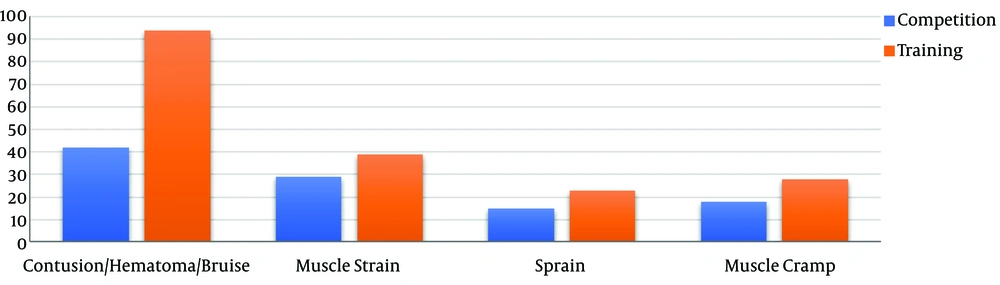
Figure 1.
The most common injuries during competition and training
4.3. Injury Causes
The three most common injury causes were contact with other players (n = 150, 39.3%), overuse (n = 115, 29.7%), and noncontact trauma (n = 27, 6.9%) (Table 2). Of the injuries related to overuse, 36 resulted in absences from competition for more than one week.
Table 2.Causes and Severity of Competition and Training Injuries
| Causes of Injury | Training | Competition | ||||||
|---|---|---|---|---|---|---|---|---|
| Without Absence | Absence 1 - 3 Days | Absence 4 - 7 Days | Absence > 7 Days | Without Absence | Absence 1 - 3 Days | Absence 4 - 7 Days | Absence > 7 Days | |
| Overuse | 1 | 28 | 26 | 11 | 10 | 18 | 8 | 13 |
| Non-contact trauma | 1 | 2 | 3 | 11 | 0 | 1 | 1 | 8 |
| Recurrence of previous injury | 1 | 3 | 4 | 1 | 0 | 2 | 5 | 4 |
| Contact with another athlete | 16 | 24 | 48 | 5 | 18 | 21 | 7 | 11 |
| Contact: Moving object | 0 | 0 | 0 | 1 | 1 | 1 | 1 | 1 |
| Contact: Stationary object | 1 | 0 | 0 | 3 | 0 | 0 | 0 | 1 |
| Violation of rules | 0 | 3 | 3 | 1 | 0 | 1 | 0 | 1 |
| Field play conditions | 1 | 8 | 12 | 5 | 0 | 0 | 0 | 1 |
| Weather conditions | 0 | 2 | 0 | 0 | 0 | 0 | 0 | 0 |
| Equipment failure | 0 | 1 | 6 | 6 | 0 | 0 | 1 | 1 |
| Other | 0 | 1 | 6 | 6 | 2 | 1 | 1 | 0 |
4.4. Illness Incidence and Distribution
In total, 75 illnesses were reported in 63 players, which was equivalent to 210 incidents per one thousand players. The most commonly affected systems were the respiratory system (n = 46, 61%) and the gastrointestinal system (n = 16, 21%). The most common diagnoses were respiratory tract infections (n = 33, 44%) and gastroenteritis (n = 14, 18%). The most common cause of illness was an infection (n = 51, 68%). Twenty-nine illnesses (39%) were associated with fevers, while pain was associated with 23 reported illnesses (31%). Sixty-seven illnesses (89%) resulted in player absences from competition or training.
5. Discussion
This study was designed to determine and analyze the injuries and illnesses that were incurred by Saudi Professional League soccer players who competed in the 2015 - 2016 Saudi Professional League season.
5.1. Injuries
The results of this study showed a predominance in lower extremity injuries among the soccer players (79%), which was consistent with previous studies reporting that lower extremity injuries accounted for between 60% and 80% of the overall injuries (2, 19-23). The excessive incidence of lower extremity injuries may have been due to the nature of the game, because high demand is placed on the lower extremities during training and competition. The results of this study also showed that contusions, hematomas, and bruises were the most common injury types (35%) among the soccer players during both competition and training. The other common injuries included ankle sprains (13.1%), hamstring strains (11.8%), quadriceps strains (10.53%), and knee ligament injuries (7.71%). These injuries were also shown to be consistently higher among the soccer players evaluated in previous studies (3, 4, 6, 22). The prevalence of these injury types emphasizes the importance of preseason screening to identify high-risk athletes, which provides early opportunities to implement personalized preventative programs. Hagglund et al. (24) reported a higher incidence of reinjuring previously injured sites in soccer players with histories of hamstring strains, groin injuries, and knee injuries. The elevated incidence of these injuries may have been related to the lack of preseason screening, the improper rehabilitation of previous injuries, or inadequate taping and bracing methods. In previous studies, the researchers have reported the significant effectiveness of preseason screening to verify joint laxity or the inadequate rehabilitation of previous injuries. Sports medicine professionals can play key roles in identifying and screening high-risk players.
Most of the injuries recorded in the current study were rated as minor or minimal, with an absence of 1 - 7 days; however, 16 of the injuries (0.04%) were severe, with an absence of more than 28 days from training or competition. This result is consistent with the results of some of the previous studies (25, 26).
In the current study, contact with the other players was identified as the predominant cause of most of the injuries sustained during competition. Reducing the number of injuries sustained during major events could become possible with referees’ strict application of the game rules, and, most importantly, changing the attitudes of the coaches and players toward “fair play.”
Another common cause of injury was overuse, which may have been due to the types of demands placed on the musculoskeletal system during soccer practice and competition (27). According to previous studies, overuse injuries constituted an injury rate ranging between 2% and 37% among professional soccer players (28-32). However, low frequencies of overuse injuries have been reported among English professional football players (33, 34). Muscle strain was reported as the most common injury in several previous studies, which may have been explained by the nature of the game (4, 22, 25). Soccer involves a lot of running, sprinting, kicking, deceleration, and acceleration-related movements. The results of the current study showed that muscle strains accounted for 17% of the injuries; however, many of these muscle strains could have been addressed with proper injury prevention programs.
Fractures were reported at a relatively lower rate in the current study during both competition and training, and the three reported fractures occurred in the upper extremities. The most common mechanisms for the upper extremity fractures were falling on an outstretched hand and falling on the shoulder. Lower limb fractures are uncommon in soccer, which may be due to the use of shin guards as protective equipment. A change in the injury incidence rate could be explained by the changes in the competition rules and other environmental factors.
Finally, the rate of reported injuries can vary, depending on the awareness among the athletes and medical staff and reporting even minor injuries and illnesses.
5.2. Illnesses
The impact of athlete illnesses on training and competition is as significant as that of injuries in professional athletes. For this reason, FIFA and other major sports organizations include illnesses in their health surveillance systems. Illnesses were reported among 15% of the total players who participated in the current study. During the 2010 FIFA World Cup, it was reported that 12% of the players experienced illnesses (35), and the rate recorded at the Fédération Internationale de Natation World Championship was 7.1% (36). Moreover, 6.7% of the athletes reported illnesses during the 2010 Winter Olympic Games (37), while 7.1% of the registered players reported illnesses during the 2009 International Association of Athletics Federations World Athletic Championship (38). All of these rates were significantly lower than the rate found in the present study; however, it is difficult to compare these illness statistics with those of previous studies due to the varying durations of the events.
The respiratory system was the system that was most affected in the current study, which is consistent with the previously reported results (35-38). This could have been due to various risk factors, such as dehydration, airway stress, or airborne pollutants and allergens (which may be inhaled during strenuous exercise).
5.3. Practical Implications
Continuously monitoring injuries and illnesses is one of the fundamental prerequisites for proper healthcare and injury prevention in the athletic population. This continuous monitoring will be helpful for recognizing the changes in the injury and illness mechanisms and their risk factors. Moreover, this information could eventually allow clinicians and researchers to implement the most relevant and up-to-date preventive measures and rehabilitation strategies in athletic training.
Not only are the coordinated efforts of sports medicine professionals, coaches, trainers, and athletes crucial for the implementation of strategies that prevent injuries and rehabilitate players after an absence, researchers also rely on this complicated teamwork for the collection of well-organized data for epidemiological studies. However, there are certain challenges to be addressed in a surveillance study of professional athletes (especially during major events), including limited data collection facilities, recording a large amount of data, individuals with different professional and educational backgrounds recording the same data, and intensive public and media scrutiny when athletes fail to perform due to injuries. In order to capture a sufficient degree of information, the injury and illness reports were kept simple, with only eight categories for each. However, this meant that we could not rule out the misclassification of any injuries or illnesses.
In most of the surveillance studies that have been conducted on sports injuries, the authors have used “time exposed to risk” as a major denominator (15, 39). Unfortunately, due to the complexity of the season, this was not feasible in the current study. In this study, the injuries and illnesses were defined as those receiving medical attention regardless of the consequences with respect to absences from competition or training. Therefore, the moderate and severe acute injuries were predominantly reported, whereas the less severe injuries (which did not require medical attention) were overlooked (40, 41).
Although the physicians and physical therapists caring for each team were provided with training on reporting the injuries and illnesses in the current study, the accuracy and internal validity of the reported data was not tested. Furthermore, all the recording was done by the medical staff members of each team. Some authors have reported that prospective injury studies conducted by a team’s medical staff underestimate the injuries and time lost due to injuries (42, 43). Retrospective interviews of the participants have been suggested (44) to improve the data quality, but this is impractical during major events. Bahr et al. (45) and Clarsen et al. (46, 47) reported that, even though they can create as much of a problem as an acute injury, athletes with overuse injuries tend not to seek any medical attention, nor lose any time in training or competition, until the pain becomes so severe that it affects performance. Therefore, overuse injuries are not properly monitored or recorded in surveillance studies. The present study reported a total of 117 (30%) overuse injuries.
The relatively short time period of the present study could be considered a limitation; therefore, in order to obtain more reliable results, a longer study period is recommended. However, some studies have reported no differences in the injury patterns and incidences during different seasons (24, 48). Contact with other players was one of the most common mechanisms of injury in the current study. Therefore, future studies should focus on the cause and prevention these injuries via rule changes or better rule enforcement.
It has been recommended that an electronic health record of all registered players be maintained, which could be helpful for sports medicine professionals with regard to continuously tracking injuries and monitoring the progress and management of various injuries and illnesses. This could stimulate the introduction of tailor-made rehabilitation and injury prevention programs for these players. The introduction of an electronic health record would have a tremendous impact on the prevention of injuries and illnesses, as well as supporting the rehabilitation of injuries among Saudi soccer players. This could also be a good remedy for the aforementioned issues regarding the reporting of overuse injuries.
All of the stakeholders should take appropriate measures to make sure that professional soccer is practiced without danger to the health of the athletes, while minimizing the risk of injuries.
5.4. Summary
This results of this study described the injury and illness profiles of the soccer players who competed in the Saudi Professional League during the 2015 - 2016 season. Out of the 386 injuries reported, most were expected to result in playing time lost. Contact with another player and overuse were the most frequently reported injury causes. Contusions, hematomas, and bruises were the most commonly reported injuries, and the most frequently reported illnesses were respiratory tract infections. A reduction in the injury incidence may be possible with appropriate preparation, a strict application of the game rules by the referees, and by changing the attitudes of the players and coaches toward the concept of “fair play.” The results of this study can serve as a valuable reference for medical staff members attempting to review the injury and illness histories of soccer players, assess emerging injury trends, and determine the causative and predisposing factors. This will further promote the implementation of more effective preventive strategies.

