1. Background
The prevalence of sedentary behavior is a major health concern, partly due to a greater percentage of the population employed in occupations with low physical demands (1). Sedentary behavior is typically defined as any activity characterized by an energy expenditure of 1 - 1.5 metabolic equivalents (METs) and a total weekly exercise time of less than 150 minutes (2). Sedentary behavior or physical inactivity is strongly correlated with cardiometabolic diseases and mortality (3, 4), and low cardiorespiratory fitness (5). According to epidemiological and anthropological observations, previous studies reported that women are less active than men (6), along with increasing rates of cardiovascular disease in women (7). Importantly, increasing physical activity levels in females has been shown to improve health-related outcomes (8).
Recently, high-intensity circuit training (HICT) has gained popularity due to its time efficiency and practicality (9). HICT is the combination of aerobic and resistance exercise, which consists of short high-intensity intervals interspersed with lower intensity recovery periods (10). In healthy individuals, HICT using body weight (HICTBW), has been shown to lead to greater improvements in physical fitness within a shorter period of exercise (7 minutes) compared with traditional HICT programs (9). Wang (11) studied the effects of a HICTBW program (12 × 30 seconds exercises with a 15-seconds rest) on cardiopulmonary fitness in overweight middle-aged men and observed that aerobic capacity was increased after 12 weeks of training. Moreover, Schmidt et al. (12) showed that an 8-week (3 days per week) HICTBW program improved aerobic capacity in moderately fit women, but not in men indicating a gender specific effect in response to HICTBW training.
In females, age- related hormonal changes could affect the responses to exercise training in middle aged women (8, 13, 14). Furthermore, adherence to prescribed exercise programs in sedentary women is often restricted due to a lack of enjoyment or the exercise being considered too difficult or strenuous to complete (10, 15, 16). For example, Sperlich et al. (17) described how female subjects reported an unpleasant feeling of pain, which led to discouragement in sustaining training sessions during a 9-week HICT program. It is therefore possible that shorter duration training programs may lead to greater training adherence in women.
Whilst previous studies have demonstrated that HICTBW training programs of 6 to 12 weeks duration are effective in improving cardiorespiratory fitness (10-12), it remains unknown whether shorter duration HICTBW programs provide similar health related benefits. Moreover, the gender and age differences in physiological responses to training (8, 13, 14) may impact the effectiveness of a HICTBW designed program. In the present study, our focus was on working women between 30 and 40 years old to assess if this particular age group could improve health-related fitness following a short-term training program.
2. Objectives
The aim of the present study was to investigate the effects of a shorter duration, i.e. 4 weeks, modified HICTBW program on cardiorespiratory fitness and body composition in middle aged, sedentary women.
3. Methods
3.1. Participants
Twenty-four healthy women aged 30 - 40 years with a body mass index (BMI) of 18.5 - 22.9 kg.m2 were recruited.
All participants exercised < 150 minutes per week and had no resistance training experience (2). The participants had no history of any musculoskeletal injuries, abnormal reproductive hormone status, or abnormal eating habits. Participants provided written informed consent after receiving an explanation of the experimental procedures and potential risks and benefits of the study. Ethical approval was obtained from the Human Experimentation Ethics Committee of Mahidol University (MU-CIRB 2016/199.2511).
3.2. Design and Test Procedures
The participants were equally randomized into an untrained (CG; n = 12) and trained (TG; n = 12) groups. All participants were asked to maintain their normal eating habits and not perform any exercise outside of the experimental training during the 4-week program.
Prior to experimental testing, participants were instructed not to consume alcohol or caffeine beverages and to refrain from performing any strenuous activities at least 48 hours prior to arrival at the laboratory. The researcher explained all test procedures and exercises to the participants; those in the untrained group were asked to maintain their normal physical activity levels. On the test day, all participants arrived in a fasted state and were asked to drink water ad libitum to maintain hydration prior to the body composition measurements. Body weight (BW), body fat mass (BF), body fat percentages (%BF), visceral fat area (VFA), and skeletal muscle mass were measured using bioelectrical impedance (Inbody®; South Korea).
Cardiorespiratory fitness was assessed using the submaximal 6-minute Astrand-Rhyming protocol (18) using an ergometer (Ergomedic 828E; MONARK, Sweden). Heart rate (HR) was obtained using a telemetry strap positioned across each participant’s chest (RS800CX; Polar, Finland). Participants pedaled for 6 minutes at a workload to elicit a steady-state HR between 125 and 170 bpm. HR was recorded every minutes during the test. If the steady-state HR was not achieved, the workload was adjusted for another 6 minutes period. Otherwise, the test was completed. Then, workload, HR and peak oxygen consumption (VO2peak) were obtained. Relative VO2peak was subsequently calculated by dividing VO2peak by body mass.
3.3. The HICTBW Training Protocol
In the TG group, participants performed a HICTBW program adopted from Klika and Jordan (9) deemed to be easier for sedentary subjects to safely complete and which was approved by 2 sports scientists. After a standardized 5-minutes warm-up period, the participants completed 12 body weight poses (step jack, wall-sit, wall push-up, sit-up hand reach, step-up onto aerobic step, half squats, triceps dip onto aerobics step, knee plank, hops, alternate lunges, plank with rotation, and knee side plank; Figure 1). Each exercise was performed for 30 seconds with a 10-seconds rest interval (approx. 7.5 minutes per circuit), that is 30 seconds of workout per pose with a 10-seconds rest interval (duration time, approximately 7.5 minutes per circuit). Upon completion of the body weight circuit, the participants completed a 5-minutes cool-down period. The training program was performed 3 days per week over 4 weeks with the volume gradually increasing from 1 circuit in the 1st week, 2 circuits in the 2nd and 3rd week, and 3 circuits in the 4th week of training, respectively. The total training duration and exercise intensities are shown in Table 1. The percentage of maximum heart rate (%HRmax) was calculated by dividing the maximal heart rate during exercise with the age-predicted maximal heart rate and multiplying by 100. Levels of exercise intensity for the %HR max are as follows: very light ≤ 57, light = 57 - 63 and moderate = 64 - 76 (2).
Table 1.
Detailed of a 4-Week HICTBW Program
| Weeks | Circuit | Warm-up, min | Exercise Duration, min | Cool-Down, min | Total Training Duration, min | %HR max |
|---|---|---|---|---|---|---|
| 1 | 1 | 5 | 7.5 | 5 | 17.5 | 60 (light) |
| 2 - 3 | 2 | 5 | 15.5 | 5 | 35 | 66 (moderate) |
| 4 | 3 | 5 | 23.5 | 5 | 52.5 | 68 (moderate) |
Abbreviation: %HR max, percent of the maximal heart rate.
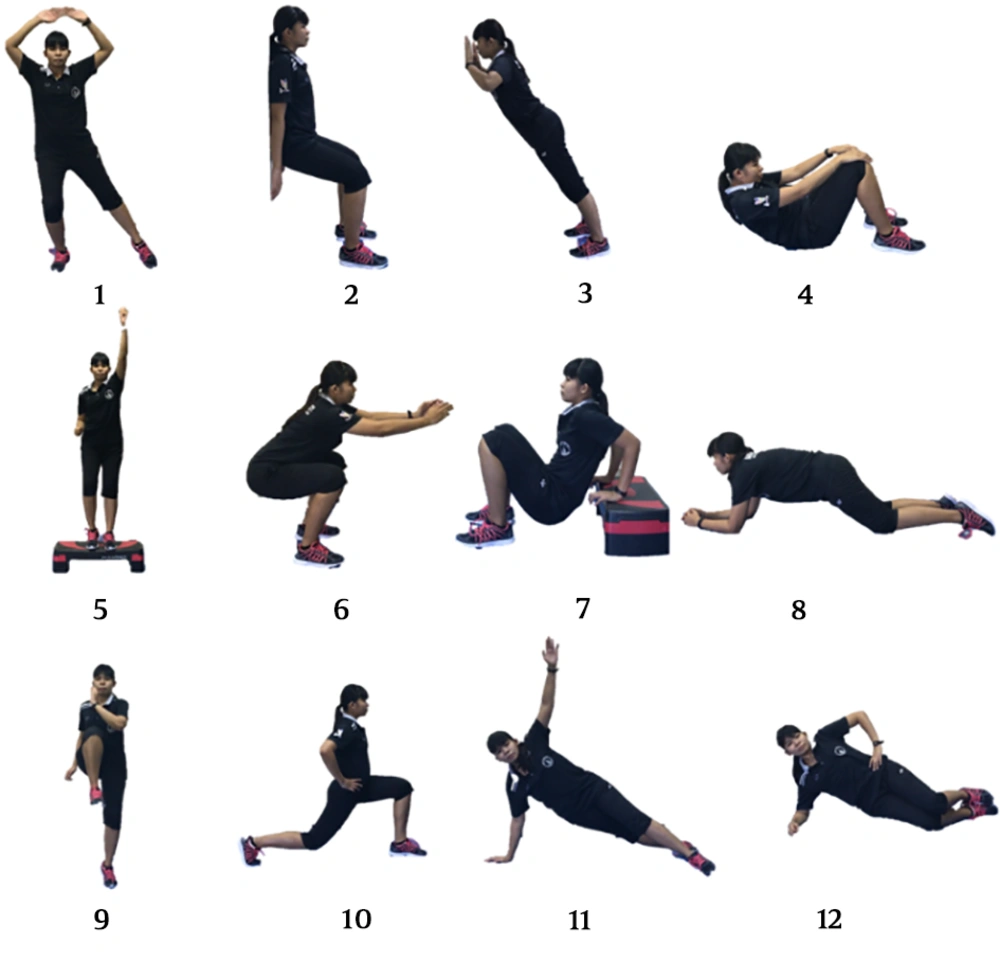
Figure 1.
The 12 body- weight poses (one circuit) of HICTBW program compose of (1) step jack, (2) wall-sit, (3) wall push-up, (4) sit-up hand reach, (5) step-up onto aerobic step, (6) half squats, (7) triceps dip onto aerobics step, (8) knee plank, (9) hops, (10) alternate lunges, (11) plank with rotation, and (12) knee side plank. Each pose was performed for 30 second with a 10- second rest interval. The total time was approximately 7.5 minutes per circuit.
3.4. Statistical Analysis
Data were analyzed using SPSS version 18.0 (IBM Corporation, Armonk, NY, USA). All data are expressed as mean ± SEM unless otherwise stated. The Shapiro-Wilk test was used to examine the normality of the data. The physical characteristics between the two groups at baseline were analyzed using the independent t-test. Analysis of comparisons between groups (CG versus TG) along the time periods (0-week versus 4- week) were carried out to determine the effect of intervention on measurements of body composition and cardiorespiratory fitness parameters by repeated- measures ANOVA followed by Bonferroni post-hoc test. The statistical significance level was set at P < 0.05.
4. Results
There were no statistically significant differences between groups in terms of participant characteristics at baseline (P > 0.05; Table 2).
| Parameters | CG | TG | P Value |
|---|---|---|---|
| Age, y | 35 ± 4 | 35 ± 3 | 0.68 |
| BW, kg | 50.0 ± 5.0 | 50.5 ± 5.8 | 0.83 |
| Height, cm | 160 ± 7 | 159 ± 4 | 0.74 |
| BMI, kg/m2 | 19.5 ± 1.2 | 19.9 ± 1.8 | 0.50 |
| Waist circumference, cm | 72 ± 5 | 71 ± 6 | 0.64 |
| Resting heart rate, bpm | 79 ± 7 | 79 ± 8 | 0.98 |
Abbreviations: bpm, beat per minute; BMI, body mass index; BW, Body weight; cm, centimeter; kg, kilogram; m2, square meter.
aThe data is shown as means ± SD.
bN = 12 for each group.
As shown in Figure 2A - D, between group effect showed that the values of cardiorespiratory fitness parameters were similar at baseline (0-week) (P > 0.05). After 4 weeks, the TG group improved significantly in the values of VO2peak (TG: 1.9 ± 0.1 L/min; CG: 1.5 ± 0.1 L/min, F (1,22) = 6.90, P = 0.01), relative VO2peak (TG: 36.4 ± 2.7 mL/min/kg; CG: 28.8 ± 1.1 mL/min/kg, F (1,22) = 6.21, P = 0.02), HR (TG: 136 ± 2 bpm; CG: 146 ± 2 bpm, F (1,22) = 6.21, P = 0.02) and exercise workload (TG: 1.3 ± 0.1 kp; CG: 1.0 ± 0.0 kp, F (1,22) = 7.86, P = 0.01) over the CG group.
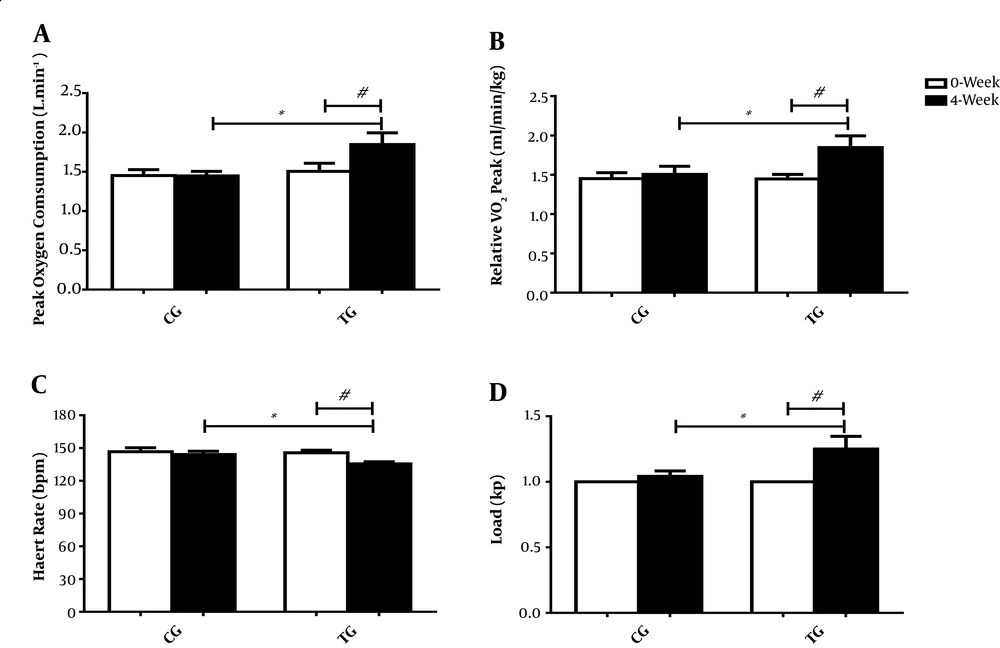
Figure 2.
Cardiorespiratory fitness parameters including peak oxygen consumption (2A), relative VO2peak (2B), heart rate (2C), and workload (2D) after 4-week compared to baseline of untrained (CG) and trained (TG) groups. Abbreviation: kp, kilopond; L/min, liter per minute; bpm, beat per minute; mL/min/kg, milliliter per minute per kilogram. Mean ± SEM are presented. Horizontal bars with * represent significant between group effect (CG and TG) and # significant within group effect (0-week and 4-week). The statistical significance level was set at P < 0.05.
In the CG group, there was no significant effect of time for all cardiorespiratory fitness parameters over the 4-week period (P > 0.05). The TG group, however, demonstrated a significant improvement in VO2peak (0-week: 1.5 ± 0.1 L/min; 4-week: 1.9 ± 0.1 L/min, F (1,22) = 6.50, P = 0.02), relative VO2peak (0-week: 29.8 ± 1.6 mL/min/kg; 4-week: 36.4 ± 2.7 mL/min/kg, F (1,22) = 5.18, P = 0.03), HR (0-week: 144 ± 3 bpm; 4-week: 136 ± 2 bpm, F (1,22) = 4.73, P = 0.04) and exercise workload (0-week: 1.0 ± 0.0 kp; 4-week: 1.3 ± 0.1 kp, F (1,22) = 7.59, P = 0.01), after a 4-week HICTBW program.
Body composition parameters were similar between groups at baseline and 4-week program (P > 0.05; Table 3). There was no significant effect of time for all body composition parameters during the pre- to post-4-week period in either group (P > 0.05; Table 3).
Table 3.
Two-Way Repeated-Measures ANOVA Tables for Body Composition Parameters of Untrained (CG) and Trained (TG) Groups at 0-Week and 4-Weeka
| Parameter/Group | 0-Week | 4-Week | Two-Way ANOVA | ||
|---|---|---|---|---|---|
| F (1,22) | P Value | ||||
| BW, kg | |||||
| CG | 50.0 ± 1.4 | 50.3 ± 1.5 | F1 | 0.05 | 0.82 |
| TG | 50.5 ± 1.7 | 50.8 ± 1.7 | F2 | 4.23 | 0.05 |
| IR | 0.02 | 0.89 | |||
| BFM, kg | |||||
| CG | 13.7 ± 0.6 | 13.7 ± 0.7 | F1 | 0.003 | 0.95 |
| TG | 13.8 ± 0.8 | 13.5 ± 0.7 | F2 | 0.86 | 0.36 |
| IR | 1.25 | 0.28 | |||
| Body fat percentage, % | |||||
| CG | 27.3 ± 1.0 | 27.2 ± 1.1 | F1 | 0.14 | 0.72 |
| TG | 27.0 ± 1.0 | 26.4 ± 0.9 | F2 | 2.18 | 0.15 |
| IR | 0.94 | 0.34 | |||
| VFA, cm3 | |||||
| CG | 55.2 ± 3.3 | 54.8 ± 3.4 | F1 | 0.07 | 0.79 |
| TG | 55.1 ± 3.7 | 52.5 ± 3.4 | F2 | 1.50 | 0.23 |
| IR | 0.81 | 0.38 | |||
| SMM, kg | |||||
| CG | 19.4 ± 0.7 | 19.6 ± 0.7 | F1 | 0.08 | 0.78 |
| TG | 19.7 ± 0.7 | 19.9 ± 0.7 | F2 | 4.13 | 0.05 |
| IR | 0.13 | 0.72 | |||
Abbreviations: IR: interaction, P: probability.
aF1: between group effect (CG and TG), F2: within group effect (0-week and 4-week).
5. Discussion
The results showed that a 4-week modified HICTBW program caused a significant improvement in exercise workload, VO2peak, relative VO2peak and HR, but did not change body weight or body composition in middle aged, sedentary women. Furthermore, there were no dropouts, even though participants were free to withdraw from an exercise study without penalty, or incidents of injury within a 4-week training, indicating that the HICTBW program can be safely implemented for promoting exercise adherence in inactive females of similar age.
To our knowledge, this is the first study to report the positive effects of a 4-week HICTBW program on cardiorespiratory fitness in sedentary women. In the present study, we demonstrated that absolute VO2peak and relative VO2peak can be increased after only 4 weeks of HICTBW training. The increase in VO2peak in the TG group infers that cardiorespiratory fitness may be improved after undertaking a short-term HICTBW program i.e., increased ability of the circulation and respiratory systems to supply oxygen to sustain physical activity. The number of weeks required to increase maximal oxygen consumption is in contrast to Schmidt et al.’s (12) findings, who reported that the VO2peak values increased after a longer duration (8 week) 14-minutes HICT training program.. The difference in the time span required to improve VO2peak between our studies may be related to the differences in the progression of the number of circuits performed over the successive study weeks. For example, Schmidt et al. (12) utilized one circuit in the first 3 weeks before increasing to two circuits during the 4th to 6th week of training. In comparison, our study increased from one circuit in the first week, to two circuits in the second and third weeks, and finally three circuits in the last week of training. Alternatively, Schmidt et al. (12) used recreationally active college-aged males and females as subjects, whose ceiling capacity to improve VO2peak is likely to have been lower than the sedentary aged females recruited in our study (14).
The present study also showed that 4 weeks of HICTBW training can increase cycling workload during submaximal exercise testing. This finding may be related to the abovementioned and well-documented cardiovascular and respiratory adaptations that can result from exercise training (18). In line with these findings, we also observed HR to decrease during submaximal exercise testing. This likely reflects a training adaptation, with an increased ability to deliver and extract oxygen at the working muscles (19). Our observations are in agreement with Trilk et al. (20), who reported that 4 weeks of sprint interval training led to a decreased HR in sedentary overweight and obese women, similarly indicating improved cardiovascular function during submaximal exercise.
In the present study, the participants’ body weights remained unchanged after the 4-week HICTBW program. It should be noted that, during the experimental testing, all participants were asked to maintain their current eating habits, which meant that energy consumption was not controlled. Consequently, the similar body mass measured after 4 weeks of training may be partly explained by the influence of diet masking any possible weight loss (21). In addition, we also observed that skeletal muscle mass and body fat parameters (body fat mass, body fat percentage, and visceral fat area) did not significantly change after the 4-week program. These results are in contrast with those of Mattar et al. (22), who reported that HICTBW program training could decrease body fat percentage and body fat mass in the first 3 - 6 weeks of training in healthy young participants. The possible explanation may be related to either (1) age specificity in responses to training (8, 13, 14), or (2) intensity of training differences (8) between Mattar et al.’s and our study. While Mattar et al. (22) had young adults (average age 21 ± 2 years) and performed 7 days/week for 6 weeks, the present study had middle-aged adults (average age 35 ± 4 years) and performed 3 days/week for 4 weeks. Therefore, this may indicate that the intensity of HICTBW training is an important consideration in the design of exercise programs focusing on body composition in middle aged, sedentary females.
5.1. Conclusions
This study showed that a 4-week HICTBW program (12 poses per circuit, 8 minutes each circuit three times weekly for 4 weeks) was sufficient to improve cardiorespiratory fitness parameters but had no effect on body composition or weight loss in middle aged, sedentary women who did not change their dietary habits.