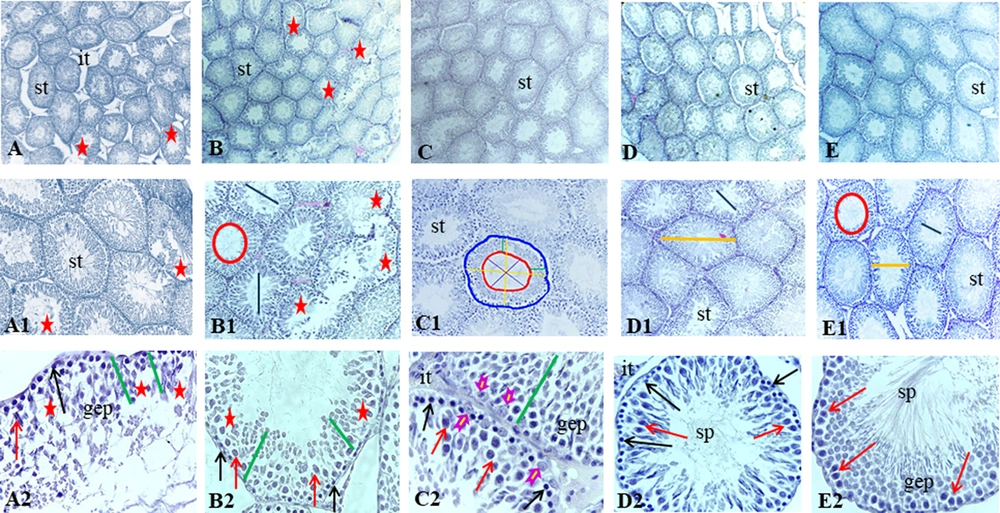
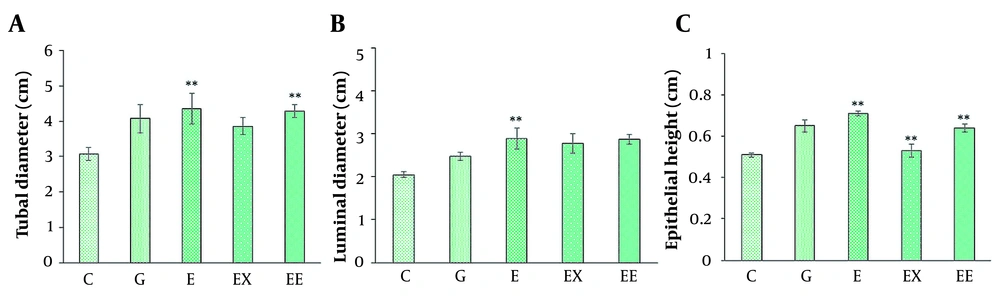
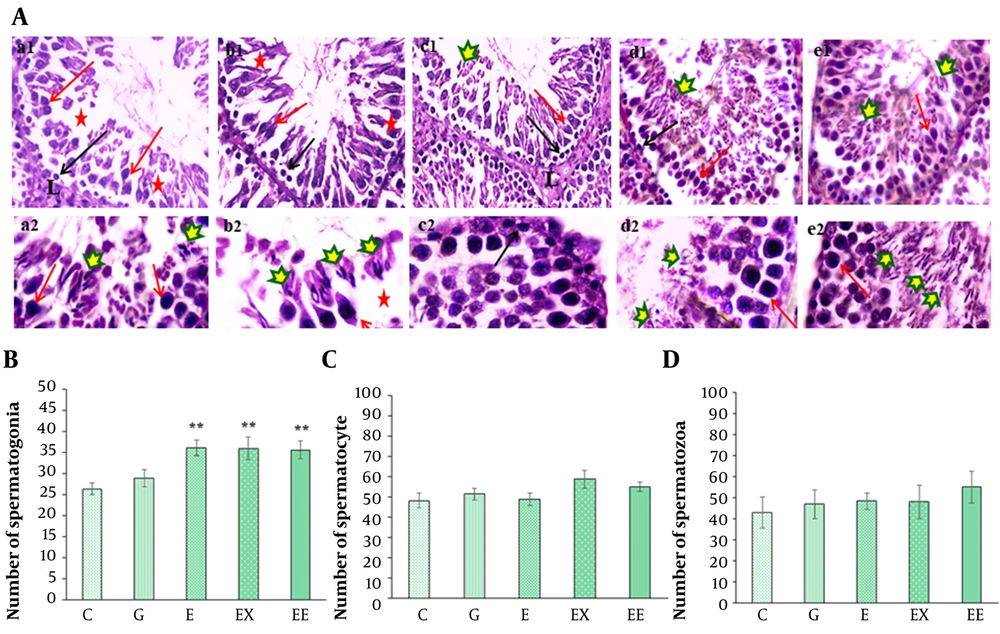
The present findings demonstrated that low-intensity exercise could improve some histological features of testicular tissue. Also, this study revealed that the consumption of rosemary and training exercises could increase the number of spermatogonia cells. Nevertheless, there were no significant differences in the number of primary spermatocyte and spermatozoa cells between different groups. Additionally, the empty spaces between seminiferous tubules were smaller in the groups that undertook exercise. However, as we did not compare different exercise intensities and various rosemary doses, the findings may not be accurately generalized.
Testicular parameters are changed by aging (
22), and aging may deteriorate male fertility and cause deficiencies in the reproductive axis (
23). The present study investigated the effects of low-intensity aerobic exercise and rosemary extract on the testis morphology of old male rats. Moreover, as the spermatogenic process takes approximately 53 days in rats (
24), we evaluated the effect of the administration of the herbal extract and exercise on male fertility in 84 days.
Exercise can make alternations in the hypothalamic-pituitary-gonadal (HPG) axis. Moreover, the effects of exercise on the testicular tissue depend on its intensity and duration, and high-intensity exercises have a more deleterious effect on reproduction (
12). One research comparing the results of low and high exercise capacity on apoptosis and spermatogenesis in rat testes found that low exercise may increase spermatogenesis via decreasing reactive oxygen species (ROS) (
25). In another study, it was demonstrated that aerobic exercise 5 times a week for eight weeks could improve fertility and sperm parameters in diabetic rats by decreasing oxidative stress (
26). Another research demonstrated that high-intensity exercise can result in spermatogenesis failure and reduction in the survival of germinal lineages and Sertoli cells in seminiferous tubules (
27). Moreover, it demonstrated that exercise can improve semen parameters, sperm DNA integrity, and pregnancy rate in infertile men (
28).
Recently, several studies have focused on the effect of different plant extracts on the function of different human body systems and healthy complexion (
29-
32). Momordica charantia fruit contains flavonoid components that can regulate cholesterol and lipoproteins levels (
33). Rosemary, which contains phenolic diterpenes, flavones, and steroids, has been widely studied for pharmaceutical purposes (
34). It also contains different types of triterpenes, including carnosic acid, rosmarinic acid, carnosol, rosmanol, betulinic acid, and ursolic acid (
35). The rosemary extract can regulate serum testosterone concentrations through a direct effect on the male sexual hormone system (
36).
There is controversy about the effect of rosemary on the reproductive system in different concentrations. On the one hand, it reduces the testicular DNA damage induced by Etoposide in a low dose of rosemary extract (
37). On the other hand, high dose consumption of rosemary can have detrimental effects on fertility (
24). Moreover, in one study, rosemary leaves improved semen quality and fertility in rabbits (
38). Another study evaluating the effect of the ethanolic extract of rosemary on injured testicular tissue in albino rats demonstrated that this extract increased male hormones and catalase (CAT) activity (
39). Rosemary extract in 100, 200, and 400 mg/kg doses improved heat stress side effects, demonstrating that this extract can be a stress moderator with the potential to regulate spermatogenesis and sexual hormones in warm climates (
36). Generally, the dosage of rosemary extract administration has a key role in regulating the reproductive system.
The results of the current study demonstrated that the daily administration of rosemary extract (100 mg/kg), with or without exercise, can confer some benefits on spermatogonia cell populations. Nonetheless, there was no significant difference in other spermatogenesis lineage cells between various groups. As there are 14 stages and 12 waves in the rat's spermatogenesis process (
40), more time may have been needed for the differentiation of spermatogonia to primary spermatocyte and spermatozoa cells in E, EX, and EE groups.
This study demonstrated that low-intensity aerobic exercise could improve some testis tissue parameters in aging. However, although daily rosemary extract (100 mg/kg) positively affected epithelial height and the number of spermatogonia cells, it was not as beneficial as exercise. Therefore, we conclude that low-intensity exercise and rosemary extract with specific concentrations could be recommended as a lifestyle-modifying approach against the deteriorating effects of aging on male fertility. Moreover, it can be proposed that future research should be focused on the impact of different concentrations of the extract and various exercise intensities on male fertility in aging.