1. Background
Organizational learning is a source of competitive advantage for dynamic organizations, particularly in highly stable workplaces. In this regard, Gong et al. (cited in Irman et al.) have suggested that organizations with the ability to learn fast can acquire a lasting competitive advantage over their competitors. In addition, organizations with a transparent process of organizational learning can solve organizational problems (1). Therefore, organizations need to continually learn to survive in today’s turbulent and fluctuating business environment and be responsive by constantly learning about new issues. However, “quantum management”, with its innovative and creative approach, enables organizations to make the most of their knowledge and learning potential (2). Quantum organizations are where lifelong learning is recognized as a culture (3). The quantum organization is continuously changing, adaptive, agile, and without borders, in which innovation and free information prevail. In these organizations, clarifying goals reduces the need for leading by managers, and instead, they emphasize on creating shared goals. Therefore, in quantum organizations, different communication processes are used to create a common perspective and indicate the goals (4). Regarding quantum management, Razavi et al. stated that quantum management theory is a metaphor of quantum and serving the manager affecting other components. This tendency as management can lead the individual from mechanical and violent behaviors to dynamic, creative, and effective environments (5). Based on the previous studies, quantum theory is widely used in the fields such as nuclear power, computing, and the Internet, as well as human skills, such as management and leadership (6). The quantum theory has developed so much so that its principles and concepts have been used as a paradigm in other disciplines, including management science, especially in the management of educational organizations (7). Creating new knowledge and learning has long been one of the main functions of universities. The greatest effort of the academic community has been to promote knowledge and enhance intellectual capital through available information, intellectual and human resources. As a result, universities must identify, extract, and exploit these resources using the right quantum management techniques (8). The purpose of quantum management is to enhance the power and effectiveness of managers and employees. In quantum management, the quantum theory attempts to use the concepts and principles of quantum theory as a guide for describing organizational phenomena and solving the relevant managerial issues (7). Yavas and Polat stated that the quantum model seems to be a comprehensive and advanced organizational model for the present and the future, especially for educational organization developments (9). Accordingly, we should focus on the quantum model and its features in educational organizations (9). Quantum managers can solve the problems of educational organizations through communication and discussion. In the quantum management perspective, the characteristics, skills, and duties of managers are different from traditional methods, as quantum managers manage the organization and human resources thoughtfully and rational (6). They also attempt to maintain a balance between stress and discipline (10). Collinson and Cook (cited in Liu and Liu) define organizational learning as “the conscious use of individual, group, and systemic learning to create new thinking and methods that continuously change and rebuild the organization to support common goals”. It is also a process, by which organizations eventually reach the ideal learning organization (11). Organizational learning can be defined as the “process of improving actions through better knowledge and understanding”, which is a changing process occurring over time. Organizational knowledge is achieved by experience (12), which means acquiring new knowledge and using it for the effectiveness and efficiency of the activities of the organization (13). According to Karpin (cited in Jegarvande and Daryakesh), a learning organization is one that “creates the opportunity for learning for all of its members and is constantly changing. Senge, who proposed learning organization theory, believes that such an organization is continually enhancing its ability to build the future (14). The learning organization has a direct impact on the organization’s commitment and performance. Accordingly, scientific policy and planning, technology, and development should employ learning organizations in research ones (15). Organizational learning is influenced by different variables for organizing and also different conditions in the organization that are associated with different outcomes. There is a strong relationship between leadership styles and organizational learning (16). Organizational learning is seen as a dynamic process based on knowledge and is translated through various levels of activity. Organizational learning can be used as a process, and organizational memory also can be considered as its outcome (17). The School of Medical Sciences of the Zahedan University of Medical Sciences is in accordance with the highest regional, national, and international standards of education to train skilled, knowledgeable, creative, responsible individuals committed to the values and professional and Islamic ethic principals as its goal to train students with the highest and most appropriate educational standards.
2. Objectives
This study aimed at designing a quantum management model for organizational learning through a systematic grounded theory approach in the Zahedan University of Medical Sciences.
3. Methods
In this qualitative study, with the help of Grand theory methods, the researcher used procedures of the interpretation that were used to understand the phenomena from the participants’ point of view and in their particular institutional and social context.
The researcher seeks to use fundamental that is necessary if a general (brief) theory or an explanation of a process is required. When existing theories do not address the problem or the participants in the process involved in the researcher’s study program, the foundation data theorizing is a “production” theory. Since this theory has a “foundation” in the data, it offers a better explanation than the theory adapted from the existing set of theories because it fits the situation; in practice, it is really efficient. Also, it takes into account the people in an environment and understands their feelings, and it may show all the complexities that are really found in the process (18). Therefore, since the existing theories do not respond to the problem, the fundamentals of theorizing data have been used to provide a better explanation by designing the model and producing the theory. Theoretical sampling in foundation data theorizing is the process of collecting data to create a theory so that the analyst can collect, encode and analyze the data, and decide what data to collect and where to find and develop it while theorizing (19).
Data were collected through snowball sampling until data saturation. Accordingly, based on the researcher’s information and the research objective, selected experts who were qualified to answer the questions were interviewed. They then introduced other experts to continue sampling. In the present study, 19 interviews were conducted in which no concept was achieved after the twelfth interview; however, to ensure theoretical saturation, seven additional interviews were conducted, and no new concept and data was obtained from the interviews. Therefore, theoretical saturation was achieved.
In this research, after theoretical sampling by taking semi-structured notes and interviews, data were analyzed in three stages: open coding (creation of concepts and categories), axial coding (identifying axial category, causal conditions, confounding conditions, contexts, strategies, and outcomes), and selective coding (theory creation), which eventually led to the presentation of the final research model in the form of a central coding paradigm.
To ensure the accuracy of the collected data, there was a long-term and in-depth conflict with the data. In addition, two other researchers, in addition to the main researchers, participated in the analysis of the data. Another way to increase was the validity of the data. From the initial interview, the codes and subcategories were formed, and then the reduction of data continued in all units of analysis (codes) until the categories emerged. Analysis of qualitative content using Nvivo software in the login section Text interviews and cataloging, coding, identifying concepts and categories, and extracting relevant quotes for support. The findings, were taken into account. In this study, obtaining informed consent, maintaining identity information, and observing trust in the implementation of the content of the interviews were considered as ethical considerations.
The statistical population of the study included faculty members and managers of Zahedan University of Medical Sciences who actively participated in research and management. The interviewees were 4 heads, 7 deputies, and 8 managers being interviewed lasted from June 16 to October 7, 2019. Each interview also lasted 35 to 70 min. The study was approved by the Ethics Committee of Zahedan University of Medical Sciences.
4. Results
Data analysis in the grounded theory approach is done in three stages: open coding (creation of concepts and categories), axial coding (identifying axial category, causal conditions, confounding conditions, contexts, strategies, and outcomes), and selective coding (theory creation). Below we describe how categories are formed from the concepts. First, we described the open coding and the coding of the interviews, followed by forming concepts and categories.
4.1. Open Coding
At this stage, all key points of the interviews were extracted and coded, and after analyzing, similar codes were assigned to the specific concepts. Finally, 20 categories and 61 concepts were identified and extracted from the open coding process (Table 1).
Table 1.
Overview of the Analysis Hierarchy Quantum Management
| Selected Category | Axial Coding of the Data | Data |
|---|---|---|
| Casual conditions | ||
| The importance of organizational learning | The need for environments for collaborative learning | Interview 11: “teamwork and team learning should be implemented in the university ...” |
| Ambiguity in identifying | Need for knowledge-based management | Interview 5: “I believe that in a cognition-based management system, we can have a purpose and plan ...” |
| The importance of the manager’s perspective | Need for purposeful perspective | Interview 7: “In the research system, we are evaluated and rated annually by the Ministry based on the specific standards. Therefore, our perspective must be purposeful ...” |
| Need for innovation | Paying attention to create new thinking and creative people | Interview 3: “As vice-chancellor of research, I’m looking for creativity and creative people ...” |
| Need to change in thinking | Contradictory thinking | Interview 2: “contradictory thinking of the managers and deputies will lead to the dynamics and progress of the organization ...” |
| Management uncertainty | Changes in Management | Interview 1: “We don’t have much time for trial and error, and also some people change after learning management…” |
| Axial category: Development of the quantum management paradigm | This category is directly resulted from causal conditions with high abstraction and is referred by all existing codes. | |
| Interfering conditions | ||
| Institutional relationships in the medical education system | Interaction and synergy of policy-making institutions in medical education | Interview 19: “Interaction of the policy-making institutions in the medical education system can influence the management process ...” |
| The attitude of senior managers of the medical education system | Social learning paradigm and using it as a pattern | Interview 12: “positive attitude of the managers toward collaborative learning can lead to using it by others...” |
| Political behavior in the organization | Forming a group to gain power | Interview 8: “Some informal groups are formed at the university to gain power and impose their ideas ...” |
| Context (background factors) | ||
| Perspective and the mission of the organization | Clarity of the perspective and organizational worldview | Interview 18: “All staff and managers at the university should be clearly aware of the perspective and organizational worldview ...” |
| Organizational culture | Integration of values and behavior patterns | Interview 5: “I believe that when values and behavior patterns are shared by all managers, employees will also follow ...” |
| Democracy | Providing a comfortable and intimate environment for managing the learning process | Interview 13: “In my opinion, in a comfortable and intimate environment and also with a good manager, a talented person can better manage the educational process ...” |
| Strategy | ||
| Management-oriented principles | This concept is based on two principles of grounded theory: (1) Constant Comparative Analysis and (2) inductive-deductive motion (18) and did not directly address in the data. It is an abstract concept where the researcher (as a research tool) was engaged in its forming. | |
| Outcomes | ||
| Educational axial transformation | Innovative developments in education | Interview 17: “In my opinion, applying the principles of quantum management will lead to innovation in education ...” |
| Management of the challenges | Coping with Organizational Learning Challenges | Interview 9: “There are always challenges to learning in an organization, which need to be addressed properly”. |
| Improving relationships | Establishing and expanding relationships | Interview 10: “In my opinion, the principles and characteristics of quantum management are a good strategy to build and develop relationships among members of educational organizations ...” |
| Looking ahead | Bringing the future into the present | Interview 14: “Each manager can Bring the future into the present with the right management ...” |
4.2. Axial Coding
In this stage, the categories extracted from the open coding process were divided into six categories, including axial category, causal conditions, confounding conditions, context conditions, strategies and outcomes, and finally, the “development of the quantum management paradigm”, which was selected as the axial category. It was chosen as the axial category since it was found in most obtained data. In other words, most respondents introduced encouragement for purposeful learning; creating an environment for creativity and innovation, and the ability to communicate continuously as the main processes of quantum management for learning, which indicates the development of a quantum management paradigm. Therefore, it can be placed at the center being linked to the other categories. It was tried to choose a comprehensive label for the axial category.
4.3. Selective Coding
Selective coding was the main stage in the grounded theory analysis, in which the theory was presented based on the results of open and axial coding. Based on the obtained relationships, the concepts resulted from open and axial coding in the selective coding stage were linked together and presented as a model at the Zahedan University of Medical Sciences (Figure 1).
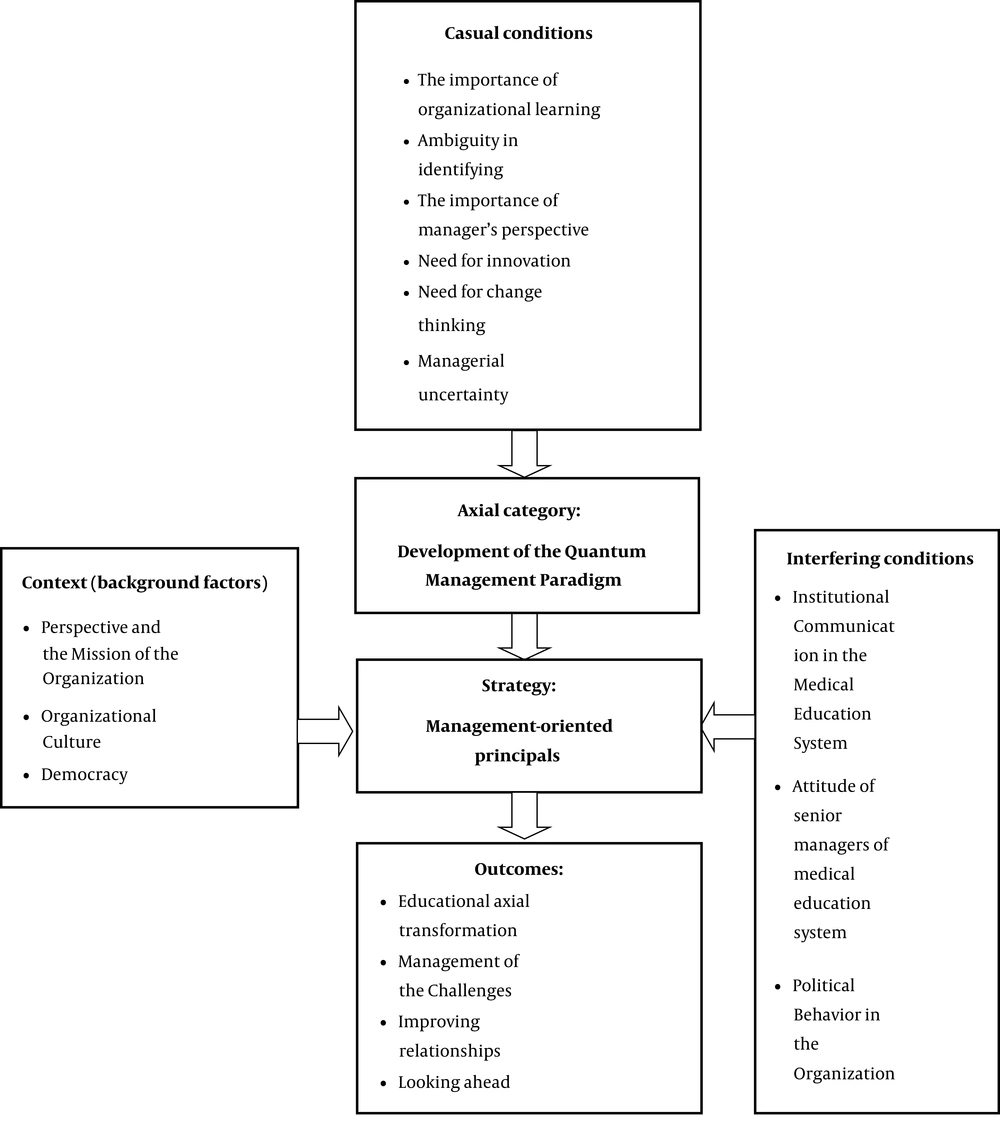
Figure 1.
The final model of the research as the axial coding paradigm
4.4. Creating the Theory
After explaining the components of the axial coding paradigm, findings of the selective coding are presented. Following the formation of the concepts and categories, the third component of the grounded theory is propositions or themes as the main output of the selective coding, which represents the public relations between a category and its concepts and between certain categories. Glaser and Strauss first called the third element a hypothesis; however, later, the term "theme" seemed more appropriate since themes involve conceptual relationships, whereas hypotheses require measurable relationships.
Theoretical themes deal with the relationships between categories in the axial coding paradigm. The output of this stage in the present study was extracted as six theoretical themes as follows:
Theme 1: Causal conditions were explained for the axial category of quantum management paradigm development, as six categories, including the importance of organizational learning, ambiguity in identifying, the importance of manager’s perspective, need for creativity, need to change in thinking, management uncertainty.
Theme 2: Institutional relationships in the medical education system, Attitude of senior managers of the medical education system, and political behavior in the organization as interfering conditions adjust the relationship between development of quantum management paradigm and management-based principals.
Theme 3: The axial category of quantum management paradigm development is characterized by encouraging purposeful learning, providing a comfortable and intimate environment for managing the learning process.
Theme 4: The main outputs of the quantum management paradigm development are achieved through the implementation of Management-based principals.
Theme 5: Educational axial transformation, Challenge management, improving relationships, looking ahead are among the most important outputs and outcomes of the quantum management paradigm development.
Theme 6: Perspective and the mission of the organization, organizational culture, democracy as background conditions, affect all the variables, concepts, and categories of the quantum management paradigm development.
5. Discussion
According to the general table of the analysis hierarchy and the final research model present in the form of the central coding paradigm, The findings of the present study show that the quantum management model is necessary for organizational learning in Zahedan University of Medical Sciences and its use can improve the policymakers in the field of medical education and university officials in promoting Help level management and encourage organizational learning and training.
As Shelton and Darling in Quantum Skills in Management presents: Quantum view, quantum cognition, quantum thinking as part of the seven quantum skills (20). The required change in thinking has been suggested by participants in model design. Harris et al. in their research, Concluded that effective management through quantum skills is essential to running a good school, especially in the changing nature of school management (21). Therefore, this result is consistent with the results of the present study. The study of Shelton and Darling about to quantum characteristics of management, the duality of creativity, and the unreliability of the manager was provided by participants in causal conditions (20). Ucar and Koseoglu posited that there was a positive and moderate relationship between the quantum leadership behavior of school principals and teachers’ creativity (22). This result confirms the need for creativity in causal conditions in this study. Volckmann (23), Kilmann (24), Valentine (25), Sullivan and Decker (26), stated the principle of encouraging purposeful learning as one of the principles of quantum management that necessitates organizational learning in causal conditions of this study.
The findings show that one of the implications of implementing the designed model is challenge management. This is the case with the research of Naderifar et al. who showed that quantum skills have high analytical capabilities to resolve conflict and management, and can be effective in perceiving and advancing the organization. It is similar to being useful for managing and leading in complex situations (6). Yavas and Polat stated in their research that organizational learning and quantum organizations are known as employee behavioral values due to the nature of the organization. As a result, the quantum model, especially in the context of the evolution of educational organizations, must be a comprehensive and advanced organizational model for the present and the future (9). Therefore, the pivotal category expressed in this study, entitled Development of Quantum Management Paradigm, while adapting to the mentioned results, can lead to the consequences mentioned by the participants, including educational transformation and looking to the future.
However, the mission and aim of universities and university managers as a learning organization is not only to prepare people for their future jobs but also, more importantly, is to help them with the productive learning and provide the context for the emergence and development of mental progress with a long-term and continuous impact on the individual. Obviously, there is a need to restructure management methods in the university environment for universities to succeed in dealing with such issues and be consistent with the higher education system in other successful countries. Accordingly, management in higher education institutions and universities should be holistic, consistent, and quantum-oriented to benefit from the potentials of professors, staff, and students.
Therefore, they can be responsive to the highest levels of society’s needs to provide and promote the physical and mental health of individuals in the community and also solve health-threatening problems. Accordingly, providing an appropriate context through adherence to the quantum management principles and skills for organizational learning, that enable managers and faculty members of this faculty to obtain and create information, interpret and transfer information, use information and create and institutionalize the knowledge to provide appropriate educational services to maintain and promote health and prevent against the diseases and also promote the quality of mental and physical health according to the highest level of standards that consequently leads to build a trust in the society toward the medicine and the health system is needed.
In general, it seems that the design of the quantum management model with an organizational learning approach in this research, which has not been addressed in research and other studies, can be a way for managers and officials of Zahedan University of Medical Sciences.
5.1. Conclusions
Given the role and special place of Zahedan University of Medical Sciences University in the higher education system, it is important to design a quantum management model with an organizational learning approach and examine the effects of its implementation in this university. In conclusion, quantum management is an important and necessary step to succeed in missions and policies at this university, based on the model designed for effective decision making, promotion and development of learning and knowledge transfer. The findings of this study provide an opportunity for managers and officials at different levels of Zahedan University of Medical Sciences to know the dimensions and components of quantum management in the field of organizational learning can be appropriate solutions improve their weaknesses in each dimension of quantum management, which in this study is proposed to choose as their behavioral pattern.
5.2. Suggestions
It is suggested to explain the positive and negative effects of implementing the comprehensive and indigenous model of quantum management with an organizational learning approach in Zahedan University of Medical Sciences, while using the expert opinions of all stakeholders in the university, by triangulating the method in future studies, in this research as, Follow in a quantitive phase.
It will be possible to determine the level of readiness of the university to change from classical to quantum management to increase effectiveness, with organizational learning approach, by knowing the dimensions and components of quantum management in area organizational learning, which can be changed through training, Attitudes, behaviors, and organizational culture are accessible.