


1. Background
Job performance is an important organizational behavior that is of crucial importance for organizational success (1). In today’s market, entrepreneurial risk-taking, and a strong tendency to develop intellectual capital are key competitive benefits (2). Entrepreneurship is progressively mentioned as a motivational factor for developing different organizations. Thus it is required to promote entrepreneurship education in universities and higher education systems. Furthermore, it has been argued that creating an integrated, coherent entrepreneurial culture among university faculty members, as the main axis of future human resources, can play an important role in the development of entrepreneurial universities (3).
Social capital is a key factor in developing entrepreneurial activities. In organizations with high levels of social capital, employees are committed to their activities, and effective interactions among them bring a strong commitment to the organizational values and goals (4). In the absence of social capital, other organizational assets lose their effectiveness, which in turn causes difficulties for progress towards cultural and economic development. Social capital also plays a significant role in the development of entrepreneurial activities in organizations and leads to creativity and risk-taking behaviors among staff, all of which are recognized as key indicators of entrepreneurship (5).
Evidence supports the importance of entrepreneurial behavior in improving employees’ performance (5). Besides, social capital is mentioned as an effective factor in entrepreneurial behavior. In a study conducted by Chen et al. to investigate the association between social capital, entrepreneurial behavior, and job performance of employees, the results indicated a positive and significant association between these three variables (6).
In addition to developing entrepreneurial behavior among employees, through strengthening social capital in organizations, managers can help them to improve their job performance. In this regard, universities and higher education systems are the most important fields for the country’s development as well as the main sources for training skillful and committed human resources (7). Understanding the role of social capital in developing such innovative aspects can be a great help for managers and policymakers to make evidence-based decisions about effective ways of improving organizational performance (7). This is especially important in some fields of study, such as medical sciences, where graduates deal with various people.
2. Objectives
The present study aimed to investigate the mediating role of entrepreneurial behaviors in the association between social capital and job performance among university faculty members of a medical sciences university in Qazvin, Iran.
3. Methods
3.1. Study Design
This cross-sectional, analytical study was conducted using a structural equation modeling among all university faculty members in all schools of Qazvin University of Medical Sciences in 2017. The university is located in the Qazvin city, which is in 150 km northwest of Tehran.
3.2. Study Population
Using the consensus sampling method, 260 faculty members were selected to participate in the study.
3.3. Data Collection
Data were collected using three instruments: (a) the 25-items Social Capital Scale encompassing structural, cognitive, and communication as three main dimensions; (b) the 12-items Entrepreneurial Behavior Questionnaire composing of four dimensions, including change behavior, strategic insight, energetic work environment, and supportive environment; and (c) a 16-item Job Performance Questionnaire developed by Paterson in 1992 that contains the dimensions of being responsible at work, teamwork, respect the discipline, and improve the work (8, 9). All instruments were rated on a 5-point Likert scale, and their validity is approved in similar studies conducted with the same purpose (10-12).
To collect data, the questionnaires were distributed by a trained student, who was a member of the research team among participants. The data collection process took a month. Before filling the questionnaire, participants were asked to sign a written consent form.
The study hypothesis was to test whether entrepreneurship behavior has a significant influence on the association between social capital and job performance.
3.4. Statistical Analysis
Descriptive statistical analysis and Pearson correlation coefficient were used to examine the association between the main variables of the study. Data were analyzed using SPSS version 20. To test the significance of observer and hidden variables as well as examining the fitness of the model, which was developed using the structural equation modeling (SEM), the path analysis through AMOS software was applied. Also, the Sobel test and VAF were used for measuring the effect and t-value of mediator variables.
4. Results
Of 260 faculty members of the Qazvin University of Medical Sciences, 210 (80.7%) accepted to participate in the current study; most of the participants were females (54.3%). Also, most of them were aged 45 to 54 years (38.1%) and married (80.9%). Regarding their education, most of the participants (36.7%) were specialists with an academic level of assistant professor (61.4%). Also, most of them (49%) had work experience for more than 10 years and were mostly working in the faculty of medicine (44.5%).
As the model was fitted to the study data, the path coefficients were evident. In the model, positive signs signify a positive association between variables. Furthermore, to examine the significance of these coefficients, the Student’s t-statistic was employed, which related values are presented in Figure 1.
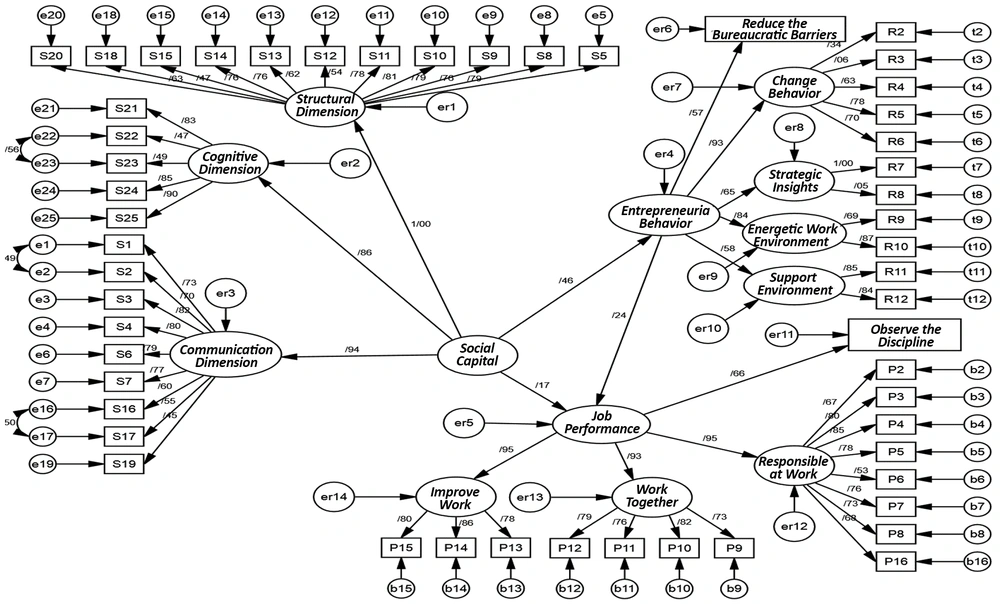
Figure 1.
Factors for estimating the standard factor analysis of the final model
As shown in the path analysis, all t-statistic values were greater than 1.96, representing the significance of all path coefficients in a confidence interval of 95% (Table 1).
Table 1.The Results of the Estimated Model by Factor Loadings (Path Coefficients) and T Statistics
| Hypothesis | Component | Direction | Variable | Standardized Load Factors | T | P Value | Result |
|---|---|---|---|---|---|---|---|
| H1 | Social capital | → | Job performance | 0.17 | 2.08 | < 0.05 | Accepted |
| H2 | Social capital | → | Entrepreneurial behavior | 0.45 | 5.11 | < 0.05 | Accepted |
| H3 | Entrepreneurial behavior | → | Job performance | 0.23 | 2.55 | < 0.05 | Accepted |
The standardized load factor reported for the association between social capital and job performance was 17%, while for the association between entrepreneurial behavior and job performance, it was 24%. In other words, one unit change in the standard deviation of these two variables would, respectively, change the standard deviation of job performance by about 17% and 24%. Moreover, in the current study, the VAF was equal to 39%. It can be concluded that entrepreneurial behavior partially mediates the association between social capital and job performance. Further, to confirm the mediation, the SOBEL test was employed, and the results were significant. Hence, the hypothesis that entrepreneurial behavior mediates the association between social capital and job performance can be accepted (Test statistic = 2.31, Std. Error = 0.047, P value = 0.02).
Concerning the study hypothesis, which was assessed using the structural equation model, software output confirmed the suitability of the structural model (Table 2).
Table 2.Fitness Indicators of Structural Equation Modeling
| Fit Index | AGFI | GFI | CFI | SRMR | RMSEA | χ2/df |
|---|---|---|---|---|---|---|
| Acceptable value | > 0.9 | > 0.9 | < 0.9 | > 0.05 | < 0.05 | < 3 |
| Fit index | 0.61 | 0.64 | 0.91 | 0.047 | 0.043 | 2.24 |
The obtained value for GFI, as one of the fitting goodness indicators, confirmed the model fitness (0.64). Also, the ratio of χ2 on the degree of freedom is one of the best indicators of the model fitness, which shows that the value of 2.24 is in the acceptable range. Furthermore, the RMSEA index estimated by the errors of the model was equal to 0.043, reflecting an optimal level.
5. Discussion
The results regarding the association between social capital, entrepreneurial behavior, and job performance revealed a significant association with the moderating role of entrepreneurial behavior. These findings are in line with the Karimi and Shahdousti study, which confirmed the moderating role of entrepreneurial behavior in the association between social capital and job performance (13).
Also, according to the findings, there was a direct association between social capital and job performance; so that the higher the social capital, the higher would be the job performance of faculty members. This finding is consistent with the findings of several studies (11, 14-16). The importance of examining the association between these variables in an organizational environment roots in the fact that organizations are looking for effective and efficient strategies to achieve their goals and to enhance the performance of their staff (17). According to the evidence, one of the most effective factors in job performance is social capital in the workplace, which enhances job performance through reciprocal recognition and trust-building among members as well as effective sharing of information, knowledge, and work experiences (18). Social capital has important impacts on the educational system, and the results of the current study showed that constructive communication among university faculty members is an effective factor in enhancing the quality of education as well as promoting occupational activities (19). Several studies have mentioned the importance of social capital as an influencing factor on personnel job performance, and its significant dimensions include trust, commitment, and mutual interactions (11, 20, 21). Nahapiet and Ghoshal argued that when staff accept the norms and values of the organization, the trust-building process begins to form. Following common norms and objectives is the basis for improving the performance as well as motivating the staff to work more committed toward organizational goals (8).
On the other hand, the results showed a significant direct association between social capital and entrepreneurial behavior among faculty members, in which such association is confirmed in similar researches (22-25). Effective communication provides opportunities for sharing knowledge and experience among staff, which leads to a cooperative-like competition. In fact, an organization with a high level of social capital can foster new ideas and strengthen creativity through an effective transferring of knowledge. This creativity eventually leads to innovation and entrepreneurship in the organization (25).
The findings about the direct impact of entrepreneurship on job performance are consistent with studies that reported a significant association between entrepreneurial characteristics and job performance (12, 26). Hence, it can be argued that the more entrepreneurial orientation among organizational members, the higher would be the level of job performance. In other words, when risk-taking and innovative behaviors are high among employees, they are more likely to have higher levels of job performance (27). Thus, to realize these features at different organizational levels, managers should motivate employees to strengthen their entrepreneurial spirit and, consequently, achieve higher levels of performance.
The current study had limitations, including using a self-assessment-based method for analyzing the entrepreneurial behavior of the participants. Therefore, it would be beneficial to assess organizational entrepreneurship behavior using operational indicators in future studies.
5.1. Conclusions
Since educational institutions, including universities, are responsible for training knowledgeable and skillful human resources needed for future firms and institutions, it is essential to pay special attention to the significant role of university faculty members as central aspects of education systems and to move toward strengthening their performance. According to the findings, strengthening social capital and promoting entrepreneurial behavior among staff can improve their performance. Furthermore, the results showed that trust-building among staff can improve social capital. Designing new incentive methods, which use entrepreneurial indicators as employees’ performance indices, is also recommended. On the other hand, social capital has an important role in the emergence and development of entrepreneurial activities. Therefore, managers can contribute to the improvement of job performance, in addition to developing entrepreneurial behavior among employees.

