1. Background
Communication, mental health, emotional intelligence, problem-solving ability, and well-being are the most prominent features among the resilient, which help individuals adapt to changes and are also essential for navigating challenging living and working conditions in the 21st century (1). Some factors such as obesity, poor fitness, aging, and neurological and respiratory disorders arouse restrictions, which limit individuals’ potentials to enter land-based exercise programs (2). According to Raffaelli et al. (3), aquatic exercise significantly enhance physical exercise, compared to land exercise.
Changing the position of the joints can affect individuals’ daily activities and participation in sports (4). Several studies have documented that when the body is immersed in water up to the shoulders, it loses “90% of gravity” (5, 6). Accordingly, water exercises are particularly beneficial for obese individuals, who are at enhanced risk of orthopedic damage, which is secondary consequences of exercise.
However, the benefits of the aquatics exercise programs in terms of health status are still controversial (5). There is no study on weight loss, cardiometabolic markers, and quality of life (QOL) for obese aged women participating in the WATERinMOTION aquatics exercise program. This physical exercise is highly welcomed by some grownups and aged individuals as it is believed that, in addition to promoting health status, the program is also associated with improvements in physical fitness and weight-related diseases such as cardiovascular and metabolic syndrome. The WATERinMOTION program is a standardized water sports program consisting of a warm-up, lineal and sidelong motions, teamwork, group dynamic, workouts, upper and lower body suspension, strengthening body core, and flexibility (7). Music is professional, and individuals at different age ranges can participate in this program. In this regard, choreography is correspondingly linked to the music.
Meanwhile, participants in other programs participate in aquatic exercise programs for at least six-week (8) or longer (2, 5, 6, 9). The present study, however, was to detect if the program held two sessions a week is sufficient for a significant increase in health in a month. Waist circumference (WC) was measured by considering internal fat deposits and the likelihood of weight-related diseases (10). Body mass index (BMI) was used to define obesity (11). Personality traits are linked to subjective well-being and described as overall emotional and mental health (12). The QOL questionnaire addresses individuals’ emotional and mental health, physical status, functional capacity, general health status, pain, vitality, and social aspects (5, 13). Dietary monitoring was also performed to detect dietary changes (5, 9).
2. Objectives
The present study aimed to determine whether the effectiveness of WATERinMOTION as a water sport in helping inactive obese aged women regarding weight loss, WC, and cardiometabolic markers (such as blood lipid markers and glycaemia), and QOL. It was hypothesized that a one-month WATERinMOTION exercise may be an appropriate option to have positive shifts in the participants’ weight, cardiometabolic markers, and QOL. The outline of the study is presented in Figure 1.
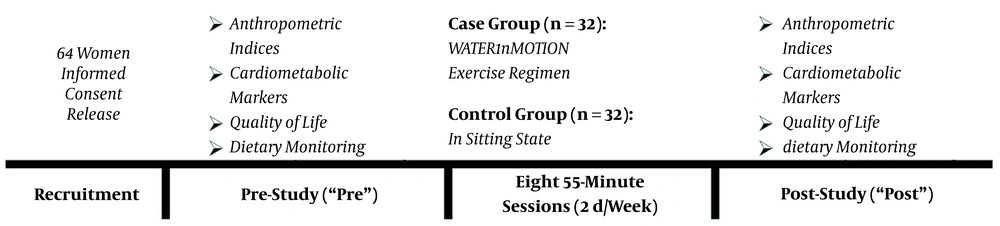
Figure 1.
Paper outline
3. Methods
3.1. Study Design, Sample, and Randomization
The participants of this cross-sectional study were recruited from inactive obese aged women who had come to the Ukrainian Sports Center (Kyiv, 2019) after reading the ads on the website to participate in the one-month WATERinMOTION exercise program. Given the potential population of 76 individuals and a 95% confidence level with five confidence intervals, the sample size was determined based on the using Creative Research systems not to be < 64 individuals (14). They were randomly assigned into two case (n = 32, with the WATERinMOTION aquatics exercise program) and control (n = 32, held in a sitting position simultaneously) groups using the convenient sampling method. The two one-month programs were run twice a week (a total of eight 55-minute sessions). A team of two physicians and two instructors explained the study objectives and procedure to the volunteers. Inclusion criteria were inactive old women having 1 - 2 and less exercise sessions per month (9), BMI > 30 kg.m-2, and 65 years of age (5, 6). Living in self-sufficiency is categorized as degrees to which the person can sustain itself without external support (the average self-sufficiency status in this study was three). The Mini-Mental State examination is the most commonly used test to evaluate memory problems or other mental abilities. The value of the Mini-Mental State examination in our study was considered above 18 for inclusion criteria (15). In addition to a remarkable family history of dyslipidemia and cardiovascular diseases, volunteers with the age-related diseases (e.g., diabetes mellitus, cancer, cardiovascular, Alzheimer’s, hypertension, orthopedic restriction, and multiple chronic conditions), hearing loss interfering listening to sports music, tobacco consumption (chronic and acute), transmittable diseases, and a medical WATERinMOTION restriction, and those taking drugs such as thyroxine, progestin, estrogen, and vitamin E, which affect lipid metabolism, and beta-blockers as well as those who missed three sessions of the program were excluded from the study.
All the participants completed dietary records over four days (3 weekdays and a weekend day) during two weeks before the study, and the same procedure was run after the study for self-reporting the dietetic alteration (5, 6). These data were processed using the EVIDENT II application, which was authorized to determine the quantity of consumed energy/kilocalorie per day (16). Moreover, they were invited to preserve their nutrition habits and physical activities in their leisure time throughout the study period. The follow-up phase was performed for all the participants every other two weeks throughout the study period. The research project and informed consent forms were approved by the Institutional Research Ethics Committee. The volunteers submitted their signed informed consent form to participate in the study one week before the intervention. The study protocol was set in accordance with the Helsinki Declaration and observed all relevant institutional policies and strategies.
3.2. Pool Exercises
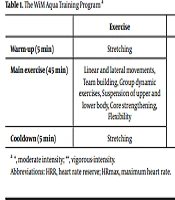
Like other types of exercises, the main phases of the WATERinMOTION program are warm-up, main set, and cool-down (7). Table 1 demonstrates more aspects of the WATERinMOTION aquatics exercise program.
Table 1.
Pool Exercise Program at WATERinMOTION
| Frequency | Intensity | Time (Duration) | Type (Exercise) | |
|---|---|---|---|---|
| Warm-up (5 min) | Twice per week | 55% - 70% of HRmaxa | One month | Stretching |
| Main exercise (45 min) | 70% - 85% of HRmaxb | Linear and lateral movements; team building; group dynamic exercises; suspension of upper and lower body; core strengthening; flexibility | ||
| Cooldown (5 min) | 55% - 70% of HRmax | Stretching |
Abbreviations: HRmax, maximum heart rate; min, minutes.
aModerate intensity.
bHigh intensity.
The WATERinMOTION program was performed in an indoor swimming pool. The water temperature was about 30°C (17), and the pool deepness was 1.30 m (17). The workout intensity ranged from 70% to 85% of the maximum heart rate (5). Polar Electro Oy- a waterproof device for measuring heart rate- manufactured by Kempele, Finland was used to control the participants’ heart rate. Furthermore, the music played in the WATERinMOTION program fits everyone in terms of speed and tempo as such everyone could follow the play (7).
3.3. Assessments
Before the first session of the WATERinMOTION program, the researchers assessed the participants’ anthropometric indices, including weight in kilogram (kg) and height in centimeter (cm), according to which the participants’ BMI was calculated. Before and after the intervention, the participants’ weights were calculated with a Scale-Tronix model 5002 manufactured by Wheaton, IL, USA, and their heights were measured with a stadiometer, while considering the exactness of 0.1 kg and 0.1 cm for both weight and height, respectively (5, 6). These calculations were made for the participants dressed in light clothing and no shoes. In this study, BMI and WC were used to study body composition (9, 18). BMI is a pattern considering “an individual’s weight unit (in kg) divided by the height squared (in meters)” (11). Obesity is considered as BMI ≥ 30 (11). Waist circumference (WC) was measured without compressing the skin in the horizontal plate at the end of the natural expiratory in the middle of the iliac protrusion to the lowest ribs (9).
Morning biochemical examinations were accomplished from 9 AM, after an hour-long rest, in a half-lying position (9), and after 12-hour night starvation before and after the intervention (6, 19). Total cholesterol (T-C), high-density lipoprotein cholesterol (HDL-C), and triglyceride (TG) were analyzed by considering the enzymatic manner of COBAS, manufactured by Roche Diagnostics, Germany. Low-density lipoprotein cholesterol (LDL-C) was computed based on Friedewald’s formula: LDL-C = TC - (HDL-C + TG/5). This mode can only be used for TG < 400 mg/dL (20). Fasting blood sugar was checked by a kit to determine the enzymatic glycaemia (Wiener® liquid AA) By oxidation method by Rosario, Argentina.
3.4. Statistical Analysis
The results are reported as mean ± SD. The Shapiro-Wilk test supported the normality of the data distribution. The paired sample t-test was used to compare the groups and time points (pre/post-intervention), and the analysis of covariance (ANCOVA) was also used to compare the results between the two groups. Pearson’s chi-square (χ2) test was applied to investigate the variations in the distribution of categorical variables. In his study, P < 0.05 was set as the significance level, and IBM SPSS software version 24.0 (for Windows) was utilized to analyze the data.
4. Results
4.1. Demographics, Anthropometric, and Cardiometabolic Markers
The mean age and height of the participants were 69.7 ± 4.4 years and 167.3 ± 5.4 meters in the case group and 70.5 ± 4.5 years and 167.9 ± 4.7 meters in the control group, respectively. Table 2 shows the other demographic information, including weight and BMI, of the participants. No specific event such as refusals, adverse reactions, and drop-out were reported in this study. All the participants completed the study procedure. The completion rate for the groups was estimated by χ2, and no significant variation was noticed (P = 0.78). At the beginning of the study (pre-intervention), there was no significant difference between the groups’ daily calorie intake, anthropometric indices, and cardiometabolic markers (P > 0.05) (Table 2).
Table 2.
| Variables | Case Group | Control Group | ||
|---|---|---|---|---|
| Pre-intervention | Post-intervention | Pre-intervention | Post-intervention | |
| Weight, kg | 98.7 ± 16.4 | 97.4 ± 16.7*# | 100.4 ± 18.3 | 100.6 ± 18.2 |
| BMI, kg.m-2 | 35.1 ± 5.1 | 34.7 ± 5.2* | 35.5 ± 5.4 | 35.5 ± 5.5 |
| T-C, mg/dL | 224.9 ± 29.5 | 221.3 ± 27.6 | 226.1 ± 25.6 | 225.7 ± 27.7 |
| LDL-C, mg/dL | 146.1 ± 28.7 | 142.4 ± 25.8 | 140.1 ± 26.0 | 139.8 ± 28.1 |
| HDL-C, mg/dL | 48.5 ± 5.9 | 49.8 ± 6.0 | 51.8 ± 6.7 | 51.8 ± 7.2 |
| FBS, mg/dL | 94.1 ± 16.1 | 93.0 ± 17.8 | 95.6 ± 17.3 | 95.8 ± 16.9 |
| WC, cm | 100.6 ± 10.7 | 100.4 ± 10.1 | 101.5 ± 11.2 | 101.5 ± 12.7 |
| Daily calorie intake, Kcal/day | 2199 ± 188 | 2221 ± 167 | 2218 ± 119 | 2225 ± 106 |
Abbreviations: BMI, body mass index; FBS, fasting blood sugar; HDL-C, high-density lipoprotein cholesterol; LDL-C, low-density lipoprotein cholesterol; T-C, total cholesterol; WC, waist circumference.
aValues are expressed as mean ± SD.
b*, P < 0.05 in comparison to pre-intervention #, P < 0.05 in comparison to the control group.
Table 2. Variation in daily calorie intake, anthropometric indices, and cardiometabolic markers in case and control groups during the study (pre/post-intervention).
The study results in terms of time (pre-/post-intervention) revealed modest but significant weight loss (P = 0.004) and a significant decrease in BMI (P = 0.002) in the case group. The case group had mean weight loss of -1.3 kg and BMI of -0.4 kg.m-2. The case group displayed better, but insignificant, effects regarding cardiometabolic markers (T-C, -3.6 mL/dl, P = 0.21; LDL-C, -3.7 mL/dL, P = 0.09; HDL-C, +1.3 mL/dl, P = 0.1; FBS, -1.1 mL/dl, P = 0.12) and WC (-0.2 cm, P = 0.14). Furthermore, the comparison of the study groups in the post-intervention phase only revealed a significant variation in weight loss (P = 0.001) (Table 2).
4.2. QOL
The groups were homogenous in terms of QOL indicators at the beginning of the study (P > 0.05). Comparing pre-and post-intervention results discloses significant improvements in health status (P = 0.03), vitality (P = 0.01), and social aspects (P = 0.04) in the case group (Table 3).
| SF-36 Variables | Case Group | Control Group | ||
|---|---|---|---|---|
| Pre-intervention | POST-intervention | Pre-intervention | Post-intervention | |
| Emotional aspects | 60.2 ± 13.1 | 60.7 ± 11.8 | 71.2 ± 8.1 | 69.3 ± 11.6 |
| Mental health | 63.4 ± 10.5 | 66.2 ± 11.3 | 63.6 ± 8.2 | 63.9 ± 7.9 |
| Health status | 70.1 ± 9.5 | 80.4 ± 9.7 | 70.4 ± 6.7 | 73.2 ± 7.6 |
| Physical aspects | 82.6 ± 11.4 | 88.4 ± 9.6 | 84.1 ± 10.2 | 84.9 ± 11.3 |
| Functional capacity | 70.7 ± 8.7 | 78.4 ± 7.9 | 71.9 ± 9.5 | 72.3 ± 8.8 |
| Pain | 65.7 ± 12.3 | 61.8 ± 9.7 | 56.8 ± 10.1 | 61.3 ± 10.5 |
| Vitality | 52.9 ± 7.1 | 63.6 ± 10.2 | 57.8 ± 11.5 | 58.1 ± 7.5 |
| Social aspects | 65.6 ± 8.9 | 76.1 ± 7.8 | 70.3 ± 6.5 | 70.3 ± 7.1 |
aValues are expressed as mean ± SD.
b*, P < 0.05.
5. Discussion
The research results showed the effect of the WATERinMOTION approach on the weight loss and cardiometabolic markers of inactive obese aged women. This aquatics exercise program revealed a slight superiority by making some improvements in QOL; however, physical exertion with a dietary restriction revealed more effectiveness in terms of weight loss after eight weeks in Fett’s study (22) on obese men. The present findings were in line with those of the meta-analysis and review reports in dictating the moderate effectiveness of exercises in weight loss, particularly when exercise is not accompanied by dietary monitoring (23).
Meanwhile, aquatic exercises are considered as one of the main calorie burners and as an excellent technique to retain weight under control (24). However, there are still controversies regarding the impact of water exercises on weight (5). In Penaforte et al.’s study (25), a two-month water sports program held three sessions a week for obese aged women revealed a significant drop in body weight and BMI. Rezaeipour and Nychyporuk (9) also had a 12-week aquafit exercise held three sessions a week for postmenopausal women and reported a significant decrease in weight loss markers. In contrast, Charmas and Gromisz (26) found no significant change in weight for young women who swam 12 weeks with three sessions per week.
A calorie-burning exercise raises the likelihood of changes in body weight (27). The Water viscosity is resistant to any physical movement of the WATERinMOTION program and leads to more energy-burning. Preserving a calorie shortage in water sports would have a positive impact on weight loss (28). The moderate weight loss in this study may be caused by a lack of compensatory increase in calorie consumption to adapt to energy expenditure during sports, suggesting that the WATERinMOTION program leads to further weight loss when held two sessions a week per month.
The triglyceride level of blood depends on food intake; hence, it was not assessed in this study (20). The present findings also exhibited positive but not significant changes in the cardiometabolic markers such as blood lipid markers and glycaemia. The findings were in contrast with those reported by Caro et al. (29) and Nakhaei et al. (30), who studied moderate-intensity regular physical exercise.
High WC aroused by visceral fat may be a risk factor resulting in many diseases such as arthritis and cardiometabolic disorders (31). The significant associations between the concerned program with weight and BMI and positive reductions in cardiometabolic markers confirmed the research hypothesis, suggesting that a one-month WATERinMOTION program can be effective in decreasing weight and improving cardiac metabolic markers in inactive obese aged women. The WATERinMOTION exercise program, however, is not suitable for individuals at health risk as it elevates cardiometabolic markers.
The control group revealed an insignificant weight gain. Although the difference was not statistically meaningful, it may lead to marked weight gain over time, which is associated with a higher risk of different chronic diseases (32). The same can be achieved when analyzing blood glucose. The results of the WC assessment in the case group were positive but insignificant. Another study on the elderly showed that a more significant decrease in WC for walking in water and longer durations (from 24 to 48 weeks) (33), thus indicating better results in comparison to the present findings.
Regarding QOL markers, the case group showed significant improvements in health status, vitality, and social aspects. Research has documented that regular aerobic exercise programs have positive effects on mood and psychological disorders such as depression and anxiety and cognitive aspects (i.e., learning and memory), improve QOL, and hence are crucial therapeutic allies (5, 34). Furthermore, the increased synthesis of endorphins caused by regular physical activity also leads to progression in individuals’ organisms (5, 34).
5.1. Conclusions
The study findings demonstrate that the short-term WATERinMOTION exercise program accompanied with no dietetical supervision has a modest effect on individuals’ weight loss. Improvements in the participants’ health status, vitality, and social aspects this program suggests the positive effects of this type of exercise on individuals’ QOL; hence, including such a program in inactive obese aged women’s lifestyle is beneficial in terms of WC and cardiometabolic markers. These findings may have some clinical implications. Since the elderly women were included in this study and given the metabolic differences rising from their age and gender, the findings cannot be recommended for other individuals. In this regard, future researchers are recommended to study the proposed protocol for a long period as it would improve the clinical outlook of obese individuals with an inactive lifestyle. Furthermore, further studies are suggested to investigate males and other age groups.