
1. Background
Hospital waste refers to all infectious and harmful wastes caused by medicines and equipment used in hospitals, health centers, medical diagnostic laboratories, and similar centers, which are considered hazardous waste (1, 2). According to the projections of the World Health Organization (WHO), about 75 to 90% of the waste generated in health centers can be considered safe, but the remaining 10 to 25% should not be ignored (3). At the global level, especially in low-income countries and most developing countries, waste management is considered a major environmental health challenge (4-6). Despite the new methods of disposal of hospital wastes, there remains a large volume of wastes disposed of through traditional means such as the sanitary landfill. Since recyclable household waste can be converted into urban fertilizers, mixing household and hospital waste threatens human health (7-9). Exposure to these types of wastes can cause diseases such as diarrhea, leptospirosis, typhoid, cholera, AIDS, tuberculosis, and ultimately lead to death (10). About 2.5 million people who have been the victims of illnesses caused by inappropriate waste management die every year (11).
Due to the increasing concern about poor waste management, researchers have developed methods and tools for waste management such as multi-criteria decision making (MCDM), multi-objective planning (MOP), and life cycle assessment (LCA) (12). Among them, MCDM is a tool for choosing the best method of waste management among a range of available methods/criteria (13).
A study by Ali et al. using the LCA method found that the best ways to manage waste were composting, incineration, and sanitary landfill. Another study by Rafei et al. that used the MCDM method stated hydroclave as the most appropriate technology for treating infectious waste (14, 15). In Qazvin province, there were 15 hospitals and about 1370 hospital beds generating about 5,122 kg of hospital waste each day, 1,533 kg of which were said to be infectious. As such, autoclave-hydroclave and chemiclave were used for the safe handling of wastes (16, 17).
2. Objectives
With increasing population alongside increased health centers, there has been increasing use of disposable medicines over the past decades. There is a significant increase in health wastes that can cause environmental pollution, negatively impacting human health if not properly managed. The present study aimed at ranking and selecting the best method of waste management in the health sector with MCDM approaches in urban and rural areas.
3. Methods
The present study was based on a quantitative method using a survey as the primary means of collecting data in Qazvin province. The research participants consisted of two groups of experts. The first group consisted of 28 experts, belonging to five fields: (1) health deputy experts (HDE); (2) environmental protection agency experts (EPAE); (3) waste management organization experts (WMOE); (4) hospital environmental health experts (HEHE), and (5) faculty members (FM). They were responsible for calculating the weight of the criteria, as well as ranking the methods of garbage disposal in urban areas of the province. The second group consisted of 22 experts in four fields: (1) HDE, (2) EPAE, (3) rural health center experts (RHCE), (4) FM who were responsible for working in rural areas and ranked waste management methods in rural areas. Both groups were included in the study by targeted sampling. The inclusion criteria in the study for selecting the experts were having an education related to the scope of the study and having at least a bachelor's degree and two years of work experience related to health waste management.
First, the factors affecting the disposal of healthcare waste were identified by conducting a literature review. The authors searched relevant databases, which included but were not limited to Medline and Scopus, and extracted articles for review. The output of this phase included a list of effective factors involved in the disposal of wastes and appropriate methods for the disposal of health and medical waste. This output served as the input for the development of a quantitative data collection instrument. In the next stage, the research instruments, after combining and summarizing the reviews in a few steps, embedded the corrective comments and recommendations from experts and professionals. The developed questionnaires were sent to participants for responding. Finally, we affirmed factors collected based on a statistical analysis of data of the initial questionnaire, in the form of a paired comparison questionnaire, and their validity using the opinion of professors and experts in terms of its form and reliability based on the inconsistency rate of 0.013. The output of this stage determined the weight of each of the 12 criteria. The research was approved as a master's thesis by the ethics committee of Qazvin University of Medical Sciences with a code of ethics (IR.QUMS.REC.1396.462).
3.1. Data Analysis
In this study, a hierarchy process method was used to measure the weight of the criteria. However, in the analytic hierarchy process (AHP), the environment maker cannot express his certain preferences, but can make a judgment based on feeling and understanding (18). In other words, this approach cannot properly reflect the uncertainty in human thought. In fuzzy sets, a proportion is given to a decision-maker, and a fuzzy number is defined by a membership set. Here, the membership function defines the degree to which the elements belong to the set of preferences in a judgment space (19). Therefore, in this study, the fuzzy AHP was used to determine the weights of criteria. The experts' answers to paired comparisons were based on verbal terms on a 9-point Likert scale, and so it was necessary to convert the responses analytically.
After converting the experts' judgments into fuzzy numbers, the experts' judgments were then combined. To combine experts' judgments, Buckley's proposed method was used. According to Buckley’s statement, the following formulas (Equation 1) were used for combining expert's judgments (N experts) (17, 20) in which Uij is a triangular fuzzy number.
Where Bijn = pairwise comparison between criteria i and j evaluated by the nth expert.
Before the weights of the criteria were calculated using Fuzzy AHP, the inconsistency ratio was measured. The maximum acceptable value of the inconsistency ratio is 0.1 when the number of criteria is more than four criteria.
After ensuring the acceptability of the inconsistency rate of the data, Chang's Extent Analysis (EA) method was used to calculate the weight of the criteria as one of the most popular and effective methods for solving the fuzzy hierarchy.
Finally, after calculating the weights of the criteria, the TOPSIS method was used separately in urban and rural areas to rank different methods of waste disposal in the health sector. It is one of the best multi-criteria decision-making models. In this method, m alternatives (here, waste disposal methods) are evaluated by n indices in the form of a decision matrix. This technique is based on the concept that the selected alternative should have the minimum distance with the ideal solution (the best possible state, A+I) and the maximum distance with the ideal negative solution (the worst possible state, A+I) [19]. One of the advantages of using this method (MCDM) in prioritizing health waste disposal methods is the use of the opinion of a large number of experts in this field with various approaches in the field of health waste disposal.
The questionnaires were distributed to the selected sample in person, and the necessary explanations were given on how to complete the questionnaires. To analyze the data of the questionnaires, Expert Choice (EC) software (ver. 8) support, designed by Saaty et al. (21), Excel (Microsoft, 2007), and Lingo (ver. 14) software were used.
4. Results
Among 28 participants who participated in urban waste management practices, 17 of them were men (60.7%), and 11 were women (39.3%). The mean age of participants was 36.9 ± 6.0; the mean work experience was 13.3 ± 6.8 years, and their experience in the current position was 9 ± 6.9 years. Most participants had a bachelor's degree (15 individuals, 53.6%). Participants in rural areas included 12 men (54.5%) and 10 women (45.5%). The mean age of the participants was 36.6 ± 6.2; the mean work experience was 10.4 ± 5.9 years, and their experience in the current position was 8 ± 5.6 years (Table 1).
Table 1.
Frequency and Percentage of Demographic Characteristics of Research Sample a
| Variables | Urban Areas | Rural Areas |
|---|---|---|
| Gender | ||
| Men | 17 (60.7) | 12 (54.5) |
| Women | 11 (39.3) | 10 (45.5) |
| Degree | ||
| BSc. | 15 (53.5) | 13 (60) |
| MSc. | 10 (35.8) | 5 (22.7) |
| Ph.D. | 3 (10.7) | 4 (18.2) |
| Field of study | ||
| Environmental health engineering | 24 (85.8) | 16 (72.7) |
| Healthcare services management | 2 (7.1) | 4 (18.18) |
| Natural resources engineering | 2 (7.1) | 2 (9.09) |
a Values are expressed as No. (%).
The results of weighting the criteria after data analysis are reported in Table 2. The opinion of the five expert groups on the weight of the criteria was the highest in terms of the criteria of air pollutants and environmental impacts, and the cost had the lowest weight. Meanwhile, the inconsistency rate at this stage was 0.013 (Figure 1).
Table 2.
The Mean Score of Each Criterion According to Experts Using Multi-criteria Decision Making Approach
| Code | Criteria | Groups | ||||||
|---|---|---|---|---|---|---|---|---|
| HDE | FM | EPAE | HEHE | WMOE | Total | Rank | ||
| 1 | Cost | 0.03 | 0.014 | 0.105 | 0.03 | 0.046 | 0.0395 | 12 |
| 2 | Solid residuals and environmental impacts | 0.081 | 0.124 | 0.089 | 0.115 | 0..179 | 0.1005 | 5 |
| 3 | Water residuals and environmental impacts | 0.145 | 0.186 | 0.136 | 0.219 | 0.175 | 0.1465 | 2 |
| 4 | Air residuals and environmental impacts | 0.165 | 0.178 | 0.154 | 0.08 | 0.203 | 0.016075 | 1 |
| 5 | Odor | 0.05 | 0.035 | 0.045 | 0.028 | 0.033 | 0.05225 | 9 |
| 6 | Release with health effects | 0.055 | 0.125 | 0.125 | 0.087 | 0.081 | 0.07075 | 7 |
| 7 | Reliability | 0.096 | 0.07 | 0.042 | 0.075 | 0.039 | 0.08175 | 6 |
| 8 | Treatment effectiveness | 0.169 | 0.073 | 0.14 | 0.102 | 0.064 | 0.1235 | 3 |
| 9 | Level of automation | 0.034 | 0.025 | 0.047 | 0.021 | 0.031 | 0.041 | 11 |
| 10 | Occupational hazards occurrence frequency | 0.099 | 0.088 | 0.097 | 0.121 | 0.076 | 0.10125 | 4 |
| 11 | Public acceptance obstacles | 0.031 | 0.04 | 0.021 | 0.04 | 0.033 | 0.04275 | 10 |
| 12 | Land requirement | 0.045 | 0.042 | 0.024 | 0.083 | 0.039 | 0.054 | 8 |
| - | Inconsistency ratio | 0.04 | 0.08 | 0.1 | 0.07 | 0.06 | 0.013 | - |
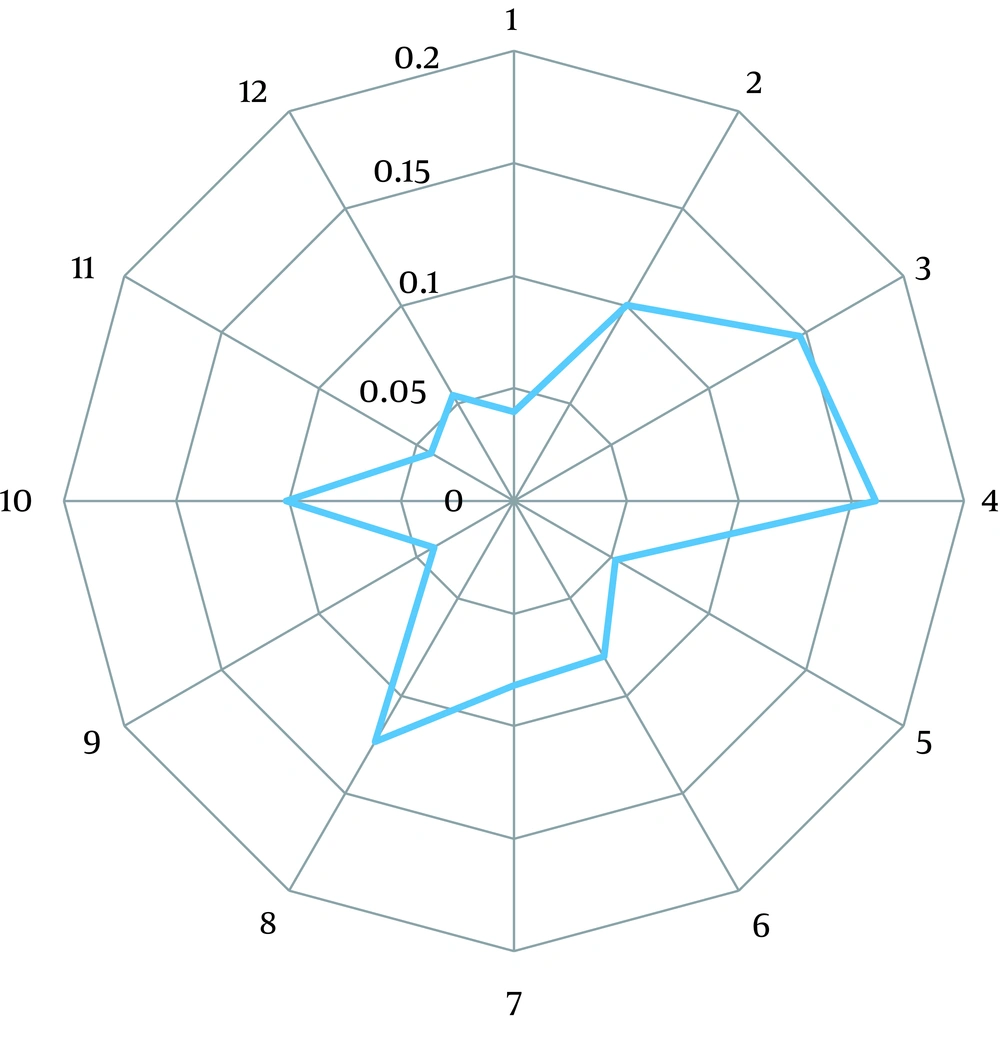
Figure 1.
Mean score of each criterion according to the experts through MCDM approach
The weights obtained in the hierarchical analysis process were used to rank the TOPSIS waste disposal methods in both urban and rural areas. The results of the TOPSIS method according to five groups of health experts to prioritize the best method of waste disposal in urban areas are shown in Table 3.
Table 3.
Ranking Waste Disposal Methods According to Experts Using TOPSIS Method in Urban Areas
| Code | Alternatives | Groups | ||||||
|---|---|---|---|---|---|---|---|---|
| HDE | FM | EPAE | HEHE | WMOE | Total | Rank | ||
| 1 | Incineration | 0.14677 | 0.58691 | 0.33150 | 0.30235 | 0.73842 | 0.29318 | 6 |
| 2 | Steam sterilization | 0.5693 | 0.47781 | 0.82836 | 0.75919 | 0.56444 | 0.75934 | 3 |
| 3 | Microwave | 0.52756 | 0.48348 | 0.94077 | 0.82268 | 0.65640 | 0.79408 | 2 |
| 4 | Sanitary landfill | 0.60466 | 0.48751 | 0.14989 | 0.34382 | 0.16812 | 0.35990 | 5 |
| 5 | Chemical disinfection | 0.49162 | 0.42069 | 0.55257 | 0.45142 | 0.44577 | 0.55447 | 4 |
| 6 | Irradiation | 0.68275 | 0.40573 | 0.82105 | 0.65580 | 0.50159 | 0.83974 | 1 |
Using the geometric mean method, the mean of the priorities of disposal methods stated by experts was ranked. The final ranking based on the criteria studied in urban areas are as follows: (1) irradiation, (2) microwave, (3) steam sterilization (autoclaving), (4) chemical disinfection, (5) sanitary landfill, and (6) finally incineration (Figure 2).
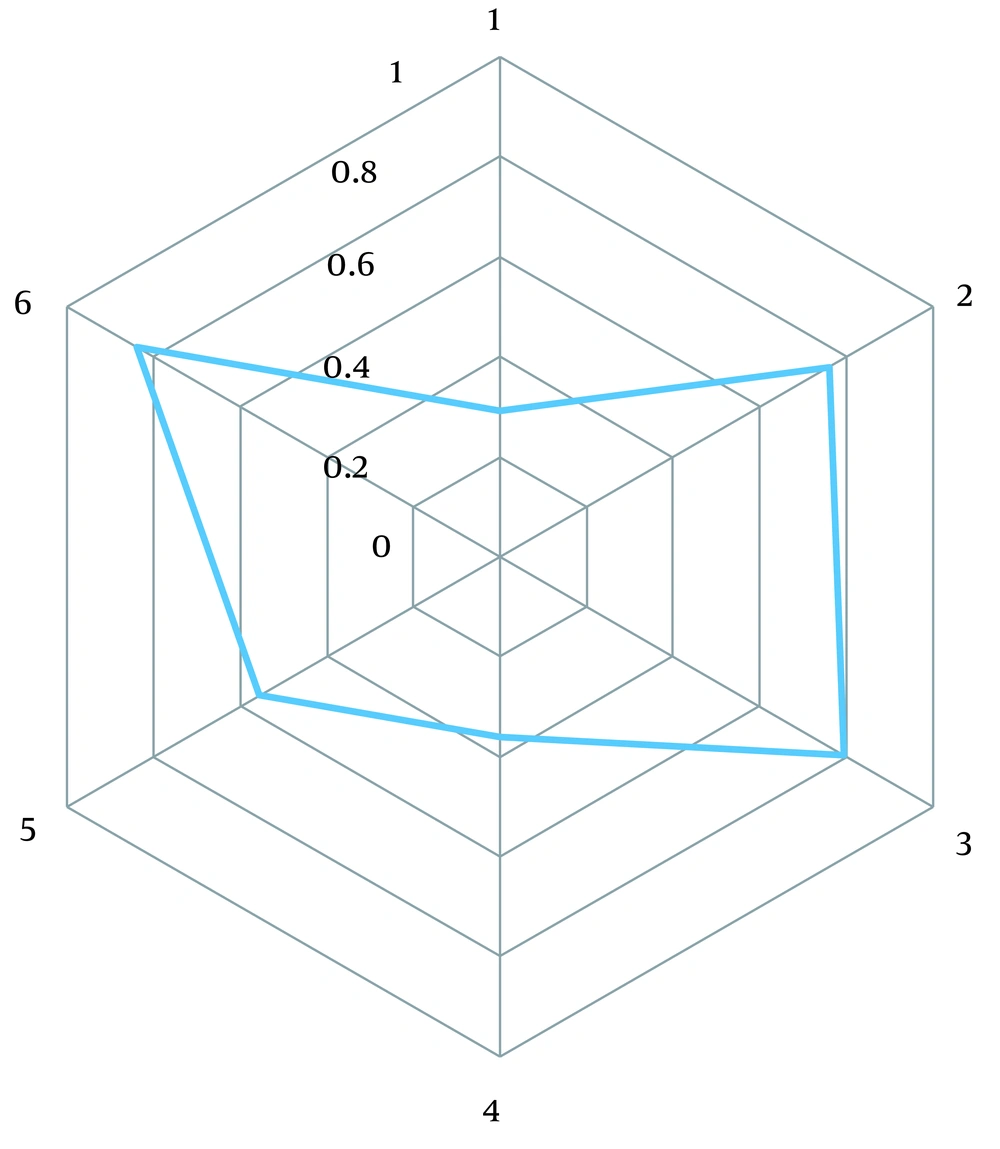
Figure 2.
Ranking waste disposal methods according to the expert group using TOPSIS method in urban areas
The results of the TOPSIS method based on four expert groups to prioritize the best method of waste disposal in rural areas are shown in Table 4.
Table 4.
Ranking Methods of Waste Disposal Based on the Experts Group Using TOPSIS Method in Rural Areas
| Code | Alternatives | Groups | |||||
|---|---|---|---|---|---|---|---|
| HDE | FM | EPAE | RHCE | Total | Rank | ||
| 1 | Incineration | 0.007 | 0.3621 | 0.1959 | 0.0100 | 0.08998 | 6 |
| 2 | Steam sterilization | 0.5601 | 0.7461 | 0.7490 | 0.9303 | 0.8679 | 1 |
| 3 | Microwave | 0.9999 | 0.7748 | 0.8632 | 0.7187 | 0.8402 | 2 |
| 4 | Sanitary landfill | 0.1680 | 0.3572 | 0.1728 | 0.5871 | 0.3236 | 5 |
| 5 | Chemical disinfection | 0.5014 | 0.3717 | 0.5574 | 0.6779 | 0.5341 | 4 |
| 6 | Irradiation | 0.8357 | 0.6783 | 0.8014 | 0.8073 | 0.8291 | 3 |
The final result of ranking based on the criteria used in rural areas are as follows: (1) steam sterilization (autoclave), (2) microwave, (3) irradiation, (4) chemical disinfection, (5) sanitary landfill, and finally (6) incineration (Figure 3).
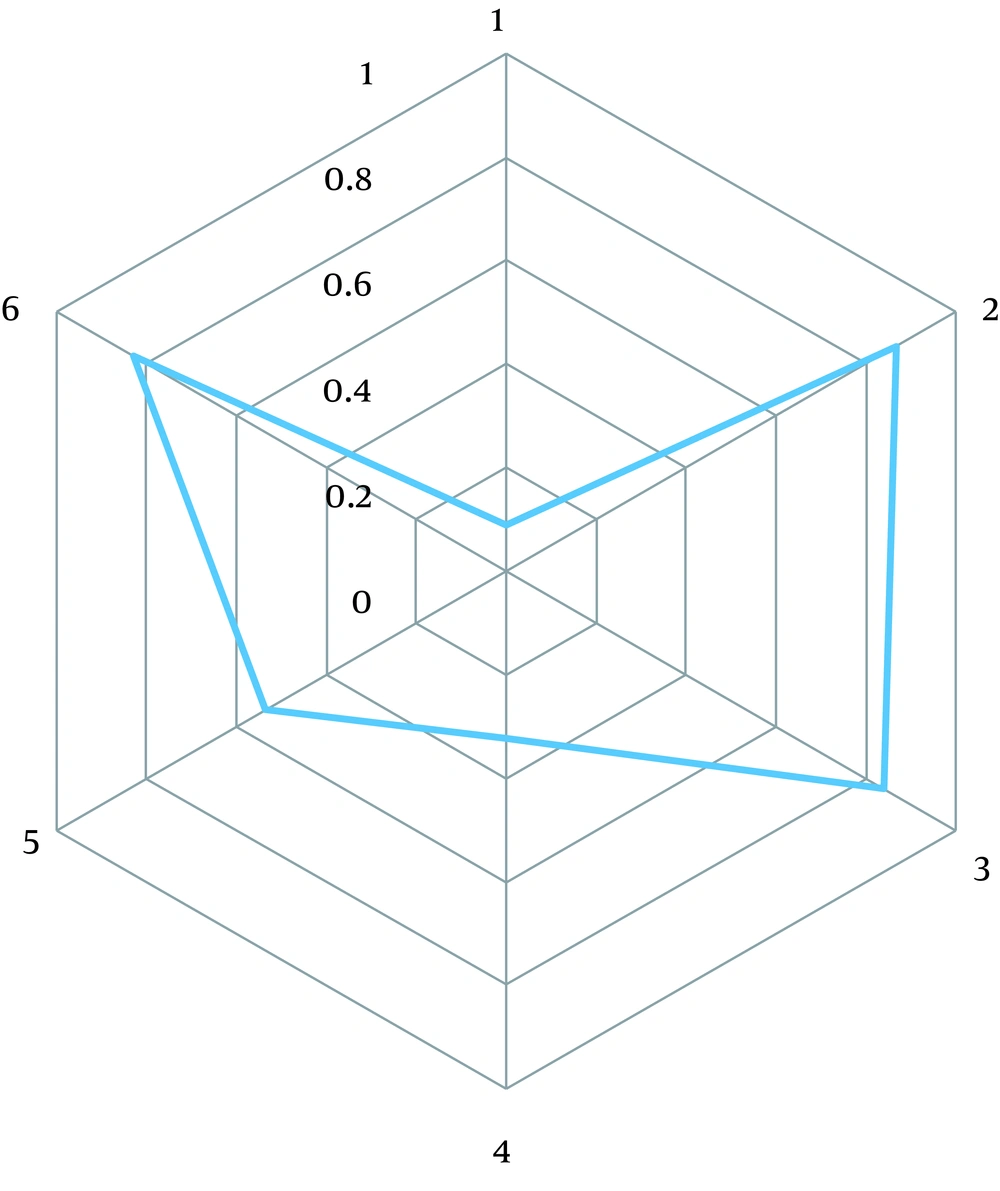
Figure 3.
Ranking waste disposal methods according to the expert group using TOPSIS method in rural areas
5. Discussion
This study aimed to investigate different options of hospital waste managers in Qazvin province to select the best method of waste disposal using the multi-criteria decision-making process. Since decision-making is challenging, assessing the alternatives of management methods of hospital wastes requires the consideration of multiple contradictory criteria according to the opinion of the expert group. The importance of forming a group to achieve a satisfactory decision is increasing day by day (22).
In this study, to prioritize the methods of waste disposal, 12 different criteria were obtained. The participants allocated the highest weight to the three criteria, including Air residuals and environmental impacts, Water residuals and environmental impacts, and the Treatment effectiveness, respectively, and the three criteria of costs, level of automation, and Public acceptance obstacles gained the least weigh. In the study by Rezapur et al. who prioritized waste disposal methods in Tehran hospitals, three criteria of the effectiveness of the action, Air residuals, environmental impacts, and barriers to public acceptance, gained the highest weights, and three criteria of costs, odor, and discharge had the least health effects (22).
The ranking of different methods of hospital waste disposal was reported based on the above criteria in different urban and rural areas. In urban areas, the best methods were irradiation, microwave, steam sterilization (autoclave), chemical disinfection, sanitary landfill, and ultimately, incineration, while in rural areas, they were steam sterilization (autoclave), microwave, irradiation, chemical disinfection, sanitary landfill, and eventually incineration.
Irradiation was chosen as the best method in urban areas. The irradiation method has the power of penetration into waste packages and containers. Fatal ultraviolet rays are also used as an additional method to destroy airborne microorganisms, along with other methods, except that there is no penetration power to waste packages (23). In rural areas, steam sterilization (autoclave) was selected as the best method. In a study by Dursun et al. (24) and Liu et al. (25), steam sterilization was selected as the most appropriate waste disposal method. The waste disposal method in rural areas in these studies confirms the findings of the present study. The autoclave method is one of the best disposal methods since it has the least impact on the environment and represents a commitment to public health.
The microwave method had second place in urban and rural areas. In a study by Hasan and Rahman (26), the microwave was described as the second method of waste disposal, which confirms the findings of the present study. Also, in a study conducted in Istanbul, the microwave had a second place (24). The microwave method is one of the most used methods to safely dispose of sanitary and medical waste, which reduces the volume of waste and is also suitable for unspecified waste materials. However, it requires a high initial investment and is not suitable for all waste materials. It should be noted that in Iran, the highest amount of healthcare waste produced in urban occurs in hospitals, which is not properly managed concerning the disposal of hazardous waste in these centers (27).
The effectiveness of incinerators as a waste disposal method has been reported with a different result. In this study, the waste incineration method had the last place in both urban and rural areas. The findings of this study are consistent with that of Asgarian Najafabadi and Ghassemzadeh, who prioritized waste disposal by the AHP method, in which waste incinerators had the last place (28). On the contrary, the results of studies show that waste incineration was selected as the best way of waste disposal in some countries (6). In a study that was conducted at hospitals in Shanghai, incineration had the last place in ranking (25). Although the waste incineration method has long been used as a standard method, due to the lack of methods for controlling air pollution at the outlet of chimneys and the possibility of contaminating the environment, the tendency toward the non-incineration methods and upgrading the methods of disposal can be effective in improving the management of hospital waste disposal, as shown also in this study (29). The results of this study showed that in the studied groups, the best methods for the disposal of waste in both urban and rural areas of Qazvin province were irradiation and steam sterilization, in sequence. For the health care waste disposal in Qazvin province, Autoclave, hydroclave, and chemiclave methods are now being used that products manufactured domestically or imported. In rural areas, methods such as sanitary landfills and incineration are also still being used. Finally, it is suggested that the necessary infrastructure for each of the selected methods in urban areas (irradiation) and rural areas (steam sterilization) be provided by health officials in the province to manage health waste disposal in a standard and safe manner. The strength of this study was to identify the best methods of health waste disposal in urban and rural areas based on the opinions of experts in this field. The limitation of this study was that only experts from this province were used to weigh the criteria and methods of waste disposal. It is suggested that national experts be used in future studies.
