


1. Background
The under-five mortality rate (U5MR) is one of the most important indicators of sustainable development. According to Iran’s Sixth Development Plan, the U5MR should reach 11.3 by 2021, with an annual reduction of about 1 per 1,000 live births. According to the 2019 report of the World Health Organization (WHO), the average global U5MR is 38.8 per 1,000 live births, ranging from 68 in underdeveloped countries to 5 in developed countries (1). Approximately 82% of mortalities in children under 5 years of age occur in two regions, namely 54% in sub-Saharan African countries and 28% in South Asia (e.g., Afghanistan, Nepal, Bangladesh, and India) (2).
In Iran, the U5MR is about 14 per 1,000 live births; however, there is still a long way to go to achieve the targets of the Sixth Development Plan (2). According to the information published by the WHO, the child mortality rate in Iran is good, compared to some of its neighbors in the Regional Office for the Eastern Mediterranean region, such as Afghanistan and Pakistan; nevertheless, it is not favorable when compared to other countries in the region, such as Bahrain and Kuwait (1).
Various studies have identified accidents and injuries as the main causes of mortality among children (1, 3, 4). Some studies have shown that accidents and injuries are the leading causes of mortality in children under 5 years of age globally. More than 95% of injuries in children occur in low- and middle-income countries. Globally, unintentional injuries are one of the main causes of child mortality, accounting for 30% of mortalities in children aged 1 - 3 years, 40% of mortalities in children aged 4 years, and 50 - 60% of mortalities in those aged 5 - 17 years (5).
Globally, an average of 186,300 children die every year due to traffic crashes, indicating a humanitarian loss of more than 500 children every day (6). Children in low-income countries have road traffic mortality rates nearly three times as high as those in high-income countries (7). In Iran, the 2018 report of the Child Mortality Surveillance System identifies accidents and injuries as the leading causes of mortality in children aged 1 - 59 months (19.72%) and the leading causes of death in rural areas (25.9%). According to the same report, the most common causes of accidents and unintentional injuries are traffic accidents (40.6%), drowning (14.3%), and foreign-body airway obstruction (13.1%) (2). In various studies, the most common causes of fatal accidents and injuries have been traffic, poisoning, drowning, burns, and violence (8-10).
In Ardabil province, Iran, in 2019, mortalities from accidents and unintentional injuries accounted for 20.1% of all mortalities. This rate has increased, compared to that of 2017 (16.5%), and is higher than the national average. However, traffic accidents are among the leading causes of child mortality, with no particular downward trend (2). With this background in mind, the present study used statistical process control to determine the specific and general causes of under-five mortality and the Haddon Matrix that can provide valuable results as a model to manage the prevention of all types of injuries and accidents. In addition, using the Haddon Matrix and accident analysis allows for designing appropriate interventions for injury prevention (11).
2. Objectives
This study aimed to investigate the factors affecting the mortality of children under 5 years of age due to traffic accidents in Ardabil province of Iran.
3. Methods
This descriptive-analytical study was conducted in Ardabil province. The target population consisted of all mortalities in children under 5 years of age that occurred due to traffic accidents in Ardabil within 2013 and 2021.
In Iran, healthcare providers (i.e., health houses, urban and rural comprehensive healthcare centers, and other healthcare facilities) collect child mortality data separately for urban and rural populations. Mortalities are recorded in the tables of vital statistics immediately after being reported. Within 15 days, the relevant questionnaires are completed to determine the cause of mortality using the information from the electronic household health record, a statement from the parents, and the child’s medical file at the hospital. Finally, the age group of the deceased and the cause of mortality are recorded in the tables of vital statistics (i.e., a large poster consisting of several tables of demographic information of the covered area, which is installed on a wall at the service provider at the beginning of the year, and the information is recorded in the relevant cells during the year). Child mortality data are sent to the city headquarters on a monthly basis, and the information collected there is sent to provincial headquarters every 6 months or annually.
The required data were collected from the standard questionnaires of the Child Health Department of Iran Ministry of Health and Medical Education, which have been completed by experts in child mortality (1 - 59 months) at the headquarters of healthcare networks and hospitals (12). The Child Injury Questionnaire has been designed by experts and specialists at various medical universities across the country and has been reviewed and standardized at the national level. This questionnaire includes the demographic information of parents and children, type of the accident, equipment/vehicle, place of death, cause of the accident, method of transfer, transfer time from the scene to a medical center, condition of the child at the time of the accident, place of the accident, training of the mother/caregiver about accidents, and training method.
In this study, the information obtained from the questionnaires was classified into three groups based on the Haddon Matrix and the cause of the accident, namely pre-injury, injury, and post-injury. This matrix was developed by William Haddon to assist in the prevention of various kinds of injuries. This matrix has 12 cells arranged in a table with four columns (i.e., host, equipment/vehicle, physical environment, and social environment) and three rows (i.e., pre-injury, injury, and post-injury). Using this table and accident analysis allows for designing appropriate interventions for injury prevention (11). The data were analyzed in SPSS software (version 24), and the coding of the matrix was done by the researcher.
Finally, p-charts were used in statistical process control to control the processes in a system and identify specific and general causes. Statistical process control is a systematic approach that uses statistical methods to identify and control production or service delivery processes. It is a set of powerful tools to improve and maintain process capability by reducing variations in the output. One of the features of p-charts is displaying allowed dispersion limits for observations. These limits are called the Upper Control Limit (UCL) and Lower Control Limit (LCL).
P-charts are used when the subgroups are not equal in size and calculate control limits based on the binomial distribution. For comparison, these limits should be converted into ratios, such as mortality rate. Mortality rates in different age groups are among the indicators prepared and analyzed every year at the university level. The following formulas are used in this regard:
where
This study was carried out based on the targets set by the Health Department of Ardabil University for child injury prevention. The present study was also approved by the Health Department and the Health System Research Committee of Ardabil University. All private information was kept confidential, and the data were analyzed for governmental and research purposes.
4. Results
The results showed that 64 children under 5 years of age died within 2013 and 2021 due to traffic accidents. The highest incidence of mortality was observed in the age group of 1 - 5 years (57.2%), followed by 1 month to 1 year (42.8%). Regarding gender distribution, 63% and 37% of the deceased children were male and female, respectively. In addition, 62.5% of the deceased children lived in rural areas. Regarding the educational level, parents mostly had primary and middle school education (56.2%).
The highest percentage of childhood mortalities occurred in passengers (54.5%), followed by pedestrians (28.1%). Only 31.5% of the deceased children were removed from the scene by a trained rescue team; nevertheless, 68.6% of the deceased children were transferred by their family and friends. Transfer time from the scene to medical centers was less than 30 minutes in 27.8% of the cases. Moreover, 74.1% of the parents received training on the prevention of accidents and injuries by health workers or healthcare workers.
Table 1.Some Variables in Child Mortality Due to Traffic Accidents in Ardabil Province, Iran, Within 2013 - 2021
| Variables | No. (%) |
|---|---|
| Condition of the child at the time of the accident | |
| Rear seat passenger in the mother’s arms | 16 (25) |
| Front seat passenger in the mother’s arms | 11 (27) |
| Pedestrian | 18 (28.1) |
| Tractor passenger | 7 (11) |
| Front/rear seat passenger without a companion | 7 (11.2) |
| Motorcycle passenger | 3 (4.6) |
| Passenger in the back of a truck | 1 (1.5) |
| Place of the accident | |
| Inner-city streets and passages | 6 (9.7) |
| Intercity roads | 24 (37.4) |
| Roads inside villages | 11 (17) |
| Rural roads | 10 (15) |
| Houses and farms | 9 (14) |
| Highways outside the city | 4 (7) |
| Equipment/vehicle | |
| Motorcycle | 10 (16) |
| Tractor | 11 (17.1) |
| Automobiles | 35 (54.5) |
| Truck and pickup | 9 (12.4) |
| Direct cause of the accident | |
| Pulling over due to the defect of the vehicle or the road or being pulled over for driving carelessly/speeding | 5 (7.2) |
| Falling out of a moving vehicle | 27 (42.2) |
| Collision with a wall or fixed object in front | 1 (1.5) |
| Collision with a moving vehicle | 12 (18.8) |
| Being run over | 12 (18.8) |
| Being run over by a car as it is leaving the parking lot | 2 (3.1) |
| Collision with a car moving backward | 5 (7.8) |
| Indirect cause of the accident | |
| Traffic violation by the driver | 28 (43.7) |
| Traffic violation by the other driver in a head-on collision | 8 (12.5) |
| Parental negligence | 26 (40.6) |
| Unsafe roads | 1 (2) |
| Vehicle defects | 1 (1.5) |
| Place of death | |
| Crash site | 46 (72.2) |
| Medical center | 12 (18.5) |
| En route to a medical center | 6 (9.3) |
Table 1 shows that regarding the condition of children at the time of the accident, 52% of the cases were in the front or back seat in their mother’s arms, 28.1% were pedestrians, 11% were tractor passengers, and 11.2% were in the front or back seat unaccompanied. Regarding the place of the accident, most accidents occurred on intercity roads (37.4%), followed by roads inside villages (17%) and rural roads (15%).
The most common vehicles were passenger cars (54.5%), followed by tractors (17.1%). Furthermore, 80% of passenger cars were Kia Pride, and 20% were Peugeot and Paykan brands. Table 1 also shows that the most common cause of accidents was falling out of a moving vehicle (42.2%), followed by an equal proportion of accidents due to collision with a moving vehicle and being run over (18.8%).
Traffic violations (43.7%) and parental negligence (40.6%) were the most common indirect causes of fatal accidents in children. Regarding the place of death, most mortalities occurred in the crash site (72.2%), in medical centers (18.5%), and en route to a medical center (9.3%).
Table 2.Relationship Between Parents’ Educational Level and Accident Variables
| Father’s Education, No. (%) | P-Value | Mother’s Education, No. (%) | P-Value | |||||||
|---|---|---|---|---|---|---|---|---|---|---|
| Illiterate | Elementaryand Intermediate | Diploma | Academic | Illiterate | Elementary and Intermediate | Diploma | Academic | |||
| Condition of the child at the time of the accident | 0.001 | 0.001 | ||||||||
| Rear seat passenger in the mother’s arms | 0 (0) | 12 (75) | 2 (12.5) | 2 (12.5) | 0 (0) | 12 (75) | 1 (6.2) | 3 (18.8) | ||
| Front seat passenger in the mother’s arms | 0 (0) | 3 (27.2) | 6 (54.5) | 2 (18.3) | 0 (0) | 3 (27.2) | 6 (54.5) | 2 (18.3) | ||
| Pedestrian | 0 (0) | 13 (72.2) | 2 (11.2) | 3 (16.6) | 1 (5.6) | 13 (72.2) | 0 | 4 (22.2) | ||
| Tractor passenger | 0 (0) | 3 (42.8) | 4 (57.2) | 0 (0) | 2 (28.5) | 3 (42.8) | 2 (28.5) | 0 (0) | ||
| Front/rear seat passenger without a companion | 0 (0) | 4 (57.2) | 1 (14.2) | 2 (28.5) | 1 (14.2) | 3 (42.8) | 1 (14.2) | 2 (28.5) | ||
| Motorcycle passenger | 1 (33.3) | 1 (33.3) | 0 (0) | 1 (33.3) | 2 (66.7) | 1 (33.3) | 0 (0) | 0 (0) | ||
| Passenger in the back of a truck | 2 (100) | 0 (0) | 0 (0) | 0 (0) | 0 (0) | 1 (50) | 1 (50) | 0 (0) | ||
| Type of vehicle causing the accident | < 0.05 | < 0.05 | ||||||||
| Motorcycle and Tractor | 1 (10) | 4 (45) | 4 (45) | 1 (10) | 4 (45) | 4 (45) | 2 (20) | 0 | ||
| Passenger | 1 (3) | 10 (29.5) | 15 (44) | 8 (23.5) | 1 (3) | 19 (55.8) | 9 (26.4) | 5 (14.7) | ||
| Pedestrian | 0 (0) | 12 (66.6) | 3 (16.7) | 3 (16.7) | 0 (0) | 16 (88.8) | 0 (0) | 2 (11.2) | ||
The chi-square test showed a statistically significant relationship between the variables of the father’s and mother’s educational level with the type of accident and condition of the child at the time of the accident (Table 2).
Table 3.Haddon Matrix of Traffic Accidents Leading to Mortality in Children Under 5 Years of Age in Ardabil Province, Iran
| Pre-Event | Event | Post-Event | ||||||||||||||||||
|---|---|---|---|---|---|---|---|---|---|---|---|---|---|---|---|---|---|---|---|---|
| Human | Equipment/Vehicle | Environment | Human | Equipment / Vehicle | Environment | Human | Equipment / Vehicle | Environment | ||||||||||||
| Under 1 year to 5 years | 1 month to 1 year | Untrained parents | Passenger cars with poor safety standards | Pedestrian | Unsafe vehicle | Father’s low level of education | Mother’s low level of education | Rural areas | Pedestrian | Front/rear seat passenger without a companion | Parental negligence | Traffic violation by the driver | Tractor and motorcycle passengers | Passenger cars with poor safety standards | Being run over | Falling out of a moving vehicle | Roads and rural places | Died at the time of the accident or in transit | The crash site by their family and friends | Time duration of transfer to a medical center |
| 37 cases | 27 cases | 18 cases | 33 cases | 13 cases | 12 cases | 27 cases | 34 cases | 40 cases | 18 cases | 35 cases | 26 cases | 28 cases | 11 cases | 33 cases | 12 cases | 27 cases | 29 cases | 51 cases | 44 cases | 15 cases |
According to Table 3, in the Pre-event phase and the human factors column, most injured children were in the age group of 1 - 5 years. Out of 64 fatal cases, 18 parents did not receive any injury prevention training. In terms of equipment/vehicle, most fatal cases involved passenger cars with poor safety standards (33 cases), followed by pedestrians (13 cases) and unsafe vehicles (12 cases). Most of the accidents occurred in rural areas (40 cases), and most parents had a low level of education.
As for human factors in the Event phase, the most common causes of accidents were being seated in the front or rear passenger seat either unaccompanied or accompanied (35 cases), parental negligence (26 cases), traffic violations (28 cases), pedestrians (18 cases), and tractor and motorcycle passengers (11 cases). In terms of equipment/vehicle, the obtained causes were related to vehicles with poor safety standards (33 cases), the child falling out of a moving vehicle (27 cases), and the child being run over (12 cases). Regarding the environment, most mortalities occurred on rural roads and passages (29 cases).
In the Post-event phase, 51 children died during the crash or while being transferred to medical centers due to the severity of their injuries. Regarding equipment/vehicle, 44 children were removed from the crash site by their family and friends. For 15 children, it took more than 30 minutes to reach the medical center.
Figure 1 shows that based on the Pre-event phase in the Haddon Matrix, environmental factors were the most influential factors in the occurrence of the crash (44.7%), followed by human factors (34.3%) and equipment/vehicle factors (24%). In the Event phase, the human factors had the greatest impact (62%), followed by equipment/vehicle factors (37.8%) and environmental factors (15.2%). Finally, in the Post-event phase, human factors had the greatest impact (46.8%); nonetheless, environmental factors had the least impact (14.5%) (Table 4).
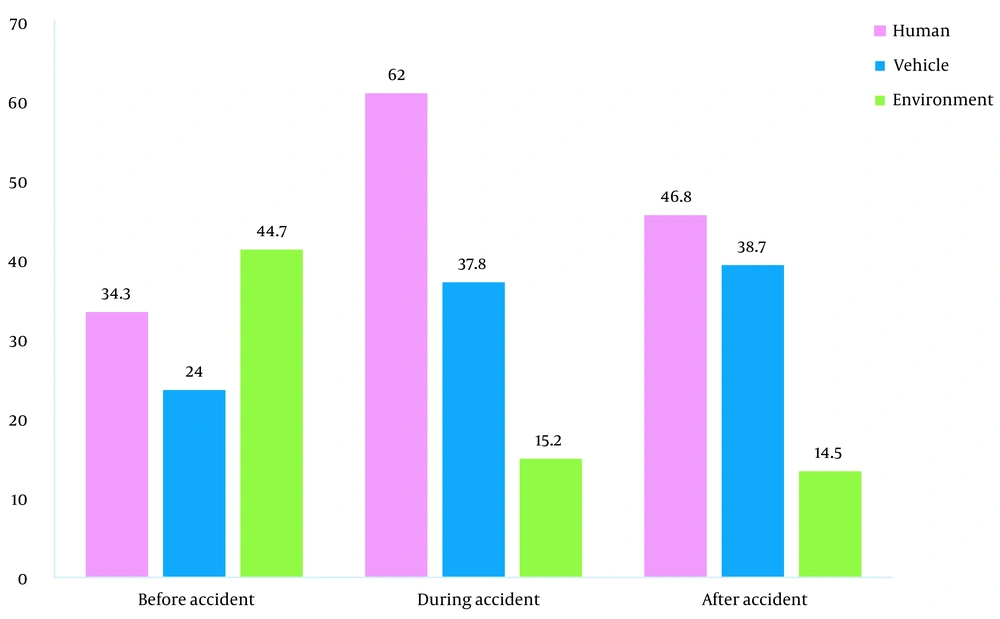
Figure 1.
Analysis of factors affecting the occurrence of accidents based on the Haddon model before the accident, during the accident, and after the accident
Table 4.Estimation of Children’s Mortality Probabilities
| Year | Ratio | Median | Upper Limit | Lower Limit |
|---|---|---|---|---|
| 2013 | 0.026865672 | 0.02649 | 0.053368 | 0.000363 |
| 2014 | 0.021538462 | 0.02649 | 0.045696 | -0.00262 |
| 2015 | 0.022222222 | 0.02649 | 0.047138 | -0.00269 |
| 2016 | 0.026946108 | 0.02649 | 0.053527 | 0.000366 |
| 2017 | 0.026490066 | 0.02649 | 0.054212 | -0.00123 |
| 2018 | 0.02000 | 0.02649 | 0.04425 | -0.00425 |
| 2019 | 0.02649 | 0.02649 | 0.05648 | -0.00350 |
| 2020 | 0.02169 | 0.02649 | 0.044249 | -0.00423 |
| 2021 | 0.02649 | 0.02649 | 0.044249 | -0.00425 |
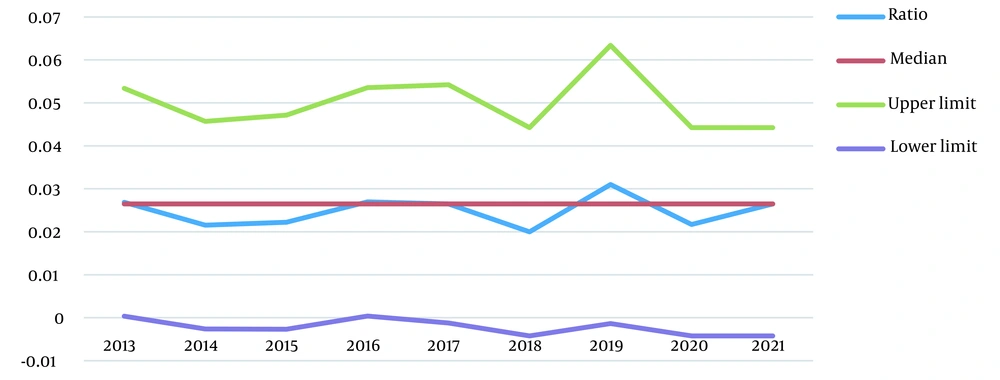
Figure 2.
Control diagram of mortality of children under 5 years of age in Ardabil University of Medical Sciences, Ardabil, Iran, due to traffic accidents in the last 9 years (2013 - 2021)
In this diagram, the horizontal axis is the year of data collection, and the vertical axis is the mortality proportion of children due to accidents. Since the number of child mortalities varies each year, the control limits are calculated separately for each year. The rate of child mortality due to accidents based on the P control chart (Figure 2) showed that the process of death prevention services due to traffic accidents of children is under control, and specific and acquired factors, such as the performance of healthcare providers, service delivery method, and support resources, do not influence it so much; however, general factors, such as driving culture whether from the opposite driver or the driver of the vehicle and the passenger, road safety, and vehicle safety, have caused not to obtain very favorable results from the current situation.
5. Discussion
In Ardabil province, traffic accidents are among the most common causes of accidents and unintentional injuries (40.6%), with no particular downward trend (2). Traffic accidents are among the leading causes of child morbidity and mortality (13). As observed in the Findings section, most mortalities from traffic accidents occurred in the age group of 1 - 5 years (57.2%%). Although traffic accidents are the leading cause of infant mortalities in Iran and the second cause of mortality in the United States (14), this is not the case in Ardabil, as accidents are less frequent in infants than in the age group of 1 - 5 years. This finding is consistent with the findings of studies by Mobasheri et al., Avon Longitudinal Study of Parents and Children (ALSPAC), and Shahid Beheshti University, Iran, which showed that road traffic accidents are not common in the age group under 1 year (8, 15).
The risk of traffic accidents increases with age. In children under 5 years of age, parents play a crucial role in reducing risks (16). As for gender, studies conducted in Iran (8, 17) and other countries (10, 16, 18, 19) indicate a higher incidence of accidents and mortalities in boys than girls, which supports the findings of the present study. This finding can be mainly attributed to high-risk behaviors and higher exposure to environmental hazards in boys than in girls.
Despite the low ratio of rural to urban population in Ardabil province, a large proportion of mortalities are reported in villages. Some other studies have also reported more mortalities due to accidents in villages than in cities (8, 10, 16, 17, 20); however, other studies claim that the prevalence of accidents in urban areas is higher (21, 22). Several factors, such as lack of medical facilities, unsafe environments for children, unsafe roads, high-risk behaviors, and parental negligence, play a role in these mortalities. Therefore, preventive measures are necessary to reduce child mortality in villages (8, 10).
In the present study, more than 70% of parents had a low level of education (i.e., high school diploma or lower). Other studies in South Korea (23) and Shahid Beheshti University of Medical Sciences (8) confirm this finding. In studies by Hosseinzadeh et al., He et al., and Mathur et al., parental education, age, child gender, and rural location are factors contributing to the incidence rate of accidents in children (22, 24, 25).
The results of the chi-square test indicated a significant relationship between the parental educational level with the type of accident and the condition of the child at the time of the accident. Similarly, Yar-Ahmadi showed that the educational level of parents has a significant effect on reducing child mortality (26). Studies conducted by Soori and Tabibi demonstrated significant differences in the mother’s education between children who had a traffic accident and those who did not (27, 28).
In the present study, most mortalities due to traffic accidents occurred during the accident (72.2%); nevertheless, in an epidemiological study of fatal accidents in children under 5 years of age in Hunan province, China, most mortalities occurred in transit (16). This difference might indicate the severity of the injury at the time of the accident, which could be due to the unsafe condition of the vehicles or roads, the failure to observe the necessary safety precautions inside the car, and other traffic violations. In the present study, traffic violations accounted for a high share of the cause of accidents (42%). Similarly, Tabibi showed that the leading cause of mortality among Iranian children under 14 years is traffic accidents, while also reporting a higher severity of injury and percentage of death in children under 10 years, which indicates the vulnerability of this age group in traffic accidents. This pattern is similar to the pattern of accidents in children under 15 years in England (28).
In this study, the highest percentage of child mortality occurred in passengers (54.5%), followed by pedestrians (28.1%). In contrast, a similar study in India reported the highest percentage of mortality in pedestrians (47.5%), and this was also reported in the US (75%), the UK (52.9%), and Pakistan (57%) (10). In the present study, a passenger is a child that is accompanied by the father, the mother or both; however, fatal accidents occurred due to the fact that the necessary safety precautions were not observed, and in almost all cases, a child safety seat, seat belt, or other safety devices were not used. This is also highlighted by the finding that 17.1% of the children were riding a tractor, which is certainly a very inappropriate means of transportation for children, and 50% of the vehicles were passenger cars, about 80% of which were Kia Pride. As for the cause of the accident, 42.2% of children fell out of a moving vehicle.
In 2008, the WHO estimated that road traffic injuries were the leading cause of fatal injuries in children and a leading cause of traumatic head and extremity injuries with consequent long-term disability throughout the WHO European Region (29). The Sustainable Development Goals adopted by the United Nations in 2015 included two specific targets related to road safety, which confirms safety as an essential element of the health and development agenda (30).
In developed countries, such as the UK, the law requires children below 135 cm in height or under 12 years of age to use the correct child car seat (31). According to the laws of Australia and New Zealand, children up to the age of 7 should be placed in a car child seat appropriate for their age and weight (32). In all states in the US, the use of child safety seats is the law; however, there are differences between states regarding the age at which wearing seat belts is allowed, varying within the age of 4 - 17 years.
PrevInfad has recently updated its recommendation (April 2019) and provided a comprehensive document summarizing the existing evidence around measures to prevent traffic injuries in children. The PrevInfad Group recommends that primary care professionals offer counseling on the use of child restraint systems and helmets on bicycles and motorbikes in well-child visits and other favorable situations, such as care in case of traffic injury of any seriousness (33).
In the present study, the most common cause of accidents after driver’s traffic violations is parental negligence (40.6%). In a survey of parents’ knowledge of child safety, Khademi et al. demonstrated that 27.6%, 7%, and 36.5% of the parents always, often, and sometimes used child safety seats in cars, respectively. Moreover, 71% of parents had a negative attitude toward using these safety measures (34).
In their study of child transportation safety, Garces et al. showed that in 70.5% of cases, the transportation of children was inappropriate, which was mostly due to not understanding the importance of child restraint systems (64%), lack of purchasing power (14.5%), and lack of awareness (5%) (13). In the present study, 74.1% of parents were trained on how to prevent accidents and injuries; nevertheless, the training did not have a significant impact on individuals’ behavior or did not focus seriously on traffic accidents and injuries. Training is also necessary for drivers. Families can play a role in preventing children’s accidents in two ways, namely through proper care and supervision and by teaching children safety rules and principles. Institutionalizing both ways requires planning.
The present study showed that the most common way of educating parents is through health workers in the villages and healthcare workers in the city; nonetheless, according to Tabibi, parents mentioned radio, television, and publications as the most important sources of information on child safety and injury prevention. However, similar to the findings of the present study, Shokohi, as cited in Tabibi, found in interviews with rural families who had an accident that they considered health workers to be an important source of child safety education for parents (28).
Based on the Haddon Matrix analysis, the results of the present study showed that in the Pre-event phase, environmental factors and equipment/vehicle factors had the greatest (44.7%) and least (24%) impacts, respectively. In the Event phase, human factors and environmental factors had the greatest (62%) and least (15.2%) impacts, respectively. In the Post-event phase, human factors and environmental factors had the greatest (46.8%) and least (14.5%) impacts, respectively. The types of factors that are effective in the occurrence of an accident include traumatic factors and vulnerable factors, and by another definition, they include the root cause and influential factors. In other words, in accident management, these factors are defined as direct and indirect factors, with indirect factors further classified into contextual factors and intermediate factors.
In this study, the environmental factors in the Pre-event phase were living in rural areas and having less educated parents. Rural areas are characterized by the lack of safety systems on roads, such as signs, lights, and guardrails, dangerous routes, and low education/literacy levels. For the control and management of these factors, public organizations, such as the electricity company, district administrations, village administrations, and the Ministry of Agriculture, should play a more active role.
Human factors in the Event phase included tractor and motorcycle passengers, the front or rear seat passenger unaccompanied or accompanied, parental negligence, and driver and pedestrian traffic violations. Human factors mean that a child is completely at risk and vulnerable when sitting in motor vehicles and agricultural machinery (without seat belts or other safety measures, such as child seats) or crossing and playing on rural roads.
A study by Arkan in Turkey also reports that although the use of seatbelts by drivers and front seat passengers has increased over the years, seatbelt use by rear passengers is still too uncommon. Likewise, the rate of use of child seats is also low (35). In order to control these factors, it is important to provide continuous training for villagers regarding the rational and safe use of agricultural machinery, motorcycles, and even passenger cars. It is necessary for relevant organizations, such as health centers, the media, and the ministry of agriculture, to carry out continuous and effective educational programs. According to this model, dangerous behaviors of drivers as the intermediary between the vehicle and the victim are also very important. In addition, police surveillance controls are crucial in rural areas.
Human factors in the post-injury phase include death during the accident or in transit due to the severity of injuries. Most of the children died at the crash site due to the severity of the injury and individuals’ inability to provide correct and timely first aid. Regarding the individuals who died in transit, it is noteworthy that it took more than 30 minutes to transfer the injured children to the first emergency center, which is due to various reasons, such as long distance, hesitancy, the child being trapped in the damaged car, or untrained first responders.
According to the p-chart, the ratio of child mortality due to traffic accidents shows that the process of child mortality prevention is under control and is not significantly affected by specific acquired factors, such as the performance of healthcare providers, service delivery methods, and support resources. However, the impact of general factors, such as driving culture, road safety, and vehicle safety, have caused not to obtain very favorable results from the current situation.
It is necessary for the health system to improve the quality of interventions and health programs at all levels, including the input, process, and output of child safety and injury prevention programs. This issue first requires education and supervision and then a new strategy and reengineering to reduce mortality caused by traffic accidents.
5.1. Conclusions
Traffic accidents are among the leading causes of unintentional injuries in Iran (38.3%), and in the pre-injury phase, environmental factors have a major impact on the occurrence of these accidents. These factors can be prevented by creating safe environments for children, building suitable roads, and raising awareness not only by health professionals but also through mass media. In the injury phase, human factors have the greatest impact and can be improved through continuous training regarding the rational and safe use of agricultural machinery and motor vehicles. It is necessary to enforce strict driving rules and regulations and provide monitoring and control to limit dangerous driving behaviors. Another factor in child mortality due to traffic accidents is aid and relief by the first responder. In this regard, it is necessary to reduce the time the rescue team takes to arrive at the scene, facilitate access to emergency centers, and provide individuals with first-aid training. Finally, it should be noted that all these mortalities can be prevented by developing safe streets and roads, ensuring child safety in cars, and training to enhance safety-related knowledge and skills.
5.2. Limitations
This study provides full coverage of death records for the age group of interest using the demographic data from Ardabil University of Medical Sciences, which led to reliable analyses. However, incomplete records about certain variables, such as living conditions and the inability to complete missing information from other sources, are the main limitations of the present study, which prevented the investigation of the effect of some variables, such as socioeconomic status and culture.
5.3. Implications for Research and Practice
The Ministry of Health and Medical Education should review the records of child mortality due to traffic accidents and prepare more comprehensive questionnaires completed by crash experts and other professionals. In addition, future researchers are advised to investigate the impact of interventions implemented after the period covered in the present study and measure child mortality factors and results in a more detailed manner. Furthermore, the costs imposed on the health system as a result of traffic accidents and the economic burden of child mortality can be explored in future studies.

