1. Context
Health is closely related to multilateral progress and development, including economic growth and development, because a healthy society is more energetic and motivated. On the other hand, direct and indirect costs decrease national income, growth, and development (1). Emphasizing the positive concept of health, the World Health Organization, in the Ottawa Health Promotion Charter, has announced that people seek to maintain and improve their health in their daily lives and in their surroundings. Therefore, the environmental approach will create healthy environments such as health-promoting cities, health-promoting hospitals, health-promoting playground environments, health-promoting work environments, and health-promoting schools (2, 3). School is one of the most important centers where people spend their childhood and adolescence, and any planning during this period in various fields, such as health, will affect their adulthood.
A person’s health during school age is affected by many individual, interpersonal, and environmental factors such as interaction with other students, school staff, quantitative and qualitative school conditions, health and nutrition laws and services, and education received, which are effective in shaping students’ lifestyles (4). School health refers to a set of measures to diagnose, provide, and promote the physical, mental, social, and spiritual health of students and those staff who are in some way in contact with students (5). Schools are institutions whose health promotion requires a holistic approach in three areas of learning in the classroom, the general atmosphere of the school, and the close relationship between home, school, and society, and have educational functions. Therefore, it is very important to maintain all aspects of people’s health in schools (6).
Health guardians have paid special attention to maintaining and improving the health of children and adolescents in schools, the future-building group of society. Various associations, such as the American School Health Association, were formed in 1927 with the presence of doctors to provide school health, and they have had some roles in school health policies in the world as scientific institutions (7). Following the expansion of school health promotion concepts in Europe, the European School Health Development Network was formed in 1980 (8). In Australia, the Australian School Health Development Association has been active since 1994 (7). Considering the growth of the adolescent population in developing countries, their health has received less attention in comparison with other age groups (9). In addition, risky behaviors such as improper nutrition and inactivity, physical injuries, smoking, drug and alcohol abuse, violence, risky sexual behaviors, the spread of AIDS, underweighting, and metabolic syndrome are among the most important public health issues. On the other hand, chronic and non-contagious diseases, with 35 million deaths out of 58 million deaths in adults in 2005, are one of the major causes of death and disability worldwide, especially in developing countries. Most of these deaths can be prevented by improving healthy behaviors from adolescence, which requires the provision of school health promotion policies and programs (10).
Investing in children’s and adolescents’ health and using effective preventive policies can bring significant economic and social benefits for this demographic group and global health (10). The ultimate goal of school health is to develop and generalize the health of students and their special educational and cultural environments to provide, maintain, and improve their intellectual, physical, psychological, emotional, and social health and those of society. Health promotion planners can find ideas for determining national priorities and guidelines and design programs to encourage schools to actively think about and promote health. Therefore, policies, laws, and guidelines should be set to strengthen healthy behaviors. Policy-makers in health and education are also trying to develop comprehensive and pervasive policies and methods to improve school health. Achieving this important issue requires determining the policies, assignments, and strategies for creating and continuing the synergy of related institutions through individual and collective thinking (11).
The review of existing studies shows that school health policies have not yet been comprehensively reviewed, and most studies have quantitatively examined the effect of using programs implemented in schools. These studies have emphasized school health promotion programs more than the policies themselves (12-15). Therefore, according to the mentioned points and the role of children and teenagers as future actors, reviewing existing policies can effectively identify the most important aspects of students’ health in schools and promote physical, mental, social, and spiritual health (16). Therefore, this study aims to review the scope of school health policies worldwide and identify the most important aspects of school health.
2. Evidence Acquisition
This scoping review was conducted in 2022 based on the PRISMA extension for Scoping Reviews (PRISMA-ScR) (17).
2.1. Eligibility Criteria
We selected medical sciences databases, including PubMed, because of having related articles about health, such as school health. We also searched citation databases such as Web of Science and Scopus because of indexing medical sciences documents and accessing more related records by the cited or citing documents’ links. Another valuable full-text database was ProQuest, for providing different documents, including grey literature. Finally, Google Scholar was searched to retrieve more related documents that may not be indexed in other searched databases. Also, these databases covered English scientific records before 2000.
2.2. Information Sources
Concerning the purpose of the research, which was a review of the dimensions of school health policies, the PubMed, Scopus, Web of Science, ProQuest, and Google Scholar databases were searched from 2000 to March 2022 for English documents without limitation regarding the place of studies. The most important search terms included school health policies and programs, along with their synonyms in Medical Subject Headings (MeSH). An example of a search strategy in PubMed is as follows:
(“Primary school”[tiab] OR “secondary school”[tiab] OR “primary student”[tiab] OR “secondary student”[tiab] OR adolescent [tiab] OR adolescence [tiab] OR teen [tiab] OR youth [tiab] OR child[tiab] OR children[tiab] OR “high school”[tiab] OR “middle school”[tiab] OR “elementary school”[tiab] OR “elementary student”[tiab]) AND (“Health polic*”[tiab] OR “school health polic*”[tiab] OR “health program”[tiab] OR “health plan”[tiab] OR “health regulation”[tiab]) AND 2000:2022 [dp].
This strategy has been defined and used for other databases based on the characteristics of each database. The search strategy of other databases is presented in Appendix 1. These searches were done based on consultation with a medical library and information science specialist.
2.3. Selection of Sources of Evidence
The related studies reference list was also reviewed to identify more relevant articles. Inclusion criteria included research and review articles and gray literature related to school health policies and programs in different countries, articles published in English, and access to the full texts, with a time limit of 2000 to 2022. Case studies, letters, letters to the editor, editorial articles, comments, and conference articles were excluded from the study. The abstract of all identified records was entered into EndNote x8. After removing duplicates, the titles and abstracts of all articles were screened, and those related to school health policies and programs were identified. This step was repeated by two reviewers independently, and disputed cases were resolved by consulting with a third person. Finally, the full text of the related studies was studied by two reviewers independently, and disagreements in including the full texts were resolved by consulting with a third person. The researchers prepared a data extraction form in MS Word 2016 and recorded the bibliographic characteristics of each record, including the first author, the year of the study, the country, the study method, and the aspects of school health policies and programs.
2.4. Critical Appraisal of Individual Sources of Evidence
We used JBI (Joanna Briggs Institute) checklists for assessing the quality of cross-sectional research (eight items) (18), qualitative studies (10 items) (19), and opinion articles (six items) (20). The SANRA (six items with a total of 12 scores) (21) and MMAT (six items) (22) scales were used for the quality assessment of literature reviews and mixed-methods studies, respectively. Studies with a score of above 85%, 85%-75%, 75% - 55, and below 55, respectively, were categorized as “excellent quality,” “very good,” “good,” and “poor quality. Qualification of the evidence was conducted independently by two reviewers. In the case of disagreement, the third reviewer reviewed the article.
2.5. Synthesis of Results
In order to analyze the data, qualitative and thematic content analysis methods were used based on Braun and Clark’s model (19). The procedures included learning the data, creating primary codes, searching for semantic units in the text, reviewing semantic units, defining and naming semantic units, and reporting. Therefore, the aspects of school health policy were determined as the main category, the subcategories related to each aspect were identified from the reviewed studies, and the overlapping cases were integrated. The data were synthesized in MS Word 2016.
3. Results
Figure 1 shows the process of selecting studies.
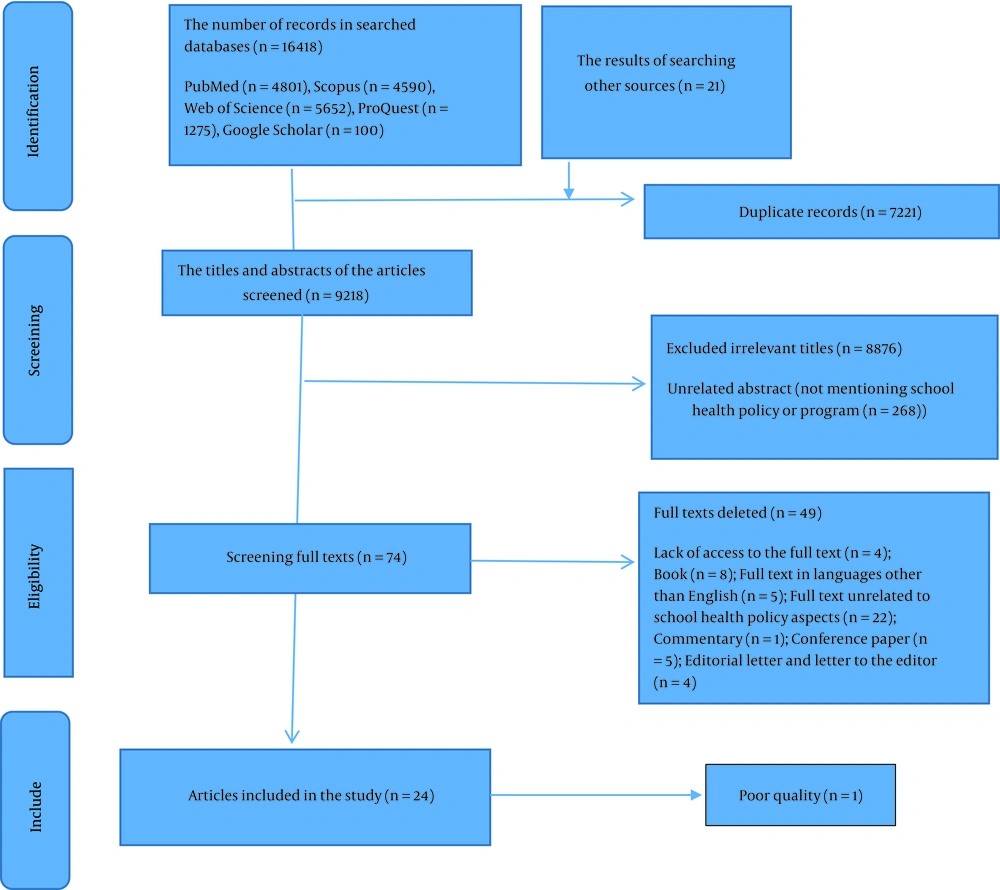
Figure 1.
Study selection process
3.1. Selection of Sources of Evidence
During this search, 16,439 records were identified, of which 7,221 were duplicates. Also, 9,218 titles and abstracts were screened according to the inclusion criteria. The most important reason for excluding studies in the title and abstract screening stage was survey studies investigating the effects of school health programs on the performance of students and school staff. Finally, among 74 full texts, 24 records were included in this study.
3.2. Characteristics of Sources of Evidence
Table 1 shows the characteristics of the included studies and the most important aspects of school health policies and programs.
Table 1.
Characteristics of Included Studies
| First Author (Y) | Country | The Aim of The Study | Study Method | Comprehensive School Health Policy or Program | Quality Assessment | Main Dimensions of Health School |
|---|---|---|---|---|---|---|
| Illuzzi (2000) | United States of America | Coordinated school health programs as an approach to dealing with adolescent obesity | Literature review | Coordinated school health program | 10 (83%) | This program includes eight components of school health services, a healthy school environment, comprehensive school health education, counseling and guidance, physical education, food services, health promotion in the workplace, and cooperation between school and community (23). |
| American Nutrition Association (2003) | United States of America | Analysis of school nutrition policies and their application | Report | Coordinated comprehensive school health program (Coordinated, comprehensive nutrition policy) | 8 (67%) | Providing and promoting healthy school meals, providing free and low-cost access to breakfast, lunch, and snacks for qualified students, making nutritious foods available in the cafeteria, meeting nutritional needs of students with special health care needs; and providing enough time for the nutrition education, preventing the sale of competitive and unhealthy foods, nutrition education programs from preschool to twelfth grade, suitable and pleasant environment for serving food, enough space and time for serving food, preparing local fruits and vegetables, access to meals at school with minimal waiting time, participation of social guardians in nutrition health programs of schools, participation of parents and students in determining meals, preparing school nutrition guidelines, mutual education of physical activity-healthy nutrition, team nutrition, garden-based learning, promoting healthy food posters and messages in the school restaurant, paying attention to the style of eating vegetables, branding school food (24). |
| Deschesnes (2003) | Canada | Comprehensive school health promotion approaches and their implementation on a wider level | Literature review | Health-promoting schools program and comprehensive school health programs | 10 (83%) | The comprehensive school health program includes eight important components of continuous and planned school health education in the student’s curriculum, school health services, healthy school environment, physical activity at school, food services, counseling services, health promotion among school staff, and cooperation between school and society. The concept of health-promoting schools also includes three curriculum components based on increasing students’ knowledge and skills in improving their physical, mental, and social health, a healthy school environment, and cooperation between school and community (25). |
| Beyers (2005) | United States of America | Comparing the application of school drug policy between Washington, Victoria, Australia, and the United States | Comparative study (qualitative) | School drug policy | 5 (62%) | According to this policy, students’ access to and use of drugs is limited by affecting their normative beliefs, checking the school environment and halls, and students’ bags and drawers for drugs. The role of media and parents is also significant (26). |
| Way (2006) | Nigeria | National school health policy | Report | National school health policy | 8 (67%) | Key components of this policy include a healthy school environment, school nutrition services, school-based health education, school health services, and school-home-community relationships (27). |
| Adegbenro (2007) | Nigeria | Evaluating the impact of school health policy on providing a safe environment for elementary school students | Cross-sectional study | School health policy in the school environment | 5 (62%) | The physical environment of the school should have suitable ventilation, light, clean classrooms, playground, and green space, and be free from dangerous and sharp tools; providing health services, drinking water, waste and garbage disposal, and precautionary safety measures, including fencing for safety and accident prevention, firefighting maneuver, public safety, defense against disasters (28). |
| Frank (2007) | United States of America | Presenting lessons learned from the three programs: CATCH, planet health, not on Tobacco | Literature review | Coordinated approach to child health (CATCH) programs, planet health, not on Tobacco | 10 (83%) | The important features of these programs include identifying the staff and resources needed to implement and disseminate these programs, participation of stakeholders (including teachers, students, school personnel, parents, non-profit organizations, and professional organizations) in all stages of program development and publication, planning for program publication at the very beginning of development and process evaluation, and evaluation of interventions to determine their effectiveness (29). |
| Bharath (2008) | India | Presentation of life skills training model to teenagers in schools | Qualitative | Life skills training program | 6 (60%) | This model emphasized the aspects of physical, mental, and social health of adolescents in school. Therefore, this comprehensive health model of adolescents aimed to affect life skills as a mediator of health promotion by emphasizing physical activities and teachers as facilitators (30). |
| Collins (2008) | United States of America | Review of school health policy in North Carolina | Literature review | North Carolina school health policy | 8 (67%) | The coordinated school health model in North Carolina includes eight components of comprehensive school health education, physical education, school nutrition services, school health services, healthy school environment, counseling, social and psychological services, promoting the health of the working environment of school staff, and cooperation of family and community in the school (31). |
| De Silva (2009) | Sri Lanka | Strengthening primary health care and promoting health in Sri Lanka schools and the need for a comprehensive national policy | Literature review | School health policy | 9 (75%) | The key components of this program are the provision of school medical services, a healthy school environment, health education, and life skills development, participation in school and community, and health promotion (32). |
| Avison (2010) | Canada | Investigating the role of stakeholders in school health policymaking | Literature review | School health policy | 11 (91%) | The role of stakeholders in health policy-making, from policy needs assessment to policy preparation and implementation, requires cooperation and coordination between stakeholders, including school staff, students, parents, healthcare providers, health professionals, non-profit sectors and industries, non-governmental organizations and industries, media, and marketing. In this regard, the participation of school staff in school health policies can be achieved through holding meetings to determine the methods of improving the health of students, such as choosing healthy foods, exercising yoga during lunch, exercising after lunch, diabetes awareness week, courage education and health promotion through drama, increasing physical activity of students through providing resources and allocating enough time to participation (33). |
| Briggs (2010) | United States of America | Analysis of school nutrition policies and their application | Report | Local health policy | 8 (67%) | Encouraging students to consume grains and low-fat foods, integrating nutrition services into school activities such as the classroom, choosing healthy foods in the community and at home, allocating enough time to nutrition education to students, training including preparation of healthy foods based on the garden training program and cooking skills, enough time to serve food, increasing consumption of fruits and vegetables, snack program after school hours, school breakfast program, summer programs, canned foods, and low-salt and low-sugar vegetables and fruits, new kitchen tools for schools, school nutrition branding, school-home-community cooperation, providing school care services, health teams, and sharing experiences, the role of nutritionists in providing food security and readiness in disasters and pandemics were considered in this policy (34). |
| Adelman (2014) | United States of America | Embedding School Health into School Improvement Policy | Literature review | School health policy | 9 (75%) | The school policy framework includes educational development, empowerment, and management. The sub-components of this framework include health development and prevention of problems through universal and low-cost interventions, primary interventions with moderate cost and need, and chronic disease intervention that requires high cost (35). |
| Wasonga (2014) | Kenya | Implementation of the comprehensive school health policy pilot program in Kenya | Qualitative study (interview, focused group, field observations) | Comprehensive school health policy | 6 (60%) | This policy includes eight key components: Values and life skills, gender problems, maintaining children’s rights and responsibility, clean water and sanitation, nutrition, disease prevention and control, special needs, disabilities and rehabilitation, and school and infrastructure security (36). |
| Carson (2014) | United States of America | Conceptual framework for physical activity promotion in schools | Literature review | Physical activity promotion program | 8 (67%) | The key components of this framework included physical education, physical activity before and after school, family and community cooperation, physical activity at school, and school staff cooperation (37). |
| Bogie (2017) | Kenya | Horizontal school health programs in rural areas in Kenya | Mixed methods | Health initiation program | 5 (83%) | The health initiation program was prepared in three parts: School health policy, provision of health and clean water, skill-based health education, strategies to fight malaria, effective hand washing methods, helminth infection, and reduction of nutrient deficiency. The topics of this program included life skills and values, gender, protection of children’s rights, health and clean water, nutrition, disease prevention and control, special needs, disability, rehabilitation, environment security, and school infrastructure (38). |
| Chandra-Mouli (2018) | India | Determining factors affecting the continuous application of adolescent education programs in schools | Qualitative (literature review and interview) | Adolescent Education Programs in School | 6 (60%) | This program is based on the AIDS coping skills training program based on 13 life skills programs and topics related to the prevention of violence, teenage pregnancy, marriage and accepting the role of parents, sexual and gender violence, peer pressure, sexually transmitted infections, sex, AIDS, drug abuse, and finally, moving toward success (39). |
| Souza (2018) | Brazil | Presenting school health model in Amazon | Qualitative literature review and expert panel) | School health program | 6 (60%) | Providing healthy food and physical activity programs and strengthening eating habits and useful activities for students were presented in this program (40). |
| Adelman (2014) | United States of America | Embedding School Health into School Improvement Policy | Literature review | School health policy | 9 (75%) | The school policy framework includes educational development, empowerment, and management. The sub-components of this framework include health development and prevention of problems through universal and low-cost interventions, primary interventions with moderate cost and need, and chronic disease intervention that requires high cost (35). |
| Baysal (2018) | Turkey | A review of recent developments in the provision of school health services in Turkey | Literature review | School health programs in Turkey | 8 (67%) | Turkey’s school health program is based on the four aspects of student health, school staff health, health education, and school environment, which is based on the Health Promoting Schools Project, which was presented by the World Health Organization and the European Assembly and Committee in 40 countries in Europe and it aims to improve the psychological and social environment of schools and the health status of students (41). |
| Franke (2020) | United States of America | Policy support for school mental health in South Carolina | Literature review | Mental health of schools program | 9 (75%) | Providing mental health in schools through the establishment of clinics and inter-departmental collaborations, financial resources, telemedicine, equal access, and evidence-based mental health education and interventions in schools (42). |
| Ojo (2020) | Nigeria | School health policy implementation in emerging health challenges in Nigeria | Literature review | School health policy | 8 (67%) | The national health policy in Nigerian schools includes providing solutions with the cooperation of various organizations to improve adolescents’ quality of life and health. School health programs in this country are based on a healthy school environment, school nutrition services, skill-based health education, school health services, and school relationship with home and society (43). |
| Oyapero (2020) | United States of America | Presentation of oral health policy document for mandatory pre-registration screening in primary and secondary schools | Report | Oral health policy | 8 (67%) | This policy emphasizes improving children’s oral health through a fluoride program, healthy nutrition, no smoking, and a stress-free environment. School dental services include tooth extraction, scaling, polishing, and filling. In other cases, these children are referred to the nearest medical centers. Cleft palate surgery is another government service (44). |
| Badran (2021) | Qatar | Providing guidelines for student health management during the COVID-19 pandemic | Mixed methods | Evidence-based school health policy during the COVID-19 pandemic | 5 (83%) | It is necessary to find solutions such as a mechanism to communicate with students with symptoms, infection control methods such as checking symptoms and temperature in the morning, adequate social distancing in classes and performing physical activities, providing hand hygiene facilities during activity hours, holding classes at different times, preventing the connection between classes, using methods to prevent contamination of school staff, informing parents about keeping students with symptoms at home, environmental control on surface pollution and sewage (45). |
| Shuro (2021) | South Africa | Integrated school health policy revised for drug abuse | Presentation of perspective and policy (qualitative) | Integrated School Health Policy | 5 (83%) | Its content includes health education and promotion, student evaluation and screening, school health package (basic, middle, and main phase), providing services in school, follow-up and referral, coordination, participation, community and learner participation, and satisfaction. Drug use is a subset of mental health and health education and promotion (46). |
This review of school health policies worldwide included 25 studies published between 2000 and 2021. Most of these studies were conducted in 2014, 2018, and 2020; three were conducted in 2021. Eleven studies employed the literature review method, nine were conducted in the United States of America, and 18 focused on presenting a comprehensive school health policy in all dimensions. Other studies included three policy frameworks, four reports, three comparative studies, two mixed-methods studies, and three qualitative studies. Specific policies included two policies regarding school nutrition, one policy regarding students’ physical activity, one policy regarding students’ mental health, one policy regarding oral hygiene in schools, one policy regarding school environment hygiene, and one policy related to dealing with drug and tobacco use in schools. Following the United States of America, Nigeria (five studies), Canada (two studies), India (two studies), and Kenya (two studies) had the highest number of studies. Qatar, Turkey, Sri Lanka, Brazil, and South Africa had only one study in this field.
3.3. Critical Appraisal of Evidence
In total, 25 studies were identified, including four reports, two cross-sectional studies, two mixed methods studies, five qualitative studies, one opinion article, and 11 literature reviews. The quality assessment of these studies showed that they had “excellent quality” (one study), “very good quality” (nine studies), and “good quality” (14 studies). One study had “poor quality” and was removed from the review process. Finally, 24 studies were included in the review.
3.4. Synthesized Results
Table 2 shows that school health has eight subcategories and 117 dimensions.
Table 2.
Dimensions of School Health Policy
| Main Category | Primary Category |
|---|---|
| School health policy | |
| Nutrition | Providing and promoting healthy nutrition, free and affordable access to breakfast, lunch, and snacks for qualified students; making nutritious foods available in the cafeteria; meeting the nutritional needs of students based on their health needs; teaching proper nutrition; preventing the sale of unhealthy foods; a suitable and pleasant environment for serving food; sufficient space and time for serving food; preparing local fruits and vegetables and promoting their consumption; access to meals at school with minimum waiting time; participation of social guardians in the school nutrition health program; participation of parents and students in determining meals and local foods; preparation of school nutrition guidelines; mutual education of physical activity-healthy nutrition; Team Nutrition; promotion of posters and healthy food messages in the school restaurant; branding school food; encouraging students to consume grains and low-fat foods; integrating nutrition services into school activities including classrooms; experiential education including preparing healthy foods based on the garden curriculum and cooking skills; after-school snack program, school breakfast programs, summer programs; low salt and low sugar canned foods, fruits, and vegetables; new kitchen tools for schools; provision of school care services; health teams and experience sharing; the role of nutritionists in providing food security and readiness in disasters and pandemics. |
| Environment health | Creating a healthy environment free of any biological, social, environmental, and physical hazards for students and staff; the physical environment of the school should have suitable ventilation, light, clean classrooms, playground, and green space; the absence of dangerous and sharp tools; provision of health services (first-aid kit), drinking water, waste and garbage disposal, and canteen control; observing health principles; safety precautions measures including fences for safety and accident prevention; firefighting maneuver, public safety, and defense against disasters; being far from excessive noise and annoying heat and cold; having suitable buildings, benches, separate toilets for boys and girls, recreational facilities and dedicated days for holding the school’s health day. |
| Cooperation among schools, homes, community, health professionals, non-profit sectors and industries, non-governmental organizations, media, and marketing | Public health education; emotional and social skills education; recreational programs; education about prevention of alcohol and drug use; provision of recreation, safety, and public health; pregnancy prevention and prenatal care; home visiting programs; vaccinations; training to deal with child abuse; social services and internships; economic development; medical counseling; violence prevention; group intervention; school dropout prevention; suicide prevention; early detection and control of health problems; short-term counseling; development of group homes; family support; clothing and nutrition; educational services for disabled people; emergency treatment; family preservation; long-term treatment; parole/incarceration; rehabilitation of the disabled, hospitalization, drug treatment, transition, and continuing care through the collaboration of school, home, and community; the participation of school staff in school health policies through holding meetings to determine the methods of improving students’ health; diabetes awareness week activities; courage education; health promotion; increasing students’ physical activity through providing resources and allocating enough time; division of duties by the school principal; health education by teachers; determination of food standards by school nutrition staff; making necessary coordination in the creation and application of school health policy by coordinators; participation of parents through cooperation in determining homework and meals; increasing the budget; increasing the physical activity of students, and participating in school meetings; promoting healthy nutrition, physical activity, and providing basic health services by public health specialists and doctors and assessing the health of students; private sector participation through the provision of healthy food sources, packaging, and healthy nutrition advertisement, providing sports tools and facilities, and affordable entertainment; media participation in promoting healthy nutrition; participation of non-governmental organizations through support, education, research, and providing services to school health policies; relationships between home, school, and society, including services such as teachers, nurses and social workers’ home visits; regular reports of the child’s health status by the school nurse or teacher to the student’s family; parents’ visits to school; regular activity of school in social campaigns; active participation of school in planning, implementation, control, and evaluation of community health; cooperation between school, home, and society in traditional and modern ways; cooperation of society in school health promotion policies. |
| Comprehensive health education (19) | Comprehensive health education including an educational curriculum for physical, emotional, and psychosocial health education; skill-based health education including getting familiar with diseases and personal hygiene and skills needed for health; oral and dental health education for students, their families, and school staff; access to toothbrushes and toothpaste and sodium fluoride; healthy nutrition and physical education at least two hours a week; blood donation; education about the dangers of smoking and new viral epidemics; prevention of unhealthy habits; health of public sectors of schools; diabetes education in schools; maturity awareness in female students; teaching life skills in terms of physical, mental, and social health; physical health education about nutrition, health, security, reproductive health, AIDS, teenage pregnancy, menstrual health, and first aids; mental health education; responsibility, accountability, and discipline; drug and alcohol abuse; stress management; time management; dealing with criticism; facing problems including love, exams, job loss, peer pressure, and suicide; social health education including gender problems, dowry problems, female feticide, social discrimination in terms of race and religion, widowhood, and corruption. |
| Provision of health services in schools (7) | The provision of preventive and therapeutic services in schools, including medical screening of students before entering school; routine medical examinations; providing basic and referral services such as medical inspection in school and follow-up; school dental services; immunization; prevention of anemia-iron supplement |
| Physical activity (3) | Learning healthy life skills through sports and physical activities; doing physical activity for an average of 30 minutes a day (150 minutes per week for primary schools and 225 minutes for secondary schools); not forcing students to do excessive physical activity |
| Counseling, social and psychological services (2) | School counseling; psychological and social services, including activities that focus on the cognitive, emotional, behavioral, and social needs of individuals, groups, and families |
| Promoting the health of school staff working environment (3) | Assessing the health of school staff; health education; fitness and sports |
Based on Table 2, health school includes nutrition (26 dimensions), environmental health (eight dimensions), cooperation among schools, home, community, health professionals, non-profit sectors and industries, non-governmental organizations, media, and marketing (49 dimensions), comprehensive health education (19 dimensions), provision of health services in schools (seven dimensions), physical activity (three dimensions), counseling, social and psychological services (two dimensions), and promoting the health of school staff working environment (three dimensions).
4. Discussion
This study used the scoping review method to determine the most important dimensions of school health policies. The results of 24 reviewed studies showed that school health policies mainly emphasize all aspects of school health, while few have focused on specific aspects of school health such as nutrition, school environment, mental health, and oral hygiene. In general, eight important aspects of school health policy were identified, including nutrition, school environment, cooperation between the school, family, and community, comprehensive health education, provision of health services in school, physical activity, social and psychological services, and environmental health of school for the staff.
One of the important aspects of school health policy is to promote healthy nutrition among students due to the prevalence of unhealthy eating and behavioral habits, which have caused obesity and increased the risk of chronic diseases such as cardiovascular diseases and diabetes. Therefore, schools can dedicate part of the education hours to teaching healthy eating styles and lead children and teenagers to consume fruits, vegetables, and nutrients with the help of nutritionists. Allocating appropriate times and places for breakfast and lunch and appropriate snacks, especially according to children’s health and medical conditions, can be among these measures. Also, parents can participate in determining school menus, especially in introducing beneficial local foods that suit the tastes of children and teenagers in that particular region. In this regard, the government and social organizations can provide children and teenagers with financial resources for free and easy access to healthy nutrition.
Schools also hire nutritionists to monitor the menus and nutrition of students, teach healthy eating styles, prepare brochures and educational guidelines, and train school staff to devote part of the class time to teaching healthy nutrition and observing it in their personal life. Clear policies regarding physical activities should also be provided along with nutritional policies. Several studies have been conducted on the impact of food programs and physical activity on children’s nutritional style and physical and mental health, most of which were surveys and did not include policies (47-51). Therefore, it is necessary to carry out more studies regarding the provision of healthy nutrition policies concerning lifestyle changes of the new generation and the occurrence of emerging and re-emerging diseases, which can be a solution to maintain and improve children’s health and adolescents.
The other important aspects that should be taken into account in the school health policy are the appropriate school environment with good access for students and a clean environment with sufficient buildings and suitable infrastructures such as recreation and entertainment facilities, separate toilets for boys and girls, waste and sewage disposal facilities, green spaces, clean and well-ventilated classrooms. This aspect also relates to creating a suitable working environment for school staff. The school environment should not only be suitable for students but also be an inspiring environment characterized by empathy, proper cooperation, and sports and work facilities. Several studies, including Kidger et al. (52), Jones et al. (53), and Hamilton et al. (54), have investigated the impact of the school environment on the performance of students and staff. Among the studies reviewed in the current research, only one study specifically dealt with the school environmental health policy (28), which shows the urgent need to conduct more studies to provide new environmental health policies in schools.
On the other hand, students first grow in the home environment and then enter the school environment and the community, which shows how these three sectors can influence children’s growth and physical, mental, and social health. Therefore, school health policies should be determined through the cooperation of these three sectors to create comprehensive and practical policies and determine the role and cooperation of each department in these policies. Families can create an atmosphere of empathy, love, and attention for their children by creating entertainment, monitoring children’s nutrition and physical activity, and participating in school meetings. The community can also participate by providing financial resources for education and research, nutrition, entertainment and recreation, and management of criminal children. Schools should also participate by educating on healthy lifestyles and creating a comprehensive health package, including physical, mental, emotional, and social health instructions and training. In line with the results of this research, studies have pointed to the effective role of family, school, and community cooperation in school performance and students’ health and success (55-57). In the policies reviewed in the current study, the aspect of family, school, and community cooperation in student health policy-making has been mentioned to a significant extent, which shows the importance of this component in school health policy-making. However, due to the importance of improving students’ health, it is necessary to adopt new policies in this regard.
In addition to all these cases, the community can participate by providing health services by doctors, nurses, and psychological counselors in schools, including first-level care and primary care to students regarding physical and mental health. Also, health education packages such as preventing risky sexual behaviors, menstrual care, pregnancy prevention, and its care, preventing the spread of infectious and non-infectious diseases, and providing health instructions during the pandemic and epidemic are necessary. In general, these services can prevent diseases and health problems among students. Soleimanpour et al. pointed out the effective role of school health service centers in students’ easy access to these services and their impact on health promotion (58). In a systematic review study, the role of these centers in equal access to health services was mentioned (59).
Another aspect of school health that health policy-makers should consider is providing health education services by schools. It means school managers must provide health specialists to educate a good lifestyle, including no smoking, healthy nutrition, and physical activity. In this regard, schools can prepare a comprehensive school health education in different aspects of health for students. Also, providing social and psychological counseling can effectively improve students’ mental and social health. Several studies confirmed our results regarding providing health education and counseling services in schools (60-65).
This study showed the importance of school health policies to improve children’s physical, mental, emotional, and social health, which should be included in school health policies according to the daily developments in the school management system and students’ education. This review shows that the number of school health policies is low globally, and each country must prepare a comprehensive school health policy regarding their economic, social, cultural, environmental, and political conditions. Also, each province or state in one country can modify the national school health policy based on their situation. So, health policy-makers have a main role in this regard and should be entered into national school health policy-making by related organizations such as the Ministry of Health.
4.1. Conclusions
The results of this study showed that the most important aspects of school health policy include school nutrition policies, policies related to school environment health, policies related to school, home, and community cooperation, policies related to comprehensive health education, policies related to the provision of health services in school, policies related to physical activity, counseling, social and psychological services, and promoting the health of school staff working environment. Despite the small number of studies regarding some of these aspects, there is a need for more research on accurate and transparent policies.
4.2. Limitations
One limitation of the present scoping review was the lack of access to full texts of some seemingly qualified articles. Also, most of the studies were done by survey and cross-sectional methods that did not mention the aspects of school health policy. On the other hand, several studies were written in languages other than English, which were excluded from the study despite being related to the research topic. In addition, we did not have access to some related medical databases, such as CINAHL and Embase, which may have had related articles. Therefore, it is suggested that newer and more comprehensive policies be presented in each aspect raised in this study based on the new conditions.