


1. Background
Infertility is defined as the non-occurrence of pregnancy after a year of unprotected sexual intercourse, which can be seen in primary and secondary forms (1). Infertility, as a crisis, imposes much stress on infertile couples and disrupts their quality of life and marital relationships (2). In a study conducted in 2015 to determine the social effects of infertility on infertile Iranian women, Hasanpoor-Azghdy et al. concluded that infertility caused instability in marital life, isolation, and emotional and domestic violence against women (3).
Having children is a social responsibility for the family, and inability in this regard negatively affects the couple's social life, emotional status, marital relations, future plans, self-esteem, and body image. Therefore, infertility is a crisis in the life of couples and causes excessive stress in the long term (4). Fertility is important in terms of culture and society, especially for women (5), as infertile women feel more responsible for infertility, which may cause psychological distress (6). The violence against infertile women is higher than other women (5). In the study by Rahebi et al., physical, mental, and sexual violence against infertile women in Iran was 68%, 70%, and 60%, respectively (6). Ali and Bustamante-Gavino performed a study in Karachi, revealing that the most common reason for domestic violence against women was infertility and not having children, especially boys (7).
The prevalence of domestic violence against women has been reported to be higher in Iran than in other countries, reaching 61.8% (8). The results of a study by Sheikhan et al. showed that infertile women experienced domestic violence in 34.7% of cases, out of which 5.3% had experienced physical violence, 74.3% emotional violence, and 47.3% sexual violence (9). Violence affects the lives of millions of women around the world and in all socioeconomic and educational classes (6). On the other hand, domestic violence against women increases the distress of infertile women (4).
Violence against women, as a complex social issue, causes problems, such as anxiety, depression, suicidal thoughts, and stress, among women (10). Women who experience violence must deal with the painful memories of that stressful event. The most common reaction to a stressful event is anxiety. Those who go through events beyond normal experience sometimes develop severe, anxiety-related complications called post-traumatic stress disorder (PTSD) (11, 12). Post-traumatic stress disorder is characterized by a strong reaction to traumatic or stressful events. People with PTSD struggle with long-term problems adapting to the environment and returning to life (13).
Roozitalab et al. reported that 41.3% of infertile women participating in their study were affected by PTSD, and there was a relationship between perceived stress and PTSD in infertile women (14). Most PTSD symptoms in infertile women are associated with a feeling of helplessness, loss, stigma, failure to cope with infertility, depression, and anxiety (15). The results of a study by Bradow showed that 46% of women with primary infertility and 33% of women with secondary infertility had PTSD (16). Various studies have reported violence against infertile women (17-19), and some investigations indicated a relationship between the quality of life of infertile women and PTSD (14, 20). Infertility causes psychological effects on infertile women (21), and exposure to violence and high stress can lead to PTSD in people (22, 23).
2. Objectives
No study has been conducted on the relationship between perceived violence in infertile women and PTSD. Consequently, we aimed to conduct a case-control study to determine the relationship between perceived violence and PTSD in infertile women who had attended Milad Infertility Treatment Center in Mashhad, Iran, during 2017 - 2018.
3. Methods
3.1. Study Design and Samples
The present case-control study was conducted on 296 infertile women (148 infertile women with PTSD and 148 infertile women without PTSD) who had attended Milad Infertility Treatment Center in Mashhad in 2017.
3.2. Sample Size
The sample size was calculated as 148 subjects in each group based on the studies by Moghaddam Tabrizi et al. (8) and Bradow (16). The ratio formula was used, and it was assumed that the ratio of violence is 68% in infertile women with PTSD and 52% in infertile women without PTSD, with the confidence coefficient considered 95% and the power of the sample size 80%.
3.3. Procedures
After the research subject was approved by the Ethics Committee of Mashhad University of Medical Sciences, a written letter of introduction from the Faculty of Nursing and Midwifery in Mashhad was presented to the officials of Milad Infertility Treatment Center, and their consent was obtained. There is only one government infertility center in Mashhad. Therefore, there was no possibility of randomization for choosing the infertility center, and convenience sampling was used to select the research units. Non-probabilistic convenience sampling was performed based on the inclusion and exclusion criteria of the study. We first selected the case group (people with PTSD scores above 50) and then matched the control group.
The inclusion criteria for the study were being Iranian, able to read and write, 18 - 40 years old, having primary infertility, and having received confirmation of infertility from a gynecologist. The exclusion criteria for the study entailed having a history of or currently being affected with mental health problems, taking medication that affects the mind, and having a stressful or unpleasant accident having occurred to them over the last 6 months.
The researcher explained this to the subjects after obtaining informed consent from participants and completing the PTSD checklist-civilian version (PCL-C). A score above 50 from the PCL-C was considered PTSD. A score of 50 has 60% sensitivity and 99% specificity for diagnosing PTSD (24). A total of 148 women with a score < 50 in the PCL-C were selected as the case group, and 148 women with a PCL-C score > 50 were assigned to the control group. Afterward, the questionnaire on perceived violence of infertile women was completed by the participants, and the mean score of violence was compared between the group of subjects with PTSD and the group of subjects without PTSD (Figure 1).
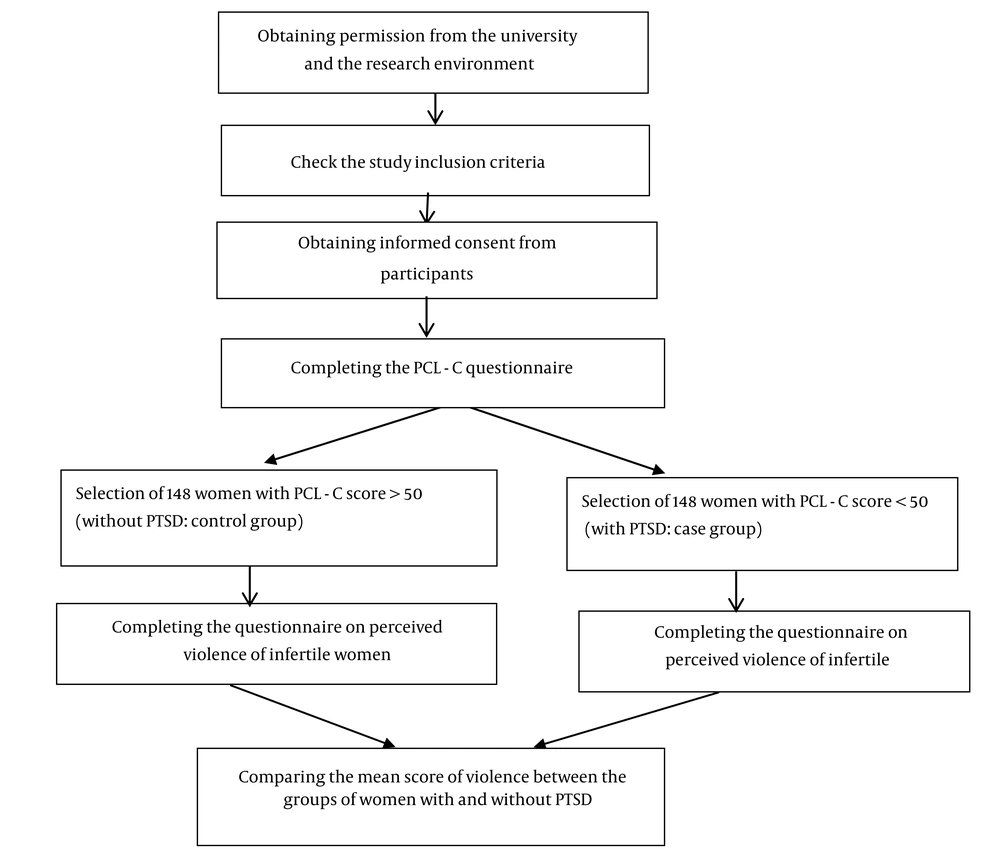
Figure 1.
Study design
3.4. Measure
Data collection tools in this study were the demographic and Infertility-Related Information Questionnaire, PCL-C, and infertile women's exposure to violence determination scale.
3.4.1. Demographic and Infertility-Related Information Questionnaire
The demographic and Infertility-Related Information Questionnaire consists of two parts. In the first part, personal and family data were given, including age, education, husband's education, employment status, place of residence, duration of marriage, and family composition. Information about infertility in the second part included how long they had been aware of infertility, duration of treatment, number of times they had undergone intrauterine insemination (IUI) and in vitro fertilization (IVF), cause of infertility, taking action to undergo treatment, hope for treatment success, and cost of treatment. The validity of the questionnaire was determined based on content validity. The questionnaire was given to seven experts and professors of Mashhad University of Medical Sciences for assessment. After considering necessary suggestions and corrections, the final tool was used.
3.4.2. PTSD Checklist-Civilian Version
This questionnaire consists of 17 items, out of which five items are about the signs and symptoms of re-experiencing a traumatic event, seven items are about the signs and symptoms of emotional numbness and avoidance, and five items are about the signs and symptoms of acute flares. Answers to the items are scored based on a 5-point Likert scale between a minimum score of zero (not at all) and a maximum score of 5 (very high). A score above 50 from the PCL-C is considered for the diagnosis of PTSD. Accordingly, in the present study, individuals with a score above 50 from PCL-C were considered individuals with PTSD. The validity and reliability of PCL-C were confirmed in a study by Ebrahimpour et al. (25). Validity was confirmed using quantitative content validity with a coefficient of 0.96, and the reliability of the Persian version of this questionnaire was confirmed by Cronbach's alpha coefficient of 0.86 (25). The reliability of the instruments was confirmed by Cronbach's alpha coefficient of 0.78 in the present study.
3.4.3. Infertile Women's Exposure to Violence Determination Scale
This questionnaire consists of 31 items and measures the violence against infertile women in five domains (domestic violence, social pressure, punishment, exposure to traditional practices, and deprivation). Answers to the items are scored based on a 5-point Likert scale between a minimum score of zero (never) and a maximum score of 5 (always). This questionnaire measures infertile women’s exposure to violence in a specific way. Answers to questions are in the form of 5 options from never to forever. Higher points mean that infertile women face more violence. This questionnaire was applied in 2014 for the first time by Onat in Turkey (26), and the reliability of the Persian version of this questionnaire was confirmed by Cronbach's alpha coefficient of 0.86 in a study by Moghaddam Tabrizi et al. (8). The instrument's reliability was confirmed by Cronbach's alpha coefficient of 0.84 in the present study.
3.5. Statistical Analysis
After being collected and coded, the data were analyzed using the SPSS software version 16. P-value < 0.05 was considered significant. In order to describe the demographic characteristics, mean, standard deviation and frequency distribution tables were used. Furthermore, the chi-squared test, odds ratio, Mann-Whitney test, independent t-test, and a logistic regression model were utilized.
4. Results
The subjects were homogeneous in the PTSD and control groups in terms of education level (P = 0.16), occupation (P = 0.49), willingness to receive treatment (P = 0.08), income level (P = 0.05), and history of using assisted reproductive techniques (P = 0.49) (Table 1).
Table 1.Descriptive Statistics for the Case and Control Groups a
| PTSD Group | Control Group | Test Results | |
|---|---|---|---|
| Woman's education | Z = -1.397; P = 0.16 b | ||
| Elementary school | 11 (7.4) | 8 (5.4) | |
| Middle school | 21 (14.2) | 20 (13.5) | |
| High school | 71 (48) | 62 (41.9) | |
| University degree | 45 (30.4) | 58 (39.2) | |
| Woman's occupation | χ2 = 2.389; P = 0.49 c | ||
| Housewife | 114 (77) | 108 (73) | |
| Work-at-home job | 16 (10.8) | 11 (7.4) | |
| Office employee | 14 (9.5) | 26 (17.6) | |
| Student | 4 (2.7) | 3 (2) | |
| Willingness to receive treatment | Exact χ2 = 5.172; P = 0.08 d | ||
| For myself | 20 (13.5) | 22 (41.4) | |
| For my husband | 0 (0) | 5 (2.8) | |
| For both of us | 128 (86.5) | 121 (77.8) | |
| Income level | Z = - 1.895; P = 0.05 b | ||
| Lower than enough | 48 (32.4) | 34 (23.0) | |
| Almost enough | 100 (67.6) | 113 (76.4) | |
| More than enough | 0 (0) | 1 (0.7) | |
| Prior use of assisted reproductive techniques | χ2 = 2.389; P = 0.49 c | ||
| None | 59 (39.9) | 72 (48.6) | |
| IUI | 42 (28.4) | 36 (24.3) | |
| IVF | 33 (22.3) | 27 (18.2) | |
| Other | 14 (9.5) | 13 (8.8) |
Abbreviations: PTSD, post-traumatic stress disorder; IUI, intrauterine insemination; IVF, in vitro fertilization.
a Values are expressed as No. (%) unless otherwise indicated
b Mann-Whitney test
c χ2.
d Fisher’s exact test.
The mean age of the subjects was 30.92 ± 5.65 years in the group of subjects with PTSD and 30.68 ± 6.64 years in the control group. Based on the results of the Mann-Whitney test, there was no significant difference between the two groups (P = 0.70, Z = -0.37). The subjects' mean duration of marriage was 8.30 ± 4.16 years in the PTSD group and 7.99 ± 4.54 years in the control group. Moreover, the Mann-Whitney test showed no significant difference between the two groups (P = 0.30, Z = -1.02).
Our findings revealed a significant relationship between PTSD and violence against infertile women (Z = - 9.651, P < 0.001). The mean score of violence was 59.22 ± 7.31 in the group of subjects with PTSD and 41.10 ± 13.33 in the group of subjects without PTSD, and the risk of violence was 1.11 times higher in the PTSD group than in the healthy group (OR = 1.11, CI 95%: 1.08 - 1.14). A logistic regression model was used to determine the simultaneous relationships of the indices violence, age, number of IUI treatments, number of IVF treatments, and duration of marriage with PTSD. The results showed that the unvaried logistic regression model was statistically significant (R-square = 0.256, F = 19.970, P < 0.001) and that only violence was a significant predictor of PTSD (Table 2).
Table 2.Determining the Effects of Intervening Variables on the Risk of Exposure to Risk Factors in People with PTSD Based on the Unvaried Logistic Regression Model
| Variables | Beta Coefficient | Standard Deviation | Significance Level | Exp (B) | 95% CI | |
|---|---|---|---|---|---|---|
| Lower | Upper | |||||
| Violence | 0.110 | 0.015 | < 0.001 | 1.11 | 1.084 | 1.149 |
| Age | 0.026 | 0.027 | 0.35 | 1.02 | 0.972 | 1.083 |
| Number of IUI treatments | -0.123 | 0.163 | 0.44 | 0.884 | 0.643 | 1.216 |
| Number of IVF treatments | -0.097 | 0.276 | 0.72 | 0.908 | 0.528 | 1.560 |
| Duration of marriage | 0.011 | 0.045 | 0.81 | 1.01 | 0.925 | 1.105 |
Abbreviations: PTSD, post-traumatic stress disorder; IUI, intrauterine insemination; IVF, in vitro fertilization.
5. Discussion
In the present study, there was a significant relationship between PTSD and violence against infertile women. We found that the risk of violence was 1.11 times higher in the PTSD group than in the control group. In the study by Roozitalab et al., 41.3% of infertile women participating in the study had PTSD, and there was a relationship between infertility stress and efforts to receive infertility treatment and PTSD (14). The incidence rate of PTSD among infertile women is very high, and women consider infertility a life-threatening injury that causes numerous physical and psychological effects. Yang and Yeo demonstrated a significant difference between the quality of life of infertile women with and without PTSD (20). In the research by Ozturk et al., one-third of infertile women were the victims of domestic violence, and the amount of domestic violence increased with the diagnosis of infertility (27). Infertile women are subject to psychological pressures from those around them. When they are repeatedly asked about the time to have children, they may have a psychological crisis which might lead to the repetition of violence against women (28).
Diagnosis and assisted reproductive therapies will lead to many psychological pressures on individuals in addition to the need for spending money and time (29). The results of a review study by Mirzaei et al. showed that sexual violence was related to PTSD, anxiety, and depression (30). In a study by Rashti and Golshokouh, physical-psychological and sexual domestic violence was correlated with PTSD in married women (31). In a study by Akyuz et al., there was a relationship between psychological distress in infertile women and domestic violence, which was consistent with the results of the present study, and there was also a relationship between violence and PTSD in women (4). Assisted reproductive therapies are considered one of the most important stressors in infertile women (32). Infertile women often consider infertility as the most stressful event of their lives and describe repeated and successive courses of treatment as repeated periods of crisis. In addition to somatic involvement, assisted reproductive therapies can cause adverse psychological reactions. Long waiting periods, feelings of loneliness and exclusion, and fear of treatment failure cause high anxiety and somatic symptoms (33). Many women show PTSD symptoms during assisted reproductive therapies, and PTSD is reported to be higher in infertile women with a history of abortion and avoidance coping strategies and who express less emotion (34).
Most PTSD symptoms in infertile women are associated with a feeling of helplessness, loss, stigma, failure to cope with infertility, depression, and anxiety (16). Post-traumatic stress disorder is reported to be 8% in the general population, whereas it is six times higher in infertile people than in other members of society (35). In a study by Tabrizi et al., infertile women were significantly more exposed to psychological, physical, and economic violence than fertile women (36).
In the current study, there was no significant relationship between PTSD and the number of IUI and IVF treatments. Corley-Newman and Trimble reported no relationship between different types of assisted reproductive therapies and PTSD in infertile women (35), consistent with our results. On the other hand, Moghaddam Tabrizi et al. showed that with increased duration of the marriage and the period the couple had become aware of infertility, women's exposure to violence increased, and there was a relationship between violence and general health scores (8). The latter findings were not consistent with the results of the present investigation.
Individuals diagnosed with infertility and under treatment for a more extended period are likely to have used a variety of therapies, which are often associated with low success rates. They are more worried and disappointed about the outcome of treatment (37). In most cases, women consider themselves the cause of infertility and often seek to discover the cause (38). In addition, infertile women are more highly influenced by the effects of assisted reproductive therapies than their husbands (33). More than 80% of women experience moderate to severe stress during infertility diagnosis and treatment (39).
In the present study, PTSD had no relationship with infertile women’s age and education level. Akyuz et al. observed no relationship between psychological distress in infertile women and their education level and age (4), which is in line with our results. However, Behdani et al. reported that depression in infertile women had a relationship with their education level and employment status. Infertile women with higher social function seem to experience lower levels of depression in response to stress because of their financial independence, occupational identity, and non-isolation (40). It seems that at higher levels of education, husbands act as a protective factor against violence and PTSD in women due to their greater awareness of infertility, more appropriate behavior, supporting their wives, and more adaptive mechanisms against stress.
Among the strengths of this study, we can mention homogenizing the case and control groups as far as possible. However, one of the weaknesses of the present study is sampling. Due to the existence of only one government-owned infertility treatment center in Mashhad, the results were collected only from one infertility treatment center, which reduces the generalizability of the results. The purpose of this study was to assess the relationship between perceived violence and PTSD in infertile women, and it was not possible to control all variables, such as the previous history of violence and spousal support, which was one of the limitations of our study.
5.1. Conclusions
The results of this study showed that the risk of violence was higher in subjects with PTSD than in subjects without this disorder. Therefore, it is recommended that patients in infertility treatment centers be screened for violence and PTSD. Those affected by PTSD and violence should be identified, and steps be taken to help and support them. Necessary training needs to be provided to healthcare providers who deal with infertile patients.


