1. Background
Smoking is verified as an important cause of death globally (1). It is argued that more than 50% of deaths are caused by cigarette addiction. The key point for smoking cessation is situational temptations. Cue strength or temptation is defined as an urge to engage in a behavior when exposed to certain environmental situation or internal stimuli (2). Also, situational temptation is one of the important constructs of the transtheoretical model (TTM). The stages of TTM are as follows: pre-contemplation, contemplation, preparation, action, and maintenance (3). In this model of behavior change, temptation is as a mediating variable that influences whether or not a person takes action and maintains any successful behavior change that is made, or relapses into previous risky behavior (4).
Many smokers reported relapse as a result of temptation such as being in a party, visiting smoker friends, and could not overcome the temptation (5).
Efforts to enhance the knowledge of main factors of temptation to be considered in educational interventions to overcome temptation may be facilitated by the development of suitable tools that can identify the specific ways to assess the main factors of temptation in educational programs on smoke cessation. As a result, the current study aimed at psychometrically evaluating the short form of situational temptations scale for smoking cessation based on TTM.
However, it was not attempted to examine English to Persian translation of situational temptation scale to measure whether this scale had sufficient psychometric properties. Due to the cultural differences (6) in temptation, the increasing rate of smoking especially among workers (5), decrease in the age of smokers (7), and many other negative effects of smoking such as health and its socioeconomic aspects (5) was necessary to confirm whether this scale can be used in the workers of a factory and whether the Persian version of the instrument had no bias in comparison with the English version to approve the short form of situational temptation scale for smoking cessation.
Due to the dramatic rate of smoking among the factory workers (8) and setting basic health interventions as the most favorable intervention to recognize the barriers of quitting smoking in the work settings and assess the effectiveness of the interventions (8), it was decided to select the automobile manufacturing company in Bam, Iran and the workers as the participant of the study in order to psychometrically evaluate the short form of situational temptations scale for smoke cessation among Iranian workers as the purpose of the current study.
2. Methods
The current cross sectional study was conducted from November to December 2016.
2.1. Sampling Method and Sample Size
Totally, 218 participants were recruited from an automobile manufacture factory in Bam, Iran using stratified random sampling. The sample size was considered sufficient with regard to the fact that 15 cases were needed for each question; therefore, the total sample size was 9 × 15 = 135 workers (9). Also, since the authors wanted to make sure about the optimal sample size, it was multiplied by 1.60; therefore, 220 questionnaires were distributed, out of which 218 were completed.
2.2. Inclusion/Exclusion Criteria
Inclusions criteria were being male, being current smoker with the history of smoking at least 100 cigarettes, being in age susceptible to smoking, and being able to read and write in Persian. However, the workers in pre-contemplation and contemplation stages of TTM and also the ones involved in any smoking quitting action were excluded from the study. The main reason for including only the workers in the preparation stage was due to the fact that authors were planning to implement an intervention for these people since according to the TTM, every stage of change needs its own strategy for any possible interventions (10). It was thought that the most convenient sample for the study would be a sample of individuals at preparation stage; otherwise a number of different interventions should have been implemented for people in different stages of change and it was impossible for several reasons including time constrains and scarce resources.
The Questionnaire
In the current study, two questionnaires were applied. The first was about demographic characteristics of the studied participants and the second one was a five-option Likert scale, TTM-based questionnaire for smoking cessation developed by Prochaska et al. (11, 12). The latter scale has two versions as the original scale including 83 items and the short form scale including only 38 items. In the current study the short form was applied. Both versions contain four subscales as the stage of change, decisional balance, process of change, and situational temptation (13, 14). Situational temptation is a nine-item subscale. This subscale is applied when the researchers want to measure the situations in which the individual is motivated or aroused to smoke. For example; I smoke cigarettes when I am with friends at a party or I smoke when I am very angry about something or with someone. The smoking behavior of the participants was reported by themselves.
2.3. Data Collection
In the current study, data were collected by the workers at their work places during two weeks.
2.4. Translation and Cultural Adaptation
The current study validated the previous translated situational temptation subscales (15). In the current study (15) this subscale was firstly translated from English into Persian by the two translators and back translated by the other two independent translators. The translators were fluent both in the English and Persian languages. They were all experienced in health care profession and were working in the field for many years. Then, the research team and translators examined the questionnaire for accuracy.
2.5. Content Validity
To assess the content validity, a panel of experts including 10 health professionals (seven specialists in health education and three experts in tobacco control) evaluated the questionnaire for wording style. Relevance of items and scaling were also checked. Accordingly, a few minor changes were made.
2.6. Face Validity
The face validity of the instrument was assessed by 20 male smokers to insure that they understood questions and it was easy to respond to them (15). This sample was excluded from the main study.
2.7. Construct Validity
In The current study Exploratory factor analysis (EFA: principle component extraction with varimax rotation) and confirmatory factor analysis (CFA: with maximum likelihood estimation) were applied. Cumulative variance (CV) > 0.4 and the Kaiser-Meyer-Olkin (KMO) > 0.7 were considered as good fit indices in EFA; and REMSEA < 0.05, GFI > 0.9, AGFI > 0.9, P value > 0.05 were considered as good fit indices in EFA. Also, for construct validity, average variance expected (AVE) > 0.4 was considered as a good fit index.
Reliability
Cronbach’s alpha and composite reliability (CR) > 0.7 were considered as good fit indices for reliability.
2.8. Statistical Analysis
All statistical analyses were conducted with SPSS version 18 (SPSS Inc., Chicago IL) and AMOS21. Mean ± standard deviation (SD) was applied to assess continuous variables while frequency (percent) was used to assess the categorical variables. Furthermore, t test was used for comparison between the two groups and the Kolmogorov-Smirnov test was used to assess the normality distributions of the variables.
2.9. Ethical Issues
All ethical principles were considered in the study. The ethics committee of Tarbiat Modares University approved the study protocol. Informed consent was obtained from all participants.
3. Results
3.1. Participation
Totally, 218 subjects with the mean age of 30.52 ± 6.66 years participated in the current study (100% response rate). The demographic variables are shown in Table 1. According to this table, all subjects were male (n = 218, 100%) and most of them were married (n = 188, 86.2%).
Table 1.
Distribution of Demographic Variables of the Studied Participants
| Variable | No. (%) |
|---|---|
| Age, y | |
| ≤ 25 | 41 (18.8) |
| 26 - 30 | 94 (43.1) |
| 31 - 35 | 55 (25.2) |
| > 35 | 28 (12.8) |
| Marital status | |
| Single | 30 (13.8) |
| Married | 188 (86.2) |
| Educational level, y | |
| Under diploma < 12 | 33 (15.2) |
| Diploma = 12 | 161 (73.9) |
| Upper diploma > 12 | 24 (11.0) |
| Number of cigarette smoking per day | |
| ≤ 10 | 152 (69.7) |
| > 10 | 66 (30.3) |
3.2. Validity
The first step to confirm the validity of the scale was content validity in which the CVI and CVR indices were calculated (15). Another measurement of validity used in the current study was average variance expected (AVE). AVE was calculated with CFA and EFA. The AVE was calculated as 45.7% and 39.0% with CFA and EFA, respectively. Finally, predictive validity was used to confirm smoking temptation as a predictive factor for smoking. The t test was used to show the relationship between the number of cigarettes smoked per day (G1 ≤ 10 cigarettes per day, G2 > 10 cigarettes per day) with total smoking temptation scores as G1 = 27.84 ± 7.70, G2 = 30.57 ± 6.69, respectively, which revealed positive significant relationship (P value = 0.013). Due to the significant relationship between these two variables, good predictive validity was considered.
3.3. Reliability
In the current study, through using EFA and CFA, CR was calculated 80.4% and 77.8%, respectively. These two values showed good reliability according to CR index. The reliability was also confirmed by Cronbach’s alpha (α = 80.1%) (Table 2 and Figure 1).
Table 2.
| Question | Item Weight Based on EFA | Item Weight Based on CFA |
|---|---|---|
| β | Β (T Value) | |
| I smoke cigarette, when I am with friends at a party | 0.715 | 0.708 (8.86) |
| When I first get up in the morning | 0.725 | 0.633 (9.01) |
| When I am very anxious and stressed | 0.662 | 0.587 (8.07) |
| Over coffee while talking and relaxing | 0.604 | 0.589 (7.28) |
| When I feel I need to get relaxed | 0.642 | 0.582 (7.76) |
| When I am very angry about something or with someone | 0.651 | 0.544 (7.85) |
| With my spouse or close friend who is smoking. | 0.641 | 0.606 (7.83) |
| When I recognize I have not smoked for a while | 0.684 | 0.682 (8.41) |
| When things are not progressing on my way and I am disappointed | 0.745 | 0.669 (ref) |
| Composite reliability, % | 80.4 | 77.8 |
| Average variance expected, % | 45.7 | 39.0 |
| Cronbach’s alpha, % | 80.1 |
Abbreviations: CFA, confirmatory factor analysis; EFA, exploratory factor analysis; KMO, the Kaiser-Meyer-Olkin.
aEFA goodness of fit index: KMO = 91%; %cumulative of variance = 45.6%; the Bartlett chi-square test = 573.14; P < 0.001.
bCFA goodness of fit index: REMSEA = 0.006; GFI = 0.973, AGFI = 0.955; P value = 0.452.
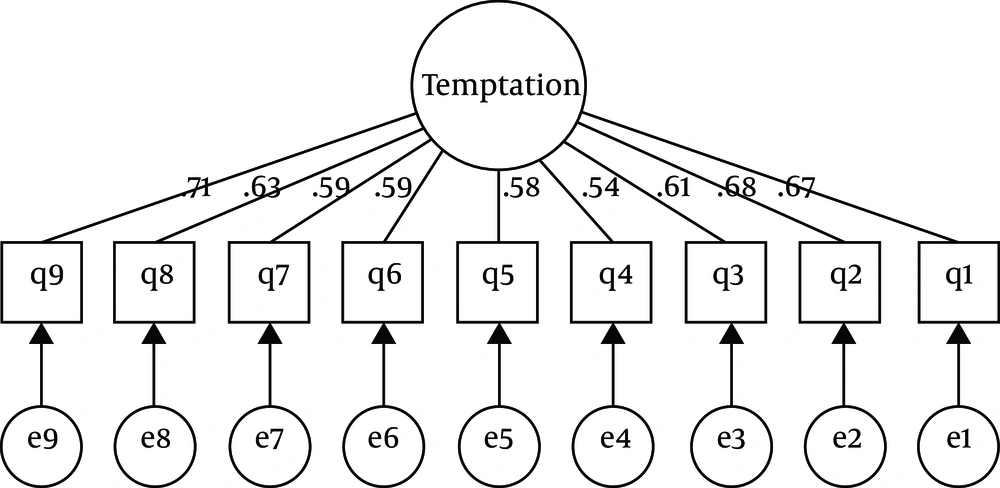
Figure 1.
Model Path Using Confirmatory Factor Analysis
4. Discussion
The current study evaluated the reliability/validity of the previously translated situational temptation subscales (15) among automobile factory workers. The results of the present study showed that the temptation subscale was a valid and reliable tool, which could be used to measure temptations regarding smoking among factory workers. Furthermore this measurement could assess why the smoker workers in some situations could not quit smoking while they actually intended to quit it. In other words, according to the TTM the ones in preparation stage (3). In the current study, based on CFA analysis, all nine items of situational temptation scale were verified in the target group. As temptation reflects the converse of self-efficacy, it means the intensity of urges to engage in smoking behavior while in difficult situation (3), it can be concluded that in the current study participants, the difficult situations to decide to begin smoking are the same as other studies (16).
In the current study, the studied workers verified that they tempted to smoke while they were in stressful situations, when they were with their smoker friends, and when they thought they had not smoked for a while. In this regard, Prochaska et al. believed that typically three factors cause the most common kinds of temptations including emotional distress, positive social situation, and craving (3).
The psychometric evaluation of the translated situational temptation scale in the present study showed that this scale was a valid and reliable instrument to measure temptation among Iranian smoker workers; the result was consistent with those of other previous studies (16-18).
Moreover, the results of other studies such as that of Plummer et al. with higher reliability, supported the current study results (19). It means that the procedures of psychometric evaluation in the current study were consistent with previous evidence in which the authors tried to validate the scale. The results of the current study confirmed high internal reliability of the temptation scale that was consistent with previous studies (15). Furthermore, regarding temptation variables, the current study findings were supported by the findings of other studies (15-19).
The current study had good reliability, which was consistent with the results of the study by Scott in which Cronbach’s alpha coefficient (α) regarding reliability of the instrument was 0.89 for the total sample (20). In the study by Mansourian et al. the Cronbach’s alpha of the temptation reliability test was similar to that of the current study (21). Furthermore, the current study findings supported the results of other previous researches in which the internal consistency were measured through Cronbach’s alpha coefficient and two-week interval test-retest correlation and also split-half coefficient for the 25-items smoking temptation scale that all were optimal (22). In addition, in previous evidence, (22) the EFA showed five factors, which explained 57.28% of the total variance; therefore, the current study verified that the temptation scale was an effective measurement to distinguish the people in different stages of change due to smoking cessation (22).
Despite the strong points of the current study, there were some limitations; for instance, all the participants were male; therefore, the results of the study cannot be generalized to female workers. Furthermore, the sample was taken from a specific industry in Southeast of Iran and the study findings could not be generalized to all Iranian workers. Moreover, the study included just the smokers in the preparation stage and the study results cannot be generalized to smokers in other stages. EFA in the current study was not the main finding; hence, it was reported just for comparison with CFA. Despite all mentioned limitations, the results of the current study were supported by other published evidence. Nevertheless, the findings of the current study showed that this instrument could be used to measure behavioral changes of smoking cessation among adult males who are going to change their behaviors in the next 30 days. However, more researches in future with larger sample sizes, which included different subgroups are strongly recommended.
4.1. Conclusions
The current study approved the short form situational temptation scale for smoking cessation. However, to ensure for a reliable/valid instrument to realize smoking behaviors, more researches are recommended.