


1. Background
Construction and demolition (C&D) waste is generated from the construction, renovation, and demolition of buildings, roads, bridges, land excavation or formation, and site of clearance or renovation of destroying communities due to natural or man-made disasters such as earthquake or war (1-3). A huge quantity of C&D waste in worldwide scale is the consequence of the rapid growth of population, urbanization, and development of the construction industry (4). For instance, in Lisbon (Portugal), the C&D generation rate was reported to be 0.60 ton/year per capita (5). The amount of C&D waste generation in the European Union was reported about 461 million tons annually (6). In South Korea, C&D waste equals 49.9% of the total generated waste with the production rate of 68 million ton/year (7). The generation rate of C&D waste in the UK estimated about 100 million tons per year (8). In Shanghai (China) with a population of about 24 million in 2012, about 13.7 million tons of C&D waste was produced (9). In 2003 in Tehran, the capital city of Iran, the generation rate of C&D waste was estimated at approximately 6.82 million tons per year (10). Moreover, in another study conducted in Shahroud city (Iran) in 2009 with a population of about 129000, an annual estimate of 0.219 million tons of C&D waste was reported (11).
Considering the C&D waste generation trend, it can be noted that the management and disposal of C&D waste become a serious environmental and health problem (2, 12). The most important C&D waste generation impacts are comprised of using a large number of land resources for waste landfilling/dumping, damaging the disposal site nearby by dangerous contamination, and wasting natural resources (9, 13).
In Iran, the management of C&D waste is among the fastest-growing concerns due to fast urbanization and population growth, and rapid development of the construction industry. In spite of that, the C&D waste management has not gained proper consideration. Consequently, designing a management plan for C&D waste is essential. On the other hands, the accessibility of adequate and precise data on characteristics and its current management conditions are among the basic prerequisites for the effective performance of every waste management program. The accessible data about C&D waste production rate in Iran is scarce. In addition, there are no accessible and precise data describing the real practice of managing and handling C&D waste.
2. Objectives
In this study, we firstly estimated the amount of C&D waste in Tabriz (Iran). Then we attempted to assess how C&D waste is handled and ultimately disposed of. In addition, we aimed to assess the existing policies on C&D waste management. Finally, some feasible suggestions about C&D waste management had been presented to enhance the present condition.
3. Methods
3.1. Study Area
Tabriz with an area of 324 km2 and a population of 1.558 million people is the capital city of East Azerbaijan province and the fifth biggest city in Iran (14).
3.2. Estimating C&D Waste Generation Rate
Among the two main methodologies, which generally applied to estimate the C&D waste production rate, the second approach used for estimating C&D waste generation rate in this study (1, 15). In this method, C&D waste generation is determined according to the Equation 1, which is according to some measurements of the construction or demolition activity level in a district (by area of the structure, m2) and the average waste production per building area (tons/m2) (15).

where W is the total weight of building-related C&D waste (tons/year), CW and DW are the weight of construction waste and demolition waste (tons/year), respectively. The CA is the area of buildings constructed or renovated, DA is the area of buildings demolished (m2/year), and Gc and Gd are the average waste generation per building area during construction and demolition activity (tons/m2), respectively (1, 15, 16).
In this study, the data of all the permits issued for construction of new buildings (CA) and demolition of old buildings (DA) were obtained from the Tabriz City Hall during 2003 to 2015 (m2/year). The area of permits issued for renovation was assumed as 10% of the permits issued for construction (m2/year). The average waste generation rate per building area during demolition (Gd) activity was determined by weighing all the produced waste during the demolition of a randomly selected building (620 m2 area and 3 floors) in Tabriz city (tons/m2). It should be added that the total waste volume was determined during weighing, which allowed for calculating the specific weight of the waste reported in kg/m3. The average waste generation rate per area of contraction (Gc) activity was taken 2.27 kg/m2 according to the previous study conducted by Mosavi and Hafezi Mogdas in 2010.
Non-building related waste (such as that from roads, bridges, and other structures) was included in this study. The amount of annual C&D waste (tons/year) was estimated for the past 13 years. Then a multilayer perceptron artificial neural network using the batch training method and gradient descent algorithm was used to predict the production of C&D waste in 2016 - 2025. The analyses were performed utilizing SPSS V. 17 statistical software (17).
3.3. Survey of the Current C&D Waste Management Condition
The data collection procedure used to assess current management conditions of C&D waste consisted of completing a checklist, visiting and observing the C&D waste disposal site, interviewing authorities, using scientific databases, and contacting the City Hall, local and national environmental protection agencies, and other organizations.
4. Results
4.1. Generation Rates of C&D Waste
Table 1 represents the summery of the result of determining the amount of waste generation in a demolished building. The generation rate of C&D waste for demolition and excavation and the total recyclable metals were determined to be 2.267 ton/m2 and 0.05 ton/m2 (50 kg/m2), respectively. The amount of area taken up by buildings constructed in Tabriz city (m2/year) during 2003 and 2015 is presented in Table 2. As revealed in Table 2, the amount of C&D waste was determined between 167034 and 848480 ton/year during 2003 - 2015. The trend of generation rate during the study period in Tabriz city was illustrated in Figure 1. As indicated, there is a sharp reduction in C&D waste generation in 2009 probably due to downswing in construction activity. Moreover, the annual generation rate of C&D waste per capita was obtained as 0.114 - 0.534 ton/year during the study period. The annual average amount and generation rate of C&D waste per capita were determined to be 591420 and 0.393 ton/year, respectively. Furthermore, it was estimated that an average of 12881 ton/year of metals was only being recycled by the demolition of buildings in Tabriz city. The waste generation rates for 2016 - 2025, were estimated to vary from 679349 to 742755 metric tons annually (Figure 2). Of course, as previously mentioned, the research team was not able to gather precise information on non-building-related waste, thus they were not included in this estimate. In this regard, if all C&D waste, including both building and non-building-related debris, were included in the dataset, the total estimated waste could be significantly more than the amount estimated by the current study. The comparison of the C&D waste generation rate in Tabriz city with those in other cities is presented in Table 3 (8). While the annual C&D waste generation rate was determined as 0.114 - 0.534 ton/year per capita (with an average of 0.393 ton/year) during the last 13 years in Tabriz city, it was reported to be between 0.107 and 1.18 ton/year per capita in both the developed and developing cities and countries. The variation in the generation rates (ton/year per capita) among different countries and cities can be due to various methods of construction and renovation, the quality and standards of primary building materials and rate and quality of developing processes, etc.
Table 1.The Summery of Result of Determining the Amount of Waste Generation in a Demolished Building
| Items | Amount |
|---|---|
| Total area of demolished building, m2 | 620 |
| Total weight of C&D waste, ton | 1405.35 |
| Weight of C&D waste without excavation for foundation, ton | 904.72 |
| C&D waste of excavation for foundation, ton | 500.63 |
| Weight of total metals item of C&D waste, ton | 31 |
| Total volume of C&D waste, m3 | 1146.40 |
| C&D waste per area, ton/m2 | 2.267 |
| C&D waste per area without excavation for foundation, ton/m2 | 1.459 |
| C&D waste per area of excavation for foundation, ton/m2 | 0.808 |
| Metals per area, ton/m2 | 0.05 |
| Density of C&D waste, ton/m3 | 1.226 |
Table 2.Amount of Permission for Construction and Renovation (C&R) and Demolition and Consequence C&D Waste During 2003 Until 2015 in Tabriz City
| Year | Construction Area, m2/y | Renovation Area, m2/y | Total C&R Area, m2/y | Generation Rate, ton/m2 | C&R Waste, ton/y | Demolition Area, m2/y | Generation Rate, ton/m2 | Demolition Waste, ton/y | Total C&D Waste, ton/y | Population of Tabriz (× 106) | C&D Waste, ton/y per capita |
|---|---|---|---|---|---|---|---|---|---|---|---|
| 2003 | 3176226 | 317623 | 3493849 | 0.00227 (2.27 kg/m2) | 7931.04 | 275547 | 2.267 | 624665 | 632596 | 1.368 | 0.457 |
| 2004 | 2378155 | 237816 | 2615971 | 5938.25 | 206312 | 467709 | 473648 | 1.378 | 0.339 | ||
| 2005 | 1898620 | 189862 | 2088482 | 4740.85 | 164711 | 373400 | 378141 | 1.388 | 0.269 | ||
| 2006 | 2463875 | 246388 | 2710263 | 6152.30 | 213749 | 484568 | 490720 | 1.398 | 0.347 | ||
| 2007 | 2410484 | 241048 | 2651532 | 6018.98 | 209117 | 474068 | 480087 | 1.413 | 0.336 | ||
| 2008 | 3578355 | 357836 | 3936191 | 8935.15 | 310433 | 703752 | 712687 | 1.429 | 0.492 | ||
| 2009 | 838669 | 83867 | 922536 | 2094.16 | 72757 | 164940 | 167034 | 1.445 | 0.114 | ||
| 2010 | 2879124 | 287912 | 3167036 | 7189.17 | 249773 | 566235 | 573424 | 1.461 | 0.388 | ||
| 2011 | 3672625 | 367263 | 4039888 | 9170.54 | 318611 | 722292 | 731462 | 1.495 | 0.483 | ||
| 2012 | 4151752 | 415175 | 4566927 | 10366.92 | 360177 | 816521 | 826888 | 1.532 | 0.533 | ||
| 2013 | 4260165 | 426017 | 4686182 | 10637.63 | 369582 | 837843 | 848480 | 1.570 | 0.534 | ||
| 2014 | 3747158 | 374716 | 4121874 | 9356.65 | 325077 | 736950 | 746307 | 1.648 | 0.447 | ||
| 2015 | 3148041 | 314804 | 3462845 | 7860.66 | 273102 | 619,122 | 626983 | 1.689 | 0.367 | ||
| Average | 2969481 | 296948 | 3266429 | 7414.79 | 257611 | 584005 | 591420 | - | 0.393 |
Table 3.The Comparison of C&D Waste Generation Rate of the Studied City (Tabriz) with the Other Reported Researches
| Estimated Study | Generation Rate, ton/y (× 106) | Population of Study Time (× 106) | Generation Rate, ton/y per capita |
|---|---|---|---|
| This study (Tabriz city) between 2003 - 2015 | 0.167- 0.848 (Ave = 0.591) | 1.36 - 1.68 | 0.114 - 0.534 (Ave = 0.393) |
| Tehran (capital city of Iran) | 6.82 | 7.5 | 0.909 |
| Shahroud (Iran) | 0.021 | 0.129 | 0.162 |
| United States (average of country) (16) | 170 | 290.1 | 0.586 |
| Lisbon (Portugal) (5) | 0.348 | 0.5 | 0.60 |
| European Union (6) | 461 | 490 | 0.94 |
| UK (8) | 100 | 63.7 | 1.56 |
| South Korea (7) | 68 | 50.22 | 1.35 |
| Shanghai city (China) (9) | 13.7 | 24 | 0.570 |
| Recife city (Brazil) (18) | 0.5 | 1.487 | 0.29 |
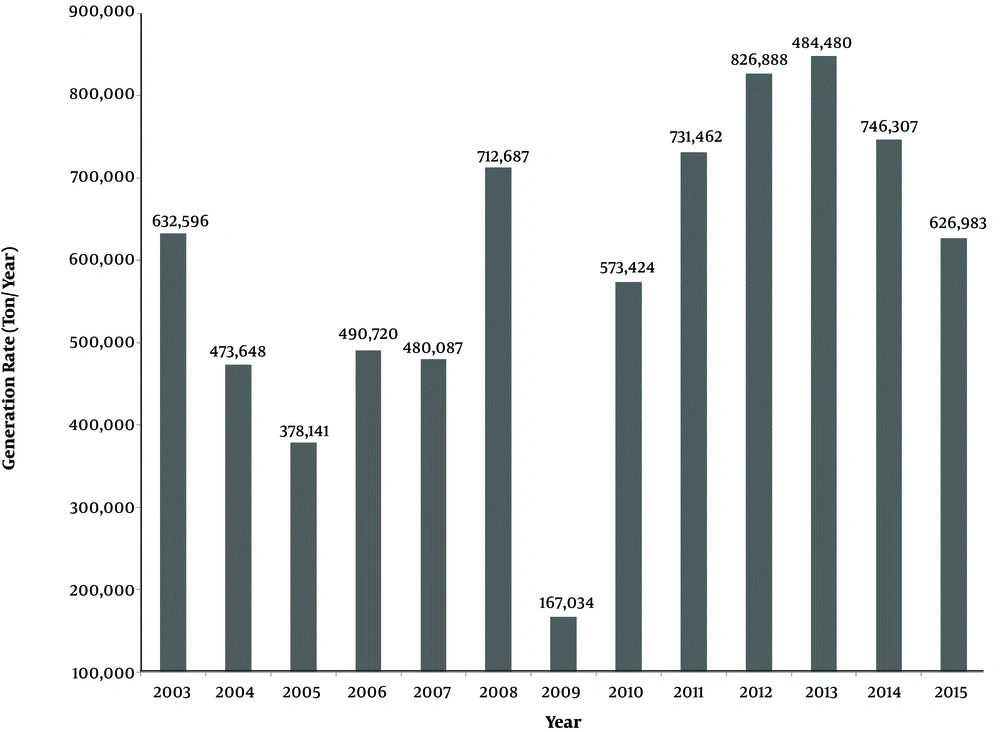
Figure 1.
Trend of C&D waste generation in Tabriz city during 2003 - 2015
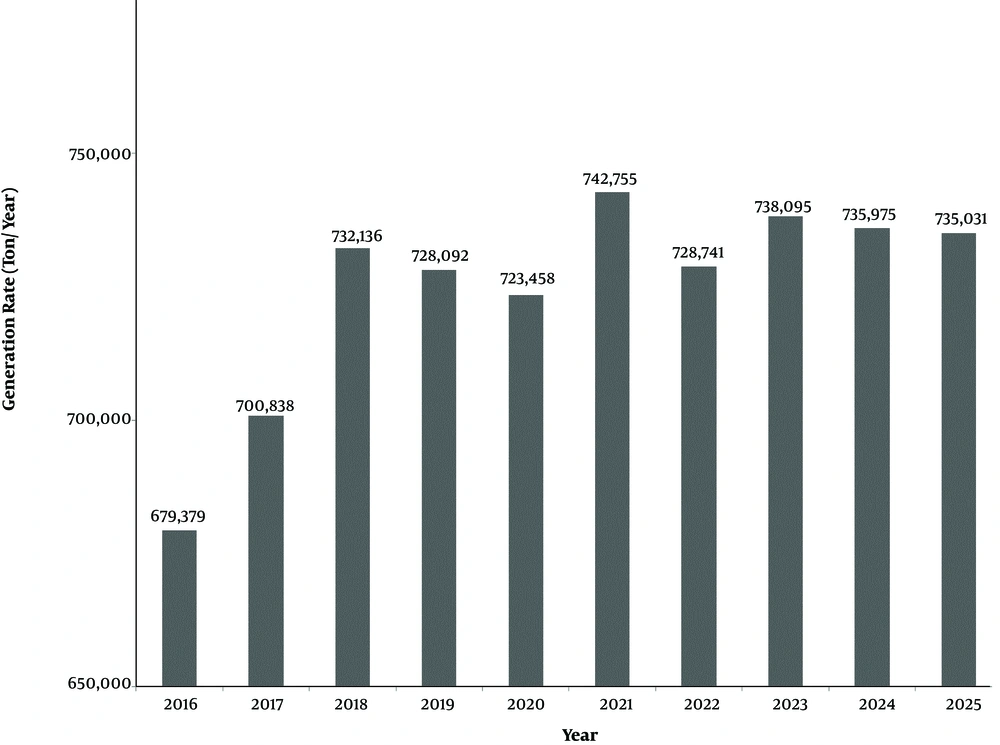
Figure 2.
The estimated amount of generated C&D waste by artificial neural network estimates in Tabriz for the years 2016 to 2025
4.2. Current C&D Waste Management Condition and Regulation in Tabriz City
Currently, there exists general legislation regarding waste management in Iran, which also uses to C&D waste. Based on clause 9 of the executive instruction comprised in that regulation, all C&D waste producers in cities and villages should pay attention to the instruction of separation, storage, and transportation of C&D waste. Meanwhile, no distinguished and clear regulation and instruction for separation, storage, transportation, and final disposal were presented. According to the municipality’s regulation, C&D waste producers are only responsible for carrying generated waste out of cities or villages. In such a condition, after obtaining a demolition permit, the contractor collapses the building. During the period of demolition, recyclable materials are comprised of all metal items such as girders, pipes along with windows and doors and their frameworks (about 50 kg/m2), and a portion of woods for selling or sometimes reusing (breaks) in new building if possible. Then all remnant debris (more than about 95%) was loaded mechanically and sometimes manually as C&D waste to carrier trucks for transportation. Nevertheless, due to non-availability of any standard disposal site in the studied area, the carrier trucks generally unloaded the C&D waste at the nearest distance from the city in public lands, waterways, valleys, roadsides, even in pastures and conservation areas, and sometimes inside cities or nearby villages. Moreover, as there are no systematic controls over dumping C&D waste so that it can penalize whoever unloads C&D waste within the cities and villages’ surroundings, no effort is made to reduce or recycle C&D waste in the area. It should be also explained that only little amount of C&D waste is sometimes used for land reclamation purposes. However, the method implemented for the C&D waste disposal in Tabriz city can create numerous environmental and health risks and even economic losses. The public health effects, environmental damages, and economic losses can include, but cannot exclude water and soil pollution, air pollution by particulate matter, creating unpleasant sights, making a shelter for rodent as a vector of some diseases, losing the property, and land worth and so on.
4.3. Reviewing Appropriate Collection, Recycling and Disposal Programs, and Presenting a Waste Management Plan of C&D Waste for Tabriz (Iran)
Based on relevant scientific resources, the most important strategy and hierarchy for integrated management of the C&D waste is reducing source, reusing, recycling, and finally landfilling of the rest in a suitable disposal site (9, 19, 20). Reducing, reusing, and recycling are known as 3Rs of C&D waste management (2, 21). One of the best ways for source reduction of the C&D waste is by increasing the lifetime of buildings and the quality of construction; consequently, the unnecessary destruction and demolition of buildings are decreased. Preventing the destruction of buildings due to economic reasons is another method of source reducing. The lifetime of buildings in Iran is 42 years, which in comparison to the average in industrialized countries is low (22). This can be due to the low quality of primary material used in construction, the low quality of construction processes, and even occasionally because of the policies of municipalities, which by issuing construction and destruction permissions, encourage citizens to destroy villa houses or one/two floor buildings and instead make multi-floor buildings and sometimes skyscrapers to gain greater profits. Therefore, for improving the C&D management condition, as the first step, the quality of primary material and standards of construction processes should be enhanced. The economic motivations for destroying buildings should be neutralized by applying suitable policies. Then particular and feasible policies, rules, and regulations should be approved and implemented to all levels of the C&D waste management. In the provision of sustainable feasible regulations, the experiences of other countries should be noticed. Moreover, a central final disposal site should be designated, designed, and operated for metropolitan cities such as Tabriz according to the environmental, health, and economic considerations. Ultimately, the responsible organizations should more strictly supervise the C&D waste collection, storage, recycling, and final disposal.
5. Discussion
The amount C&D waste in Tabriz city was estimated to be 167034 - 848480 and 0.114 - 0.534 ton/year per capita, which is more than that obtained in some other regions in Iran and in other countries. The C&D waste management condition in comparison to other cities in developed countries is not desirable. Currently, except for some recyclable materials such as metals, most of the C&D waste (averagely 591420 ton/year) are disposed in the suburb of Tabriz city. There is not any standard disposal site in the metropolitan city of Tabriz. Moreover, there is not any punishment or systematic controls for those who dump the C&D waste in the city’s surrounding. In addition, no effort is made for reduction of C&D waste. Even though, the use of some bad policies such as application of non-standard materials in the construction of buildings, unsuitable supervision of construction processes, and sometimes issuance of permission by the city hall’s officials for collapsing buildings for economical purposes causes an increase in the amount of C&D waste. Therefore, there is considerable concern for C&D waste disposal regarding the environment, health, economy, and other aspects. As a result, a strong policy is recommended to be applied to source reduction, reuse, and recycle the C&D waste. Furthermore, a central final disposal site should be designed and operated for metropolitan cities e.g. Tabriz; meantime responsible organizations must also pay more attention to reducing C&D waste, reusing, recycling, and eventually, landfilling of the rest in suitable disposal sites.

