Full Text
Full text is available in PDF
Official Publication of Health Promotion Research Center
Authors
Job involvement is a work-related attitude which helps to increase the effectiveness of the organization. On the other hand, individuals corresponding to a specific personality type behave in a certain way and have certain expectations, objectives and needs.
The aim of the study was to determine the level of nurses' job involvement and its association with their personality traits in teaching hospitals affiliated to Shiraz University of Medical Sciences in 2013.
This was an applied, cross-sectional and analytical-descriptive study. A sample of 110 nurses was determined using a multi-stage sampling method including cluster sampling, stratified sampling proportional to size, and simple random sampling methods. The required data were collected using two questionnaires that measured nurses' job involvement and their personality traits. Collected data were analyzed using the SPSS16.0 software on the basis of statistical tests including Kolmogorov-Smirnov (KS), ANOVA, independent-samples t-test, Pearson correlation coefficient, and multiple linear regression (Stepwise method). A P < 0.05 was considered statistically significant.
The results showed that the studied nurses' personality traits and job involvement were moderate. Moreover, the results of the multiple linear regression indicated that the studied nurses' job involvement had significant and positive associations only with achievement orientation (P < 0.001) and being formal and official nurses (P = 0.034).
According to the results of the present study and to increase employees' job involvement, hospital administrators should establish an equitable employee performance system and provide appropriate rewards and incentives, adequate career advancement and job promotion opportunities, opportunities for making mistakes and learning from those mistakes for employees and providing a greater job security for contract employees.
© 2014, Author(s). This is an open-access article distributed under the terms of the Creative Commons Attribution 4.0 International License (CC BY 4.0) (https://creativecommons.org/licenses/by/4.0/) which permits unrestricted use, distribution, and reproduction in any medium, provided the original work is properly cited.

Ramezani F, Rabani F, Yaghoubi F, Ramezani E, Hamedi A, et al. Examining the Impact of Job Motivation on Aggression, Burnout, and Stress Among Nurses in North Khorasan Teaching Hospitals (2023 - 2024). Iran J Psychiatry Behav Sci. 2026;20(2):e153649. doi: https://doi.org/10.5812/ijpbs-153649
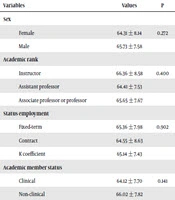
Mirzaei-Alavijeh M, Hosseini SN, Ashtarian H, Karami-Matin B, Ahmadi Jouibari T, et al. Job Involvement Among Faculty Members of Kermanshah University of Medical Sciences and Its Relationships with Professional Variables. J Health Rep Technol. 2020;6(1):e99557. doi: https://doi.org/10.5812/ijhls.99557
Janatolmakan M, Vafaei K, Hematti M, Chalehchaleh M, Goodarzi A, et al. Correlation between Nurses' Job Performance and Organizational Climate in educational hospital of Kermanshah University of Medical Sciences in 2016. J Clin Res Paramed Sci. 2017;6(2):e81360. doi:
Raeissi P, Mohebbifar R. Job motivators from the employees and managers' point of view in teaching hospitals affiliated to Qazvin University of Medical Sciences. J Inflamm Dis. 2024;10(1):e155196. doi:
Najjari R, Kermani B, Farzad H. Relationship between the nurses’ subjective and objective career success and extraversion and introversion personality types. J Kermanshah Univ Med Sci. 2014;18(7):e74082. doi: https://doi.org/10.22110/jkums.v18i7.1815
Last Update: 0 months ago
Last Update: 0 months ago
Last Update: 0 months ago
Last Update: 4 days ago