


1. Background
Nonalcoholic fatty liver disease (NAFLD) is one of the most prevalent liver disorders in the world, that its prevalence varies among general populations of different countries. Studies have reported a prevalence of 21.5-31.5% in Iran (1). NAFLD is defined by the lipid accumulation exceeding 5-10% of liver weight in the absence of alcohol consumption or very low consumption (2). It is associated with diabetes, hypertension, hyperlipidemia, and obesity diseases (i.e., metabolic syndrome components). It is also known as the hepatic manifestation of metabolic syndrome. Disorders of lipid secretion, oxidative stress, lipid peroxidation, apoptosis, and necrotic inflammation are mentioned as risk factors of liver injury. Meanwhile, several studies reported that some patients with liver disorders did not present any sign or symptom before the diagnosis. Hence, NAFLD development can be a challenging issue. Also, it is reported that, in some cases, patients with NAFLD present symptoms such as weakness, fatigue, nausea, and right upper abdominal pain. Hence, the disease may be diagnosed by either ultrasound or elevated liver enzyme tests in many of such patients. Moreover, advanced stages of the disease are accompanied by comorbidities such as splenomegaly, jaundice, and ascites. A liver biopsy test is an important tool for the definitive diagnosis of NAFLD. However, it is an expensive and invasive procedure. Besides, there are numerous non-invasive diagnostic methods such as measuring aminotransferase levels, plasma CK-18, MRI, transient elastography, and ultrasound-based imaging techniques (3, 4).
Investigating and treating the NAFLD is of crucial importance due to its chronicity, increased prevalence, high economic burden (5), and progression risk of the disease toward cirrhosis and liver failure (6). Thus, it is necessary to develop novel therapeutic options and/or techniques to reduce the impacts of NAFLD and preventing its progression (7). The use of naturally derived substances for treating several diseases is increasing, including NAFLD, mainly because of lower side effects.
Carum copticum (or Trachyspermum ammi) seeds (CCS), commonly known as Ajwain (8), is an important member of the Apiaceae family that grows spontaneously in the eastern regions of India. Carum copticum is mostly cultivated in India, Iran, Afghanistan, Pakistan, and Egypt countries. The Ajwain seeds (the fruits of the plant that are small, elliptical, yellowish-brown, and smells like thymol) have medicinal properties. Besides, CCS is known for its warm nature in Iranian traditional medicine and is mentioned as a digestive, anti-flatulence, anti-diarrhea, appetizer, stomach and liver tonic, anti-dyspnea, and antitoxins (9-11).
Recent studies reported that Ajwain contains numerous medicinal properties, including antioxidant, antimicrobial, antispasmodic, hepatoprotective, carminative (9, 12), anti-inflammatory, immunologic, antihyperlipidaemic, antihypertensive (9, 13), and anticarcinogenic (14). Such properties are due to the high amount of volatile oils (Thymol), Terpinene, Paracymene, β-Pinene, and other components such as carbohydrates, glucosides, saponins and phenolic (carvacrol), protein, fat, fiber, and minerals like calcium, phosphorus, iron, and nicotinic acid (niacin) (9). Shafiezadeh et al. (15) investigated the efficacy of CCS on the treatment of patients with NAFLD. However, their study has some limitations such as heterogeneity, being a single-center, and small sample size. According to what was mentioned above, CCS and its essential oils can influence fatty liver treatment by improving stomach activity and reinforcing medicinal effects on the liver and its enzymes.
2. Objectives
The current study aimed to evaluate the effects and efficacy of CCS extracts on liver enzymes, serum lipids, the grade of fatty liver, and anthropometric measurements in patients with NAFLD.
3. Methods
3.1. Study Design, Participants, and Sample Size
In this multi-center, randomized, triple-blind, placebo-controlled clinical trial study, 90 patients with grades of 1 to 3 of NAFLD (based on the ultrasonic test) referred to two medical centers located in Tehran (Iran) from March 21, 2019, to October 23, 2019, are investigated. The sample size was estimated as 90 subjects (45 in each group), based on the Shafiezadeh et al. (15) with a 95% confidence interval and β = 30%. The mean and standard deviation was separately calculated for each group (-15.2 ± 22 and -4.6 ± 2.5 for the intervention group and control group, respectively). These values were estimated based on the prevalence formula:
The possible drop out of the patients was considered as 50%.
3.2. Inclusion and Exclusion Criteria
The inclusion criteria were willingness to participate, being aged 18 to 60 years, approved diagnosis of NAFLD by ultrasound technique, not having a comorbidity (e.g. diabetes, heart failure, renal (kidney) failure, liver failure, liver cirrhosis, overt mental disorder, chronic obstructive pulmonary disease, and neoplasm patients), pregnancy and lactation/breastfeeding, long-term hospitalization, and not using alcohol, tobacco, illicit drugs, and drugs affecting liver enzymes during the past six months. The exclusion criteria were unwillingness to participate, pregnancy after participation in the study, drug intolerance (sensitivity), requiring other medical procedures such as surgery, and high missing information in medical records.
Initially, 119 patients were registered in this research. After evaluating potential participants against inclusion and exclusion criteria, 90 subjects were selected. Finally, 68 patients completed the study (See Figure 1).
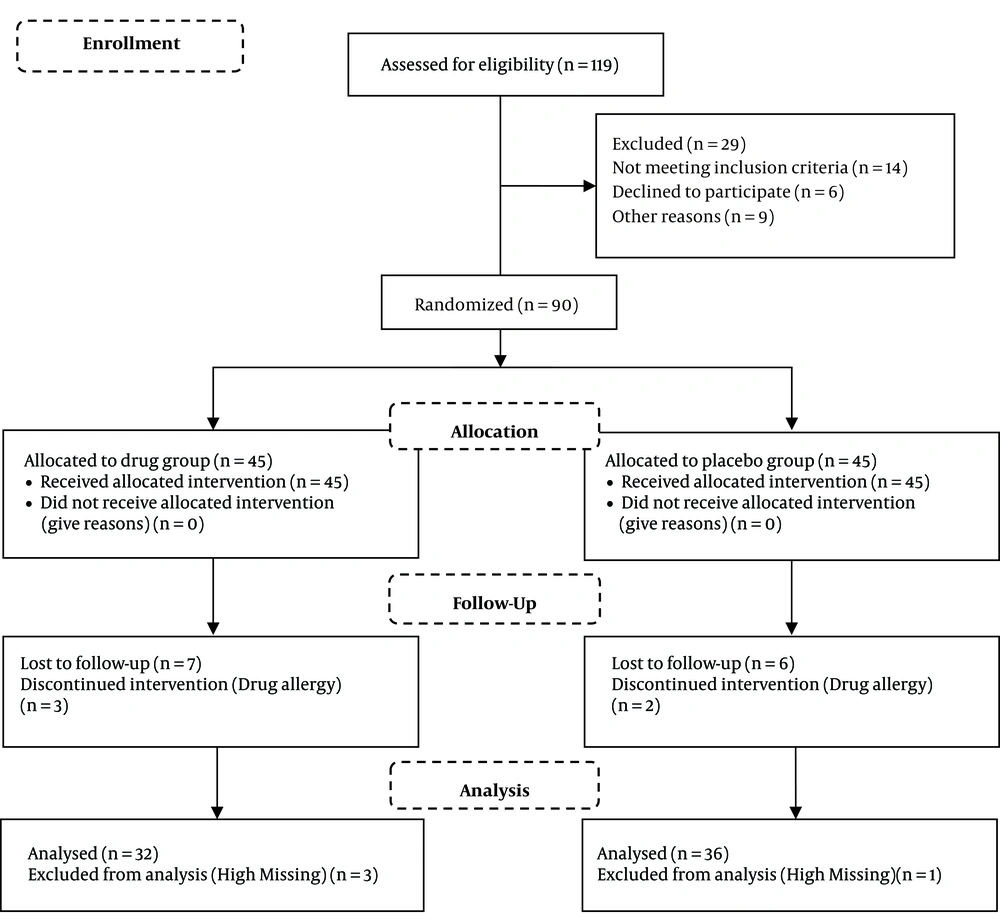
Figure 1.
Consort follow diagram
3.3. Outcomes and Variables
In this study, several anthropometric indices were investigated, including weight and height, both at the beginning and end of the study. The Body Mass Index (BMI = Kg (Weight)/m2 (Height)) was also calculated. In this case, all measurements were performed by an experienced expert to minimize measurement errors. Also, Fasting Blood Sugar (FBS), liver enzymes (ALT and AST), and lipid panel (Triglyceride (TG), Cholesterol (Chol), Low-Density Lipoprotein (LDL), and High-Density Lipoprotein (HDL)) were measured for all patients at the beginning and end of the study. Also, this procedure was performed to diagnosis functional dyspepsia with the Leeds questionnaire. Finally, a liver ultrasound was performed with the Alpinion E-CUBE 15 EX ultrasound device (made in South Korea) and by a primary sonographer to determine the possible changes after eight weeks of treatment. It worth noting that drug interactions and possible side effects (e.g. gastrointestinal, cutaneous, etc.) were evaluated every three weeks. The Leeds questionnaire was used to assess the severity of dyspepsia. In this case, the scores of 1 to 12, 13 to 24, 25 to 36, and 37 to 48 were defined as mild dyspepsia, medium, severe, and very severe, respectively. The validity and reliability of this questionnaire are confirmed in previous studies (17).
3.4. Drug and Placebo Preparation Process
In this study, Ajwain seeds were purchased from the wholesale markets of medicinal plants. After identifying and confirming the scientific name and other plant characteristics, it was registered by the herbarium code of 1628 in the herbarium of the Tehran University of Medical Sciences, School of Pharmacy. Then, the drug and placebo were prepared in the forms of aqueous extracts of Ajwain seeds and cornstarch flour, respectively. Ajwain seeds were Extracted using the percolation method (18). This process was performed by an expert and using 500 mg capsules with the same shape and color. It should be noted that the drug capsules contained 170 mg of aqueous extract of Ajwain and were standardized based on the amount of total phenol. The phenolic content for each capsule was 28.59 mg.g-1 powder inside the capsule (based on Gallic acid).
3.5. Randomization and Interventions
Patients were randomly assigned into two groups of the drug (Ajwain) and placebo. This procedure was performed by the blocked randomization method (AB and BA). The random assignments were prepared outside the study center and delivered to the sealed, opaque, and sequentially numbered envelopes. The aqueous extract of Ajwain seeds was prescribed in 500 mg capsules for the drug group. In the placebo group, the cornstarch flour was prescribed in similar capsules with the same doses as the previous group. Also, diet and exercise recommendations, walking for just a half-hour every day and five days a week were considered for both groups to change their lifestyle. The uniform and anonymous drugs were first produced in the form of capsules by an experienced pharmacist. Then, the mentioned drugs were coded. Afterward, participants were asked to take medication three times a day (a half-hour after a meal with a cup of warm water) for eight weeks. It was implemented based on the same instructions.
3.6. Ethical Considerations
Initially, the objectives of the study were explained to all potential participants. Then, if agreeing, written informed consent was obtained. Besides, the research procedures were performed following the Human Ethics Committee of Shahed University (ethical code: I0R.Shahed.REC.1396.82). Also, this clinical trial is approved by the Iranian Registry of Clinical Trials study (IRCT20171102037178N2).
3.7. Statistical Analysis
Data were analyzed using R statistical software version 3.1.2 (R Project for Statistical Computing, Vienna, Austria). Statistical significance was considered when P value < 0.05. The qualitative and quantitative variables are reported by frequency (in percent) and mean (± SD), respectively. The Kolmogorov-Smirnov (K-S) test was applied to test for a normal distribution. The between p-value was calculated either by Mann-Whitney U test or t-test, and the within p-value was calculated either by paired sample t-test or Wilcoxon signed-rank test. The P value was calculated for comparing the qualitative variables between the two groups based on the chi-square or Fisher’s exact test and Relative Risk (RR).
4. Results
In this study, the medical records of 68 NAFLD patients were reviewed, 48 (71%) male and 20 (29%) female. The mean age of participants was 42 years. The youngest and oldest participants were 20 to 63 years. The characteristics of patients (i.e. gender, age, BMI, waist, and sonography grade), separated by the group, are provided in Table 1. There was no significant difference between the two groups concerning gender, age, BMI, waist, and sonography grade. Mean ± SD of variables such as BMI, Leeds score, FBS, TG, cholesterol, HDL, LDL, AST, and ALT, separated by the group, at the beginning and end of the study is provided in Table 2. The cholesterol, HDL, and LDL did not statistically change during the study period in both groups. However, variables such as BMI, FBS, and AST being significant during the study, but their changes during study between the two groups were the same. The results also revealed significant changes in variables such as Leeds score, TG, and ALT between the two groups. The sonographic findings showed significant improvements in the intervention group compared to the placebo group (RR = 2.43 95%, CI (1.15-5.65), and P value = 0.034) (see Figure 2). In this study, the number needed to treat (NNT) was 4.2, which means that on average, 4.2 patients needed to receive experimental treatment (instead of control treatment) for one additional patient to have the study outcome.
Table 1.The Distribution of Gender, Age, BMI, Waist, and Sonography Grade, Separated by the Group, at the Beginning of the Study
| Group | P Valuea | ||
|---|---|---|---|
| Drug (n = 32), No. (%) | Placebo (n = 36), No. (%) | ||
| Gender | 0.795 | ||
| Male | 22 (68.8) | 26 (72.2) | |
| Female | 10 (31.3) | 10 (27.8) | |
| Age, year | 0.137 | ||
| ≤ 20 | 1 (3.1) | 1 (2.8) | |
| 21-30 | 4 (12.5) | 0 (0.0) | |
| 31-40 | 11 (34.4) | 18 (50.0) | |
| 41-50 | 8 (25.0) | 12 (33.3) | |
| ≥ 51 | 8 (25.0) | 5 (13.9) | |
| BMI, kg/m2 | 0.287 | ||
| ≤ 25 | 1 (3.1) | 3 (8.3) | |
| 25-35 | 26 (81.3) | 31 (86.1) | |
| ≥ 35 | 5 (15.6) | 2 (5.6) | |
| Waist, cm | 0.087 | ||
| ≤ 90 | 1 (3.1) | 5 (13.9) | |
| 91 - 110 | 22 (68.8) | 27 (75.0) | |
| ≥ 111 | 9 (28.1) | 4 (11.1) | |
| Sonography Grade | 0.338 | ||
| I | 10 (31.3) | 15 (41.7) | |
| II | 17 (53.1) | 19 (52.8) | |
| III | 5 (15.6) | 2 (5.6) | |
aThe P value was calculated based on the chi-square or Fisher's exact test.
Table 2.The Mean ± Standard Deviation (SD) of Study Variables at the Beginning and End of the Study, Separated by the Group
| Variables | Pre test Base Line, Mean ± SD | Post test 8 Weeks Later , Mean ± SD | P Value Withina | P Value Betweenb |
|---|---|---|---|---|
| BMI | 0.095 | |||
| Drug | 31.2 ± 4.64 | 30.61 ± 4.44 | < 0.001 | |
| Placebo | 29.36 ± 4.08 | 28.97 ± 3.91 | 0.002 | |
| P value | 0.165 | |||
| Leeds Score | 0.048 | |||
| Drug | 24.12 ± 12.44 | 10.09 ± 12.03 | < 0.001 | |
| Placebo | 21.41 ± 9.50 | 13.92 ± 9.96 | < 0.001 | |
| P value | 0.489 | |||
| FBS | 0.207 | |||
| Drug | 95.53 ± 9.73 | 92.65 ± 11.61 | 0.037 | |
| Placebo | 96.41 ± 10.14 | 93.6 ± 9.52 | 0.015 | |
| P value | 0.059 | |||
| TG | 0.017 | |||
| Drug | 169.51 ± 75.92 | 165.06 ± 83.77 | 0.269 | |
| Placebo | 164.19 ± 61.7 | 174.22 ± 58.26 | 0.026 | |
| P value | 0.966 | |||
| Cholesterol | 0.100 | |||
| Drug | 179.19 ± 36.65 | 178.03 ± 32.54 | 0.501 | |
| Placebo | 171.53 ± 35.06 | 176.43 ± 35.13 | 0.106 | |
| P value | 0.584 | |||
| HDL | 0.477 | |||
| Drug | 38.09 ± 7.46 | 40.13 ± 7.71 | 0.076 | |
| Placebo | 37.39 ± 5.4 | 40.33 ± 10.92 | 0.117 | |
| P value | 0.917 | |||
| LDL | 0.413 | |||
| Drug | 111.1 ± 34.23 | 109.5 ± 30.37 | 0.894 | |
| Placebo | 107.75 ± 28.08 | 103.01 ± 33.36 | 0.054 | |
| P value | 0.768 | |||
| AST | 0.314 | |||
| Drug | 36.88 ± 22.19 | 29.8 ± 13.71 | < 0.001 | |
| Placebo | 30.94 ± 10.07 | 26.61 ± 7.53 | 0.001 | |
| P value | 0.438 | |||
| ALT | 0.012 | |||
| Drug | 58.53 ± 42.5 | 43.82 ± 27.9 | < 0.001 | |
| Placebo | 41.28 ± 22.91 | 36.49 ± 17.36 | 0.092 | |
| P value | 0.066 |
aThe within P value is calculated based on the paired sample t-test or Wilcoxon signed-rank test.
bThe between P value is calculated based on the Mann-Whitney U test or t-test.
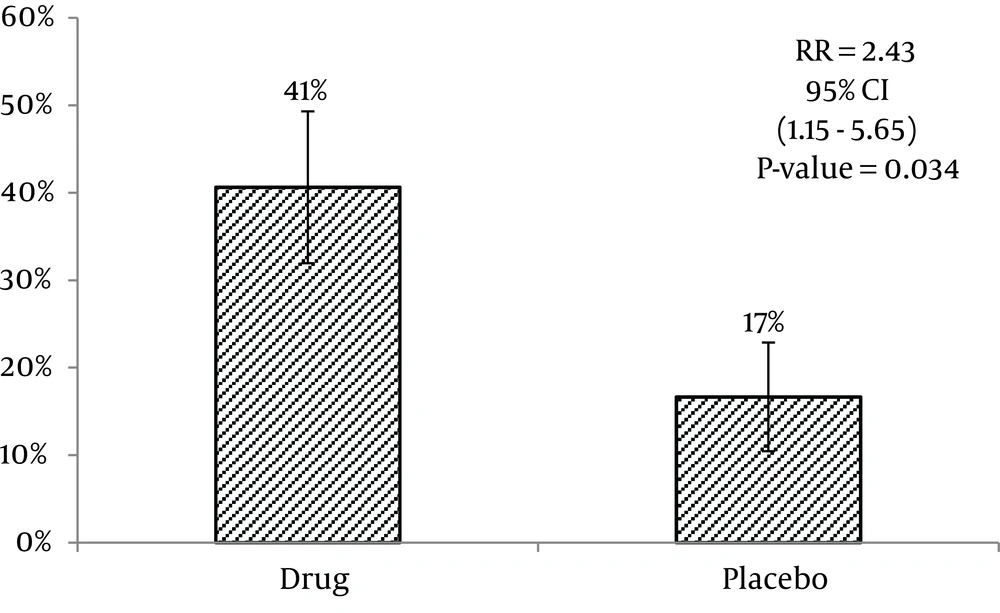
Figure 2.
The error bar for sonography finding improved according to the two groups
5. Discussion
Although balanced weight is approved as a key to treat NAFLD complications, less than 50% of people have been successful in losing weight (19). Hence, using a combination of a healthy balanced diet and complementary and alternative therapeutic options is necessary. Nowadays, several pharmacological options are available to treat NAFLD, including insulin-sensitizing drugs (metformin and thiazolidinediones), lipid-lowering agents (orlistat and statins), hepatoprotective medications (ursodeoxycholic acid), and antioxidants (vitamin C and vitamin D) (3, 20). The findings of the present study revealed that Ajwain consumption for two months could significantly change the total score of the Leeds questionnaire, TG, ALT, and sonographic findings, which is in line with a previous study (15). In other words, our results support the efficacy of CCS in treating NAFLD patients. Some studies mentioned Ajwain as a key for reducing weight, and it is the main ingredient of some medications of Greek traditional medicine (fixed-dose combination) (21). According to the Iranian Traditional Medicine (ITM), the change's in the normal temperament of the liver (warm) toward a cold temperament weakens the normal function of the liver, which in turn results in increased prevalence of chronic liver diseases such as NAFLD. Therefore, warm herbs and liver tonic are widely using for treating patients with NAFLD (22). The extracts and essential oils of Ajwain seeds are using as a digestive and liver tonic in the ITM. Also, in his book "Canon of Medicine", Ibn Sina has considered Ajwain as a liver tonic, effective in treating liver diseases, and cold liver (11). The methanolic extract of Ajwain also contains hepatoprotective properties. An in vivo study reported that the methanolic extract of Ajwain could protect the liver by avoiding an increase in the serum levels of liver enzymes of AST, ALT, and ALP followed by a normally-lethal dose of paracetamol and preventing CCl4-induced prolongation of pentobarbital sleeping time in mice (23). In the present study, the serum levels of ALT were significantly dropped in patients treated with Ajwain seed extracts compared to the placebo group.
The anti-hyperlipidemic properties of alcoholic and oily extracts of the C.copticum powder have also been proven on albino rabbits. This issue is associated with a decrease in the total LDL-C (low-density lipoprotein cholesterol), total fats, and triglycerides, and a significant increase in HDL-C. It also contains significant amounts of fiber, which affects fat metabolism by reducing the intestinal absorption of fat (24). In the same vein, the findings of the present study indicated a significant decrease in serum triglyceride levels for the drug group compared to the placebo group. However, at the end of the study, no significant changes were observed in FBS, CHOL, LDL, and HDL. Accordingly, it is possible to achieve better results by increasing the drug doses, treatment duration, and using other methods for preparing the studied drugs.
The results of the ultrasound demonstrated that the drug group had better outcomes than the placebo group. Our literature review revealed that apart from the study of Shafizadeh et al. (15), no other study has investigated the effects of Ajwain on the fatty liver. However, Hormati et al. developed a randomized, double-blind, controlled trial study and showed that Dava Al-Balgham (a combination of Trachyspermum Ammi and three plants of Nigella sativa, Zataria multiflora, and Pistacia lentiscus) has a significantly greater effect on weight loss, waist circumference, and serum ALT level in patients with NAFLD than that of the placebo. These results are consistent with the findings of the present study (16). Several clinical studies have investigated the effect of herbal remedies such as Glycyrrhiza glabra, Cuminum cyminum, Berberis vulgaris, Cinnamomum zeylanicum, Chlorella vulgaris, Camellia sinensis, Silybum Marianum, Zingiber officinale, Cichorium intybus extract, Curcuma longa (25), Capparis spinosa (26), Zataria multiflora (27), and Beta vulgaris extract (28) in the treatment of fatty liver. Their results showed that herbal remedies have several properties (e.g. antioxidant and anti-inflammatory) that can be effective in treating and preventing the development of NAFLD.
In addition to the factors of overweight, obesity, metabolic disorders, malnutrition, and inactivity (29, 30), some other factors such as chronic bacterial infection caused by Helicobacter pylori (31, 32) and intestinal microbiota (33) can affect the development of NAFLD or severity of its consequences. Some researchers reported that gut microbiota in lean individuals can increase the accumulation of liver fatty acids and mediate various inflammations of TNFα and interleukin-6 (34). On the other hand, the Ajwain plant can be effective in the treatment of fatty liver and patients with NAFLD, mainly because of its anti-bacterial properties (35) and positive effects on the modification of intestinal microbes (36). It has also been reported that in NAFLD patients, fat accumulation in the liver stimulates the production of ROS and increases oxidative stresses in mitochondria and inflammation of liver cells, which result in cell death (3). Therefore, this plant can inhibit the progression of the disease through its hepatoprotective properties (23, 37) and its antioxidant and anti-inflammatory effects (38). Since the NAFLD is associated with hypertension (it is a component of the metabolic syndrome (39)), Ajwain can help treating NAFLD patients through its anti-hypertensive properties (9).
The current study has three main limitations. The first one is associated with the application of FibroScan. Although it is one of the best non-invasive tests for quantifying liver fibrosis, because of financial limitations, we did not use this technique in the present study. The second limitation is about not considering insulin resistance. The third limitation revolves around the time limitation, so that this study was implemented in two months. Hence, these limitations should be considered in future studies.
5.1. Conclusion
This study demonstrated that oral consumption of the aqueous extracts of CCS for eight weeks has a significant effect on patients with NAFLD. In addition, it could significantly improve ALT and the grade of fatty liver. In other words, it was found that through significantly reducing WHR, TG, and relative reduction of BMI, CCS can help physicians to manage other metabolic disorders associated with NAFLD such as obesity and hyperlipidemia.


