3’ untranslated region of HCV genome is slightly variable among different genotypes. HCV replicates with different recognition signals at the 3’-end and this may contribute to differences in virulence of different genotypes and their replicative efficiency in cell culture system (
23). Results of cloning and sequencing of HCV 3’ untranslated region from five infected patients showed 98% similarity among intra-genotypic isolates and 87% homology among inter-genotypic isolates reported from other countries, showing that, although conservation is maintained in this part of the genome, different genotypes do exhibit some nucleotide variations. The nucleotide sequence of this region confirms the presence of three distinct regions i.e., a variable region (VR), a poly U/UC tract (of variable length and sequence in five different samples) and a highly conserved 3'X-tail as reported previously (
8 ,
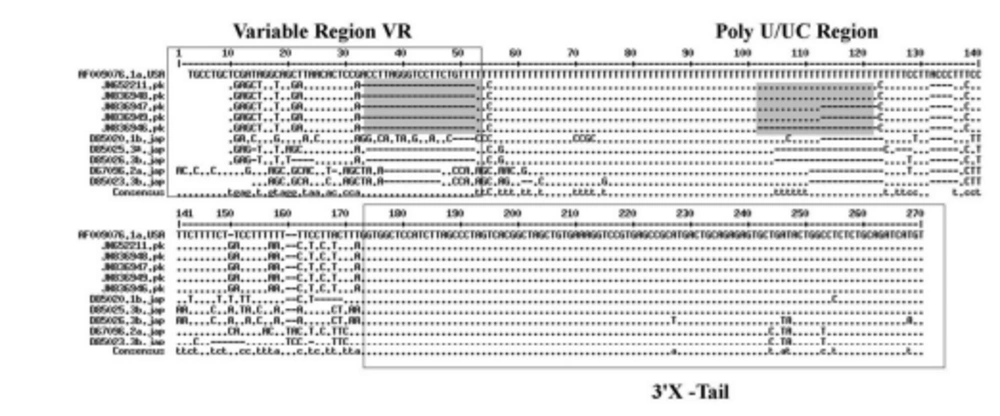
24). The length of variable region is 26 nucleotides and its sequence was conserved in all 5 clones, length of Poly U/UC region was different, two clones JN652211 and JN836948 have 111 nucleotides in this region, while JN836947 and JN836949 have 101 nucleotides, a single clone JN836946 had 90 nucleotides (
Figure 1). The X-tail was the most conserved part, 98 nucleotides in length. A domain ACACUCC at position 16 and a UUC motif representing the last three nucleotides of variable region as previously described for the HCV-3a strain S52 (
25) were found conserved in all of our clones. Additionally no extra U residues were found at the end of the X-tail in our 3a isolates, as otherwise reported for the variants of HCV 1b genotype. To further analyze, multiple sequence alignment of clones (accession numbers JN836946, JN836947, JN836949, JN652211, JN836948) was carried out with the HCV genotype 1a 1b, 2a, 2b, 3a, 3b isolates (
Figure. 1). Results showed that the variable region is significantly different in length and nucleotide sequence among different genotypes whereas it is conserved among the same genotype. Alignment results showed that reference strain HCV H77-1a has a 10 nucleotide sequence at the end of the variable region (VR); this region is found to be missing in all of our clones and the one reported from Japan with subtype 3a (accession number D85025). The length and sequence of Poly U/UC region is different among our clones, varying from 100 nts (JN836948, JN652211), 91nts (JN836949 JN836947), to 79 nts (JN836946). This finding is in consistency with the Poly U/UC tract of variable length in earlier reported sequences of 1a and 1b (
25,
26 ) and a homouridine sequence with a minimum of 26 residues are essential for effective replication in cell culture (
5). Interestingly the length of poly U/UC tract is associated with the replication efficiency of the virus in chimpanzees as HCV with a longer poly U/UC region had a replicative advantage over the one with a shorter poly U/UC region (
27). While the last region, 3'X tail, was found to be 98 nts and was conserved in all of the different genotypes giving possible evidence for its involvement in replication, stability (
6,
28) and translation of HCV polyprotein (
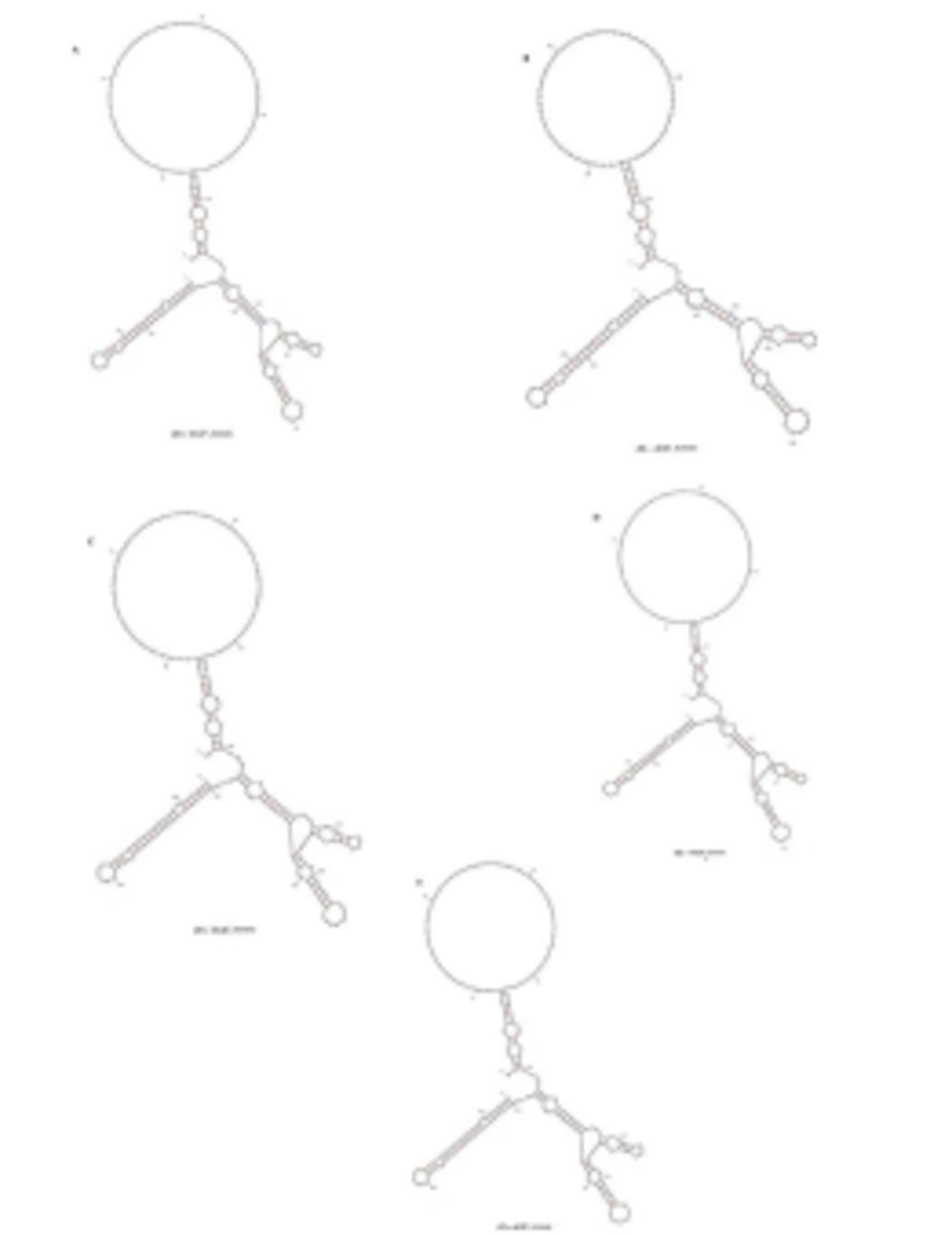
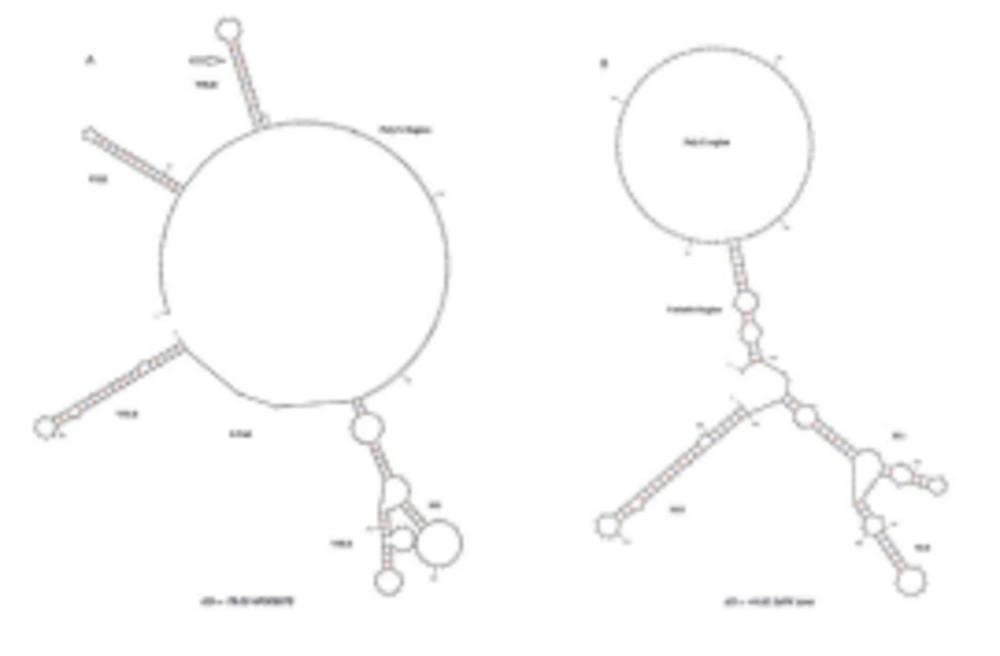
29). Secondary structure for this RNA molecule was predicted using the Mfold software, which is a dynamic programming software based on minimizing free energies (MFE) and provides the thermodynamically favored structure. The predicted structure contained one stem loop in the variable region and three stem loops in the X-tail with a minimum free energy of -52 kcal/mol (
Figure 2,
3). Although two stem loops are reported for the variable region in the 3'UTR (
4 ,
5) a missing stem loop in the variable region in our isolates (
Figure 3) might have some subtype specific functional importance that needs to be investigated. The varying length of Poly U/UC does not affect its overall secondary structure (
Figure 2,
3). Despite the minor substitutions, the overall secondary structure of 3'X-tail is conserved as the stem loops I, II and III in this part have been reported previously to be essential for in vivo infectivity (
27,
30,
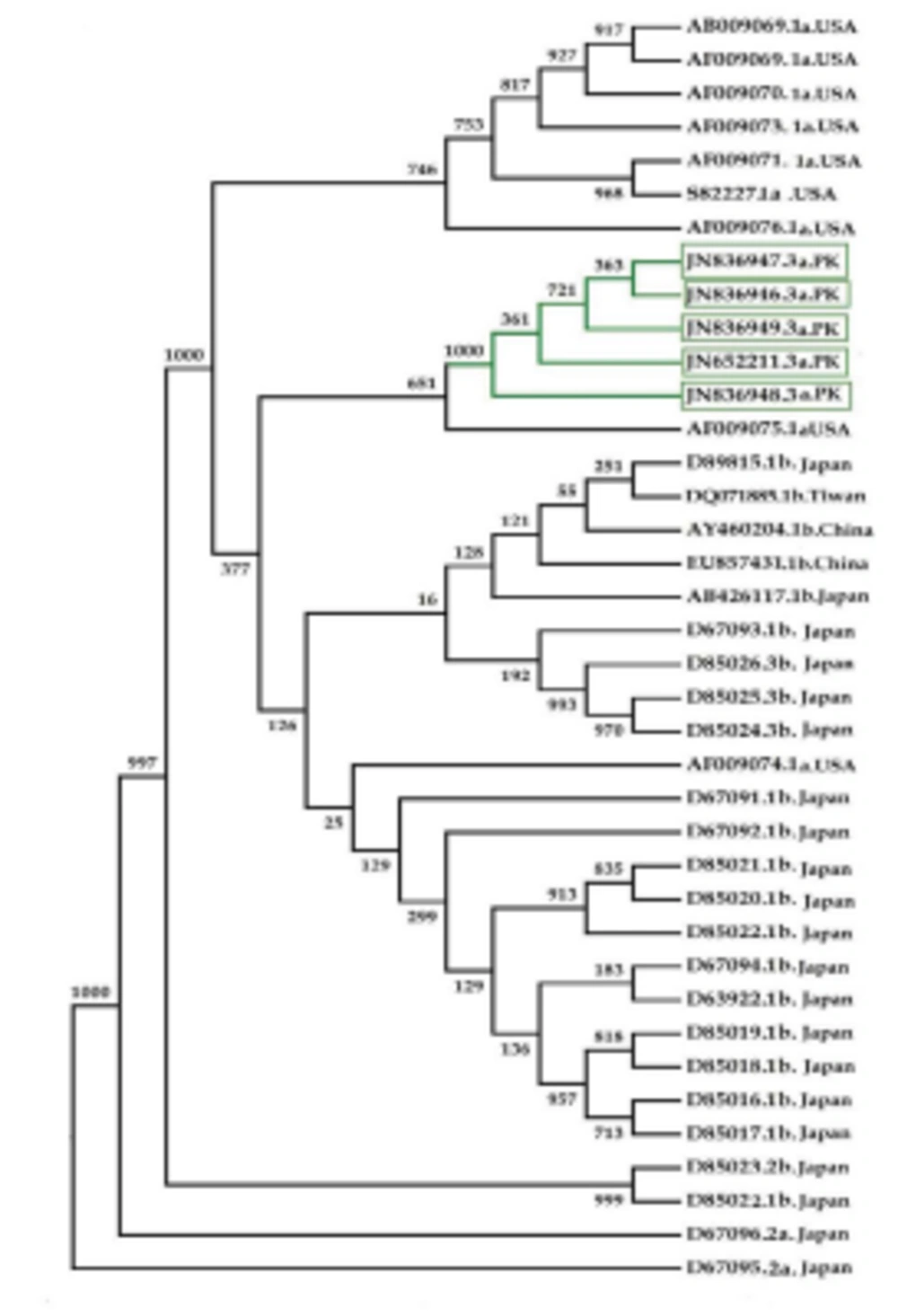
31). To analyze the phylogenetic relationship between our Pakistani HCV isolates and other strains reported from different parts of the world, 3'UTR sequences were retrieved from the HCV data base. There are a few 3'UTR sequences in the data base and the rest of them were taken from the full genome. There are a few reliable full genome sequences available. Only those sequences that showed reliable results are included in the phylogenetic analysis. The phylogenetic trees were constructed using the maximum likelihood method (
22) . The tree constructed clustered Pakistani isolates together (
Figure 4) showing their close relationship with 1a USA and Japanese subtype 1b. Recent reports from Pakistan also suggest a phylogenetic link between Pakistani HCV isolates and Japanese HCV isolates for genes like the NS4a region (
32) core region (
33) and E1, E2 region (unpublished data from our lab). There are a few reports on the structural and functional motifs of HCV 3'UTR. However, from protein binding and deletion mutant studies, it is now believed that this cis-acting element is indispensable for viral replication. Our study suggests that there is a vital need for extensive characterization of this region from all genotypes. It would be of great interest to evaluate the functional role of genetic diversities existing in variable and poly U/UC region of 3'UTR. We propose that these variations might be responsible for heterogenic viral efficiency and pathogenicity associated with inter-geographical and inter-genotypic isolates. To the best of our knowledge, the current study is the first report on 3' untranslated region from HCV genotype 3a, from Pakistan. We have observed a missing stem loop in the variable region of our isolates that might be associated with the relatively high rate of HCV infection in Pakistan. In addition polyU/UC region was found to be variable in length and sequence both inter-genotypically and intra-genotypically. These variations may be associated with replication efficiency of individual HCV isolates and possibly play an important role in variable outcomes of the disease seen in various patients infected with the same genotype. Since the X-tail reported here is highly conserved among all genotypes, suggesting its imperative role in replication and proving it to be a potential target of RNA interacting drugs. This study necessitates functional characterization of these HCV regulating elements to elucidate variable viral efficiency and pathogenecity associated with inter-geographical isolates.