IHH is the most common benign tumor of the liver in children, which accounts for 12% of all pediatric liver tumors and HBL is the most common malignant liver tumor in children, which accounts for 40-60% of all pediatric liver tumors (
1-
6). Histopathologically, IHH is recognized as a mesenchymal tumor composed of thin vascular channels lined by a single layer of plump endothelial cells within a scanty fibrous stroma (
8). Most IHH cases lack symptoms and regress spontaneously without treatment(
9), thus the actual incidence of IHH may be higher than 12% of all pediatric liver tumors. The treatment algorithm bases on the imaging features of the lesions and the presence or absence of complications(
10). HBL is classified by histopathology as epithelial type or mixed epithelial/mesenchymal type. Surgical resection is the mainstay of treatment for HBL, and with the use of neoadjuvant chemotherapy, up to 85% of HBL cases become resectable and can be cured(
11).
The age of diagnosis of IHH and HBL is notable, nearly 86% of IHH cases are diagnosed in the first 6 months of life, and approximately 30-50% of the HBL cases occurre in the first year of childhood (
1-
3). The IHH is also the most common fetal and neonatal liver tumors(
2); which may develop apparent or severe clinical complications such as palpable abdominal mass, cutaneous hemangioma and congestive heart failure (
6,
10). In our series, the mean age of diagnosis of IHH and HBL was 5.8 months and 35.1 months respectively. Three IHH cases and thirty-two HBL cases were older than 6 months, all asymptomatic, and we speculated that lack of symptoms might result in their delayed diagnosis. Additionally, although the palpable abdominal mass was more likely to be detected in HBL group than IHH group, from birth to a palpable abdominal mass may be a long time, which might be the reason for the older mean age of diagnosis of HBL than IHH.
Serum AFP is a useful laboratory marker for the differential diagnosis of pediatric liver tumors. AFP concentrations are normally elevated at birth, up to 40,000 ng/mL, decrease rapidly after birth, and do not reach the normal adult level until 6 months of age(
7). AFP levels are rarely elevated above the normal reference range for age in IHH patients, while nearly 90% of HBL tumors consist of hepatoblast-like cells which secrete large amounts of AFP (
2,
3,
5,
11). Unambiguous etiology of increased serum AFP in IHH is not well-established, recent study has shown that hepatocytes near or entrapped within the IHH tumor might be the source of the increased serum levels(
12).
In our study, there were some similar clinical features between IHH and HBL. Firstly, similar to the HBL group, the IHH group also showed a male predominance, which was contrary to previous studies (
3,
4,
6,
10). Small sample of our IHH group might be the reason. Secondly, although there was no HBL patient suffering from cutaneous hemangioma and CHF, only four in IHH group suffered from these two complications and no statistical difference was detected (
P > 0.05). The precise incidences of cutaneous hemangioma and CHF in patients with IHH are unclear because of the wide disparity in different studies (
3,
10,
13). Thus, the two clinical features should not be considered as an effective indicator for distinguishing IHH from HBL.
The imaging findings play a vital role for the diagnosis and treatment strategies selection forpediatric liver tumors. There are several modalities in common use including CT, MRI and ultrasound. With the improvements of these imaging techniques, findings of dynamic contrast-enhanced CT and MR are often specific and diagnostic for IHH (
4,
14); however, it is deemed inappropriate to take CT or MR as the first-line imaging method for children with suspected liver mass due to its radiation or high cost. Ultrasound can provide real-time assessment, it is not expensive, without ionizing radiation, and moreover, it helps to evaluate the hepatic and portal venous involvement (
15).
In nearly 50% cases of the both groups, the lesion was located in the right lobe of the liver, which was consistent with previous studies (
1,
3,
11). Mortele et al(
16) proposed that the number of lesions cannot be regarded as an indicator for distinguishing IHH from HBL because both diseases can present as solitary or multiple, and our study also supports this finding. Calcification is attributed to central hemorrhage, necrosis, or fibrosis of the lesion, especially in IHH with large size and HBL of mixed epithelial/mesenchymal type (
17,
18), our study showed no statistical difference in the frequency of calcification between the two groups. As regards to the vein tumor thrombus, it may occasionally occur in HBL whereas never occurs in IHH because of their different pathological behavior, but the difference of vein involvement incidence was not significant, thus, it was a non sensitive indicator in the differential diagnosis.
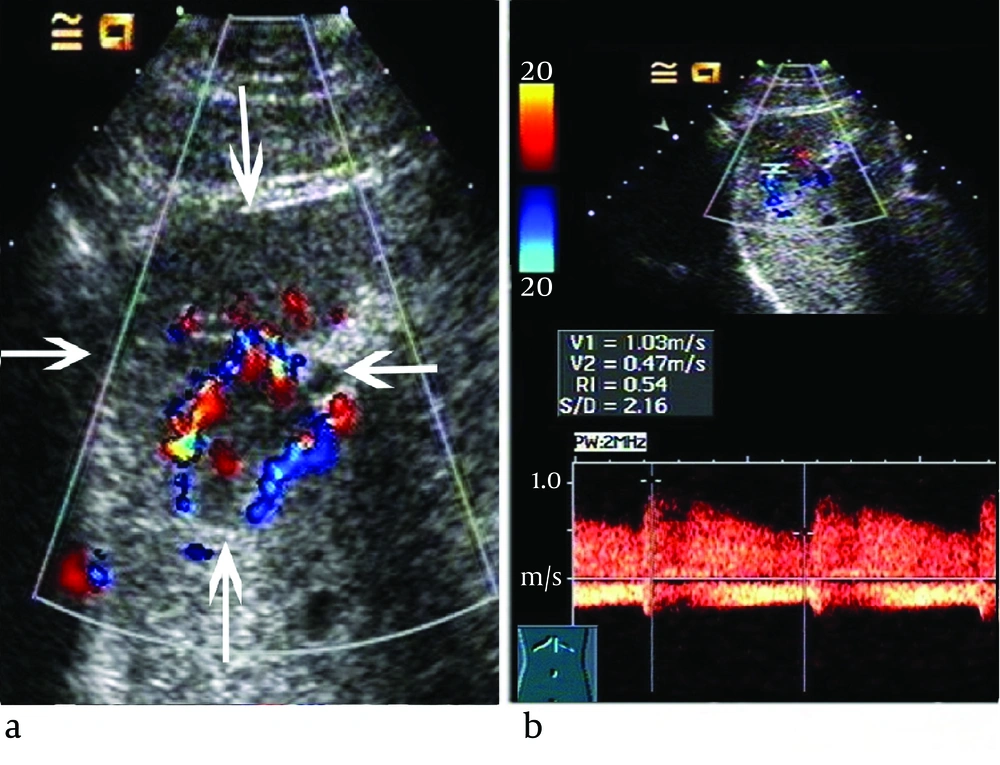
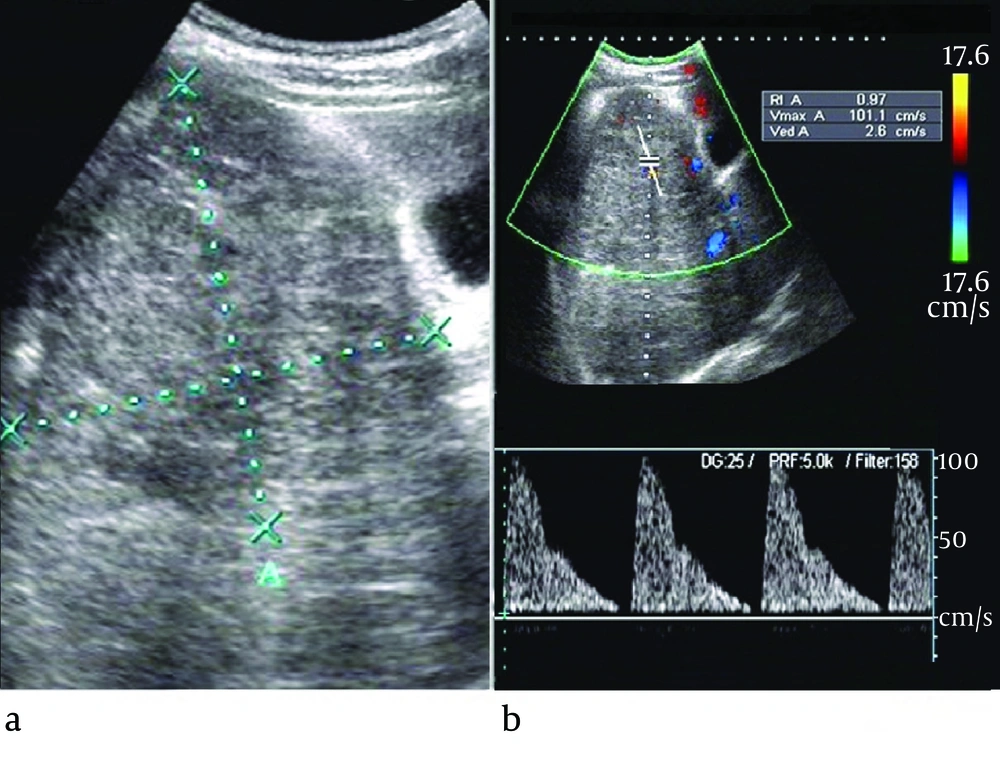
The color and spectral Doppler analysis of IHH revealed a variety of flow patterns. Kassarjian et al (
18) showed abnormal color flow in 60% of IHH patients and the presence of shunting was confirmed in 44%. Paltiel et al (
19) studied 13 children with IHH and revealed that the range of the peak Doppler shift overlapped with those previously literatures reported for malignant liver tumors. Other reported Doppler features included enlarged hepatic arteries and veins, large feeding and draining vessels surrounding or within the tumors, venous flow in some anechoic areas (
18,
20). However, little attention has been paid to analysis of resistant index (RI). In our series, the color Doppler showed color flow in 8 (61.5%) IHH patients and the spectral Doppler also showed variable flow patterns: venous flow only in one case, arterial flow and/or venous flow in 7 cases, which was in accordance with published data (
18-
20). Although the abnormal color flow were the same commonly observed in HBL compared to IHH, the spectral Doppler showed significant difference between the two diseases, that is, the IHH was more prone to appear as arterial flow with RI < 0.7 and/or venous flow, whereas the HBL was more likely to appear as arterial flow with RI > 0.7. Histologically, the IHH is composed of numerous vessels in size from small (capillary) to large (cavernous), it contains arteriovenous malformations and venous, lymphatic or capillary components (
19), thus it may act as arteriovenous shunt with relatively low RI and/or venous flow. Whereas the HBL mainly consists of numerous and disorderly hepatoblast-like cells, we speculated that lack of arteriovenous anastomosis or draining vein might be the reason for relative higher RI in HBL. Therefore, although IHH showed great variability in Doppler ultrasound, spectral Doppler might be of great utility in differential diagnosis between IHH and HBL.
Nearly 10% of HBL occurs in the neonatal period and it is also the third most common of the fetal and neonatal liver tumors (
2,
21). IHH may obtain a delayed diagnosis due to absence of symptoms. Moreover, recent studies have showed IHH with elevated AFP and HBL with very low AFP level (
22,
23). Thus, a combination of multiple parameters may be much more efficient. Combined the clinical features including age (< 6 months) and normal AFP level yielded high capability in differential diagnosis, with sensitivity, specificity and Youden index of 77% (10/13), 95% (36/38), and 0.72. When combined clinical features (age and AFP) and spectral Doppler as the diagnostic criterion for distinguishing these cases with positive color flow signals, the sensitivity, specificity, accuracy and Youden Index were 88%, 95%, 89% and 0.83, respectively. In other words, clinical features and spectral Doppler are useful parameters for differential diagnosis.
There were several limitations to our study. Firstly, four patients with IHH didn’t obtain pathological diagnosis owing to the risk of bleeding after biopsy and the unsuitability of surgery in patients with multiple or diffuse lesions. In addition, the pediatric liver tumors are rare diseases, so our study is a small series despite the long duration of patient collection over 10 years. Finally, none of the patients in our study underwent contrast enhanced ultrasound (CEUS). Although CEUS has higher diagnosis efficacy in focal liver lesions than baseline ultrasound, it is still a relative contraindication in children.