
1. Introduction
A manuscript submitted to a journal with a robust peer-review system is reviewed by two or more experts in the field. According to the reviewers’ comments and recommendations, the editor decides as to whether (i) accept the manuscript as is; (ii) accept pending English revisions; (iii) reject it; (iv) provisionally accept the manuscript, indicating the need for some minor revisions; (v) indicate that the manuscript needs to undergo major revisions; (vi) recommend transfer to another journal from the same publishing house; (vii) reject and resubmit, which means that the authors have an opportunity to totally revise and resubmit the work as a new manuscript (1-4). Therefore, almost all accepted manuscripts undergo some degree of revisions (2). The word “revision” is defined as “act of revising” or “a change/a set of changes that corrects or improves something.” Revision means to “see again” or “to look at something from a fresh, critical perspective” (5). Revising also is defined as “to look over again to correct or improve” or “to make a new, amended, or up-to-date version” (6).
Appropriate revision of a manuscript is crucial for its eventual acceptance (7). Revision is a learnable skill that is different from the initial manuscript preparation (8). Authors should welcome reviewers' suggestions and revise the manuscript with an optimistic point of view (4) since reviewers are experts who generously spend time evaluating a manuscript and share their expertise to improve a manuscript (9). In addition, the peer-review process improves the manuscript (10) and makes it more scientifically sound, coherent, and compatible with the journal’s desired standards (7, 11). Different sections of the accepted revised version(s), especially the abstract, results, and discussion, are significantly improved compared to the submitted version. For instance, in a study, the general medical value and overall quality were enhanced by 14% and 22%, respectively (10).
In this presentation of the “scientific publishing in biomedicine” series, we provide a practical guide on how to address the various types of reviewers’ comments (i.e., minor or major revisions, conflicting comments, or those that authors disagree with or cannot adhere to) and as to how one should craft a response to the reviews. We also provide the principles for making a successful revision.
2. Functions of the Revision
Revising a manuscript has two main functions: (1) to improve the first version as much as possible and (2) to maximize the final chance of its acceptance (12). Although revising a submitted work may seem frustrating at first, it is notable that the final goal of the reviewers/editors is to improve the overall quality, credibility, and readability of a manuscript (2). In addition, the revision process is a chance for the authors to prevent later embarrassment for a serious flaw that may be indicated in the form of a letter to the editor (13).
3. Process of the Revision
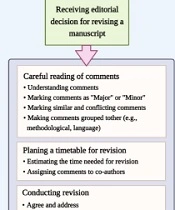
A step-by-step process for revising a manuscript is summarized in Figure 1. Five main steps can be identified and are defined for the revision process: (1) Reading and understanding the comments and marking them as “major” or “minor”, (2) planning a timeline for the revision and assigning the comments to the co-authors to address, (3) conducting revisions and making changes, (4) highlighting the changes in the revised manuscript, and (5) drafting a response to reviewers’ comments.
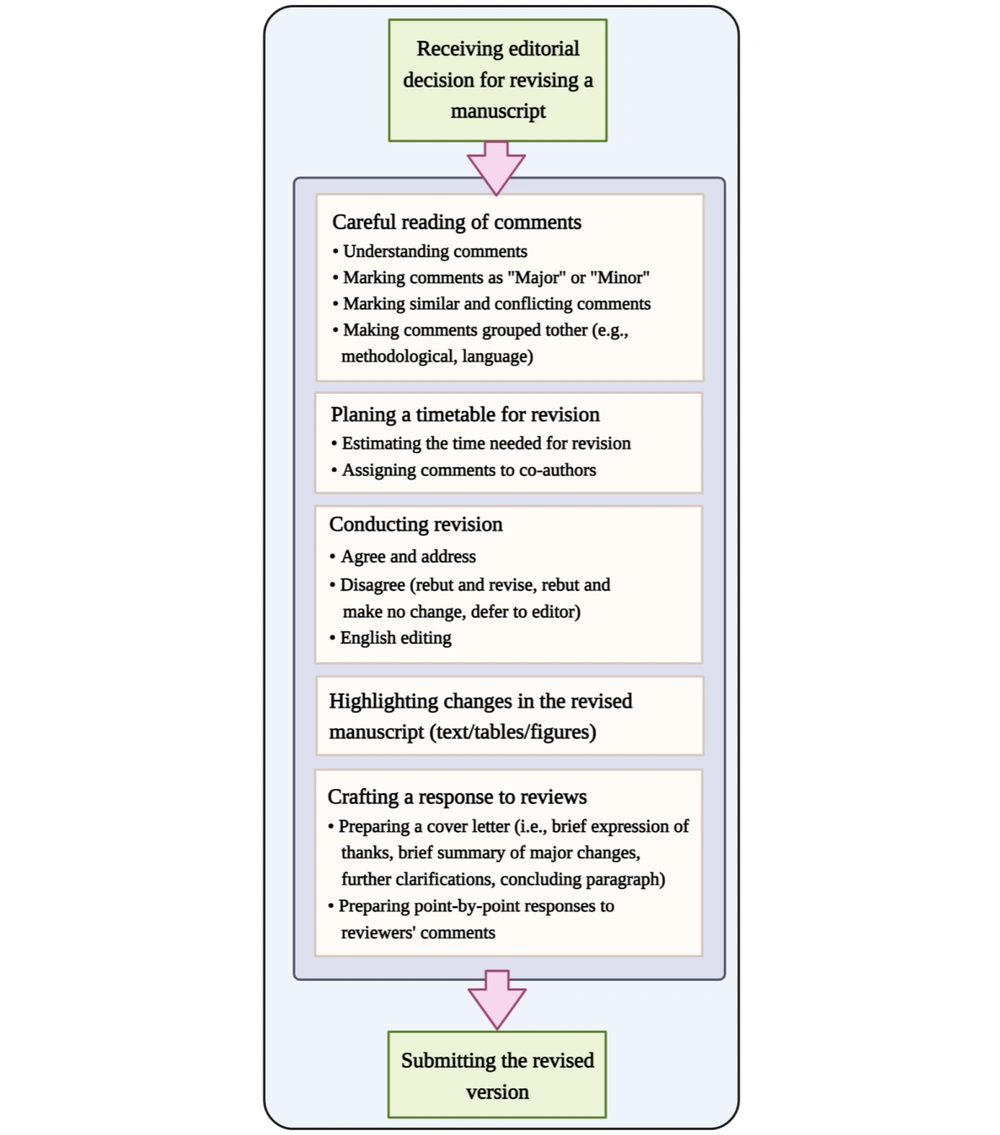
Figure 1.
Step-by-step process of revising a peer-reviewed manuscript
3.1. Reading and Understanding the Reviewers’/Editors’ Comments
Upon receiving the comments, the authors must try to understand them, let the comments percolate for a couple of days, and not respond or make hasty changes (7). They should approach the comments from the reader’s point of view (12). A good idea would be to meet with the co-authors and research group members to brainstorm in order to generate ideas and reach a consensus on the comments.
Authors may receive comments as an organized and numbered report or as long paragraphs including several comments. Authors, therefore, should make sure that they read, understand, and address every comment and split them into several separate points if necessary. A suggestion is to print the review report and start by numbering every comment (e.g., C1, C2, …) (7). If a comment includes multiple suggestions, the authors can split it into separate subsections (e.g., C1.1, C1.2, …). Reviewers may address their comments by identifying the page and line number in their reports (7); otherwise, authors must connect each comment to the corresponding section in the manuscript.
Based on the comments and the recommendations, the editor may decide to require changes categorized as “major” or “minor.” Reviewers are advised to differentiate their comments into major and minor in their referee reports (14); however, they may not indicate whether comments are critical (mandatory to do) or merely somewhat important (optional to do). Therefore, the authors need to decipher and identify the major concerns that the reviewers have and to prioritize the reviewers’ comments, asking themselves, “which comments are critical and will cause the manuscript to be rejected if they are not addressed?”
Adequately addressing a/the major comment(s) is (are) critical and necessary for acceptance of the manuscript (13); editors, therefore, consider major corrections essential for the final acceptance of the manuscript. Major comments are usually related to the scientific and methodological contents of a manuscript (15). They typically address inconsistencies among different manuscript sections, faulty deductions, insufficient data to support the conclusions or overreaching conclusions, inadequate description of the methodology or experimental procedures, and insufficient references to provide adequate background to the issue being discussed.
Minor comments are suggestions for improving the manuscript, which the reviewer is likely to leave to the author’s discretion to adhere or not (13). As defined by Morgan (16), the editor-in-chief of Canadian Medical Association Journal, a minor revision usually includes one or more of three activities: (1) providing additional information or adding references, (2) deleting unnecessary material, or (3) making minor corrections in the text (e.g., sentence structure errors, misspelled words, etc.). Tightening up the language, deleting tables with similar content in the text, and shortening the introduction and discussion are the most common suggestions provided by reviewers as minor comments (16). Comments on syntax or grammar/typographical mistakes, quality of tables and figures (4), and experimental requests that are not crucial to the conclusion but may improve the manuscript are other examples of minor comments. The editor may skip minor comments, and these comments may not result in receiving a rejection.
Some comments from the two or three reviewers may be similar, or there may be opposite or even conflicting views about the same issues. In that case, the authors need to mark and handle them appropriately when conducting the revision and writing a response to the reviews. It may also be helpful if the authors mark the related comments and assign them into a category; e.g., all the comments related to methodology could be grouped, and all that is related to language could be under one category (17).
3.2. Planning a Timeline and Schedule for the Revision
Following effective reading of the reviews, the second step is to estimate the time needed for an effective revision. Authors should plan to complete the revision within the editor's suggested time frame, and if they think it may exceed the deadline, they should request the editorial office for an extension. For revising a manuscript with multiple authors, a practical strategy is to create a table and add all the comments, and then assign one or more comments to an author to address. This approach can simplify the revision process and ensure that the manuscript is resubmitted within the deadline. In addition, if the editor requests a minor revision, sending the revised version back quickly may result in a more prompt acceptance because the editor’s mind is likely to be fresh (18).
3.3. Conducting the Revision
The third step in revising a manuscript is conducting the requested changes according to the comments. Dealing with comments may not be straightforward because authors do not find the comments always justified or feasible; in addition, reviewer’s misunderstanding, some kind of ambiguity, or conflicting comments make revising a challenging work. Authors are advised not to take a negative or major comment as a personal attack and instead approach it with a neutral perspective. For conducting the revision, comments are divided into those that authors agree or disagree with (Table 1).
Table 1.
Conducting Revisions of a Peer-reviewed Manuscript (12)
| Author Decision on Reviewer Comment | Feasibility/Effect on the Manuscript | Suggested Actions |
|---|---|---|
| Agree | Feasible to do | Provide changes that best address the requested work |
| Not feasible to do | Discuss it as a study limitation | |
| Disagree | A suggestion would not make the manuscript any better | It is advised to make change |
| A suggestion would make the manuscript worse | Rebut but revise to provide more clarification | |
| Rebut and make no change | ||
| Defer to editor |
3.3.1. Agreeing with the Reviewers’ Comments
In the case of major comments, if you agree with a comment, provide changes that best address the requested changes (12). However, if the requested experiment/work is not feasible, but the authors agree with the reviewer’s opinion, they should discuss it as a study limitation; however, this action may result in rejection (12). Sometimes, reviewers fail to understand or appreciate a point, and authors notice that the point might also not be clear enough for the readers. In that case, they should apologize for the lack of clarity and try to make their point clearer, without any ambiguity, by re-writing the sentences or providing enough background (13, 19). In the case of minor comments, the authors are advised to make such requested changes without arguing with the reviewer(s), even if they do not entirely agree (18, 20).
3.3.2. Disagreeing with the Reviewers’ Comments
In some cases, authors may decide that the reviewer's suggestion is not correct. Here, there are two possibilities: (1) the suggestion would not make the manuscript any better, and (2) the suggestion would make the manuscript worse, for which they have three options as discussed below (Table 1) (12).
3.3.2.1. Rebut but Revise
In most cases of disagreement(s), the authors need to revise their manuscript anyway (12). These include minor disagreement(s), or when adhering to the reviewer’s suggestions is possible and, in general, does not harm the manuscript (12). In some cases, the authors may disagree with the comment(s) but may satisfy the reviewer by minor modifications to the text. Generally, it is better to appreciate such comments, thank the reviewers for their suggestion(s), so that they are convinced that they are listened to and understood (19). For example, suppose a comment criticizes the novelty of the work. In that case, the authors may need to enhance the clarity of their study question, highlight the gaps in current knowledge in the introduction, discuss their new observations, or provide more details about the study's implications. Suppose a reviewer suggests further interesting experiments or analysis, but that will not change the conclusion; it is acceptable to rebut but highlight the suggestion as a direction for future research in the revised manuscript. If a reviewer fails to understand something but the authors believe that the text is clear enough or the reviewer may miss the point, they are advised to accept the blame and revise the text as much as possible (19).
3.3.2.2. Rebut and Make no Change
In case of serious disagreement, where comments are contrary to the authors’ opinions or requested changes seem “unreasonable”, opening the discussion with the reviewer is acceptable. Some requested changes by the reviewers may be too extensive and not possible, e.g., increasing sample size or changing the study protocol (3). Likewise, if the reviewer(s) request too much work that falls outside the study's aim, it is acceptable to reply that the request goes beyond the scope of the current study (19). In that case, the authors should discuss scientifically and systematically rationalize their disagreement. Even more preferably, they should back it up by supporting evidence and citing references in the reply (13). This reasoning helps the editor understand the authors' reason(s) and goes a long way to convince them why they are correct and that the requested change is unnecessary or undesirable (21). Another case for rebutting and not making changes is the reviewers' conflicting comments. For example, reviewer #1 requested the authors to do X instead of Y, but reviwer #2 emphasized that Y is better; if authors believe that reviewer #2 is correct, the authors should rebut the comment of reviewer #1 and refer to the statement made by reviwer #2 (Figure 2).
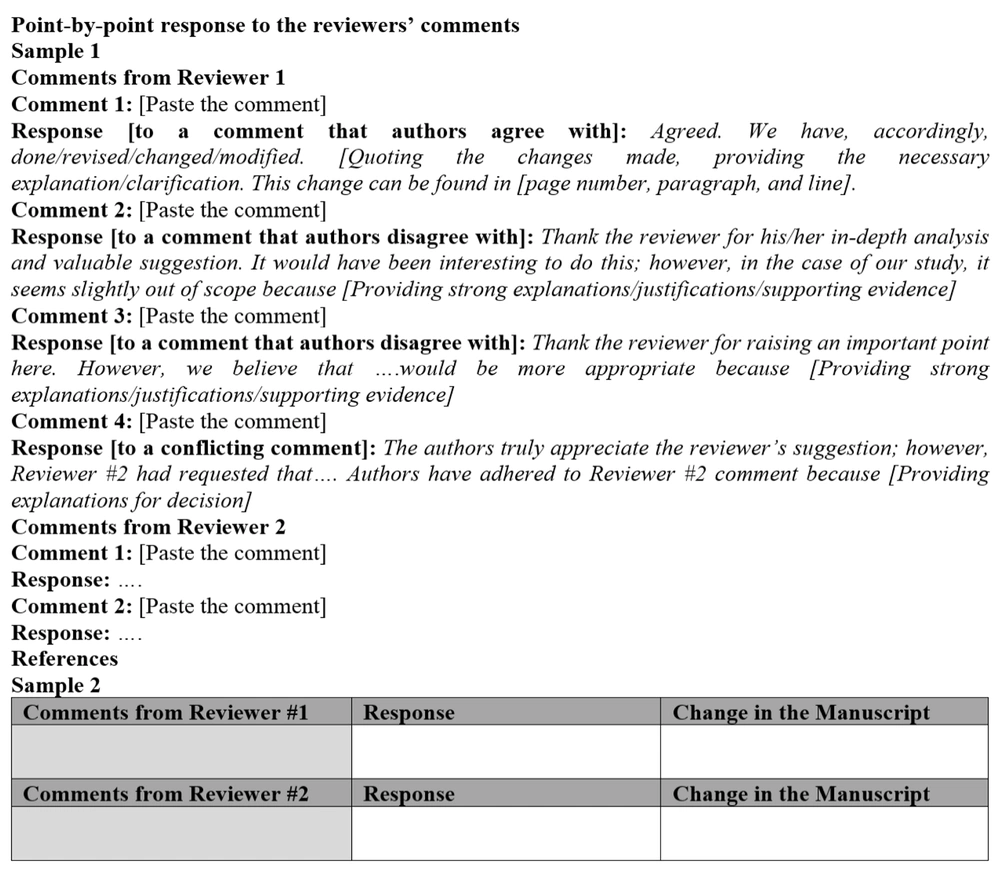
Figure 2.
A sample of point-by-point response to reviewers’ comments
3.3.2.3. Defer to Editor
Suppose the authors scientifically discussed their disagreement with a comment, but the response did not (or would not) make the reviewer satisfied. In that case, the issue can be resolved by appealing to the editor (13). For example, the reviewer requested authors to do X instead of Y, but the authors believe that Y is the best; in that case, the authors should refer the issue to the editor by using these words “If the editor strongly prefers X, please let us know, and we can amend and provide an alternate version.” Another case to request the editor(s) for final judgment is if the reviewer has made conflicting comments, which is the most frequent call to editors (22).
3.3.3. English Editing
Although some preliminary evidence indicates that there are or could be linguistic bias issues in academic reviewing (23), native English speakers may criticize the language because it does not sound natural to them. In that case, the manuscript should be carefully revised by the authors. A native English speaker or a professional language editing service should be employed to improve the readability and convince the reviewer(s). Authors may benefit from online writing assistants such as Grammarly to improve the text.
3.3.4. Updating the References
Before finalizing the revision, it is recommended to seek newly published papers that have not been cited in the first submission. Updating the references and citing recent literature may enhance the manuscript by providing a more up-to-date document around the topic and provide more effective support for the hypothesis of the manuscript (13). This issue should be acknowledged in the cover letter, where the authors highlight further clarifications beyond the reviewers’ requests (see section "cover letter").
3.4. Highlighting the Changes in the Revised Manuscript
After addressing the requested suggestions, all changes within the text/table(s)/figure(s) should be identified by coloring/highlighting or using Microsoft Word’s track changes feature. Some authors prefer to use different colored fonts or highlights to separate corresponding responses to different reviewers. This issue needs to be addressed in the cover letter by a sentence, e.g., "red- and blue-colored text represent changes requested by reviwer #1 and reviwer #2, respectively". The authors need to follow the journal's instructions since some journals indicate how changes should be incorporated. For example, the journal may request you to submit two versions of the revised manuscript, a "revised version with highlighted changes" and a "clean version". Notably, authors should try to address the reviewers’ comments while they adhere to the journal’s requirements; e.g., if presenting more data is requested by the reviewers, but the journal restricts the length, the data may be provided as supplementary material (24).
3.5. Preparing a Response to Reviews
The final step in completing the revision before its resubmission is crafting a “response to reviews”, or a rebuttal, which has two aims (12): (1) outlining the changes made in the manuscript and how they address the reviewers’ criticism, and (2) make it easy for the handling editor to accept the paper. Response to the reviews has three sections: (1) “a brief expression of thanks”, (2) “a summary of major changes”, and (3) “detailed point-by-point responses to reviewers’ comments” (12, 25). These sections may be merged as one document or accommodated as separate files, including “cover letter” and “response to reviewers” (25). A well-organized response to the reviews will minimize a potential source of confusion and frustration for both the reviewers and editors, enhancing the chance of acceptance (21).
3.5.1. Cover Letter
In the first part of the cover letter (also known as the second cover letter (26)), the authors acknowledge the editor and reviewers for their time and for considering the manuscript and providing valuable comments. For example, they can use the following: “we thank the editor and reviewers for their time and careful reading of our manuscript and thoughtful comments” or “we would like to thank the reviewers for their time, thoughtful comments, and efforts towards improving our manuscript”. This introductory section shows that the authors are cooperative, appreciative of the reviewers’ efforts, time, and enthusiasm for improving their work (12). When a reviewer provides very insightful suggestions, the authors can also appreciate the reviewer in the acknowledgment section of the manuscript by an explicit sentence like "we would like to thank the reviewer for the time and effort devoted to improving the quality of our work" (21). However, some journals may not allow the acknowledgment of reviewers (19).
In the second part of the cover letter, the general concerns of reviewers and a concise description of the authors’ efforts to address these concerns should be highlighted (12). This paragraph addresses the most substantive changes in the revised version (e.g., new experiment or new analysis that change the conclusion). Addressing conflicting or divergent comments or any serious disagreement with a reviewer can be presented here. For example, when the authors adhere to one of the conflicting comments, they need to explain why they did not adhere to the other conflicting comment. Authors should explain how they choose one of the conflicting comments and provide supporting evidence by writing a strong statement (27). The rebuttal may also say, “the reviewers do not seem to be consistent with their suggestions, and in some cases, are quite divergent”. If the requested changes made by the authors surpass the journal's word count and or reference limitations, they should be highlighted in this section. In that case, the following answer can be sent to the editor: "responding to all the reviewers' suggestions has made it necessary to increase the number of citations and extend the length of the manuscript. We have gone from 35 to 45 citations, and from 4250 to 5210 words”. Any additional changes in the revised version beyond the requested changes by reviewers/editors should be addressed here. In this section, the authors can also indicate if one or several comments were unclear; they should emphasize that they would welcome further clarity if the reviewer/editor believes the change should be made (21).
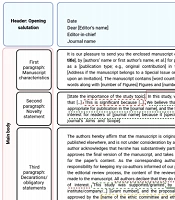
The concluding paragraph of the cover letter should be a straightforward but polite ending; for example, “the authors wish this version will satisfy the editor and reviewers and meet all standards of the journal. The authors welcome further constructive comments if any”. Such formal and polite sentences reflect a willingness to make further changes if required (17). A sample of cover letter is provided in Figure 3.
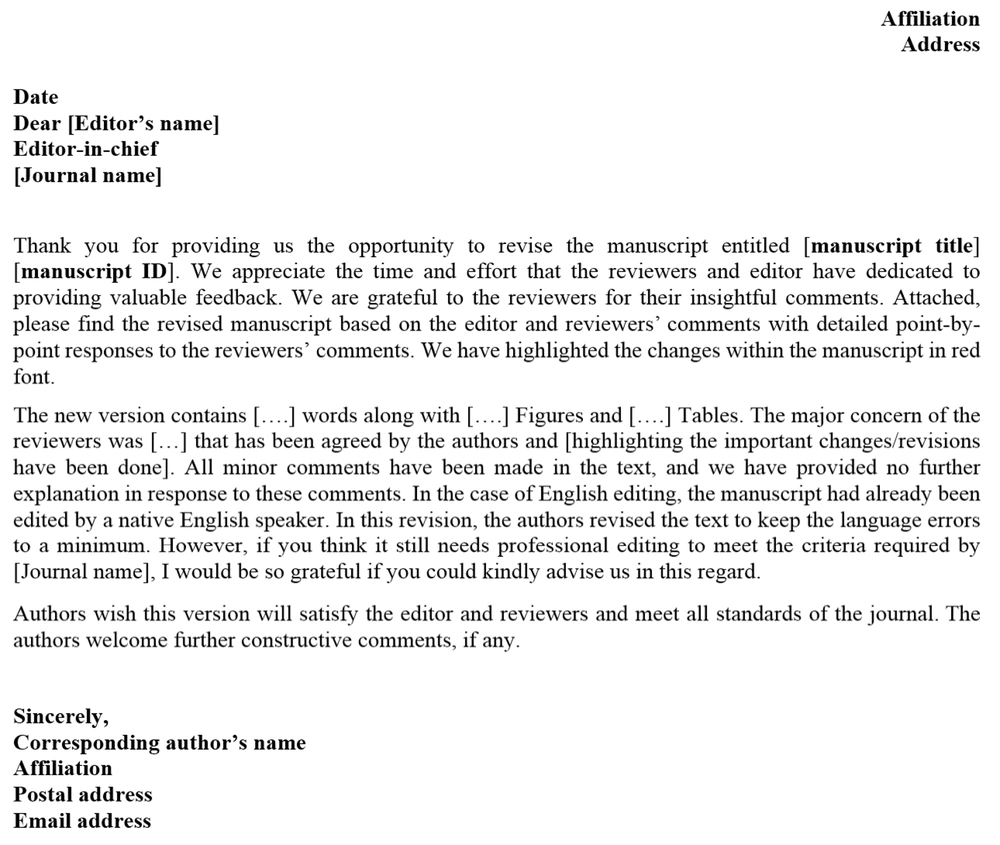
Figure 3.
A sample of second cover letter
3.5.2. Response to the Reviewers
This section should be organized using the headings such as “reviewer 1” then “comment 1”, followed by “response” (18, 21). The authors should make sure that each comment is answered and listed consecutively. Authors should reply in the same order as the comments made by the reviewer. One recommendation is to copy and paste all of the reviewers’ and editor’s comments and insert the response to each point immediately below it, using a different color or font to distinguish the comments from the response (24). An alternative way in organizing the responses to the reviewers is to use a table including the referee’s comments, the author responses, and the changes made with “page and lines” in different columns (21). A sample of point-by-point response to reviewers’ comments is provided in Figure 2.
3.5.3. Components of a Response to a Comment
A response to a comment, which the authors agree with and have performed essentially, has three main components: (1) a short and definite response (i.e., agreed or yes), (2) a quote indicating the change directly, and (3) an address to the change(s). For replying to minor comments such as grammatical corrections or formatting, a short response like “agreed and done” is satisfactory (12). When a suggestion improves the manuscript significantly, a brief note of thanks at the start of the reply is welcomed (13). Quoting the changes made directly in the response is recommended unless the changes are significant; for example, including a new section/table is too long to quote. Such an approach helps the reviewers to understand the changes without back and forth between the text and the response, making the response self-contained (19). Corresponding changes in the text/tables/figures should be addressed directly in the response by specifying the page and line number of the revised manuscript.
Replying to a comment that the authors disagreed with and refused to adhere to should not be opened with phrases such as “we totally disagree” or “the reviewer obviously does not know this field” (18). Instead, the authors should try to show their disagreement by choosing words that do not offend the reviewers and show appreciation of the comments/suggestions. Some useful phrases for polite rebutting of comments have been provided (18). Moreover, authors should not just reply with a simple assertion of disagreement (e.g., We disagree) and then move on (21). Instead, they should go ahead with their explanations or provide enough background supporting their argument. In case of multiple interpretations of a comment, the authors' response should explain what they have understood and proceed with the argument (20). If two reviewers raised similar comments, authors should reply to both, but their response to reviwer #2 may be just a simple address, e.g., “see the response to reviwer #1, comment 3”.
3.5.4. General Rules of Replying to a Comment
General rules to effectively reply to a comment are “answering completely”, “answering politely”, and “answering with evidence” (18). Keeping a neutral and polite tone throughout the responses is essential, especially in case of disagreement(s) with the comments/suggestions. In both agreeing and disagreeing replies, the author should respect the reviewers’ opinions. Overall, the authors' response must sound more like a scientific discussion than a court defense (18, 21). Authors may require to support their argument by citing references or including supplementary/unpublished data (20). Some good examples of “appropriate, strong, clear, and compromising” compared to “inappropriate, weak, vague, and confrontational” responses to referees’ comments are available for interested readers (21).
4. After Revision
After submission of a revised version of a manuscript, the authors will be informed by the journal’s editorial office about a decision on their manuscript, which may be “accept”, “invite for a second revision”, or “reject.” Upon acceptance for publication, the corresponding author will be contacted to correct the proofs of the manuscript. Box 1 provides the dos and don’ts of galley proof corrections and proofreading of an accepted manuscript.
Box 1.
Galley Proof and Proofreading of an Accepted Manuscript
| The Dos and Don’ts of Galley Proof Corrections and Proofreading |
|---|
| Almost all journals send an electronic “galley proof” to the corresponding author to make suggestions using an online form or provide a separate pdf document annotated by the author’s corrections. Collins dictionary defines "galley proof" as a "printer's proof taken from type in a galley to permit correction of errors before the type is made up in pages." Thus, proofreading an accepted manuscript aims to correct superficial spelling, grammar, syntax, punctuation, and formatting (28). |
| At this stage, the authors have a final opportunity to make corrections (in text, tables, figures, or references); however, more substantial changes (e.g., new results, corrected values, and changes of the title and authorship) are not permitted unless discussed with the editor (29). Publishers usually provide 24 - 72 hours for authors to revise and return the corrected proofs. |
| Authors should consider some critical points at the proofreading stage: checking the authors' names and affiliations, updating citations (for in-press references published at the proofreading time), and checking for typos and grammar errors. Authors may also be asked to answer queries from the copy editor. |
| Some publishers like Elsevier (30) and Springer (31) offer an online proof tool that helps the authors quickly and easily apply corrections, comments, and change requests to their galley proof and submit them directly for correction. |
The revised manuscript might be sent back to the authors, with the editor requesting a second round of revisions if the submitted revisions were not satisfactory. In that case, the authors need to follow and repeat all the steps outlined in revising the manuscript again. In case of a rejection, the author should try to understand why the manuscript was rejected and how they can improve it for submission to another journal.
5. Conclusions
Revising a peer-reviewed manuscript has five main steps, including (1) effectively reading the comments, (2) providing a scheduled framework for the revisions, (3) conducting the revision, (4) highlighting changes in the revised manuscript, and (5) crafting a suitable response to reviews. The principles of making a good revision are provided in Box 2. Revising the manuscript and making a well-organized response to the reviews is a critical component of the scientific publishing process that affects the manuscript’s destiny, being accepted for publication or rejected. One of the most important rules to perform a successful revision is maintaining a positive attitude and be open to criticism. In case of any disagreements, the authors should reply with a well-reasoned justification supported with enough background and details. A self-contained point-by-point response to the comments that clearly addresses the corresponding changes in the manuscript helps the reviewers and editors to quickly appreciate the changes made by the authors.
Box 2.
Dos and Don’ts of Revising a Peer-reviewed Manuscript
| Dos |
|---|
| Read all comments carefully and try to peek inside the reviewer's mind |
| Seek advice from co-authors and expert colleagues, or refer to the editor if a comment is unclear (especially where the unclear comment is a major point) |
| Discuss with the reviewer and editor scientifically and systematically |
| Provide enough scientific background in case of a disagreement with a comment or refuse to make the requested changes |
| Cite references appropriately in reply to support an argument |
| Be polite and respectful when responding to both agreeing and disagreeing comments |
| Be consistent in performing manuscript changes and replying to the comments |
| Keep your response concise and to the point |
| Highlight all changes in the text/table/figure clearly |
| Address all changes by specifying page numbers and lines in response to comments |
| Check for page numbers and lines of changes after finalizing the text |
| Follow journal's guide for authors for resubmitting |
| Revise within the deadline appointed by the editor |
| Don'ts |
| Ignore a reviewers' comment that you do not understand or have a problem handling it |
| Rebuttal all or most comments |
| Argue for minor requested changes |
| Reply with a short response without providing enough details |
| Include data/result/reference or additional information just in response to reviewer, not in the manuscript or supplementary material |