
1. Introduction
Primary adrenal insufficiency or Addison disease (AD) is a rare illness resulting from the failure of glucocorticoids with or without deficits in mineralocorticoids and adrenal androgens. The incidence rate of AD is about 35 to 120 cases per million people. Its symptoms depend on the level of stress, glucocorticoid, mineralocorticoid, androgen deficiency, and t comorbidities. Diagnosis in the symptomatic period is not difficult; however, it is challenging in the initial phase. Symptoms are not specific at onset and may include generalized weakness, lassitude, anorexia, fatigue, vertigo, chronic malaise, preferential salty meals, orthostatic hypotension, weight loss, and muscle and joint pain (1).
AD is a relatively uncommon disease; however, its prevalence has grown in the last three decades. Based on an expressive registry, autoimmune adrenalitis is the commonest etiology of AD (2). Skin hyperpigmentation and neuropsychiatric manifestations, like irritability, apathy, cognitive impairment, depressive symptoms, sleep disorders, and delusions, are observed during adrenal insufficiency. Psychiatric symptoms and isolated clinical manifestations are rare at the onset of AD (3). Instead, they are commonly accompanied by the cardinal signs of adrenal insufficiency associated with the disease severity. Although this problem is essential, several physicians, such as endocrinologists and psychiatrists, are not informed about the correlation between such diseases. This report presents a case with adrenal insufficiency manifested by the psychotic syndrome.
2. Case Presentation
A 28-year-old Iranian female, a primary school teacher, with a history of immune thrombocytopenic purpura (ITP) and asthma since childhood, presented with a 13-month history of progressive depression with insomnia and nightmare symptoms. After a specialized psychiatric consultation, haloperidol, clomipramine, and clonazepam were prescribed. After eight months, the patient's symptoms worsened, and abdominal pain and weight loss due to anorexia started. Because of GI symptoms, the psychologist requested a gastroenterologist consultation.
She was an active teacher in primary school, formerly without any problem. Due to tiredness and inability to teach, the patient had applied for retirement. The patient complained of amenorrhea and lost 10 kg weight in eight months.
During the first visit, she was cachectic and agitated. She had mild dehydration with an arterial blood pressure of 85/40 mmHg, a respiratory rate of 18/min, a blood glucose level of 90 mg/dL, and a pulse rate of 120/min (Table 1). Her physical exam showed hyperpigmented elbow, knee, ankle, and buccal mucosa in the mouth (Figure 1). Physical examination and initial laboratory tests suggested adrenal insufficiency. A specialized laboratory test was performed to confirm the diagnosis (Table 1). Laboratory test and abdominal CT confirmed AD (Figure 2, Table 2). Therefore, she was admitted to the ward due to her general condition and examination. A complete blood count test was performed (Table 2). The percentages of neutrophils, lymphocytes, monocytes, and eosinophils were 38%, 51%, 3%, and 8%, respectively. Mean corpuscular volume (MCV) was normal; therefore, we did not check ferritin since there was normocytic normochromic anemia.
Table 1.
Vital Signs and Primary Laboratory Tests
| Parameters | First Day | Second Day | Third Day | Fourth Day |
|---|---|---|---|---|
| BP (mmHg) | 85/50 | 95/60 | 98/65 | 10/68 |
| PR (No/min) | 110 | 100 | 98 | 85 |
| BS (mg/dL) | 80 | 75 | 90 | 89 |
| Ca (mg/dL) | 8.6 | 8.8 | 8.7 | 8.7 |
| Creatinine (mg/dL) | 1 | 0.9 | 0.9 | 0.7 |
| BUN (mg/dL) | 30 | 25 | 20 | 18 |
| HB (gr/dL) | 9.5 | 9.8 | 9.5 | 10 |
| WBC (c/mL) | 7500 | 7800 | 9000 | 9500 |
| PLT (c/mL) | 67000 | 78000 | 120000 | 160000 |
| Na (mEq/L) | 130 | 134 | 136 | 138 |
| K (mEq/L) | 3.3 | 3.8 | 3.9 | 4 |
| pH | 7.3 | 7.35 | 7.36 | 7.36 |
| HCO3 (mmol/L) | 15 | 18 | 21 | 22 |
| CO2 (mmHg) | 28 | 23 | 36 | 37 |
Abbreviations: BP, blood pressure; PR, pulse rate; BS, blood glucose; Ca, calcium; BUN, blood urea nitrogen; HB, hemoglobin; WBC, white blood cells; PLT, platelets; Na, sodium; K, potassium.
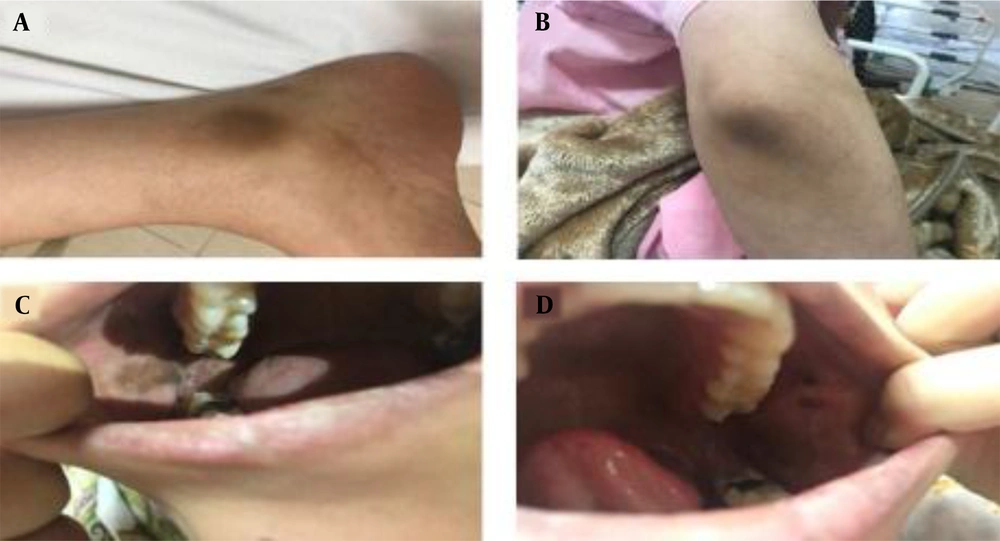
Figure 1.
A) Wrist hyperpigmentation, B) elbow hyperpigmentation, C and D) buccal mucosa hyperpigmentation
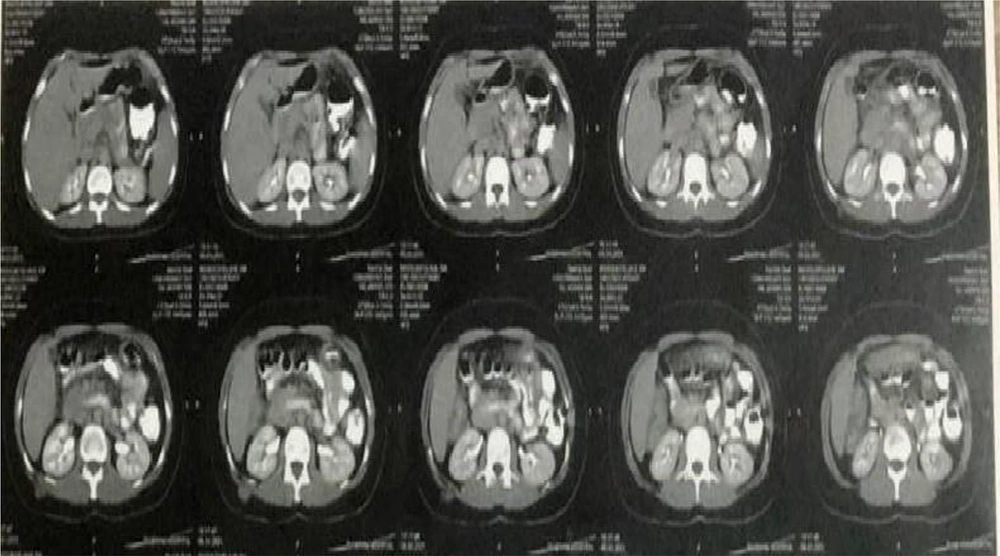
Figure 2.
Abdominal CT
Table 2.
Results of Hormonal Tests and Differential CBC
| Parameter | Values | Normal Range | Unit |
|---|---|---|---|
| Serum cortisol | 1 | 60 - 230 | ng/mL |
| ACTH | 355 | 7.1 - 53.3 | pmol/L |
| Prolactin | 35 | 5 - 40 | ng/dL |
| LH | 7.5 | 1.2 - 12.7 | mIU/mL |
| FSH | 10 | 3.3 - 21.7 | mIU/mL |
| Estradiol | 43 | 15 - 30 in follicular phase; 60 - 480 in mid - cycle; 42 - 250 in luteal phase | pg/mL |
| TSH | 3.4 | 0.35 - 5.5 | mIU/L |
| Free T4 | 14.35 | 10 - 22 | pmol/L |
| Total IgA | 118 | 40 - 70 | mg/dL |
| Anti TTG | 16 | < 20 | IU /mL |
| Neutrophils | 38 | 40 - 60 | Percentage |
| Lymphocytes | 51 | 20 - 40 | Percentage |
| Monocytes | 3 | 1 - 4 | Percentage |
| Eosinophils | 8 | 0.5 - 1 | Percentage |
Abbreviations: ACTH, adrenocorticotropic hormone; LH, luteinizing hormone; FSH, follicle-stimulating hormone; TSH, thyroid-stimulating hormone.
Hormonal tests were conducted due to the patient's menstrual irregularity (amenorrhea). This was performed to check that amenorrhea is not because of a pituitary problem. According to the results (Table 2), the serum level of cortisol was low (1 ng/mL), and plasma ACTH level was very high (355 pmol/mL), showing that the patient had primary adrenal insufficiency (primary adrenal disease), characterized by menstrual irregularities. The patient also was suffering from hypokalemia due to anorexia and vomiting. The exact information about her vomiting duration and frequency was not recorded, but she vomited several times a day.
To correct hypokalemia, we started intravenous hydrocortisone (100 mg every eight hours) and normal saline (3 L/day). The symptoms significantly improved on the third day. The patient remained calm and had a normal sleep without depressive symptoms or psychosis after 72 hours of treatment. The patient's depression medication was discontinued based on psychiatrist consultation. The patient was discharged with hydrocortisone (30 mg/day) and fludrocortisone tablets (0.1 mg/day).
During one year of follow-up, she was in good general condition without psychological symptoms and continued her work as a teacher. The patient's menstrual disorder disappeared during this period, and she gained 6 kg weight.
3. Discussion
In the current case report psychiatric disorder was a significant symptom of chronic adrenal insufficiency. This case showed no severe clinical manifestation and cardinal symptoms of this metabolic disorder, like the Addisonian crisis. Klipel, in 1899, for the first time reported AD psychiatric manifestations defined as "Addisonian encephalopathy" (4). Limited similar case series (n = 25) published from the 1940s to 1950s indicated a 64 - 85% correlation between AD and psychiatric diseases. Nonetheless, nowadays, this association is not widely considered (2).
The majority of case studies of AD associated with psychiatric symptoms represented that male patients are slightly more influenced than females, and such symptomatology commonly can start before treatment and diagnosis of adrenal insufficiency. Depression, as the most common disorder, is accompanied by adrenal insufficiency, with commonly mild mood manifestations, motivation reduction, and behavior change. On the other hand, catatonia, psychosis, delirium, disorientation, and memory deficit are not commonly observed. Psychosis correlates with Addisonian crisis and severe AD symptoms, and merely nine case reports showed a correlation between a psychotic symptom and the primary clinical picture of adrenal insufficiency.
The cause of psychiatric disorders in AD has not been well addressed, and there are many theories suggested in some case reports. Hyponatremia is linked to brain swelling and encephalopathy, leading to memory, consciousness, and thinking disorders. Decreased glucocorticoid, which can be found in the brain, particularly the hippocampi, causes memory deficit and frontal circuit dysfunction with reduced processing speed, executive function, reasoning, and thinking. A reduction in cerebral glucocorticoid stimulation increases neural excitability, leading to an improvement in sensory information detection. Also, proopiomelanocortin (POMC) as an anterior pituitary hormone is produced secondary to reduced glucocorticoid. In addition, elevated endorphin levels are associated with psychosis and hallucinations (4).
In the case of adrenal insufficiency diagnosis, each cause is associated with inadequate low cortisol generation. Serum cortisol levels are elevated in the early morning (about 6 AM) and range from 10 to 20 mcg/dL (275 to 555 nmol/L) compared to other times during the day. The low serum cortisol level (lower than 3 mcg/dL or 80 nmol/L) in the early morning suggests adrenal insufficiency. The patient is diagnosed with primary adrenal insufficiency (primary adrenal disease) when serum cortisol is inadequately low, and a simultaneous plasma ACTH level is very high, similar to the present case study.
In primary adrenal insufficiency, plasma ACTH at 8 AM is high (over 4000 pg/mL; 880 pmol/L). In patients with mineralocorticoid deficiency, besides cortisol deficiency, plasma renin level or activity should be assessed, while aldosterone concentrations are low, with elevated serum potassium and reduced serum sodium concentrations. On the contrary, in secondary or tertiary adrenal insufficiency, plasma ACTH levels are low or low normal (Table 1). The normal level of ACTH at 8 AM ranges commonly from 20 to 52 pg/mL (4.5 to 12 pmol/L) in the two-site chemiluminescent assay (5, 6). Previous studies have shown that AD is associated with other autoimmune diseases; thus, a medical history of coeliac disease, thyroid disease, vitiligo, or atrophic gastritis increases suspicion of another autoimmune diagnosis and the probability of another autoimmune polyendocrine syndrome (APS).
For AD treatment, hydrocortisone in two or three divided concentrations (total concentration: 10 to 12 mg/m3/day) is considered the glucocorticoid of choice to manage chronic primary adrenal insufficiency. Glucocorticoid dose relieves symptoms of glucocorticoid deficiency. Most patients with primary adrenal insufficiency finally need mineralocorticoid replacement using fludrocortisone. Dehydroepiandrosterone (DHEA) therapy is suggested for females with an impaired sense of well-being or mood instead of optimal glucocorticoid and mineralocorticoid replacement when needed. The main points investigated in this study are:
(1) Keep in mind that psychiatric disorders, such as insomnia, agitation, and depression, can be the manifestations of AD, but they may rarely be the first manifestations;
(2) Adrenal insufficiency should be considered while treating a psychiatric patient (with depression and psychosis) with no family or personal history of psychiatric illness or cases without failed medical treatment for depression;
(3) Addison disease is an autoimmune disease that can be seen with other autoimmune diseases (type 1 diabetes, autoimmune thyroiditis, celiac disease, premature menopause, Graves' disease, pernicious anemia, and Sjögren's disease).
In conclusion, we reported a rare case of psychiatric disorder as a significant symptom of chronic adrenal insufficiency. This case indicated that physicians should be informed about the neuropsychiatric symptoms of adrenal insufficiency. This should be considered while treating a psychiatric patient (with depression and psychosis) with no family or personal history of psychiatric illness or cases who failed medical treatment for depression. Psychiatric disorders have a high prevalence, and adrenal insufficiency is a rare disease; therefore, an appropriate workup is recommended in exceptional cases such as the presence of some clinical manifestations of AD.