1. Background
Ramadan, the ninth lunar month, is the holiest month for Muslims around the world. During the 29 - 30 days of Ramadan, fasting is an obligatory observance for Muslims, including medical staff who practice Islamic teaching. Islamic fasting is an intermittent fasting that lasts from dawn to sunset. It differs from other intermittent fasting models (1, 2), because observants do not drink during the Ramadan fasting period. In tropical regions of Indonesia, the fasting duration is 13-14 hours. The majority of Muslims normally have two meals a day during the fasting month: one before sunrise and one after sunset (3). They are encouraged to continue their normal daily activities during Ramadan fasting, with little change made to physical activities.
Previous studies have found varied effects of Ramadan fasting (4-16). The duration of Ramadan fasting varies among areas of different latitudes. Hence, the effect of Ramadan fasting may differ between countries. Climate, culture and socio-demographic status could also influence the variety of Ramadan fasting effects.
In healthy individuals, Ramadan fasting decreases body weight, low-density lipoprotein (LDL) and fasting plasma glucose (6-10). One study has reported Ramadan fasting to be associated with evening hypercortisolism and increased insulin resistance (15). These changes during Ramadan fasting are expected because the limited frequency of meals and the fasting state can affect body metabolism and the circadian cycle (15). In the fasting state, the body switches its source of energy from glucose to fatty acids. Fatty acids are released from adipocytes, which can decrease body fat. The loss of body fat, especially visceral fat, is desirable, but prolonged fasting can trigger a catabolic state, thus increasing gluconeogenesis with proteolysis, which ultimately decreases protein mass. Examining changes in body composition during Ramadan fasting may give insight into whether this observance could decrease body fat mass without triggering the undesirable effect of gluconeogenesis.
2. Objectives
In this study, we examined the influence of Ramadan fasting on body composition in healthy medical staff.
3. Patients and Methods
This study was a routine longitudinal study of weight changes during and after Ramadan fasting (August – October 2013) in healthy medical staff members of the Dr. Cipto Mangunkusumo General Hospital. The measurement of body weight before and after Ramadan fasting is performed annually in our institution. The subjects were medical staff (physicians, nurses and nutritionists) in the hospital’s internal medicine ward. Every year, all Muslims fast during Ramadan, including medical staff members at the Dr. Cipto Mangunkusumo General Hospital. A consecutive study was designed to gather medical staff members to participate in this study. A week before Ramadan fasting, all staff members were invited to participate in this study. The ethical committee at the hospital (Komite Etik Fakultas Kedokteran Universitas Indonesia RSUPN Dr. Cipto Mangunkusumo) was informed about this study. The committee informally gave permission to publish the result of this study. A written explanation of the study’s purpose and informed consent were given to the participants.
Inclusion criteria were healthy medical staff members who performed normal daily activities while participating in Ramadan fasting for 28 days and who volunteered to be involved in the study. Medical staff members who did not fast for the full 28 days for any reason, such as stopping fasting during menstruation or developing an illness in the middle of the fasting month, were excluded. Forty-three staff members who fasted for 28 days volunteered for and participated in the study. The compliance of the subjects was well observed. Moreover, all of them were medical staff members so that we could easily check their compliance with fasting.
The study consisted of anthropometric, body composition and dietary intake measurements. The measurements were conducted on the first and 28th days of Ramadan as well as 4 – 5 weeks after fasting. The subjects were not given any restrictions or special instructions on dietary intake or physical activity. Measurements from all three time points were obtained for only 25 subjects.
The body weight, height and body composition were measured using GAIA 359 PLUS (Jawon Medical, South Korea), a bioelectrical impedance analysis (BIA) device, via the tetra-polar electrode method using eight touch electrodes. Many studies have shown the BIA to have high accuracy and reliability (17). The device can measure height, weight, protein mass, minerals, water, body fat and waist-to-hip ratio (WHR). The analyses were performed at each time point between 10.00 am and 3.00 pm. According to the National Health and Nutrition Examination Survey guidelines, the waist circumference is the circumference at the top of the iliac crest, and the hip circumference is the widest portion of the buttocks (18).
Dietary intake was evaluated by means of a 24-hour food recall. Food quantities were explained using household measurements (slice, plates, glass, spoons, cups, etc.). A sample of a food record was given as an example. The participants’ individual records were reviewed, and nutrient calculations were carried out using NutriSurvey (NutriSurvey for windows. Copyright 2007. Dr. Juergen Erhardt SEAMEO-TROPMED RCCN, Indonesia. www.nutrisurvey.de). All of the food recalls were reviewed by the nutritionists. The under- or over-reporting of food recalls by the participants was omitted from the dietary data.
Statistical analyses were performed with SPSS (version 17, IBM, New York, USA). The nominal or ordinal variables were reported as proportions, and the numerical variables were reported as mean values and standard deviations or medians with minimum and maximum values. The numerical variables that were measured at, before and during Ramadan were compared using paired t tests for normal data distribution (parametric analysis). For the abnormal data distribution, the Wilcoxon test was used as the non-parametric analysis. Unpaired t tests, one-way analysis of variance (ANOVA) and repeated ANOVA were used for two independent, K-independent and K-dependent sample analyses, respectively. Statistical significance was associated with a P value under 0.05.
4. Results
4. 1. Baseline Characteristics
The majority of subjects were female (84%), and the mean age was 34.19 ± 11.25 years old. Fifty-four percent of the subjects were nutritionists, and the rest of them were physicians (23%) and nurses (23%). The mean weight of the subjects was 59.82 ± 11.25 kilograms. Almost half of the subjects were overweight or obese (49%). Based on the measurement, the mean of the BMIs of the subjects was 23.71 ± 3.96 kg/m2, and the mean of the WHR was 0.80 ± 0.06 meters. Their average calorie intake was 1598.10 ± 454.32 Kcal.
Table 1.
Baseline Characteristics on First day of Ramadan Fasting
| Variable | Frequency No. % | Mean ± SD |
|---|---|---|
| Gender | ||
| Male | 7 (16) | - |
| Female | 36 (84) | - |
| Age, y | 43 | 34.19 ± 11.25 |
| Weight, kg | 43 | 59.82 ± 11.25 |
| Body mass index, kg/m2 | 43 | 23.71 ± 3.96 |
| Waist-to-hip ratio | 43 | 0.80 ± 0.06 |
| Profession physician | 10 (23) | - |
| Nurse | 10 (23) | - |
| Nutritionist | 23 (54) | - |
| Calorie intake, Kcal | 43 | 1598.10 ± 454.32 |
4. 2. Weight and Body Composition Changes During and After Ramadan Fasting
Body composition, BMI, WHR and intake during Ramadan fasting are presented in Table 2. Weight and body compositions decreased during Ramadan fasting, with the exception of protein (P = 0.082). WHR also decreased, but the decrease was not statistically significant. Energy intake increased during Ramadan fasting, but this change was not significant (P = 0.218). Body fat contributed the most significant portion of weight loss, while protein contributed the least.
Table 2.
Changes in Anthropometric Measures and Body Composition During Ramadan Fasting
| Nomber | First day | 28th day | Difference | P Value | |
|---|---|---|---|---|---|
| Weight, kg | 43 | 59.82 ± 11.252 | 58.95 ± 11.201 | -0.874 ± 0.859 | < 0.001 a |
| Protein, kg | 43 | 8.56 ± 1.392 | 8.51 ± 1.376 | -0.049 ± 0.170 | 0.082 a |
| Fat, kg | 43 | 17.00 ± 6.422 | 16.52 ± 6.331 | -0.484 ± 0.597 | < 0.001 a |
| Mineral, kg | 43 | 3.43 ± 0.618 | 3.37 ± 0.614 | -0.054 ± 0.059 | < 0.001 a |
| Body water, kg | 43 | 30.81 ± 4.907 | 30.52 ± 4.875 | -0.293 ± 0.486 | 0.001 a |
| Body mass index, kg/m2 | 43 | 23,71 ± 3.959 | 23.35 ± 3.963 | -0.36 ± 0.371 | < 0.001 a |
| Waist-to-hip ratio | |||||
| Male | 7 | 0.846 ± 0.0500 | 0.839 ± 0,05610 | -0.007 ± 0.0138 | 0.220 b |
| Female | 36 | 0.789 ± 0.0630 | 0.787 ± 0.0618 | -0.002 ± 0.0112 | 0.224 b |
| Calorie intake, Kcal | 39 | 1628.87 ± 434.832 | 1641.82 ± 476.676 | 12.94 ± 760.608 | 0.561 a |
aWilcoxon test.
bPaired t-test.
Weight decreased during Ramadan fasting in this study. However, 4-5 weeks after Ramadan fasting, the weight returned to the same level as the first-day measurement. Figures 1 and 2 show the averages of weight, protein, fat and minerals during and after Ramadan fasting. The fat, body mass and mineral changes were significant (P < 0.05) during and after Ramadan fasting, while the protein mass changes did not reach significance (P = 0.053).
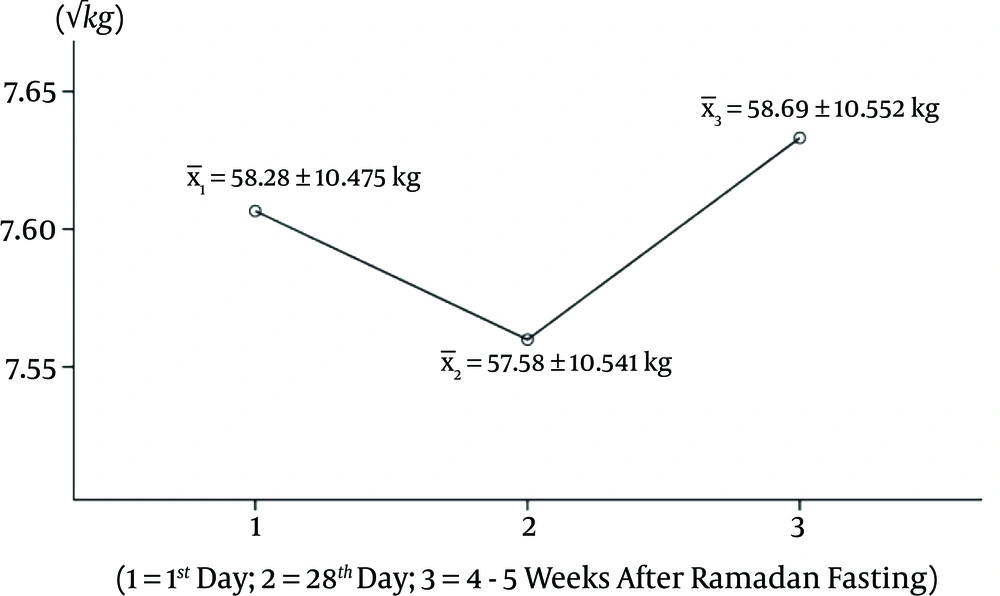
Figure 1.
Body weights on the first and 28th days as well as 4-5 weeks post fasting were significantly different (R-ANOVA; P < 0.001) but did not differ significantly between the first day and 4-5 weeks after Ramadan fasting (P = 0.102).
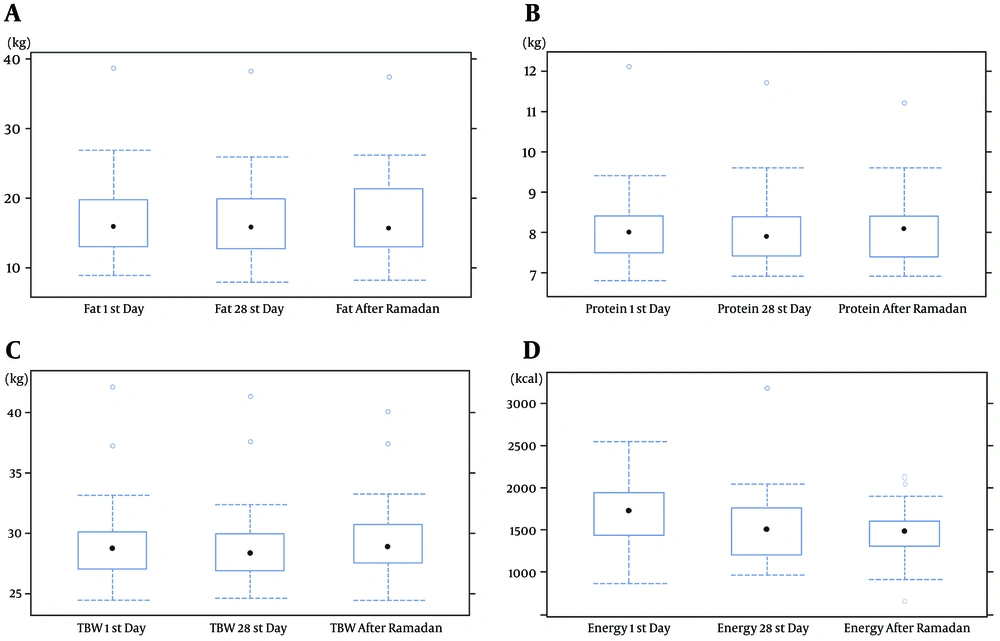
Figure 2.
Weight loss was small but significant for fat A, and protein body mass B, changes between first day and 28th day of Ramadan fasting (P < 0.001), while the total body weight C, and energy D, did not change significantly (P > 0.05).
5. Discussion
Our study reported that Ramadan fasting can decrease body fat without the loss of protein body mass. This could be significant for addressing the safety and benefit of Ramadan fasting and could be considered a rule of fasting for a patient with a metabolic disturbance, i.e. diabetic patients.
A comparison of our results with those of other studies is presented in Table 3. Our study showed Ramadan fasting decreased body weight, consistent with the findings of other studies (5, 6, 8, 10, 19, 20). A notable result is that weight loss was not associated with the decrease in calorie intake. The insignificance of calorie intake during Ramadan was also observed by Norouzy et al. (8) and Sadiya et al. (5) A plausible explanation for the weight loss during Ramadan is the increase in energy requirement due to an increase in physical activity or basal metabolism. During Ramadan, there are additional obligatory observances besides fasting. These obligatory observances include night prayer and reading the Quran, which could increase the observants’ energy requirements. Sleeping patterns also change during Ramadan (15). Bahijri et al. (15) observed that the cortisol circadian rhythm was abolished and that circulating insulin levels and the homeostasis model assessment insulin resistance equation (HOMA-IR) index increased during Ramadan fasting. This pattern is typical of conditions associated with chronic stress, with the level of catecholamine during stress usually increasing. The increase in catecholamine level during Ramadan fasting could influence the body’s basal metabolism. However, further research should be conducted on this theory.
Table 3.
Comparison of Our Findings With other Studies
| Parameters | Present Study | Norouzy et al. (8) | Hosseini et al. (19) | Faris et al. (20) | Sadiya et al. (5) |
|---|---|---|---|---|---|
| Measurement | |||||
| First | 1st day | A week before | A week before | A week before | A week before |
| Second | 28th day | A week after | A week after | 22nd day | Fourth week |
| No. of subjects | 43 | 82 | 15 | 50 | 19 |
| Male | 7 | 31 | – | 23 | 5 |
| Female | 36 | 51 | 15 | 27 | 14 |
| Healthy subjects | Yes | Yes | Yes | Yes | No |
| Ages | 22 – 54 | 18 – 37 | 20–45 | 18 – 51 | 37.1 ± 12.5 |
| Weight changes | Decreased | Decreased | Decreased | Decreased | Decreased |
| BMI changes | Decreased | Decreased | Decreased | No change | Decreased |
| Fat changes | Decreased | Decreased | No change | No change | No change |
| Protein changes | No change | - | No change | - | No change |
| Mineral changes | Decreased | - | No change | - | - |
| Water changes | Decreased | - | No change | - | No change |
| Intake | No change | No change | - | - | No change |
| Weight rebound | Yes | - | - | Yes | - |
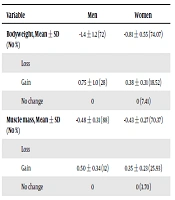
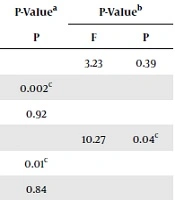
Our study found that the proportion of weight loss did not differ across gender and profession. The study by Norouzy et al. (8) and a meta-analysis by Kul et al. (6) found males to have higher weight loss than females did during Ramadan. Weight loss can be the result of physical activity. In our subjects, relatively no differences existed in physical activity across neither profession nor gender in our medical staff members. However, because the number of subjects was limited, further study is required to validate this finding.
While weight loss during Ramadan fasting was consistently found across subjects, the body composition results varied. The insignificance of protein mass loss in our study was consistent with the findings of Hosseini et al. (19) and Sadiya et al., (5) but the results for fat, mineral and total body water changes varied. In our study, these three body components significantly decreased during Ramadan fasting, with the fat component contributing the greatest proportion of weight loss. Hosseini et al. (19) and Sadiya et al. (5) reported a significant decrease only in body fat. These findings suggest that in Ramadan fasting, the body metabolism is switched to lipolysis but not gluconeogenesis. Gustaviani et al. (21) also found that Ramadan fasting did not cause the formation of β-hydroxybutirate, the product of lipolysis in well-controlled diabetic patients. A decrease in body fat, especially visceral body fat, is beneficial. An increase in abdominal adipose tissue confers an independent risk of cardiometabolic and cerebrovascular disease (22, 23). In this study, we found a non-significant decrease in WHR.
The effect of Ramadan fasting on decreased weight and body fat was small and temporary. In our study, the weight and body fat were regained 4-5 weeks after Ramadan (7, 20). Other studies have also found the weight loss during Ramadan fasting to be regained shortly after Ramadan. The temporary effect of Ramadan on body weight and composition means the benefits of Ramadan fasting do not last long.
In line with our study, there is evidence to suggest that Ramadan fasting decreases several risk factors and improves biological parameters. However, no studies have yet reported the long-term or clinically significant effects of Ramadan fasting on health status in general or on the reduction of metabolic and cardiovascular diseases. A systematic review performed by Salim et al. (14) noted that the incidence of acute cardiac illness during Ramadan fasting was similar to that on non-fasting days, with BMI, lipid profile and blood pressure showing significant improvement in normal healthy subjects, patients with stable cardiac illness, metabolic syndrome, dyslipidemia and hypertension. Unfortunately, there is no evidence to suggest that Ramadan fasting could actually decrease the metabolic or macro-vascular diseases. This could be caused by the temporary nature of the Ramadan effect.
Another form of fasting in Islam is Sunnah fasting, which is held every Monday and Thursday throughout the year. The combination of Ramadan and Sunnah fasting may be able to extend the beneficial effect of religious fasting. Further research is needed to determine the effect of the implementation of such fasting on body weight and general health.
This study discusses the important role of fasting and its effectiveness in reducing weight, BMI, body fat and body water but not protein body mass. Our report could be significant for addressing the safety and benefit of Ramadan fasting. This study can also serve as a reference for practitioners and people who want to follow the rule of Ramadan fasting in reducing weight and also for those who have a metabolism disorder. The limitation of the study is the small number of subjects, which cannot fully represent the general population. Moreover, the proportion of male and female subjects is unbalanced, so this study did not compare body composition between male and female participants.
Ramadan fasting resulted in weight loss even it was only a temporary effect, as the weight was quickly regained within one month after fasting. The catabolism state, which is related to protein loss was not triggered during Ramadan fasting. Ramadan fasting seems to be useful for people who want to reduce their weight, but they need to maintain daily meal and physical activities to prevent weight gain. Further research is needed to evaluate the effects of weight loss during Ramadan fasting in healthy individuals.