
1. Background
Type 1 diabetes (T1D) is the most common metabolic disorder during childhood and adolescence (1, 2), which is caused by the destruction of pancreatic beta cells and a defect in insulin secretion (3). Its prevalence is one in every 400 to 600 children around the world (4, 5). It is increasing in both prevalence and incidence (6, 7) by about 2% to 5% in the world every three to six years (8). It has been estimated that one out of 500 adolescents have T1D in Iran (9). Control of diabetes requires lifetime intensive self-care behaviors (10), and 95% of diabetes care refers to self-care (11); the most important self-care behaviors are diet modification, checking blood glucose, timely injection of insulin, and appropriate physical activity (12). These behaviors are influenced by attitude, personal beliefs, and culture of the society, in which one lives (13).
Adolescence is a critical period of human life, such that some psychologists describe it as a period of turbulence and stress (14), and major changes in patients are needed to adapt with chronic diseases like T1D (12). In fact, adolescence is the most difficult period to control and manage T1D in patients with this disease (10). Denial of treatment programs is a major problem in the treatment of patients with diabetes, varying from 30% to 60% (15). Adolescents with T1D experience short-term and long-term problems that can affect their lifestyle; they require support from various sources such as family, classmates, and health care professionals (16). Self-care education of T1D is a complex intervention that provides knowledge and skills needed for self-care and lifestyle changes for individuals (11). There is no standard and recognized worldwide model for everyone with T1D though a wide range of educational interventions have been tested to date (17).
In the recent years, research related to the impact of culture on health has increased due to the fact that researchers have understood the importance of culture in health problems, and increasing health literacy, as well as development and implementation of public health interventions. One of these cultural models that was used as a theoretical framework of this study is the PEN-3 model, which was published for the first time in 1989 by Airhihenbuwa and developed later in 1995, 2010, and 2012 (18). This model is composed of three interrelated and interdependent primary domains; each domain includes three factors that form the acronym PEN (19). Supplementary information about this model is presented in the"Theoretical Framework"section.
Diabetes self-care education needs research and intervention in a specific cultural context (16). In T1D, it is not possible for the patient to be under the supervision of care institutions during all hours of the day, and a major contribution to its control is the responsibility of the patient. On the other hand, the results of various studies show that only a small number of these individuals perform self-care regularly, despite problems and common complications of the disease. Thus, increasing their ability to perform self-care and designing self-care education programs is essential. In Iran, research on T1D, especially in terms of qualitative and culture-based interventions, is scarce.
2. Objectives
The purpose of this study was to identify factors affecting self-care performance in adolescents with T1D, according to the PEN-3 cultural model.
2.1. Theoretical Framework
Culture is an important underlying factor that shapes human behavior, and should be considered in all health promotion programs aimed at improving and modifying individuals’ habits. Regarding diabetes self-care process, in which individuals’ health behaviors shape the context of the family, community and society, all cultural factors play positive and negative roles (20). The PEN-3 model is designed to situate culture at the core of determinants of health behavior in health promotion and public health interventions. It provides the opportunity to examine cultural practices that are critical to positive health behaviors, acknowledges unique practices, and identifies negative factors that have an adverse influence on health (21, 22). In this model, the focus is not on the person yet on multiple factors that collectively shape his/her health decisions (23).
The three dimensions of PEN-3 model and the related component are as follows:
2.1.1. Key Influence on Health Behaviors
Perceptions (knowledge, beliefs, and values that can facilitate or prevent the motivation to change a behavior), enablers (social or organized forces, which can increase health behaviors or prevent them by creating obstacles), and nurturers (reinforcing/disappointing factors that one can obtain from other people, who are important to him/her).
2.1.2. Impact of Behavior on Health
Positive (perceptions, enablers, and nurturers that contribute to the involvement of a person, family or community in positive health functions), existential (values and beliefs existing in different cultures yet not as a threat to health), and negative (perceptions, enablers, and nurturers that contribute to the involvement of a person, family or community in negative health functions that cause harm to health).
2.1.3. Focus on Interventions
Person (emphasis on the principle that health education should make a person sensitive and committed about improving health behaviors), extended family (health education should be directed not just towards family immediately, yet towards the extended family or relatives of the person as well) and neighborhood (health education should be directed towards improving the health of neighborhood and community) (Figure 1) (18, 24).
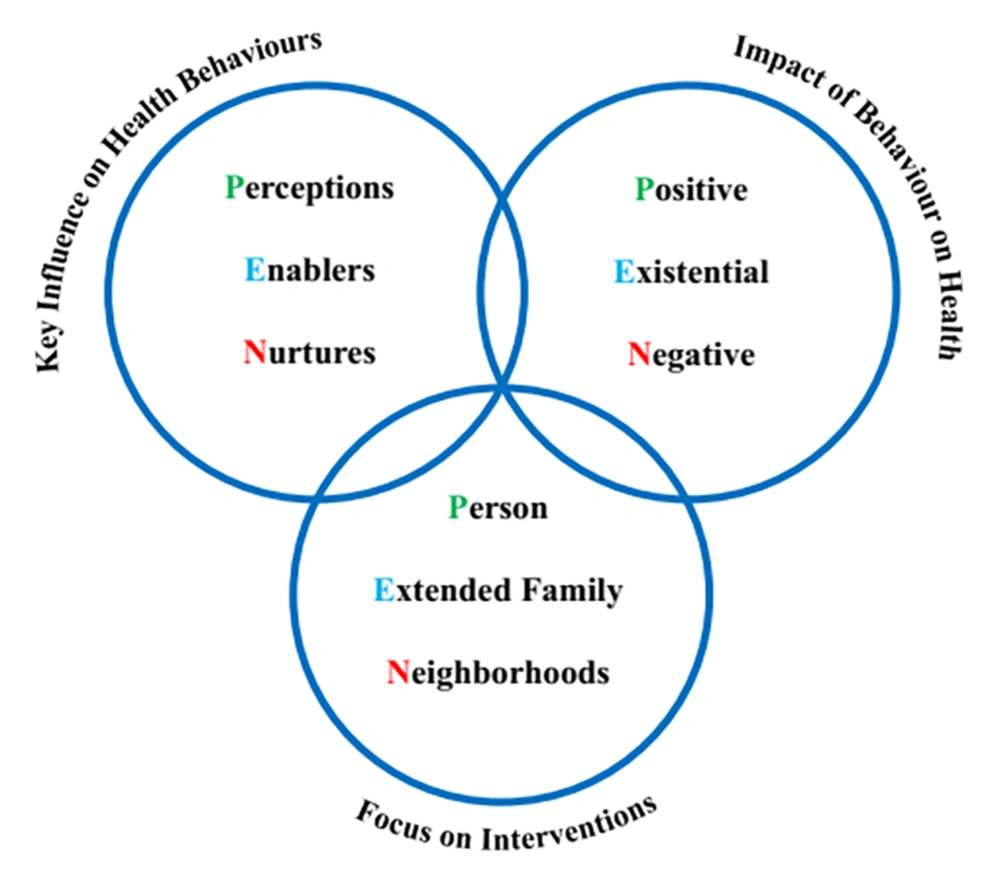
Figure 1.
The PEN-3 cultural model adapted from Collins O. Airhihenbuwa, the founder of the model (19)
3. Methods
This qualitative study employs the PEN-3 cultural model to identify factors affecting self-care performance in adolescents with T1D within a cultural framework. The study population included adolescents with T1D, who referred to the Iranian Diabetes Association in 2016.
3.1. Recruitment
In-depth semi-structured interviews were conducted initially with 12 adolescents aged 14 to 19 years old, ten parents, and four diabetes specialists. The purposeful sampling method was employed on diabetic patients at least one year after diagnosis of their disease. They also had the ability and willingness to share their experiences of everyday life with T1D. The interviews with adolescents, parents, and diabetes specialists continued until data saturation. The interviews began with general questions (e.g.,"Tell me about your daily life") and subsequent questions focusing on how the patient managed his/her diabetes. Examples of these questions include the following:
- What is T1D?
- What are some challenges to adhering to self-care performance in adolescents with T1D?
- Are the services and equipment needed to perform self-care behaviors available?
- Are there situations or people that make it easier for patients to follow self-care?
Each interview lasted 30 to 60 minutes, and the recorded file was read and written down verbatim immediately after each interview. The text of interviews was read several times to achieve a general sense, and coding of the texts continued until data saturation. Content analysis identified emergent themes based on the PEN-3 model.
Inclusion criteria for the patients participating in individual interviews included diagnosis of T1D at least one year before the study, age of between 14 and 19 years, being literate enough to complete forms, and interested in participating in the study. The parents participating in the individual interviews should have T1D adolescents aged 14 to 19 years and traverse at least within one year of diagnosis of their disease, and the diabetes specialists should have been associated with patients with T1D for at least five years and the patients should have introduced them as their physician.
Integrating qualitative data collection approaches, in order to more thoroughly investigate a research problem, is an increasingly prominent technique, and the strengths of one method can offset the limits of another (25). Focus groups generate a rich understanding of people’s experiences and beliefs (26). In the present study, to complement the researchers’ perspectives and to include experienced participants, a focus group discussion (FGD) was carried out with the participation of 13 people in the previous step (six patients, five parents and two diabetes specialists, who have provided good experiences in individual interviews and agreed to attend in group discussions), as well as one coordinator, one observer, and one note-taker. The themes identified through in-depth interviews were written on a whiteboard. The researchers asked participants to express their views on the themes, and report whether there are other factors that that need to be added. The participants’ feedback from the focus groups verified data from the individual interviews and provided further data on factors affecting self-care performance in adolescents with T1D.
Guba and Lincoln's approach that includes credibility, dependability, transferability and conformability as the criteria of trustworthiness was used (27). To improve the credibility of the study, those who had plenty of knowledge and imagination about factors affecting self-care performance in adolescents with T1D (patients, parents, and diabetes specialists) were recruited. Sampling strategies allowed for maximum variation to occur and a vast range of views and perspectives to be considered, giving more credibility to data. The researcher used prolonged engagement and spent extended time with the respondents to gain better understanding of their behaviors, values, and social relationships in a social context. Self-monitoring, peer debriefing, and member checking were other ways to ensure the accuracy and believability of the study.
3.2. Analysis
In the current study, the researchers followed a directed content analysis method based on the main constructs of PEN-3 model, including (1) perceptions, (2) enablers, and (3) nurturers, which would have positive, existential, and negative effects on targeted behaviors. However, for each construct, as the main theme of the present qualitative analysis, a number of categories emerged from the data, which were placed in the 3 × 3 table as supposed (Table 1).
Table 1.
Application of PEN-3: Diabetes Self-Care Needs Assessment Results
| Domains | Positive | Existential | Negative |
|---|---|---|---|
| Perceptions | Awareness of self-care behaviors; Attitude of patients towards disease; Attitude of patients, parents and physicians towards the effects of spirituality on self-care | Awareness about the complications of the disease | Lack of knowledge of patients, parents and community members about the disease and its causes; Attitude of patients and parents towards reasons for becoming sick (Why me?); Hiding the disease; Stigma; Low self-efficacy |
| Enablers | Easy access to needed medical services (insulin, blood glucose test strips, …) | Use of traditional medicine | Limited education; Fear of diabetes complications; High cost of blood glucose test strips; Lack of educational therapeutic curricula based on spirituality; Ignoring the role of spirituality in treatment and self-care by physicians, patients and their families |
| Nurturers | Influence of maternal support | Appreciating their health and fitness by seeing our sufferings | Conflict between parents and patients; Family lifestyle; Poor interaction and communication of patients with each other and with their family members |
3.3. Ethical Considerations
After obtaining permission from Tarbiat Modares University's Research Ethics Committee (Ethics Code: IR.TMU.REC.1394.43), conditions and implementation of the study were completely explained to the samples, and a written informed consent for recording their interviews was obtained from all participants. They were assured that their information would be completely confidential, and the right to withdraw from the study for all participants was reserved.
4. Results
Table 2 shows the demographic characteristics of the participants (patients, parents, and specialists, separately). The emerged 21 factors, which could affect self-care performance in T1D adolescents (Table 1) are as follows.
Table 2.
Characteristics of the Study Participants
| Characteristic | Patients | Parents | Physicians | Total |
|---|---|---|---|---|
| Sex | Girl (7) | Mother (8) | Woman (3) | All (26) |
| Boy (5) | Father (2) | Man (1) | ||
| Average age, y (mean ± SD) | 16.83 ± 1.53 | 41.9 ± 5.17 | 54.25 ± 6.5 | 32.23 ± 15.64 |
| Education | High school (10) | Primary and high school (5) | Diabetes specialist | - |
| University (2) | University (5) | |||
| Job | School and university students | Housewife (5) | - | - |
| Employee (3) | ||||
| Free (1) | ||||
| Retired employee (1) | ||||
| Religion | Shia Muslim | Shia Muslim | Shia Muslim | - |
| Average duration of disease, y (mean ± SD) | 6.17 ± 3.13 | - | - | - |
Numbers in parentheses indicate number of study participants.
4.1. Perceptions (Positive)
The knowledge of the adolescents and their parents regarding self-care behaviors was appropriate. They knew they needed to note their diet, check their blood sugar in a timely manner, inject insulin in a timely manner, and have appropriate physical activity. They believed that diabetes could be controlled by performing these self-care behaviors. Despite this acceptable level of awareness, their self-care behaviors were weak. A 16-year-old female said:
"Self-care means you must control the disease, you know what to eat and what not to eat, timely inject insulin … and do light exercise … But I often do not adhere to the diet recommended by my doctor".
The other positive perception, which was seen in all the three groups of participants, was the role and importance of spirituality in regular self-care and coping with the disease. They believed that spiritual needs of patients with T1D should be recognized and considered in care of patients by the medical team, yet this was not considered in practice. A 17-year-old male said:
"When the disease frustrates a person, it can spiritually help him/her to be reawakened, help him/her to believe in himself/her…Many patients have spiritual needs related to illness...yet they are not considered by their physician".
4.2. Perceptions (Negative)
The most important theme with higher frequency among the patients and their parents was"Why me? Or Why my daughter/son?"patients compared themselves with their friends, and when they saw themselves with some restrictions (such as eating no sweets) and feeling of losing organs, they experienced stress and lost their incentive to continue their daily treatment plan and self-care behaviors. Their answers to the above questions would be "injustice", or "God's punishment". A 19-year-old female said:
"I often ask myself"Why me?, or Why I cannot eat sweet things? It's not fair… so I feel stressed".
A 15-year-old male said:
"I think this disease is due to my sins that I did before, and God wants to revenge me."
The patients and their parents did not have acceptable level of knowledge about the disease and its causes. A 19-years-old teen with seven years of T1D history said:
"Diabetes is caused by eating too sweet…".
Another negative perception was hiding the disease from friends and relatives, because they felt this might affect their communication with others. A 15-year-old male said:
"My friends do not know that I am afflicted with diabetes… because my connections are affected".
A 45-year-old mother said:
"I guess the reason for hiding is that she thinks she has something less than others".
The other negative perception that bothered the patients with diabetes was the attitudes of the general public, called stigma or label. A 19-year-old diabetic girl said:
"When some people see a diabetic patient, they look at him/her surprisingly and look at him/her like an AIDS patient …".
Lack of confidence in their abilities or feelings of low self-efficacy in all participants was the major obstacle in their self-care activities. A diabetes professional said:
"Many patients become discouraged because they see self-care behaviors as boring, so they think they cannot do them".
4.3. Enablers (Positive)
One positive and crucial point was that now T1D patients have access to all required services to control their diabetes. For instance, a male diabetes specialist said:
"There was a time (27 to 28 years ago) we used to inject with a needle for two/three months…, but the condition these days is much better".
4.4. Enablers (Existential)
Traditional treatment is among the existential enablers that was used by some of the diabetic patients along with insulin therapy; however, since they felt it had no effect on their disease, they stopped using it. A 19-year-old adolescent said:
"I used traditional treatments, but I see they are no longer effective, so I stopped using them".
4.5. Enablers (Negative)
One of the negative enablers was inadequate effective education associated with T1D in public and private institutions and the media. A female diabetes specialist said:
"Education is one of the most important services that diabetic patients require; there is limited education on T1D in mass media including Radio and TV".
One other negative enabler was the high price of test strips to measure blood sugar level, despite the easy access. For example, a diabetes specialist mentioned:
"Unfortunately, blood glucose test strips are not supported or paid by most insurance companies…".
Fear of complications of diabetes, particularly elevated blood sugar levels was the other negative enabler expressed by the participants. A diabetes specialist stated:
"When a patient comes to my office, he/she asks when do I lose my sight? When do I lose my kidneys?... This makes him/her disappointed …".
Despite the emphasis on the effect of spirituality on self-care and diabetes control, many physicians and healthcare teams do not ask about and do not identify the patients' spiritual needs. For example, a 48-year-old mother mentioned:
"In general, physicians do not care about spirituality in the treatment and control of the disease…".
4.6. Nurturers (Positive)
One main positive nurturer for patients with diabetes was the great impact of mothers' emotional support, which may help control the patients' blood glucose. A 18-year-old patient stated:
"My mother largely contributed to coping with my disease and self-care…".
4.7. Nurturers (Existential)
One main existential nurturer for adolescents with T1D was that other people appreciate their health and fitness by seeing their suffering: A 16-year-old patient said:
"When other people see our nutritional limitations and multiple daily insulin injections, they thank God for their good health".
4.8. Nurturers (Negative)
One of the negative nurturers was that the parents were totally unaware of how to interact with their T1D adolescents, especially when the patient does not comply with self-care. A 50-year-old mother stated:
"When he does not listen to us, his father gets angry and says he does not comply and, sometimes, disputes with him".
Traditional lifestyle in the Iranian family is also one of the negative nurturers and a major obstacle to regular self-care for some patients. For example, a 19-year-old patient said:
"In spite of my diabetes diagnosed when I was eight years old, I still could not set my sleep hours according to my doctor's order".
Poor communication of patients with each other, especially with those, who have successfully controlled their disease was another negative nurturer. For example, a 37-year-old mother said:
"Communication with my child's peers, who have diabetes and talking to them about what they have done to control their blood sugar had much impact. I do not have the disease, maybe I do not understand it".
5. Discussion
According to the current research results, in the opinion of patients, their parents and diabetes specialists, several factors may influence self-care behaviors and control of diabetes in T1D adolescents. A summary of these factors is presented in Table 1. Some of these factors are explained below:
The most common factor having a key role in creating positive perceptions in adolescents with T1D is to answer the most important questions of these patients: "Why the disease?" and "Why me?" Of course, these questions will not occur in patients with certain religious and spiritual trends. On the other hand, such questions mainly come to mind in all those involved with chronic diseases; thus, they must be answered in accordance with their religious and spiritual conditions (28). When an adolescent thinks that the illness is injustice and oppression, this can influence his/her motivation to perform self-care behaviors and control the disease. A qualitative study among adolescents with T1DM in Zambia showed that "Why me?" causes stress among the respondents, and they consider it unfair (29). In a study by Ismail et al. (30), it was found that over half of the responders attributed their illness to fate and the will of God, or as punishment for sins of a past life. Also, in a study by Adejumo et al. (31), over 25% believed that diabetes was due to witchcraft or a punishment from God.
Education is an important element in the treatment of patients with diabetes, which should be considered as a continuous process (17, 28). The America Diabetes Association (ADA) recommends that patients with diabetes should at least annually evaluate their information and skills in the control of diabetes (17, 32). In Iran, there is limited education on T1D, particularly on the Radio and TV. This is the main reason for the lack of recognition of the disease by the public, and consequences such as labeling (stigma). Moreover, patients have to hide their illness for fear of confrontation with others because the stigma associated with diabetes is rooted in the lack of information about the disease (33). Public education is a key strategy to increase the awareness of people about T1D and reduce the stigma associated with it. In this regard, researchers plan to design and implement educational contents during group therapy and resolve defects in the pilot study. In addition to sending the outcome to the Iranian diabetes associations, educational programs should be broadcasted through the Radio and TV.
In the present work, the patients and their parents did not have acceptable level of knowledge about the disease and its causes. In a study by Barbosa and Heleno (34), most parents had no knowledge about the disease and its symptoms. Becoming proficient regarding the knowledge on the disease prevents or reduces the occurrence of complications. Therefore, getting familiar with T1D and its causes, proper self-care behaviors, and modifying the lifestyle of patients and their families in educational classes are essential. Lifestyle education for both patients and their families is considered as an important strategy in the treatment of T1D, and there is a need for revision in the lifestyle of all family members, especially after the diagnosis of diabetes in a family member (35).
Many studies have pin pointed the importance of interaction between families and T1D patients as well as the relationship between conflict management and treatment adherence (36-38). If adolescents want to be independent in their self-care of the disease and decisions, they will most probably have conflict with their parents (39). According to the study results, education about the interaction between parents and patients and their conflict management is one of the important issues that must be addressed. However, as mothers have a key role in helping the patients in coping with the disease and performing regular self-care behaviors, their participation in training sessions will increase the rate of success of programs. In a study conducted by Schilling et al. (40), most of the adolescents reported a dispute with their parents in the management of diabetes.
Increasing communication and familiarity between the patients and their families through community on religious and spiritual occasions and via virtual spaces, as well as education by peers or older patients, who have successfully controlled their diabetes with regular self-care, should be considered in the course of group therapy. In a study by Roblin et al. (41), the participation of adults with diabetes in the educational programs significantly improved the condition of younger diabetic participants.
Since strips for blood glucose measurement are not under the protection of insurance in Iran, and not all families are able to afford patient check-ups regarding their blood sugar levels on daily basis and do not correctly recognize the time of insulin injections, the current researchers plan to have correspondences with Iran’s Ministry of Health through Iranian Diabetes Association and Tarbiat Modares University for paying due attention to the issue. In a study by Qin et al. (42), 85.5% of the participants stated that costs of glucose test strips was high for them.
In line with in the present study, in several studies (7, 38, 43), fear of diabetes and its complications was identified as a major obstacle in performing regular self-care behaviors and glycemic control. Therefore, it seems that adolescents should be taught to perform proper self-care and be helped with diabetes complications instead of emphasis on diabetes complications, through appropriate solutions and strategies to reduce stress and fear of complications of diabetes during group therapy.
A key factor for influencing the ability of individuals in educational plans is their self-efficacy level, which is an important prerequisite for changing their behavior and the most important index in self-care (44). Low levels of self-efficacy were found to be a barrier for performing self-care behaviors among adolescents in the present study. Self-efficacy has been suggested as the strongest determinant of diabetes self-management behavior in various studies (10, 15, 44), therefore, the use of special techniques and skills to increase self-esteem in T1D adolescents should be considered.
5.1. Conclusion
According to the results of this study, diabetes management during adolescence is challenging in the opinion of patients, their parents, and diabetes specialists. Education about diabetes is both necessary for patients and also for their family and all individuals in the community. The government and the Ministry of Health should coordinate with health insurance agencies to decrease the costs of blood glucose test strips. Due to the effect of local culture and religious beliefs in Iran on the decisions of patients with strict diseases, placing health issues in the worshiping and spiritual agenda can increase their motivation to do this job appropriately. Unfortunately, despite the great emphasis on paying attention to spirituality and the religious needs of patients in Iran, such an attention has not been paid to the educational curriculum of nurses and physicians.
Limitations of the present qualitative study include: Limited sample size and limited generalizability of the results. Also, it is possible that the participants had not shared their real information. The results of this study should be examined in a pilot study to verify the effectiveness of training.