Full Text
Full text is available in PDF
International Journal of Endocrinology and Metabolism
Research Institute for Endocrine Sciences
Authors
Maternal serum human Chorionic Gonadotropin (hCG) and Alpha Fetal Protein (AFP) were originally introduced to detect trisomy 21 and neural tube defects. However, in the absence of aneuploidy or neural tube defects, mid-trimester maternal serum hCG and/or maternal serum AFP associated with adverse pregnancy outcomes. Pregnancies with unexplained mid-trimester elevation in maternal serum hCG and/or maternal serum AFP, are at increased risk for pregnancy complications resulting from placental insufficiency.
Mid-trimester maternal serum hCG>2.5 MoM associated with an increased risk for pregnancy complications including: late fetal loss, gestational hypertension, preeclampsia, intrauterine growth restriction (IUGR), preterm delivery and intrauterine fetal death(IUFD). Mid-trimester maternal serum AFP levels >2.5 MoM are thought to reflect a defect in placentation and associated with an increased risk for pregnancy complications including: late fetal loss, gestational hypertension, preeclampsia, IUGR, preterm delivery and IUFD.
Combined mid-trimester elevation in maternal serum hCG and AFP levels suggest a more complex type of placental pathology. They have stronger association with pregnancy complications including: late fetal loss, gestational hypertension, preeclampsia, IUGR, preterm delivery and IUFD.
Mid-trimester maternal serum hCG or AFP levels alone cannot detect all pregnant women with increased risk to develop pregnancy complications. Multiparameter testing of placental function in mid-trimester (maternal serum hCG and AFP screening, uterine artery Doppler and placental morphology) may allow us to identify women with increased risk to develop severe placental insufficiency and pregnancy complications. However, future prospective studies are needed to confirm the prognostic significance of multiparameter testing of placental function in mid-trimester.
© 2013, Author(s). This open-access article is available under the Creative Commons Attribution 4.0 (CC BY 4.0) International License (https://creativecommons.org/licenses/by/4.0/), which allows for unrestricted use, distribution, and reproduction in any medium, provided that the original work is properly cited.
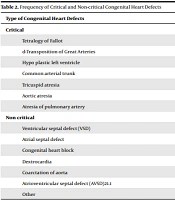
Aghaamoo S, Lotfi M, Mirmohammadkhani M, Hemmatian MN. Evaluation of Second-Trimester Maternal Serum AFP Value in the Detection of Congenital Heart Defects. Middle East J Rehabil Health Stud. 2021;8(4):e111917. doi: https://doi.org/10.5812/mejrh.111917
Jamal A, Vosoogh S, Tabatabaei RS, Salamat F. Placental Size and Uterine Artery Doppler for Prediction of Adverse Pregnancy Outcomes in Women with Low Pregnancy-Associated Plasma Protein-A. Shiraz E-Med J. 2022;23(7):e120716. doi: https://doi.org/10.5812/semj-120716
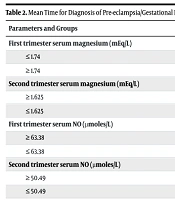
Maria Thomas J, P Shenoy R, V Bhat P, Kamath A, Prabhu K, et al. Serum Magnesium and Nitric Oxide Levels in Early Detection of Pre-eclampsia and Gestational Hypertension. Fertil Gynecol Androl. 2025;5(1):e154402. doi: https://doi.org/10.5812/fga-154402
Khosravirad A, Zayeri F, Baghestani AR, Yoosefi M, Bakhtiyari M. Predictive Power of Human Chorionic Gonadotropin in Post-Molar Gestational Trophoblastic Neoplasia: A Longitudinal Roc Analysis. Int J Cancer Manag. 2017;10(9):e9015. doi: https://doi.org/10.5812/ijcm.9015
Pakniat H, Hajiseid Javadi E, Chegini V, Khajevand N, Molaverdikhani S. The Relationship Between the Full Biophysical Profile and Rapid Biophysical Profile in Antepartum Fetal Surveillance. J Inflamm Dis. 2024;26(4):e156326. doi:
More by these authors
Last Update: 0 months ago
Last Update: 0 months ago
Last Update: 0 months ago
Last Update: 2 days ago