


1. Background
Addiction is a condition that results in significant harm to the individual and to society as a whole (1). Substance abuse is a prevalent phenomenon all around the world and has affected human society as the most important cause of “social damage” (2). Clearly, drug abuse and alcohol use in young adults represent a major public health problem. For young people, alcohol and drug abuse interferes with their cognitive and emotional development, increases the chance of accidental injury and death, and magnifies the likelihood of drug dependency. For adults, drug abuse is associated with lung cancer, coronary heart disease, acquired immune deficiency syndrome (AIDS), violent crime, child abuse, and unemployment (3).
The results of cohort studies have shown that alcohol use, marijuana use, and sex with multiple partners increase during the transition from high school to college (4). Studies in the United States indicated that 63.1% of college students had used alcohol in the past 30 days, while 16.6% and 14.5% of students reported past 30-day use of tobacco and marijuana, respectively (5). The lifetime prevalence rate of any substance use among college students in western Kenya was 69.8%, while the lifetime prevalence rate of alcohol use was 51.9%. Moreover, 97.6% of alcohol users had consumed alcohol in the week prior to the study (6).
Recent research has indicated the frequencies of the experience of alcohol, traditional narcotics (e.g., opium and marijuana), and psychedelics (e.g., ecstasy) to be 15.1%, 3.1%, and 5.6%, respectively, among adolescents in Tehran, Iran. In addition, the results of multivariate logistic regression indicated that low parental control rather than medium control (AOR: 0.09), lifetime cigarette use (AOR: 10.41), having a tobacco user friend (AOR: 4.36), and having an alcohol user friend (AOR: 5.84) are factors that are significantly related to the experience of alcohol use in female adolescents (7). The results of another study showed the incidences of first experience of water pipe smoking (hookah), chewing tobacco (Nas), tramadol, drugs, and alcohol were 21.5%, 6.1%, 4.7%, 4.2%, and 7.2%, respectively. The results also showed that 3.5% of the students started smoking in 2010. In addition, lifetime experience and annual incidence of these behaviors was 2 – 5 times more likely among adolescents with a family member or a friend who used substances compared with those without a history of substance use. Furthermore, such behaviors were 2 - 3 times higher in adolescents with abnormal general health compared with normal ones (8). The results of a study among university students in Iran showed that about 15% of participants had used substances in the past month and 15.1% in the last year. Tobacco was the most commonly used substance (19.2%). The second and third most commonly used substances were opium (15.4%) and alcohol (10.8%) (9). Statistical evidence indicates that 34% of divorces in the country stem from addiction and its related problems (10).
The accelerated development of drug abuse and related problems in students’ society and its harmful outcomes, such as a lack of academic motivation, educational failure, physical and psychological diseases, suicide, reckless driving, destruction of public property, abusive behaviors, feeling of a lack of identity, and hazardous sexual behavior, are indicative of the necessity for planning and preparing preventive interventions in universities (11, 12). However, provision for any kind of planning requires an understanding of existing conditions and the recognition of the current situation of drug abuse among students. Nowadays, experts consider that epidemiological reviews are the first step in designing preventive plans (13).
The number of studies on substance use among Iranian university students in the epidemiological field is limited; moreover, in some research, methodological insufficiencies have been observed. In most of the studies that have been conducted, substance use outbreak indexes have not been observed in accordance with the current outbreak estimation indexes that is, outbreaks during the lifetime, last year, and last month which were considered in this research.
2. Objectives
The present research aims to provide an epidemiological review of substance use in students at Islamic Azad university in Zahedan, Iran.
3. Patients and Methods
The present research was carried out using the descriptive sectional method. The population under study included all male and female students of the Zahedan branch of Islamic Azad university who were studying in 2011 - 2012 academic year.
Statistical sampling was carried out based on cluster sampling and distribution of gender, faculty, and degree, with a total number of 1,025 individuals. Compiled data were analyzed via the descriptive statistics method and K-square statistical test, in addition to the logistic regression method.
4. Results
In total, 1,025 questionnaires were distributed; 11 of these were excluded because of gaps and inconsistencies in the responses, so that 1,014 questionnaires were analyzed. It was found 74.1% of the respondents were studying for a bachelor’s degree, 23% for an associate’s degree, and 2.9% for a master’s degree. Furthermore, 21.1% were aged 18 - 20 years, 26.2% were 20 - 22, and 51.6% were 22 or older.
In the current study, outbreak of cigarette smoking during the life period of the students was 22%, in the last year it was 11.7%, and in the last month it was 7.6%. In this research, alcoholic drink usage was rated as 12.6% for the life period, 7% for the last year, and 4.1% for the last month.
The present research showed that hookah smoking was prevalent among students at levels of 40.4%, 27.1%, and 15.3% for the life duration, the last year, and the last month, respectively.
Table 1. Demographic Characteristics of Studentsa
| Variable | Values |
|---|---|
| Gender | |
| Female | 538 (53.1) |
| Male | 476 (46.9) |
| College | |
| Humanities | 339 (33.4) |
| Medical Sciences | 216 (21.3) |
| Technical Engineering | 292 (28.8) |
| Teacher Training | 103 (10.2) |
| Basic Sciences | 64 (6.3) |
| Citizenship | |
| Native | 849 (83.7) |
| Foreign | 165 (16.3) |
| Degree | |
| Associate | |
| Female | 122 (12.1) |
| Male | 111 (10.9) |
| Baccalaureate | |
| Female | 401 (39.6) |
| Male | 349 (34.5) |
| Master’s Degree | |
| Female | 14 (1.4) |
| Male | 15 (1.5) |
| Age, y | |
| 20 - 18 | 214 (21.1) |
| 22 - 20 | 266 (26.2) |
| > 22 | 523 (51.6) |
| Undetermined | 11 (1.1) |
aValues are expressed as No. (%).
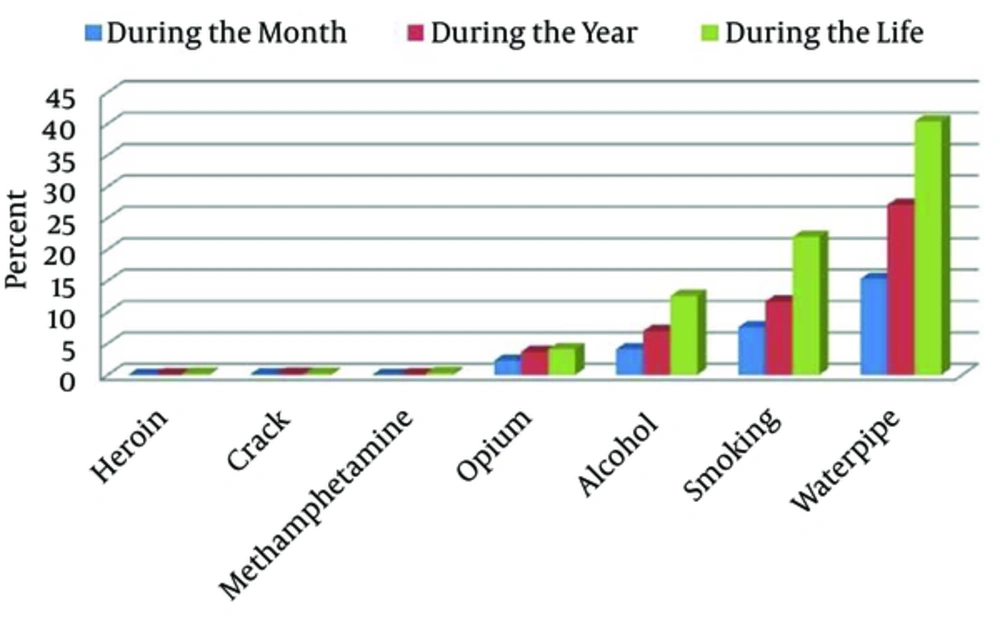
Figure 1.
Lifetime prevalence in the last year, and in the last month.
5. Discussion
The findings indicated a low prevalence of heavy substance use (opium, marijuana, methamphetamine, heroin) and a high prevalence of light substance use (cigarette, hookah, and alcohol). The prevalence rates of substance use in students for duration of life, the last year, and the last month were 7.5%, 5.2%, and 3.7%, respectively. The prevalence rates of cigarette use in students for duration of life, the last year, and the last month were 22%, 11.7%, and 7.6%, respectively. The prevalence rates of alcohol usage among students for duration of life, the last year, and the last month were 12.6%, 7%, and 4.1%, respectively. The prevalence rates of hookah smoking among students for duration of life, the last year, and the last month were 40.4%, 27.1%, and 15.3%, respectively.
In a study to determine the prevalence of drug use among university students in Iran conducted by Sarrami et al. over the two decades of research, the researchers showed that 24.3% - 57.24% of males and 1.8% - 27.7% of females had smoked at least once, with a total prevalence of 17.3% - 31.5 %. Regular consumption of cigarettes was found in 15.6% - 30.6% of males and 5.8% - 13% of females, with a total of 14.2% - 20%. The rate of smoking among males was found to be 2.4% - 4.7% (14). The prevalence of drug use among university students in Hamadan showed a lifetime prevalence of drug use among students where the hookah accounted for 46.8% of drug use, smoking for 28.1%, alcohol for 11.6%, opium for 6.5%, hashish for 0.6%, and heroin pills for 1.9% (15).
The differences between the results of this research and the findings of other researchers (14, 15) may have been due to cultural factors and people’s customs in the region in terms of the drugs available at parties. The ministry of health and medical education have warned about the much greater adverse effects of the hookah in comparison to cigarettes, but unfortunately, hookah use is about twice as prevalent as cigarette smoking.
5.1. Conclusion
Accelerated development of drug abuse and related problems in the university student population and its harmful outcomes, such as a lack of academic motivation, educational failure, psychological and physical diseases, suicide, destruction of public property, abusive behavior, feelings of a lack of identity, and hazardous sexual behavior, makes it necessity to plan and prepare for preventive interventions in universities.
