


1. Context
Viral hepatitis is a common bloodborne infection with a high rate of mortality, 1.4 million deaths globally every year. Five viruses, hepatitis A virus (HAV), hepatitis B virus (HBV), hepatitis C virus (HCV), hepatitis D virus (HDV), and hepatitis E virus (HEV) are responsible for this deadly disease. HBV and HCV account for 90% of the deaths, while the remaining are related to other viruses (1, 2). The routes of viral transmission are percutaneous or mucosal exposure to infected blood or body fluids, sexual intercourse, particularly in homosexual men, perinatal transmission, drug abuse in low endemic areas, and parenteral transmission (3).
Generally, the inflammatory response is useful for the host. Cellular inflammatory responses release cytokines to control cellular stress and minimize cellular damage in response to viral infection. The host immune responses to hepatitis viruses are weak and unable to down-regulate and clear the infection, which can activate the antigen-specific immune response in patients, leading to activation of lymphomononuclear cells in the liver resulting in fibrosis, cirrhosis, and/or hepatocellular carcinoma (HCC) (4).
C-reactive protein (CRP) (0.1 - 5.0 mg/L of blood) is an acute phase reactant synthesized by hepatocytes in response to inflammatory reactions as a result of the innate immune response of the host that facilitates apoptosis and phagocytosis. In addition, CRP can also activate the classical complement pathway through binding to C1q protein. The production of CRP is regulated by proinflammatory cytokines, such as Interleukin 6 (IL-6), IL-1β, tumor necrosis factor-α (5, 6). Among these interleukins, IL-6 is the most important inflammatory cytokine that regulates CRP gene expression. The CRP gene is located on chromosome 1. In hepatocytes, IL-6 induces CRP production at the transcription level, which is promoted by IL-1β (5, 7).
The results of in vitro experiments have indicated that HBV enhances the expression of the IL-6 and IL-1-β gene via transcriptional transactivation activity of hepatitis B virus X protein (HBx) and CRP (7). However, it has also been reported that decreased production of CRP in patients chronically infected with HCV decreased the level of CRP gene expression (8). Nonetheless, there is no systematic review of the relationship between HBV and HCV and CRP levels; thus, in the current meta-analysis, we tried to elucidate this relationship.
2. Methods
2.1. Selection of Test Parameters
CRP is an acute-phase protein synthesized in the liver in response to inflammation. It is used to determine the progression and development of the disease inflammatory markers. CRP has been shown to be significantly altered in viral hepatitis (1, 2, 7, 9-23). Studies freely accessible in PubMed or ScienceDirect on hepatitis patients between January 1, 2015, and December 31, 2019, were reviewed that are displayed in Figures 1A and B and 2A and B analyzed by the random-effects model.
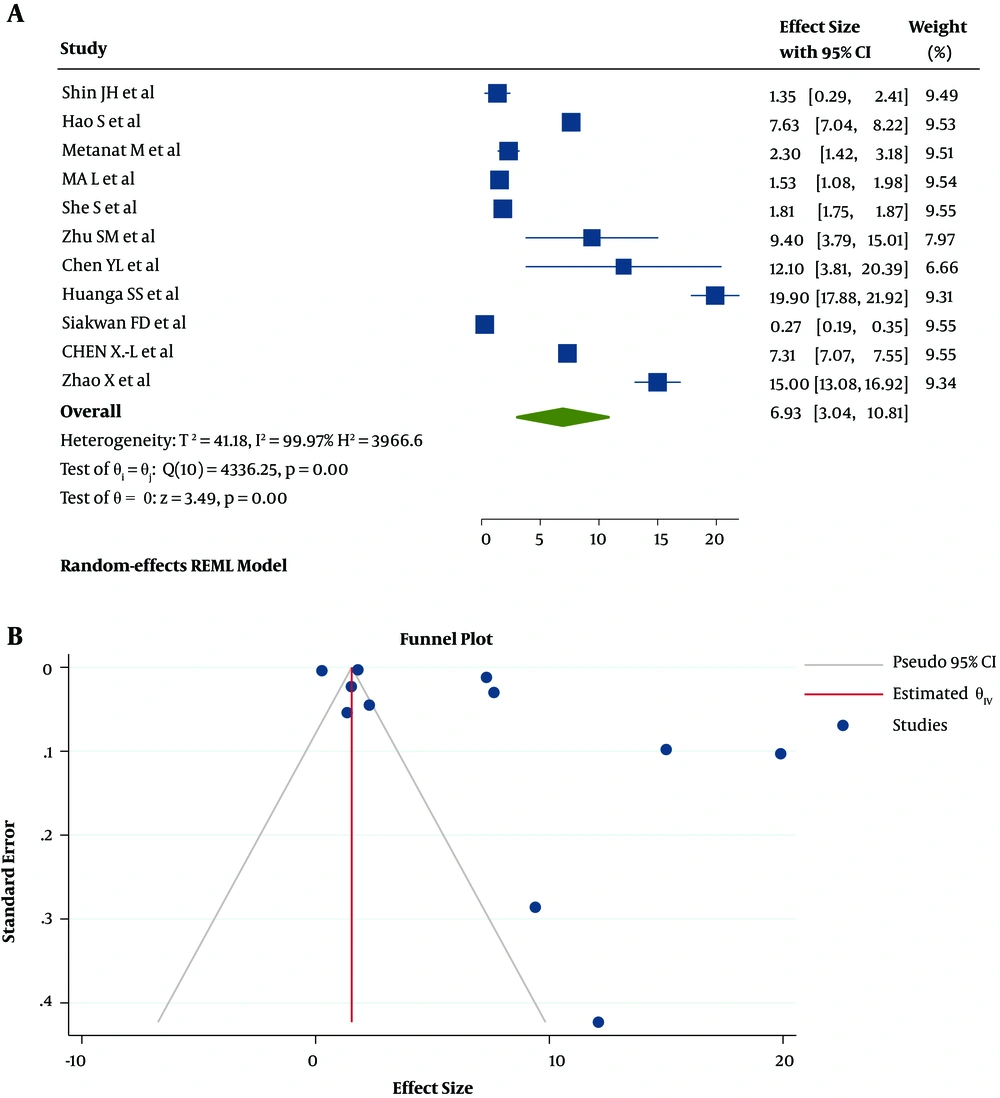
Figure 1.
A, Forest plot of random-effects meta-analysis for C-reactive protein (CRP) in hepatitis B; B, Funnel plot with pseudo 95% confidence interval for C-reactive protein (CRP) in hepatitis B.
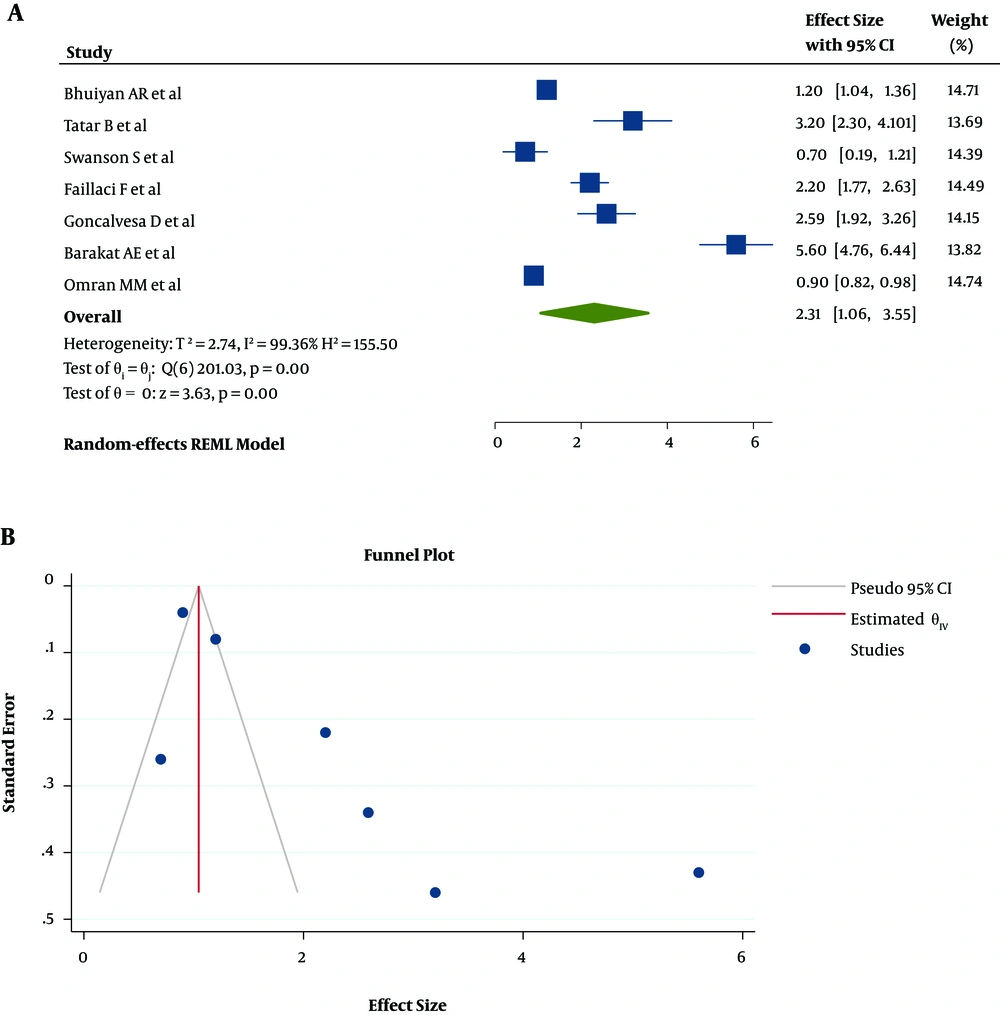
Figure 2.
A, Forest plot of random-effects meta-analysis for C-reactive protein (CRP) in hepatitis C; B, funnel plot with pseudo 95% confidence interval for C-reactive protein (CRP) in hepatitis C.
2.2. Literature Search
PubMed database was searched for articles on the association between hepatitis B or C and CRP levels. The keywords used for the search were hepatitis B, hepatitis C, CRP, and inflammation. Full-text articles in English were selected in this study, and their references were also accessed for additional support.
2.3. Inclusion and Exclusion Criteria
For this meta-analysis, only studies on hepatitis B or C and estimated plasma CRP levels were included. Inclusion criteria were: (1) reporting the mean level and the corresponding 95% confidence intervals (CIs) of plasma CRP levels; (2) case series or cross-sectional studies. The flowchart of the study selection process, along with the number of selected and excluded studies at different levels, is indicated in Figure 3.
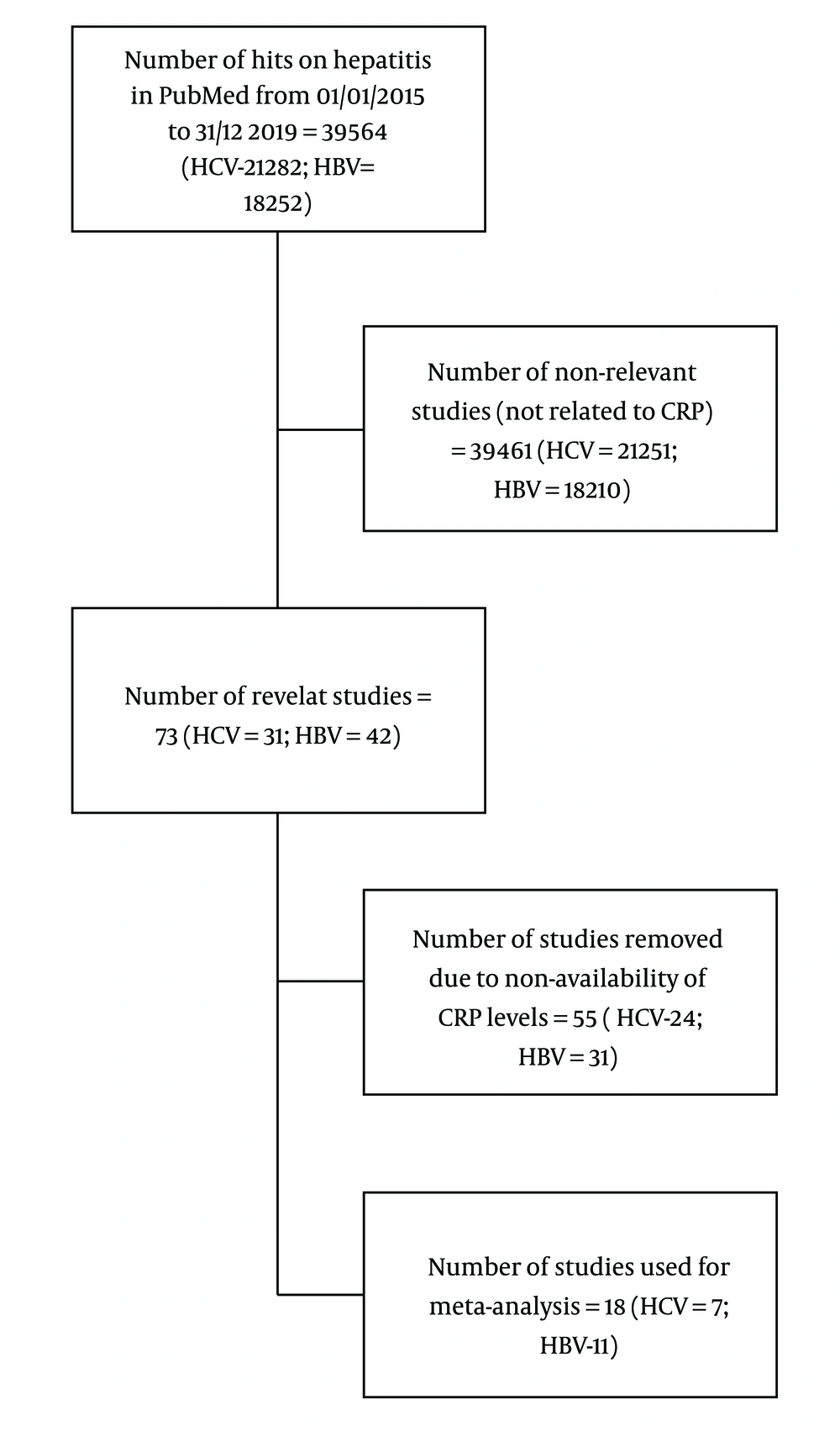
Figure 3.
Flowchart of the process of study selection
2.4. Data Extraction
The epidemiological guidelines were followed for meta-analysis of observational studies (24). The following data were extracted from each study: the first author’s last name, year of publication, the number of patients, the mean, and corresponding 95% CIs for CRP.
2.5. Statistical Analysis
Separate tables were created for hepatitis B and hepatitis C. The pooled means and the corresponding 95% CIs of CRP was estimated by the random-effects model because data were hypothetically a random selection of all possible studies in the meta-analysis. STATA-16 statistical software was used to prepare the forest plot and funnel plot. to indicate the heterogeneity among studies, I2 value was used; I2 of less than 50% indicated a higher degree of relationship among studies. Statistical significance was fixed at a P value of less than 5%. The bias of the study was calculated using the funnel graph, as shown in Figures 1B and 2B.
3. Results
Eighteen articles that met the inclusion criteria of our study conducted on the relationship between hepatitis B and hepatitis C and CRP were included in the study. Eleven studies were associated with hepatitis B (2, 7, 15-23) and seven were associated with hepatitis C (1, 9-14). Table 1 and summarize the pooled mean level, lower limit, upper limit, I2, and P value of CRP associated with hepatitis B and hepatitis C, respectively. The pooled mean for CRP in hepatitis B was 6.93 mg/L (95% CI: 3.04 - 10.81) and for hepatitis C was 2.31 mg/L (95% CI: 1.06 - 3.55). Inconsistency was high among the studies, with the I2 of more than 90% as presented in Tables 1 and 2.
Table 1.The Summary of Studies on Patients with Hepatitis B and the Pooled Mean Level of CRP and the 95% Confidence Interval (CI)
| Author | Mean | 95% Confidence Interval | |
|---|---|---|---|
| LL | UL | ||
| Shin et al. (22) | 1.35 | 0.292 | 2.408 |
| Hao et al. (7) | 7.63 | 7.042 | 8.218 |
| Metanat et al. (2) | 2.3 | 1.418 | 3.182 |
| MA et al.(23) | 1.53 | 1.079 | 1.981 |
| She et al. (20) | 1.81 | 1.751 | 1.869 |
| Zhu et al.(19) | 9.4 | 3.795 | 15.005 |
| Chen et al. (16) | 12.1 | 3.809 | 20.391 |
| Huanga et al. (18) | 19.9 | 17.881 | 21.919 |
| Dapaah-Siakwan et al. (17) | 0.27 | 0.192 | 0.348 |
| Chen et al. (15) | 7.31 | 7.075 | 7.545 |
| Zhao et al. (21) | 15 | 13.079 | 16.921 |
| Total | 6.925 | 3.038 | 10.813 |
Table 2.The Summary of Studies on Patients with Hepatitis C and the Pooled Mean Levels of CRP and the 95% Confidence Interval (CI)
3.1. Hepatitis B
Eleven studies showed a statistically significant association between CRP levels and hepatitis B. The overall CRP mean level in all studies was 6.93 mg/L (95% CI: 3.04 - 10.81), with I2 of 99.97%, as shown in Figure 1A. The publication bias was high because most of the studies were located outside of the funnel figure, as shown in Figure 1B.
3.2. Hepatitis C
CRP reported in all seven studies on its relationship with hepatitis C, had disclosed a statistically significant association. The overall CRP mean level in all studies was 2.31 mg/L (95% CI: 1.06 - 3.55), with I2 of 99.36%, as shown in Figure 2A. The publication bias was high because most of the studies were located outside of the funnel figure, as shown in Figure 2B.
4. Discussion
The current meta-analysis, to our knowledge, is the first meta-analysis evaluating the prognostic value of CRP in patients with viral hepatitis. The pooled mean level of CRP in 11 studies on hepatitis B and 7 studies on hepatitis C were retrieved in this study. We assumed that the samples were selected randomly; thus, the random-effects model was used. The high degree of heterogeneity among the studies was due to the diversity of locations, cultures, economic status, and different duration of the studies.
As reported in previous studies, CRP is an acute phase reactant protein synthesized by hepatocytes in response to inflammatory reactions, such as tissue injury, cardiovascular disease, and viral and bacterial infections (5).
Our meta-analysis results indicated that the pooled mean level of CRP in hepatitis B was higher than the normal range, which could be due to poor host immune responses against the hepatitis B virus. This can cause a failure in the reduction of infection by the body and trigger the production of cytokines storms leading to inflammation and CRP. This finding is consistent with those reported by Hao et al. (7), Zhu et al. (19), Chen et al. (16), Huanga et al. (18), Chen et al. (15) who declared an increase in CRP levels in hepatitis B patients. However, studies done by Shin et al. (22), Metanat et al. (2), MA et al. (23), She et al. (20), Dapaah-Siakwan et al. (17), and Zhao et al. (21) showed no increase in CRP levels in hepatitis B patients.
In our study, the pooled mean level of CRP was within the normal range for hepatitis C patients. The possible mechanism is that in patient chronically infected with HCV alterations in local immune response of the liver and decreased production of CRP resulted in CRP levels within normal range (25). Studies conducted by Bhuiyan et al. (1), Tatar et al. (14), Swanson et al. (13), Faillaci et al. (12), Goncalvesa et al. (10), and Omran et al. (9) showed the CRP levels within normal range; however, Barakat et al. (11) reported an increase in CRP levels in hepatitis C patients.
5. Conclusions
This study reported the pooled mean level of CRP in hepatitis B and hepatitis C as the most common causes of viral hepatitis. The overall mean level reported in this study could be useful in measurement of liver damage and prognosis of viral hepatitis. The pooled CRP mean level for hepatitis C was in the normal range; however, serum level of CRP (pooled mean) was found high in hepatitis B patients. Therefore, we suggest that the pooled mean level of CRP could be useful for the determination of the prognosis of hepatitis B and its related complications.
