1. Background
Hospital-acquired infection (HAI) (also known as nosocomial infection) is defined as a localized or systemic condition resulting from an adverse reaction to an infectious agent or its toxin that develops in a patient 48 hours or more after admission to a hospital and was not incubating at the time of admission (1, 2). All hospitalized patients are susceptible to contracting a nosocomial infection. Some patients are at greater risk of HAIs than others, including young children, the elderly, and persons with compromised immune systems (3, 4). Other suggested risk factors are long hospital stays, the use of indwelling catheters, failure of healthcare workers to wash their hands, overuse of antibiotics, and hospitalization within the previous year (5).
A great proportion of HAIs are caused by extremely resistant pathogens such as methicillin-resistant Staphylococcus aureus or multidrug-resistant Gram-negative bacteria, which are highly likely to result in an increase in morbidity and mortality (6). HAIs caused by multidrug-resistant organisms are also associated with prolonged hospital stays and the need for administration of expensive antimicrobials, which in turn increases the costs of care (7). Excessive antibiotic prescribing by hospital doctors results in the selection of resistant bacterial strains. Transmission of those resistant strains within hospitals occurs through cross infection of the patient population via the hands of healthcare staff who come in frequent contact with patients (7).
In the vast majority of developed countries, well-established nosocomial infection surveillance systems are available for collecting data on the prevalence of HAIs (8). The U.S. Centers for Disease Control and Prevention, for instance, estimates that HAIs in American hospitals account for approximately 1.7 million infections and 99,000 associated deaths each year (4). More than half of all HAIs occur outside of the intensive care unit (ICU). Based on a study of a large sample of the U.S. acute care hospitals, on any given day, approximately 1 in 25 hospital patients has at least one healthcare-associated infection (4). HAIs are also associated with an estimated excess healthcare cost of $28 to $33 billion each year (9).
Although the magnitude of HAIs in many developing countries is not clearly understood, it has been estimated that it affects from 5% to 15% of hospitalized patients in regular wards (10) and more than half of patients admitted to ICUs (11). This uncertainty in the burden of HAIs in developing countries is mostly because of complexities in the diagnosis of HAIs and also nonexistent or ineffective surveillance systems for gathering data on HAIs (12). The results from a systematic review and meta-analysis focusing on the burden of endemic healthcare-associated infection in developing countries showed that the prevalence of healthcare-associated infection in these countries was 15.5 per 100 patients, which was much higher than proportions reported from developed countries. The estimated prevalence of healthcare-associated infection in adult intensive care units in those countries was found to be at least three times higher than the prevalence reported from the United States. Moreover, antimicrobial resistance has been sparingly addressed in the studies published from developing countries (13).
Similarly, a great degree of variation in the estimated prevalence of HAIs in studies from Iran have been observed, which is largely due to the study design factors such as the population studied, the setting (including only ICU or all hospital wards), or the age group (adult versus pediatric admissions) (14). Moreover, many studies from Iran have been restricted to urinary tract, respiratory, or bloodstream infections or have focused on a single pathogenic agent. The data from the Iran Nosocomial Infections Surveillance program showed that the average infection rates in 100 hospitals from 2007 to 2010 were 0.6%, 0.87%, 0.96%, and 1.1%, respectively (ranging from 0.2% to 5.7%) (15). However, the results from a systematic review of the literature and meta-analysis of the data on the prevalence and causes of nosocomial infection in Iran published between 1997 and 2010 showed that the best estimate of overall prevalence of HAIs in Iran was as high as 30.43% (14). Only a limited number of studies from Iran have reported patterns of antimicrobial resistance in pathogens identified as causative agents for HAIs, necessitating a broadening of the epidemiological study of infections by multidrug-resistant pathogens in all hospitalized patients.
2. Objectives
The aim of this study was to determine the epidemiology of nosocomial infections and related antimicrobial resistance patterns in a tertiary-level teaching hospital in Zahedan, Southeast Iran.
3. Patients and Methods
This was a cross-sectional study of patients admitted to Ali-Ibn-Abitalib Hospital, a tertiary-level teaching center in Zahedan, Southeast Iran, conducted from March 2013 through March 2014. All patients admitted during this period who were found to have at least one of the four types of common nosocomial infections (i.e., surgical site infection, urinary tract infection, pneumonia, and bloodstream infection) were included in the study. An infection control nurse reviewed each patient's medical records at the time of admission and weekly thereafter during the entire inpatient stay. The head nurses in each ward were also requested to retrospectively identify possible HAI cases since the beginning of the study and to report daily possible new cases among patients. All the identified HAIs were registered into the Iranian National Nosocomial Infection Surveillance Software. The data collected for this study included the patient’s age, sex, admission ward, invasive procedures, infection onset dates, location of infection, organism isolated, and patient’s condition at the time of discharge.
Identification of bacteria from clinical samples was carried out using standard bacteriologic methods. Testing of in vitro susceptibility of the bacterial isolates to different antibiotics was done in accordance with the Clinical and Laboratory Standards Institute (CLSI) guidelines, using the standard disk diffusion technique (Kirby–Bauer method) on Mueller-Hinton agar (16). The antibiotic disks used in this study were purchased from the Iranian Padtan Teb Company (www.padtanteb.com) and contained the following antibiotics: amikacin (30 μg), cephalothin (30 μg), cefotaxime (30 μg), ceftazidime (30 μg), ciprofloxacin (5 μg), norfloxacin (10 μg), gentamicin (10 μg), imipenem (10 μg), trimethoprim-sulfamethoxazole (5 μg), nitrofurantoin (300 μg), erythromycin (15 μg), nalidixic acid (30 μg), tetracycline (30 μg), and carbenicillin (100 μg). The criteria published by the CLSI was used to interpret the test results (17).
De-identified information was used for data analysis using descriptive statistics. Data analysis was performed using the SPSS version 20 statistical software package (Chicago, IL).
4. Results
A total of 16,140 patients were admitted to the hospital during the study period, including 162 found to have HAIs, with an overall HAI rate of approximately 1%. These included 79 female (48.8%) and 83 male (51.2%) patients. The mean age of the patients was 48.8 ± 24.5 years. More than half of the subjects were older than 50 years (Table 1). The majority of the cases were reported from ICUs (79.6%), followed by internal medicine (10.5%), obstetrics and gynecology (7.4%), and surgery wards (2.5%). The prevalence of HAIs in ICUs was 26.1% (129 of 493 admissions). The most common HAIs were pneumonia (67.9%), urinary tract infections (18.5%), surgical site infections (8.6%), and bloodstream infections (4.9%). Overall, 18 subjects died because of HAIs, accounting for a case fatality rate of 11.1%.
The relative frequencies of different types of microorganisms isolated from patients with HAIs are shown in Figure 1. Acinetobacter (18%) and Enterobacter species (18%) were the most common types of pathogens isolated from patients identified as having HAIs.
| Variable | Frequency |
|---|---|
| Sex | |
| Female | 79 (48.8) |
| Male | 83 (51.2) |
| Age group, y | |
| < 20 | 24 (14.8) |
| 20 - 30 | 18 (11.1) |
| 31 - 40 | 16 (9.9) |
| 41 - 50 | 20 (12.3) |
| > 50 | 84 (51.9) |
| Season | |
| Spring | 33 (20.4) |
| Summer | 42 (25.9) |
| Autumn | 45 (27.8) |
| Winter | 42 (25.9) |
| Ward | |
| ICU | 129 (79.6) |
| Internal Medicine | 17 (10.5) |
| Ob/Gyn | 12 (7.4) |
| Surgery | 4 (2.5) |
| Procedures | |
| Suction | 76 (46.9) |
| Intubation | 32 (19.8) |
| Surgery | 19 (11.7) |
| Urinary catheter | 20 (12.3) |
| Vein catheter | 6 (3.7) |
| Infection site | |
| PNEU | 110 (67.9) |
| UTI | 30 (18.5) |
| SSI | 14 (8.6) |
| BSI | 8 (4.9) |
| Underlying diseases | |
| No | 157 (96.9) |
| Yes | 5 (3.1) |
| Outcome | |
| Discharged | 144 (88.9) |
| Died | 18 (11.1) |
a Abbreviations: BSI, bloodstream infection; ICU, intensive care unit; Ob/Gyn, Obstetrics and Gynecology; PNEU, pneumonia; SSI, surgical site infection; UTI, urinary tract infection.
b Data are presented as No. (%).
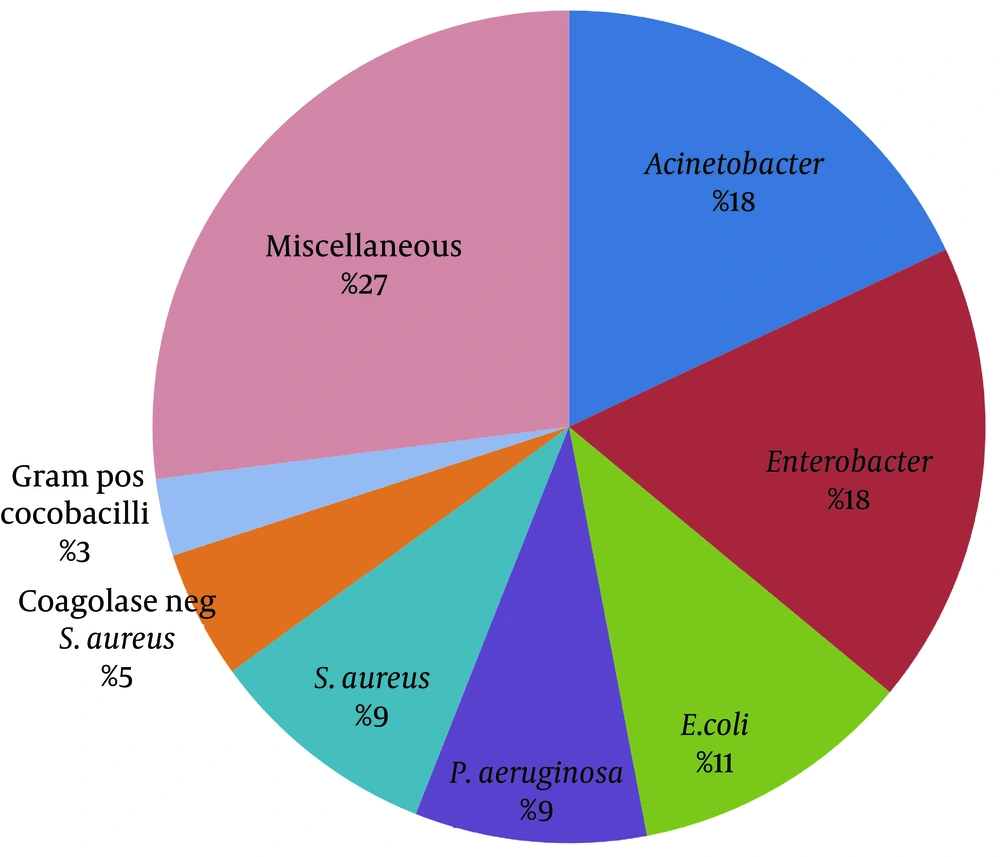
Figure 1.
The Proportion of the Microorganisms Isolated as Causative Agents for Hospital-Acquired Infections in Zahedan, 2013-2014
Acinetobacter species were the most common type of pathogen isolated from HAI patients with bloodstream infection and pneumonia (Table 2). Escherichia coli was the prominent causative agent for urinary tract infections in HAI cases.
Table 2.
| Site of Infection | Acinetobacter spp. | Enterobacter spp. | Escherichia coli | Pseudomonas aeruginosa | Staphylococcus aureus | Others |
|---|---|---|---|---|---|---|
| BSI | 3 (37.5) | 2 (25.0) | 0 (0.0) | 0 (0.0) | 0 (0.0) | 3 (37.5) |
| PNEU | 25 (21.2) | 16 (13.6) | 9 (7.6) | 9 (7.6) | 13 (11.0) | 46 (15.3) |
| SSI | 0 (0.0) | 0 (0.0) | 0 (0.0) | 0 (0.0) | 0 (0.0) | 14 (100.0) |
| UTI | 1 (2.8) | 7 (19.4) | 8 (22.2) | 5 (13.9) | 1 (2.8) | 14 (30.6) |
a Abbreviations: BSI, bloodstream infection; PNEU, pneumonia; spp., species; SSI, surgical site infection; UTI, urinary tract infection.
b Data are presented as No. (%).
Multidrug resistance was observed in 95% of the bacterial isolates, ranging from 80% for coagulase-negative S. aureus to 100% for Acinetobacter species, E. coli, and S. aureus (data not shown). Antimicrobial susceptibility testing revealed that the majority of the bacterial isolates were resistant against commonly used antibiotics with highest resistance against the third-generation cephalosporins. The overall results for antimicrobial susceptibility testing of the most commonly isolated pathogens causing HAIs are presented in Table 3.
Table 3.
| Antibiotic | Acinetobacter spp. (n = 33) | Escherichia coli (n = 18) | Enterobacter spp. (n = 7) | Pseudomonas aeruginosa (n = 12) | Staphylococcus aureus (n = 7) |
|---|---|---|---|---|---|
| Amikacin | 26 (78.8) | 0 (0.0) | 3 (17.6) | 2 (16.7) | 2 (28.6) |
| Cephalothin | 31 (93.9) | 16 (88.9) | 12 (70.6) | 12 (100.0) | 1 (14.3) |
| Cefotaxime | 27 (81.8) | 14 (77.8) | 9 (52.9) | 5 (41.7) | 4 (57.1) |
| Ceftazidime | 27 (81.8) | 11 (61.1) | 10 (58.8) | 7 (58.3) | 4 (57.1) |
| Ciprofloxacin | 25 (75.8) | 8 (44.4) | 10 (58.8) | 4 (33.3) | 2 (28.6) |
| Norfloxacin | 21 (63.6) | 6 (33.3) | 8 (47.1) | 5 (41.7) | 4 (57.1) |
| Gentamycin | 21 (63.6) | 6 (33.3) | 9 (52.9) | 2 (16.7) | 3 (42.9) |
| Imipenem | 13 (39.4) | 6 (33.3) | 7 (41.2) | 3 (25.0) | 3 (42.9) |
| Trimethoprim-sulfamethoxazole | 14 (42.4) | 9 (50.0) | 6 (35.3) | 7 (58.3) | 4 (57.1) |
| Nitrofurantoin | 16 (48.5) | 4 (22.2) | 3 (17.6) | 4 (33.3) | 2 (28.6) |
| Erythromycin | 15 (45.5) | 4 (22.2) | 6 (35.3) | 3 (25.0) | 1 (14.3) |
| Nalidixic acid | 9 (27.3) | 4 (22.2) | 1 (5.9) | 1 (8.3) | 1 (14.3) |
| Tetracycline | 4 (12.1) | 5 (27.8) | 3 (17.6) | 2 (16.7) | NA |
| Carbenicillin | 4 (12.1) | 2 (11.1) | 2 (11.8) | 1 (8.3) | 1 (14.3) |
a Abbreviations: NA, not available; spp., species.
b Data are presented as No. (%).
5. Discussion
In this study, approximately 1% of patients admitted to the hospital during the 1-year study period developed HAIs. Our study results are comparable with the results from a study on the national nosocomial infection surveillance program in Iran (15). However, our study found much lower proportions than those estimated for developing countries and those found in other studies conducted in Iran (13). For instance, a study on the prevalence of HAIs in a tertiary-level teaching hospital in Tehran, Iran, showed an overall HAI rate of 3.34 per 100 patients and an infection rate of 5.27 per 1000 patient-days (18). Another study on the prevalence of HAIs in a teaching hospital found an overall infection rate of 4.14, and urinary tract infection, surgical site infection, blood stream infection, and pneumonia rates were 1.82, 1.22, 0.5, and 0.5, respectively, per 1000 patient-days of admission (19). A similar study that included data collected during 2008 and 2009 from eight university hospitals showed that the HAI prevalence was 9.4% (3). The great degree of variation observed in the estimated prevalence of HAIs from different studies in Iran might be a reflection of the performance of the surveillance system in different hospitals. Although the Iran national nosocomial infections surveillance system software has proven to be a useful tool for data collection (20), it will be prudent to identify and rectify the shortcomings of the currently used surveillance system to better estimate the infections related to healthcare provided in hospitals.
In our study, approximately 80% of HAI cases were reported from ICUs with a prevalence of 26.1%, which is in agreement with the estimates reported from similar studies. A prospective multicenter study on the surveillance, control, and management of infections in ICUs in Southern Europe, Turkey, and Iran found that of 749 patients studied, 176 subjects (23.4%) had HAIs (21). However, some studies reported higher figures for the prevalence of HAIs in ICUs. A study on the prevalence of nosocomial infections in two teaching hospitals in Shiraz, Iran, reported that 51.7% of patients admitted to ICUs had an infection based on culture and clinical findings (22).
Another study on the prevalence of nosocomial infections in adult ICUs from 75 countries reported that 51.4% of patients admitted to ICUs had infections related to healthcare, ranging from 46.1% in African countries to 56.4% in Eastern European countries (11). Infection is a common problem for patients in ICUs and might be related to mechanical ventilation and other invasive procedures commonly used to treat ICU patients (23).
In the present study, pneumonia was the most common type of infection (approximately 70%). Since the majority of the HAI patients were reported from ICUs, these results are comparable with other studies from Iran that found respiratory infections were the most common type of HAI (24, 25). However, urinary tract infections have also been reported as the most common type of infection among patients with HAIs, with prevalence ranging from 28.9% to 43.6% (15, 20, 26).
Gram-negative bacilli were the most frequently isolated pathogens from patients with HAIs. These Gram-negative organisms are often resistant to multiple antibiotics, including cephalosporins and fluoroquinolones, which are commonly used to treat infections due to these organisms. For instance, the proportions of the isolated Gram-negative bacilli resistant to cephalothin, cefotaxime, and ceftazidime were 77.7%, 86.1%, and 91.7%, respectively. The proportions for E. coli were 61.1%, 77.8%, and 88.9%, respectively. Our findings are similar to the results of antimicrobial susceptibility testing for Enterobacteriaceae recovered from HAI patients in Hamedan, Iran, which reported most isolates were resistant to cefazolin, cefixime, and also cotrimoxazole (27). Over the past two decades, the world has witnessed an alarming increase in the prevalence of antimicrobial resistance among Gram-negative bacteria (28), which has been associated with an increase in the mortality, morbidity, and hospital costs associated with those infections. Similarly, most Enterobacter species are either very resistant to many agents or can develop resistance during antimicrobial therapy, and the choice of appropriate antimicrobial agents is complicated (29). The major classes of antimicrobials used to manage infections with these bacteria include the beta-lactams, carbapenems, fluoroquinolones, aminoglycosides, and trimethoprim-sulfamethoxazole. A great proportion of the Enterobacter species isolated from patients in this study were resistant to cephalosporins (52.9% to 70.6%), ciprofloxacin (58.8%), and gentamycin (52.9%). Lower degrees of resistance were observed for trimethoprim-sulfamethoxazole.
Acinetobacter species were the second most common type of pathogen isolated from patients with HAIs. These microorganisms are basically multidrug resistant, and relatively few antibiotics are active against them. In general, first-, second-, and third-generation cephalosporins, macrolides, and penicillins have little or no anti-Acinetobacter activity (30, 31). Although amikacin is one of the few medications to which Acinetobacter is usually sensitive, our study showed that 78.8% of Acinetobacter species isolated were resistant to this antibiotic. These findings are in agreement with the antimicrobial susceptibility patterns of Acinetobacter species isolated from an ICU of a university hospital in Iran that reported less than 7% of Acinetobacter species isolates were susceptible to aminoglycosides, ceftazidime, cefotaxime, imipenem, cefepime, and ciprofloxacin (32).
The quality of microbiological investigation is highly likely to influence the successful isolation of causative pathogens and antimicrobial susceptibility testing results. In addition to the study setting, the great variation in the type of pathogens isolated from HAI patients from different studies could be partly explained by the quality of the microbiological tests used in each study. One of the limitations of this study was that antimicrobial susceptibility test results were not available for all clinical samples, and a set of routine antibiotic disks were used for testing, regardless of the type of pathogen isolated.
In summary, the results from our study showed that the prevalence of reported HAIs was relatively low compared with similar studies. This could be a reflection of under-reporting and/or under-diagnosis of HAIs in this setting. There is a need for reinforced HAI surveillance among hospital staff and infection control nurses via modification of the current surveillance system for nosocomial infections along with stringent measures to reduce the emergence of multidrug-resistant bacteria by health education on infection control measures.