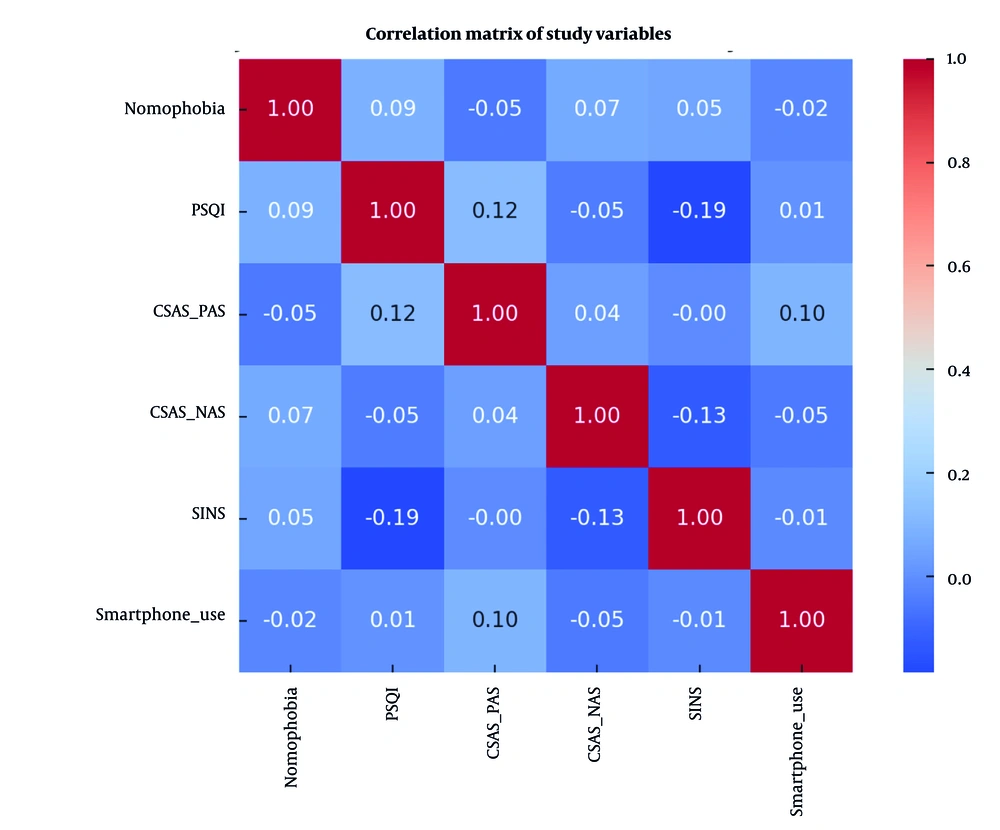
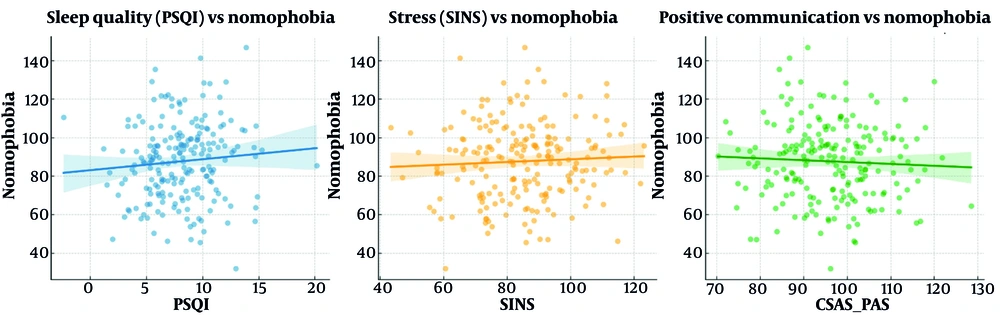
This study investigated the relationship between nomophobia and key psychosocial factors — sleep quality, communication skills attitudes, and perceived stress — among nursing students in Kashan, Iran. The results demonstrated that nomophobia is moderately prevalent in this population and is significantly associated with poorer sleep quality, higher stress levels, and less positive attitudes toward communication skills training. These findings provide nuanced insight into the psychological correlates of nomophobia within a clinical education context and suggest important targets for intervention.
The observed positive association between nomophobia and poor sleep quality aligns with a substantial body of research documenting the detrimental effects of excessive smartphone use on sleep parameters among university students (
23,
24). These studies emphasize that mobile phone overuse disrupts circadian rhythms and sleep architecture, leading to daytime fatigue and cognitive impairments. Our findings extend this literature by focusing on nursing students, who face particular academic and clinical demands that may exacerbate the impact of sleep disturbances on functioning. However, some studies have reported weaker or non-significant associations between mobile phone use and sleep quality when controlling for confounders such as mental health or lifestyle factors (
25), suggesting that the relationship may be context-dependent. These discrepancies underscore the need for further research investigating mediating and moderating variables in this relationship.
Perceived stress was identified as the most robust predictor of nomophobia in both hierarchical regression and Bayesian analyses. Our correlation of R = 0.51 and regression coefficient of β = 0.39 for stress-nomophobia are notably stronger than those reported in prior studies (
5,
26), suggesting a particularly pronounced relationship in nursing students under clinical training pressures. This finding is consistent with theoretical frameworks positing that problematic smartphone use may serve as a maladaptive coping mechanism to alleviate stress and anxiety (
27,
28). Similarly, several empirical studies among college students and healthcare professionals have reported significant positive associations between perceived stress and nomophobia (
29,
30). However, conflicting evidence exists, with some investigations suggesting no direct link between stress and mobile phone dependency once depression or personality traits are accounted for (
31).
To address nomophobia, interventions such as CBT-based stress management programs incorporating smartphone usage tracking applications and sleep hygiene workshops tailored for nursing students could be effective in reducing dependency and improving well-being in nursing schools. Our results highlight the importance of considering stress management interventions within nursing education to potentially reduce nomophobic behaviors and improve psychological well-being.
The negative association between positive attitudes toward communication skills and nomophobia is a novel contribution that adds to the limited but growing literature on this topic. Previous research has underscored the role of interpersonal competencies in buffering against maladaptive technology use (
32), and our findings support the hypothesis that students who value and engage in communication training may possess better coping resources, reducing dependence on digital devices as substitutes for face-to-face interactions. Conversely, the lack of a significant relationship between negative communication attitudes and nomophobia contrasts with some prior studies reporting that social anxiety and communication apprehension can exacerbate nomophobia (
33). This discrepancy may reflect cultural or educational differences in the nursing student population and warrants further exploration.
Interestingly, daily smartphone use was a significant predictor of nomophobia only before accounting for psychosocial variables, indicating that stress, sleep quality, and communication attitudes may mediate or confound this association. This finding resonates with critiques of simplistic screen-time paradigms that neglect psychological context (
34). The Stress-Coping Model supports this interpretation, suggesting that it is the psychological response to stress, rather than mere usage time, that drives nomophobic behaviors (
14). Our results emphasize the importance of integrating psychosocial dimensions into conceptual models of nomophobia, moving beyond mere usage metrics to understand underlying drivers of problematic mobile phone attachment.
Methodologically, the combination of frequentist and Bayesian analytic approaches enhanced the rigor and interpretability of our findings. Bayesian regression provided probabilistic evidence that complemented P-value significance, allowing for richer conclusions about predictor credibility and effect sizes. This dual-method strategy has been advocated in recent behavioral health research to improve reproducibility and nuanced interpretation (
35).
Nonetheless, limitations must be acknowledged. The cross-sectional design limits causal inferences, and the reliance on self-report measures introduces potential biases. Furthermore, cultural factors, such as Iran’s high smartphone penetration and reliance on social media despite censorship, may influence nomophobia’s prevalence and expression, potentially limiting generalizability to Western populations with different digital habits or access to mental health resources. Comorbid mental health conditions, such as anxiety or depression, which were not assessed, could also confound the observed relationships. Longitudinal designs and objective behavioral assessments are needed to clarify temporal dynamics and causal pathways.
5.1. Conclusions
This study provides evidence that nomophobia among nursing students is significantly associated with perceived stress and poor sleep quality, with positive communication skills attitudes serving as a protective factor. These findings underscore the need for holistic interventions addressing psychosocial well-being in nursing education. Implementing CBT-based stress management programs with smartphone usage tracking and sleep hygiene workshops could mitigate nomophobia’s impact, supporting students’ psychological and professional well-being in high-pressure academic and clinical environments.
5.2. Future Studies
Future research should employ mediation analyses to explore stress as a mediator between sleep quality and nomophobia, elucidating underlying mechanisms. Randomized controlled trials (RCTs) testing the efficacy of digital detox programs, CBT-based interventions, or communication skills training are needed to validate practical solutions. Additionally, studies in diverse cultural settings, particularly in Western populations, would enhance generalizability and clarify the role of cultural and digital contexts in nomophobia.