
1. Context
Cognitive intervention has attracted substantial attention in recent years due to an improvement in cognitive function among older adults. Regarding older adults, cognition becomes flexible, and accordingly, intervention programs take place within the greater context of cognitive interventions (1, 2). The activities resulting from mental stimulation, such as memory training, contribute to the maintenance and improvement of daily functional capabilities (3, 4). In addition, flexibility can be improved by implementing different training strategies, which aid in encoding and recovering information (2, 5, 6).
Cognitive performance is enhanced when personal memory is improved through intervention programs (7). Furthermore, mnemonic methods are utilized to enhance cognitive skills among adults with no major cognitive issues. These methods include attention, imagery, categorization, association, and rehearsal (8, 9). Typically, a combination of the above-mentioned strategies is utilized in cognitive intervention programs. According to some studies, intervention programs might contribute to the maintenance or improvement of cognitive performance among adults (10, 11).
Probable memory function enhancement is exemplified by systematic reviews of results and meta-analyses conducted on cognitive interventions. Based on the studies of Verhaeghen et al. (12), an average gain of 0.73 standard deviation (SD) in standardized pre- and post-intervention cognitive performance by means of training confirmed that cognitive intervention might boost memory in healthy older adults. In addition, some studies reported the positive influences of cognitive interventions on cognitive competency and training on delayed recall, immediate recall, and associative learning (13, 14). In the present study, the programs for adults with normal cognitive functioning included interactive group sessions, which lasted several days or weeks and were supervised by a trainer and self-guided training systems in the form of take-home packages (6, 14-17).
Obviously, an increase in age is related to less training benefits, which contradicts some studies (12, 18-20). However, some studies demonstrated cognitive improvement in utilizing mnemonic instruction for one or two sessions (21, 22). Group-based memory intervention programs normally take 5 - 10 one-hour sessions (21, 22).
In another study, Luszcz and Bryan (23) highlighted that there is an associated health risk for individuals aged over 65 in some areas, such as cognition, psychomotor competency, and vision. Therefore, the present study utilized a meta-analysis to evaluate the influence of intervention programs on enhancing cognitive functions among older adults. The present study included cognitive studies conducted over 27 years (1990 - 2017) to see whether there is any significant difference between the strategies implemented during the interventions in terms of impact and whether the participants’ attributes play any role in enhancing intervention effects among older adults.
2. Objectives
The current study’s primary aim was to examine the efficacy of cognitive interventions in older adults. This goal was accomplished by (1) reviewing published studies conducted between 1990 to 2017, (2) determining the effectiveness of cognitive intervention, and (3) disseminating and critically examining the results of experimental and quasi-experimental studies.
3. Evidence Acquisition
(1) What is the average difference in effect between experimental and control groups?
(2) Are interventions effective in the memory quality of older adults?
(3) Is particular training taught during the program more effective than others in improving older adults’ cognition?
3.1. Data Sources and Searches
A review of studies related to cognitive training among older adults published between 1990 - 2017 was considered in the present study. A combination of the following keywords was entered into computerized databases to distinguish the relevant studies: “elderly and intervention program”, “aging and memory”, “aging and intelligence”, “elderly and intelligence”, “treatment program on elderly”, “memory in elderly”, “intervention program on elderly memory and intelligence”, “treatment program on memory and intelligence in elderly”, “memory in elderly people”, “treatment program on memory in elderly”, “elderly intelligence”, “elderly”, “aging and memory”, “elderly and intelligence”, intervention program and elderly memory”, and “intervention program on elderly intelligence”. The databases used included Iran Science and Technology Information Center, Scientific Information Database, Springer, PubMed, Science Direct, LibGen, ERIC-Journal Lists, ERIC-European Research Institute of Catalysis, ERIC-Education Resources Information Center, Wiley, Wiley Online Library, CIVILICA, VIRASCIENCE, and EBSCO. In addition, some of the reference lists extracted from the articles were used. All studies published in either English or Farsi were considered. However, book chapters, theoretical and review articles, and articles with no control group were not taken into consideration.
3.2. Study Selection
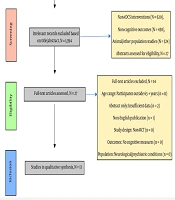
The cognitive performance outcomes, which were in line with the criteria, were selected. First, 174 articles published between 1990 and 2017 on cognitive performance in older adults were selected. Then, each article was reviewed by two independent reviewers who separated information related to the study design, sample cognitive performance, and age, along with the mean and SD of participants’ scores on cognitive tests before and after the intervention in the experimental and control groups. Inter-rater reliability was confirmed by both reviewers based on the agreement rate of 95%. However, there were some minor differences in the consensus. In the next step, cognitive strategies were coded by the raters as a section of the training program. The intervention programs were categorized into narrative therapy, poetry therapy, cognitive rehabilitation, brain screen program, memory improvement, broad-spectrum interventions, group reminiscence, multi-sensory stimulation, working memory software, cognitive-behavioral, self-help, near and far transfer software, forgiveness, memories, and psycho-educational therapeutic programs. The study flowchart is illustrated in Figure 1.
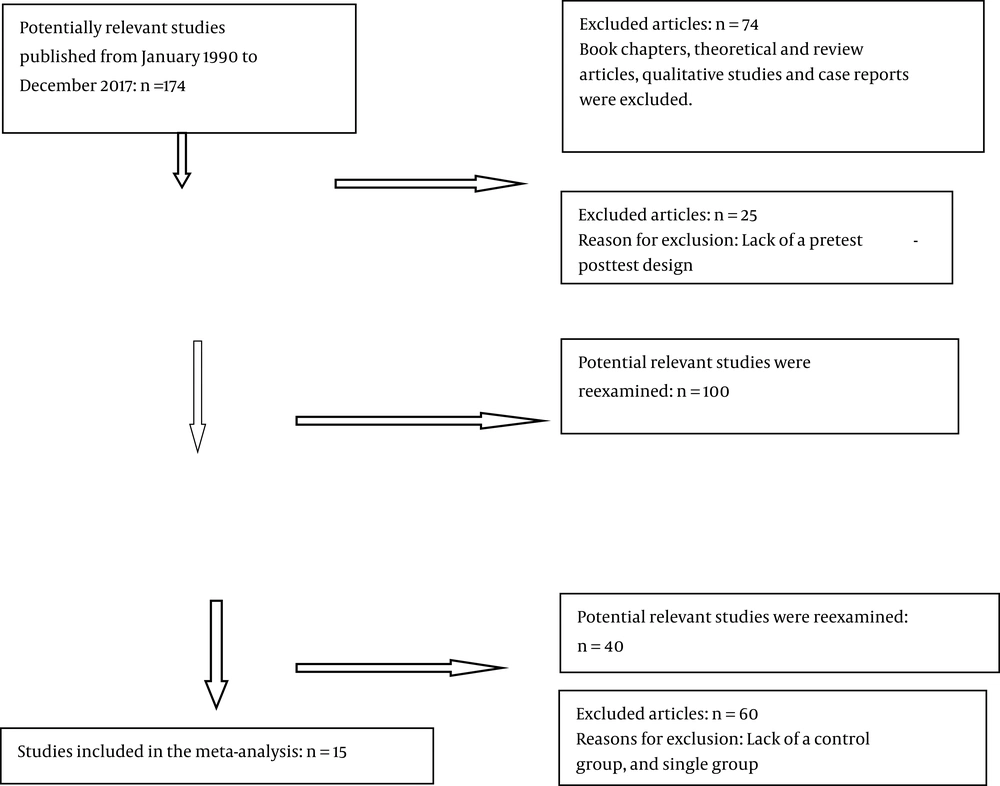
Figure 1.
The study flowchart
All types of cognitive interventions were examined. Studies that did not qualify for a meta-analysis, such as those on qualitative cognitive interventions, were excluded at the coding stage, although such studies play an important role in measuring the effectiveness of cognitive interventions in older adults. A qualitative study can explain the effects of the therapeutic process and the relationships rooted in the process; nevertheless, all studies relying on cognitive methodology were excluded. The current study was conducted using quantitative studies based on cognitive methodologies, except for the ones with a single-group design and a pretest-posttest.
3.3. Publication Bias
To assess the risk of publication bias in this study, the following criteria were used:
(1) Description of eligibility criteria for participants, (2) random selection of participants (appropriate sampling methods), (3) valid evaluation of the effects of participant cognitive training (reliability and validity evidence were reported in the article), and (4) calculation of the power of the reported study
Studies that met the above-mentioned criteria were considered to have a low publication bias, which implies confidence that the results represent unbiased estimates of the true effect.
3.4. Statistical Analysis
Meta-analysis was used for retest-adjusted effect sizes of the methodical review analysis. An overall impact size was created by weighting the effect sizes of the studies using the sample size. The specific effect sizes were presented by constructing forest plots. In addition, the publication bias evidence was inspected utilizing funnel plots. Then, Q and 15 statistics were utilized to quantify between-study heterogeneity. Furthermore, the chance-adjusted percentage of overall variation related to between-study heterogeneity was implemented for data analysis. In addition, independent random effects meta-regression of effect size estimations on covariates was implemented to probe the sources of heterogeneity. Furthermore, independent meta-regressions were applied for every 15 predictors due to the small sample size. A two-tailed α level < 0.05 was considered statistically significant.
3.5. Data Extraction
A total of 15 articles were selected from 910 studies based on cognitive training and comprised randomization for cognitive intervention regarding older adults. A lack of a control group, theoretical or review articles, and articles involving participants under the age of 50 years were considered the main reasons for excluding articles. As shown in Table 1, the 15 selected articles included a control group with 10 independent treatment programs for a total of 910 participants. The participants were aged 50 - 93 years, with a mean age of 61.11 years. The majority of the participants selected for the intervention group finished the criteria-based training. The data were collected after training. The duration of the training programs ranged from 30 minutes to 24 hours, and the number of sessions ranged from 1 to 20. Most cognitive interventions took place in a group format.
Table 1.
Detailed Studies Information
| Author | Age, y | Sample Size | Intervention | Tool | Research Design | Study Place |
|---|---|---|---|---|---|---|
| 1. Irandoost et al. (24) | 60 - 80 | 45 | Aerobic exercises | Wechsler Clinical, Memory Scale | Quasi-experimental | Qazvin, Iran |
| 2. Macpherson et al. (25) | 55 - 75 | 56 | Combined with multivitamins, minerals, and herbal supplements | Computerized battery of memory and attention tasks | Experimental | Swiss |
| 3. Sadeghi et al. (26) | Over 60 | 16 | Physical activity | Cognitive Dementia Rating | Quasi-experimental | Tehran, Iran |
| 4. Ramirez et al. (10) | 60 - 93 | 46 | Positive | State and Trait Anxiety, Beck Depression, Autobiographical Memory Test, Mini-Cognitive Exam, and Life Satisfaction Scale | Experimental | Jaen, Spain |
| 5. Hastings and West (11) | 54 - 92 | 185 | self-help condition | |||
| 6. Remy et al. (27) | 63 - 80 | 30 | Attention-demanding tasks | Mini-Mental State, Mill-Hill vocabulary test, and visual memory span | Experimental | Spain |
| 7. Bellander et al. (28) | 65 - 75 | 39 | Item recognition | Item memory test | Experimental | Zurich, German |
| 8. Xin et al. (29) | 60 - 82 | 29 | Computerized training program | Digit-span test, Raven’s Advanced Progressive Matrices test, | Quasi-experimental | China |
| 9. Barghi Irani et al. (30) | 51 - 69 | 40 | Cognitive-behavioral | Petersburg sleep quality and daily memory questionnaire | Quasi-experimental | Tehran, Iran |
| 10. Daneshnia et al. (31) | 50 - 61 | 50 | Working memory software | Wechsler Memory Scale, Rogers’ self-concept, and Aizeng’s self-esteem | Experimental | Isfahan, Iran |
| 11. Moghaddasifar et al. (32) | 50 - 70 | 28 | Multi-sensory stimulation | Wechsler Clinical, Memory Scale | Experimental | Ahwaz, Iran |
| 12. Ghanbarpanah et al. (33) | 65 | 72 | Group reminiscence | Mini-Mental State Examination, | semi-experimental | Shiraz, Iran |
| 13. Abd-Elaziz et al. (34) | Over 60 | 70 | Cognitive rehabilitation | Mini-Mental State, Digit Span, Logical Memory, and Geriatric Depression Scale | Quasi-experimental | Spain |
| 14. Kwok et al. (35) | Over 60 | 176 | Active Mind cognitive-training | Mattis Dementia Rating Scale | Experimental | Hong Kong, China |
| 15. Faraji et al. (36) | Over 60 | 72 | Poetry | Cognitive status questionnaire | Quasi-experimental | Arak, Iran |
4. Results
Every article was in accordance with the established and consistent protocols shown in Table 1.
Figure 2 depicts the effect size and weight for the 15 intervention studies at the post-intervention stage with relevant corresponding forest plots. The size of the square on the forest plot demonstrates the weights attributed to the studies based on sample size. Therefore, smaller and larger squares represent smaller and larger weights, respectively. However, larger squares lead to a higher statistical significance of the effect size. The 95% confidence interval (CI) implies that the true population value ranges from 0.166 to 0.438 for lower and upper limits, respectively.
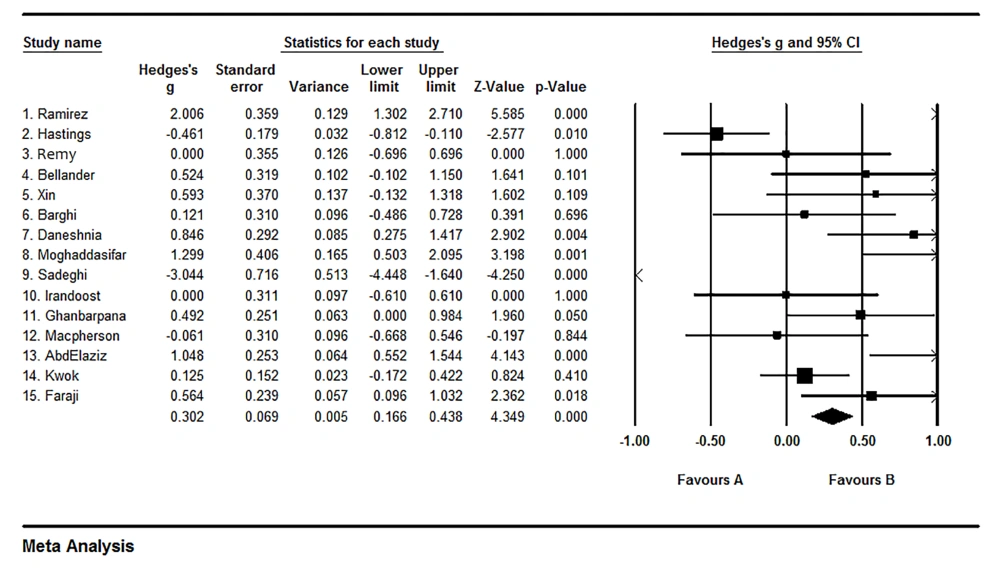
Figure 2.
Forest plot for cognitive functions in older adults
A homogeneity test was carried out to determine the effect sizes variance that implemented the Q statistic, which is a calculation of weighted standard deviations. For this study, the significance of the Q statistic was (Q = 88.59, df = 14, P = 0.000). A summarization of the implemented post-intervention homogeneity test in the fixed effects model is presented in Table 2.
Table 2.
Post-treatment Test for Homogeneity Using Random Effects Model
| Model | Effect | Standard Error | Test of Null (Two-Tailed) | P-Value | Q | Heterogeneity | Tau-Squared | |||||||||
|---|---|---|---|---|---|---|---|---|---|---|---|---|---|---|---|---|
| Number of Studies | Point Estimate | Variance | LL | UL | Z | df (Q) | P-Value | I2 | Tau-Squared | SE | Variance | Tau | ||||
| Fixed | 15 | 0.30 | 0.069 | 0.005 | 0.165 | 0.436 | 4.342 | 0.000 | 88.592 | 14 | 0.000 | 84.197 | 0.399 | 0.207 | 0.043 | 0.631 |
| Random | 15 | 0.354 | 0.183 | 0.033 | 0.004 | 0.713 | 1.937 | 0.053 | ||||||||
A diagram of the studies and associated effect sizes is shown as a funnel plot. At the bottom of the plot, a concentration of studies is depicted on one mean side. The propensity of studies to converge near the top of the plot is an indication that smaller articles have a greater likelihood of being published when possessing above-average effects and, therefore, have a higher likelihood of generating statistically significant results.
4.1. Risk of Bias in Studies
Risk of bias accounted for a portion of the heterogeneity between studies that examined the effects of cognitive training on improving cognitive functions in older adults (g = 0.30). Studies that examined the effects of cognitive training on improving cognitive functions in older adults with an average risk of bias reported a medium positive effect (g = 0.30, I2 = 84.20, Tau-squared = 0.39, 95% CI: 0.16 - 0.43).
4.2. Risk of Bias Across Studies
Studies that examined the effects of cognitive training on improving cognitive functions in older adults reported medium positive effects (g = 0.30, 95% CI: 0.166 - 0.438). The examination of funnel plots revealed small asymmetry, representing a medium risk of bias across studies that assessed the effects of cognitive training on improving cognitive functions in older adults (Figures 2, and 3, respectively). This was confirmed for studies that assessed the effects of cognitive training on improving cognitive functions in older adults by significant results of Egger’s test (Z = 4.34, Q = 88.59, P = 0.01).
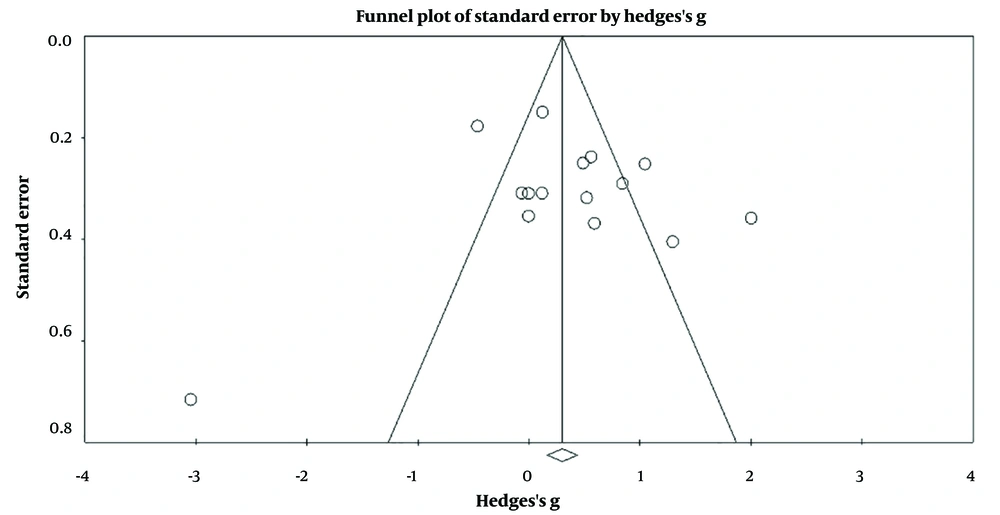
Figure 3.
Funnel plot of standard error of Hedges’ g for post-treatment data
5. Discussion
Comprehensive Meta-analysis Software (version) was employed for data analysis. Comprehensive Meta-analysis Software was employed to measure the effect sizes for each study. The software inputs included the mean and SD of scores and the number of articles in the sample. Furthermore, continuous data were employed to obtain the total mean effect size for unmatched post-data in each selected study. The Hedge’s g correction for small size bias was employed to derive the standardized mean difference. The obtained total effect size was 0.30 (SE = 0.07, 95% CI: 0.166 - 0.438).
Following Cohen (37), an effect size of 0.30 was interpreted as a median effect; however, positive effect sizes were assessed based on the significance of the Z value. The SD in the intervention groups, on average, was higher than that of the control groups.
Based on the results, intervention programs can influence cognitive functions, memory, and intelligence among older adults (5, 38). The examined articles published over the past 20 years were assessed via meta-analysis. The results indicated that the post-test effect size of the intervention group was greater than that of the control group (38). A value of 0.31 was obtained as the standardized pre-post variance between the intervention and control groups (12). The performance of older adults’ condition was significant at a moderate level. In addition, the mean score difference decreased in the intervention groups. The total small sample sizes and total effects regarding cognitive treatment might be regarded as the main reasons for the small effect size.
Generally, cognitive treatment-based studies in real-world contexts include a small number of participants. Although there is less client selection control, treatment externalizing behaviors and treatment fidelity entail less significant outcomes (39). The present study included an average sample group of the studies serving as a brief summarization of the participants’ mean effect.
In a large number of studies, the positive effect of interventions increased after the treatment, meaning that the effects of treatment might continue to improve upon active intervention. For example, Ramirez et al. (10) suggested that a positive intervention program for older adults had a considerable effect on increasing specific memory function, life satisfaction, and subjective happiness, compared to the control group, while decreasing state anxiety and depression. In another study, Kwok et al. (35) reported that the Active Mind cognitive improvement program played a positive role in Hong Kong-based Chinese older adults improving their cognitive functions. Ebbinghaus (40) recommended an effective method to enhance memory function that involved the memorization of nonsense syllables with only rote repetition. Recent studies have demonstrated that relying solely on rehearsal cannot improve memory, although it might facilitate other strategies to enhance recall (41).
However, a lack of a significant difference for greater effect sizes related to categorization strategies is in line with the results of previous studies (12, 42). Categorizing items into smaller sections or units according to their characteristics simplifies encoding and, in turn, restoring information (13, 43, 44). Typically, the use of categorical clustering in memory tasks in older adults results in improved memory in comparison to those who used less categorization (45, 46). The results of the present study are satisfactory and confirm the positive impact of interventions on cognitive functions while helping older adults experience improved memory, crystallized intelligence, and quality of life by concentrating on interventions for enhancing personal and social resources to achieve happiness.
5.1. Suggestions for Future Research
The results of the current meta-analysis highlight some fields of future studies. The present study did not cover methods that combine interventions with hormones and nutrition interventions. Such combinations might be more effective than supplementary training programs in improving cognitive functions in older adults. This can be a subject for future studies. Moreover, future research should consider verbal fluency, episodic memory, fluid intelligence, and the benefits of long-term memory that can be derived from cognitive intervention. Five-year follow-up results indicated that the cognitive interventions were effective in aiding cognitive processes (e.g., memory and intelligence) in older adults living in nursing homes (5). However, limited research provides follow-up information for over a year, and future studies are needed to describe the maintenance of cognitive interventions over time. Therefore, the limitations of this study described below should be considered.
5.2. Limitations
This study has some limitations. The first limitation is that the effects of cognitive training interventions tend to improve cognitive functions in older adults, and methods that improve cognitive functions in older adults need to be identified. The second limitation is the selection bias in participant samples, as the individuals selected for experimental groups might differ in substantial ways from the general population. One particular concern is that individuals with higher levels of memory deficits might elect not to participate in studies but might do so once remitted, which would reduce the effect size. Additionally, the majority of the records included in this study were published in English and Persian languages. Finally, the experimental studies assessed in this meta-analysis employed 15 samples that were rated as having a risk of bias.
5.3. Conclusions
The cognitive functions of older adults are directly influenced by cognitive interventions. The results of the present study validated previous meta-analyses and methodical reviews, suggesting that crystalized intelligence and memory training can play a positive role in enhancing cognitive functions. However, there is a lack of evidence confirming the superiority of one strategy over others. Finally, the results indicated greater improvements when more training strategies were implemented. Further research on the use of intervention programs can uncover new techniques that are more appropriate for older adults.