
1. Background
Mild cognitive impairment (MCI) is a critical clinical state characterized by a measurable decline in cognitive abilities that exceeds the changes expected with chronological aging but does not meet the diagnostic threshold for dementia because daily functional independence remains largely preserved (1). This condition is increasingly recognized as an important transitional window for therapeutic intervention, as individuals with MCI have a significantly higher risk of progression to Alzheimer's disease and other neurodegenerative disorders (2). Epidemiological data suggest that 10% to 20% of adults older than 65 years are affected, underscoring a major public health concern (3). Patients often experience subtle neuropsychological deficits that, although not debilitating, increase cognitive load and reduce overall quality of life (4). Given the growing global elderly population, addressing early cognitive impairment is essential to prevent long-term disability and maintain autonomy in aging populations.
Working memory is among the cognitive domains most vulnerable to impairment in individuals with MCI and constitutes a core component of executive functioning (5). It involves the temporary storage and concurrent manipulation of information required for higher-order cognitive processes, including reasoning, comprehension, and learning (6). In individuals with MCI, reduced working memory capacity directly limits the ability to solve problems and make informed decisions in real time (7). From a neurobiological perspective, these deficits are closely linked to dysfunction in the prefrontal cortex and parietal networks that support online information processing (8). Deterioration in working memory not only compromises cognitive efficiency but also increases the psychological burden on patients and caregivers by reducing the patient’s ability to independently manage multistep daily routines (9).
Sustained attention, another fundamental cognitive domain, is also frequently impaired in individuals with MCI. This construct refers to the ability to maintain consistent behavioral responses during prolonged periods of continuous and repetitive activity and is essential for effective goal-directed task performance (10). Deficits in sustained attention in individuals with MCI may manifest as increased distractibility and difficulty maintaining focus on relevant stimuli over extended periods, leading to higher error rates in both clinical assessments and daily life (11). Neuroscientific evidence indicates that sustained attention relies on the integrity of frontoparietal and thalamic networks (12). Strengthening attentional control through targeted interventions may improve the temporal stability of focus, thereby enhancing overall cognitive throughput and reducing the risk of cognitive errors that could lead to accidents or further functional decline (13).
Cognitive rehabilitation has emerged as a promising nonpharmacological intervention designed to remediate impaired functions through systematic, goal-oriented mental exercises (14). These programs leverage the brain’s innate neuroplasticity to strengthen neural circuits or develop compensatory strategies that bypass damaged pathways (15). Research has shown that structured cognitive training, including memory exercises, attention-switching tasks, and problem-solving simulations, can significantly improve cognitive profiles in individuals with MCI (16, 17). For example, studies by Fereidouni Valashejerdi et al. (17) and Gheysari and Mazaheri (18) confirmed that systematic training can enhance memory and attentional focus in older adults. These interventions not only target specific cognitive deficits but also contribute to increased synaptic density and neuronal activity in critical brain regions, such as the prefrontal cortex, thereby slowing the symptomatic progression of the disorder (19).
The integration of physical movement with cognitive tasks, as in movement-based cognitive rehabilitation, represents a multimodal approach that may yield superior outcomes through mechanisms such as enhanced prefrontal-parietal connectivity, facilitated neuroplasticity, and potential upregulation of brain-derived neurotrophic factor (BDNF) through dual-task paradigms (20). Previous studies, such as that by Nazarboland et al. (21), have shown that combining executive function training with motor activities significantly improves selective attention and inhibitory control in patients with MCI. In addition, contemporary research increasingly emphasizes the role of psychological factors, such as self-efficacy and motivation, which are reinforced during successful rehabilitation sessions. By engaging multiple neural systems simultaneously, consistent with embodied cognition frameworks that highlight the interdependence of sensorimotor and cognitive processes, these interventions may promote more robust recovery of cognitive function than single-domain tasks (22). However, despite these advances, there is still no consensus regarding the most effective duration or specific protocols required to achieve long-term stability in cognitive gains in this population.
The rationale for the present study stems from the urgent need to establish validated, culturally adapted, and multidimensional protocols that can effectively mitigate the cognitive symptoms of MCI. Although pharmacological options remain limited, cognitive rehabilitation offers a safe and proactive means of enhancing cognitive reserve in older adults. Understanding how these interventions affect working memory and sustained attention is crucial for developing clinical guidelines that can improve the standard of care in geriatric clinics. By evaluating the persistence of these effects through follow-up assessments, this study provides valuable insight into the sustainability of cognitive improvements.
2. Objectives
The primary aim of this study was to evaluate the effectiveness of a movement-based cognitive rehabilitation program in improving working memory and sustained attention in individuals with MCI.
3. Methods
3.1. Design
This study employed a quasi-experimental pretest–posttest control-group design with a 3-month follow-up assessment. Participants were allocated to groups using a random number generator after convenience sampling from eligible clinic attendees. However, full randomization procedures, such as allocation concealment and blinding, were not feasible in this clinical setting, precluding classification as a true randomized controlled trial.
3.2. Subjects
The target population comprised all individuals diagnosed with MCI who attended memory and cognitive rehabilitation clinics in Tehran during 2024. A sample of 30 participants was recruited through convenience sampling according to predefined inclusion criteria. Participants were subsequently allocated to either the experimental group (n = 15) or the control group (n = 15). The diagnosis of MCI was confirmed by a clinical neuropsychologist using Petersen’s criteria, including subjective cognitive complaint, objective impairment in 1 or more cognitive domains, preserved functional independence, and absence of dementia. Baseline cognitive screening included the Montreal Cognitive Assessment (MoCA), with scores typically ranging from 19 to 25 (mean = 22.4, SD = 1.8) across the sample.
Inclusion criteria were a clinical diagnosis of MCI, age 60 years or older, the minimum literacy required to complete the assessments, and the absence of severe sensory or motor disabilities. Exclusion criteria were other neurological disorders, such as Parkinson disease or stroke, concurrent participation in other cognitive training programs, and absence from more than 2 rehabilitation sessions. Regarding the reported age range of 55 to 75 years despite the inclusion criterion of age 60 years or older, one 55-year-old participant was included because all other eligibility criteria were met and the clinician judged the individual to be appropriate for inclusion. This was considered a minor protocol deviation. Ethical principles were strictly followed throughout the study. All participants provided written informed consent, were assured of the confidentiality of their personal data, and were explicitly informed of their right to withdraw from the study at any time without consequence.
3.3. Sample Size
An a priori power analysis was conducted using G*Power 3.1 for repeated-measures ANOVA with a within-between interaction design of 2 groups and 3 time points. Assuming a medium effect size (f = 0.25, corresponding to partial η² = 0.06), α = 0.05, target power = 0.80, and an estimated correlation among repeated measures of 0.5, the required total sample size was 30 participants (15 per group). The actual sample (N = 30) met this target.
3.4. Data Analysis
Data were analyzed using SPSS version 26. Descriptive statistics, including means and standard deviations, were used to summarize the results. For inferential analysis, repeated-measures ANOVA was used to examine differences between the experimental and control groups across the pretest, posttest, and 3-month follow-up stages after confirming that all statistical assumptions were met. No dropouts occurred during the study period or follow-up assessments; therefore, complete-case analysis was used, and no missing-data handling was required. Intention-to-treat principles were not applicable given full retention. Mauchly’s test of sphericity was nonsignificant for both variables (P > 0.05); Greenhouse-Geisser corrections were examined as a precaution but did not alter the results, and all significant effects remained significant at P < 0.05.
3.5. Procedure
After pretest assessments were administered to both groups, participants in the experimental group engaged in a structured movement-based cognitive rehabilitation program, whereas participants in the control group were placed on a waiting list and received no intervention during the study period. The intervention comprised 10 sessions of 60 minutes each, delivered twice weekly. It was delivered in small groups of 4 to 6 participants per session by a trained clinical psychologist with expertise in geriatric cognitive rehabilitation and a cofacilitator occupational therapist. Sessions were manualized with standardized instructions and activity progressions. Therapist fidelity was monitored using session checklists and periodic observation by the principal investigator. No adverse events were reported. The protocol used an integrated cognitive-motor framework, with each session designed to incorporate physical coordination and cognitive demands aimed at promoting neuroplasticity. It was grounded in dual-task training and embodied cognition frameworks, integrating motor coordination with cognitive demands to promote neuroplasticity through enhanced prefrontal-parietal connectivity and potential BDNF release. A detailed overview of the intervention sessions is provided in Table 1.
Table 1.
Comprehensive Protocol of the Movement-Based Cognitive Rehabilitation Sessions
| Session | Cognitive Objectives | Motor Objectives |
|---|---|---|
| 1 | Improving attention through age-appropriate games (e.g., letter games) and enhancing focus on social cues | Maintaining balance and strengthening finger dexterity through bead-stringing and puzzles |
| 2 | Enhancing working memory through cognitive games focused on educational memory and interpersonal communication cues | Finger dexterity, foot-finger coordination, balance, and hand-eye coordination |
| 3 | Improving problem-solving skills through exercises related to academic and interpersonal relationship conflicts | Balance, eye-foot coordination, trunk-limb synchronization, and upper limb agility |
| 4 | Strengthening advanced problem-solving strategies and repetitive cognitive challenges | Dynamic balance, bimanual coordination, and response speed |
| 5 | Improving cognitive and metacognitive strategies through mindfulness exercises related to social interactions | Large muscle coordination, agility, and upper limb synchronization |
| 6 | Continuing cognitive strategy enhancement and mindfulness training in academic contexts | Hand-eye coordination, response speed, and finger fine motor skills |
| 7 | Integrating mindfulness with social cognition and interpersonal skill development | Lower limb coordination, balance, and sustained response speed |
| 8 | Improving behavioral prediction, social skills, and emergency response training | Storytelling, image sequencing, pantomime, and sticker-based coordination games |
| 9 | Consolidating cognitive skills in older adults with a focus on interpersonal relationship mastery | Full-body coordination involving the upper and lower limbs, agility, and balance |
| 10 | Conducting posttest assessment and reinforcing self-awareness of the cognitive techniques learned | Reviewing motor achievements and final coordination assessments |
3.6. Apparatus and Task
3.6.1. Daneman and Carpenter Working Memory Test
This performance-based test assesses working memory capacity by evaluating simultaneous linguistic processing and storage. The task involves reading sets of unrelated sentences, ranging from 2 to 7 sentences, and recalling the final words in serial order. It comprises 27 items (23). In the Iranian context, Shahnazari (24) reported a Cronbach α reliability coefficient of 0.84 for the instrument. In the present study, internal consistency, measured using Cronbach α, was 0.86. Although primarily verbal-linguistic, this task was selected because of its sensitivity to central executive demands in working memory, which are commonly impaired in MCI and targeted by dual-task cognitive-motor interventions. Its ecological validity for everyday multitasking is supported in the aging literature.
3.6.2. Sustained Attention Subscale
Sustained attention was measured using the corresponding subscale of the Cognitive Abilities Questionnaire. Respondents rated items on a 5-point Likert scale ranging from 1 ("Never") to 5 ("Always"). According to the instrument’s special scoring procedure, scores range from 7 to 15, with higher values indicating better sustained attention and lower distractibility. Nejati (25) reported a Cronbach α of 0.83, whereas the present study yielded a reliability coefficient of 0.78 in participants with MCI. This self-report subscale was selected because of its brevity, cultural adaptation in Iranian samples, and established use in MCI research. However, self-report measures in individuals with MCI may be influenced by metacognitive bias; this issue is acknowledged as a limitation.
3.7. Ethical Considerations
The research protocol was reviewed and approved by the Ethics Committee of Islamic Azad University, Central Tehran Branch (approval reference: IR.IAU.CTB.REC.1404.065). All participants provided written informed consent, were assured of the confidentiality of their personal data, and were explicitly informed of their right to withdraw from the study at any time without consequence.
4. Results
The study included 30 individuals with MCI (mean age = 72.1 years, SD = 6.3, range = 55 to 75 years), 18 of whom (60%) were female. No significant differences were observed between the experimental and control groups in age (P = 0.655) or sex distribution (P = 0.718), indicating effective group allocation despite the quasi-experimental design.
Table 2 presents descriptive statistics for working memory and sustained attention across the 3 assessment points. In the experimental group, working memory scores increased substantially from pretest (mean = 12.20, SD = 2.62) to posttest (mean = 15.27, SD = 2.89) and remained largely stable at the 3-month follow-up (mean = 14.33, SD = 2.69). Sustained attention in this group also improved markedly, increasing from 9.00 (SD = 1.46) at baseline to 11.87 (SD = 1.44) at posttest. In contrast, the control group demonstrated stable scores with minimal changes over the same period.
Table 2.
Descriptive Statistics for Working Memory and Sustained Attention Scores by Group and Time Point a
| Variables and Groups | Pre-test | Post-test | Follow-up |
|---|---|---|---|
| Working memory | |||
| Cognitive rehabilitation | 12.20 (2.62) | 15.27 (2.89) | 14.33 (2.69) |
| Control | 11.40 (2.77) | 11.47 (2.48) | 11.46 (2.33) |
| Sustained attention | |||
| Cognitive rehabilitation | 9.00 (1.46) | 11.87 (1.44) | 11.07 (1.53) |
| Control | 9.04 (1.89) | 9.13 (1.96) | 9.26 (2.00) |
a Values are expressed as mean (SD).
Before conducting the repeated-measures ANOVA, assumptions were assessed. Shapiro-Wilk tests indicated that the data for both working memory and sustained attention were normally distributed at all time points in both groups (P > 0.05). Mauchly’s test of sphericity was nonsignificant for both variables (P > 0.05), supporting the use of unadjusted degrees of freedom; Greenhouse-Geisser corrections were also examined as a precaution but did not alter the pattern or significance of the results. Levene’s test confirmed homogeneity of variance between groups (P > 0.05).
Repeated-measures ANOVA showed significant main effects of time and group, as well as significant group × time interactions, for both working memory and sustained attention (P < 0.05) (Table 3). Partial eta-squared values indicated large effects for group (working memory η²p = 0.33; sustained attention η²p = 0.36) and for the group × time interactions (0.25 and 0.29, respectively), exceeding Cohen’s benchmark for large effects (η²p ≥ 0.14). These findings indicate substantial practical significance of the movement-based cognitive rehabilitation intervention beyond statistical significance alone.
Table 3.
Results of Repeated-Measures Analysis of Variance for Working Memory and Sustained Attention
| Variables and Source | SS | df | MS | F | P | η²p |
|---|---|---|---|---|---|---|
| Working memory | ||||||
| Time | 149.39 | 2 | 74.70 | 4.82 | 0.013 | 0.19 |
| Group | 52.75 | 1 | 52.75 | 20.69 | 0.001 | 0.33 |
| Group × time | 36.47 | 2 | 18.24 | 7.02 | 0.002 | 0.25 |
| Sustained attention | ||||||
| Time | 61.38 | 2 | 30.69 | 4.09 | 0.024 | 0.16 |
| Group | 47.51 | 1 | 47.51 | 23.82 | 0.001 | 0.36 |
| Group × time | 33.38 | 2 | 16.69 | 8.37 | 0.001 | 0.29 |
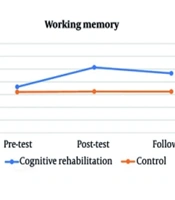
Post hoc pairwise comparisons with Bonferroni adjustment clarified the interaction effects. Within the experimental group, significant improvements were observed in both working memory and sustained attention from pretest to posttest and from pretest to follow-up (P < 0.001). No significant differences were observed between posttest and follow-up scores, indicating short-term retention of cognitive improvements (Figure 1). Between-group comparisons at posttest and follow-up also demonstrated significant differences favoring the experimental group (P < 0.001).
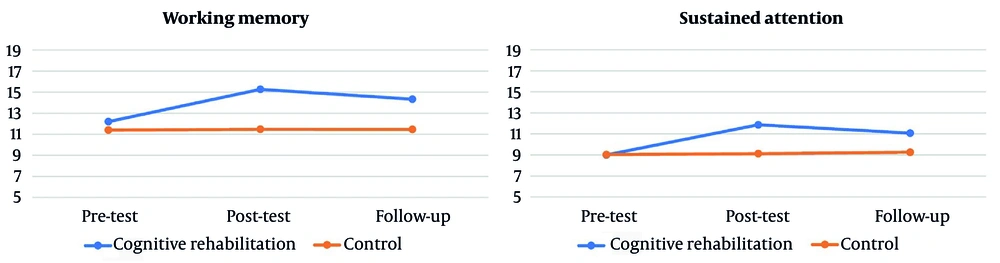
Figure 1.
Changes in working memory and sustained attention scores across time points in the experimental and control groups
5. Discussion
This study evaluated the effectiveness of a movement-based cognitive rehabilitation intervention on working memory and sustained attention in individuals with MCI. Inferential analyses indicated that the intervention produced significant improvements in both cognitive functions in the experimental group compared with the control group. In addition, the absence of a significant decline between the posttest and the 3-month follow-up suggests short-term retention of gains rather than long-term efficacy.
The marked improvement in working memory may be attributable to the multimodal nature of the intervention, which combined cognitive demands, such as attention games, problem-solving, and memory tasks, with physical coordination activities. Working memory relies heavily on the dorsolateral prefrontal cortex and posterior parietal regions (5). Dual-task paradigms integrating motor and cognitive processing may have enhanced functional connectivity within these frontoparietal networks, consistent with findings from similar cognitive-motor training studies (26). The potential contribution of increased BDNF release and neurogenesis, which are frequently associated with aerobic and coordinative exercise, may have further supported these gains; however, no direct biomarker or neuroimaging data were collected in the present study, and these mechanisms therefore remain inferred rather than demonstrated.
Regarding sustained attention, the protocol required participants to maintain focus during ongoing motor demands and environmental monitoring, which may have retrained attentional control networks involving thalamic and right-hemisphere frontal structures (10). These results align with previous reports demonstrating improvements in selective attention and inhibitory control following combined cognitive-motor rehabilitation in individuals with MCI (21). Nonetheless, the use of a self-report measure introduces the possibility of metacognitive bias, as individuals with MCI may overestimate or underestimate their attentional abilities; objective performance-based tasks would have provided a more robust index of change.
A key limitation of the present design is the waiting-list control condition, which did not account for nonspecific factors such as social interaction, structured group activity, therapist attention, physical activity per se, or expectancy of benefit (ie, the Hawthorne effect). Consequently, it remains difficult to disentangle the specific therapeutic contributions of the cognitive training elements from those of the movement-based components or from placebo-like effects of participation. Future research should incorporate active control groups, such as structured social or low-demand physical activity programs matched for contact time, or dismantling designs to isolate active ingredients and determine optimal protocol configurations.
The sustained improvements observed at the 3-month follow-up are encouraging but represent only short-term retention. Longer follow-up intervals, such as 6 to 12 months or longer, are essential to determine whether these gains persist, attenuate, or translate into reduced rates of progression to dementia. Moreover, the modest sample size, convenience sampling from a single geographic region, and lack of trial registration further limit generalizability and transparency.
From a theoretical perspective, the protocol was informed by dual-task training principles and embodied cognition frameworks, which posit that sensorimotor engagement can scaffold and strengthen higher-order cognitive processes. Although behavioral outcomes support the potential value of this approach, claims regarding enduring neuroplasticity should be tempered in the absence of direct physiological evidence. Similarly, the concept of a virtuous cycle involving increased self-efficacy, motivation, and everyday cognitive engagement is plausible and consistent with participant anecdotes, but it was not formally assessed and therefore remains speculative.
5.1. Conclusion
The results provide preliminary empirical support for the feasibility and short-term effectiveness of a structured, multimodal cognitive-motor rehabilitation program in enhancing working memory and sustained attention in individuals with MCI. Despite methodological constraints, including the inability to isolate specific intervention components, reliance on a self-report attention measure, and a relatively brief follow-up period, the observed effect sizes were large, and the retention of gains was promising. Geriatric and rehabilitation clinics may consider incorporating similar integrated protocols as part of nonpharmacological care pathways while prioritizing active-controlled, longer-term trials to establish definitive efficacy, optimal dosing, and potential disease-modifying effects.
AI Use Disclosure: The authors declare that no generative AI tools were used in the creation of this article.