
1. Background
The likelihood of forgetfulness and memory impairment increases with age (1, 2). Motor memory, a specific memory system involving movement information, encompasses a broad spectrum of actions — from skeletal movements to speech-related motions — acquired through practice and experience (3). This memory system involves three key processes: encoding, consolidation, and retrieval, with consolidation playing a particularly crucial role. Memory consolidation comprises a series of processes that strengthen through training and become more stable during offline periods of rest and practice (4, 5). Research indicates that multiple factors influence consolidation, including training structure (6). Kantak et al. (7) proposed that practice variability might engage different neural structures essential for memory consolidation during skill evaluation. Both Kantak et al. (7) and Santos et al. (8) found reduced motor skill consolidation following variable practice, contrasting with enhanced consolidation after constant practice (7, 8). These findings align with the action plan reconstruction hypothesis, which suggests that variable, random task arrangements increase cognitive effort (9). Proponents of variable practice argue that it promotes deeper cognitive processing and creates more robust mental skill representations. Memory structures developed through variable practice tend to be better organized, less context-dependent, and more resistant to forgetting than those from blocked practice (10).
Limited research has examined whether lifespan changes in motor skill learning correlate with motor memory consolidation differences. Most studies indicate that older adults show less consolidation-related skill improvement than younger individuals (11), or sometimes no improvement at all (12). This suggests that age-related declines in motor performance may stem from impaired motor memory consolidation in older populations (13). Although extensive research has examined feedback's role in memory consolidation, few studies have specifically investigated elderly populations. Existing research on other demographic groups provides relevant insights. Wang et al. (14) demonstrated that delayed visual feedback enhances motor memory consolidation more effectively than simultaneous feedback, highlighting the connection between feedback and motor learning. Similarly, Guadagnoli and Kohl (15) found Parkinson's patients showed better retention in motor tasks with 100% feedback frequency (14, 15). However, information processing theory suggests frequent feedback may hinder learning by creating answer dependency.
Investigating feedback and variable practice effects on motor memory consolidation could optimize motor skill programs across age groups. Unfortunately, little is known about how aging affects motor memory consolidation (16). The sole study examining age-related motor memory interference patterns revealed that introducing a secondary motor skill early in consolidation increases interference risk in older adults (13).
2. Objectives
However, as this study only included children and adolescents, it remains unclear whether similar age-related patterns occur in feedback-related motor memory interference. Given these gaps, we examined how practice variability and knowledge-of-results feedback affect motor memory consolidation in older adults. Considering the existing literature and theoretical disagreements, our central question emerges: Do different practice schedules (variable vs. constant) and feedback frequencies positively influence motor memory in older adults?
3. Methods
3.1. Participants
This applied, semi-experimental study utilized six experimental groups: Variable practice groups with 25%, 50%, and 75% feedback frequencies, and constant practice groups with corresponding feedback frequencies (25%, 50%, and 75%). The study included 72 older adults (mean age = 65.3 ± 4.76 years), equally divided among the six groups (12 participants per group). Sample size determination was conducted using G*Power software for a repeated-measures ANOVA design with the following parameters: Effect size (f) = 0.25, 95% confidence level, α = 0.05, and power (1-β) = 0.80. Participants were selected through purposeful sampling based on strict inclusion criteria: No history of neurological, psychiatric, or medical conditions; no alcohol consumption; and no use of substances affecting the central nervous system or learning ability (16). All participants were naive to the experimental task. Exclusion criteria included unwillingness to continue the intervention and the occurrence of illness during the exercise protocol.
3.2. Apparatus and Task
3.2.1. Dartboard and Equipment
A regulation-sized electronic dartboard was used for both practice and testing. The system automatically recorded each subject's score and radial error upon dart impact. The dartboard was mounted on the wall with its center positioned 1.73 meters above the floor surface.
3.3. Procedures
To minimize circadian influences on memory processing in older adults, all training and testing sessions were conducted in the morning (17). The study comprised three phases: Evaluation followed by retention tests at 30-minute and 24-hour intervals. Participants were assigned to six experimental groups — three variable practice groups [receiving knowledge of results (KR) feedback at 25%, 50%, or 75% frequencies] and three constant practice groups (with matched feedback frequencies).
During evaluation, the constant practice groups performed 8 blocks of 15 dart throws (120 trials total) from a fixed distance of 2.37 meters, receiving KR feedback on 30, 60, or 90 attempts depending on their assigned frequency. The variable practice groups completed an equivalent number of trials across randomized distances (2.37 m, 2.5 m, 2.6 m) with proportionally matched feedback. Knowledge of results feedback included radial error scores and directional displacement (e.g., up/down, left/right, far/near relative to the target), with participants permitted to view the target after each throw. Retention tests were administered 30 minutes and 24 hours post-evaluation.
3.4. Data Analysis
A mixed ANOVA was performed with group (6 levels: Between-subjects factor) and Block (8 levels: Within-subjects factor) as fixed factors. A second mixed ANOVA examined the effects of feedback frequency (3 levels: 25%, 50%, 75%), practice type (constant vs. variable: Between-subjects), and test phase (eighth evaluation block vs. retention test: Within-subjects), with repeated measures on the test phase factor. For significant main or interaction effects, one-way ANOVAs and Bonferroni-corrected post hoc tests were conducted to analyze specific group differences. All analyses were performed using SPSS (version X), with statistical significance set at P < 0.05.
4. Results
The results from Table 1, comparing the average performance of the experimental groups across the training blocks, indicate that the main effect of the group is significant. Bonferroni's post hoc test results reveal that subjects in the variable practice group with 75% feedback performed significantly better than those in the constant practice groups with 25%, 50%, and 75% feedback (P = 0.001). Subjects in the constant practice group with 75% feedback exhibited the highest performance, while those in the variable practice group with 25% feedback showed the weakest performance. The main effect of evaluation blocks is also significant in Table 1. Bonferroni’s post hoc test results demonstrate a significant difference in subjects' performance between the first, second, and third practice blocks compared to the seventh and eighth practice blocks (P = 0.001). Mean comparisons indicate that subjects performed best in the seventh and eighth practice blocks (Figure 1). The interaction effect of the evaluation block within the group was not significant.
Table 1.
Compare the Mean Performance of Groups in the Evaluation Phases
| Statistics | Sum of Squares | df | F | P-Value | ɳ2 |
|---|---|---|---|---|---|
| Evaluation | 82.47 | 5.92 | 60.28 | 0.001 | 0.501 |
| Group | 1.36 | 5 | 3.245 | 0.012 | 0.213 |
| Group × evaluation | 9.06 | 29.62 | 1.32 | 0.124 | 0.099 |
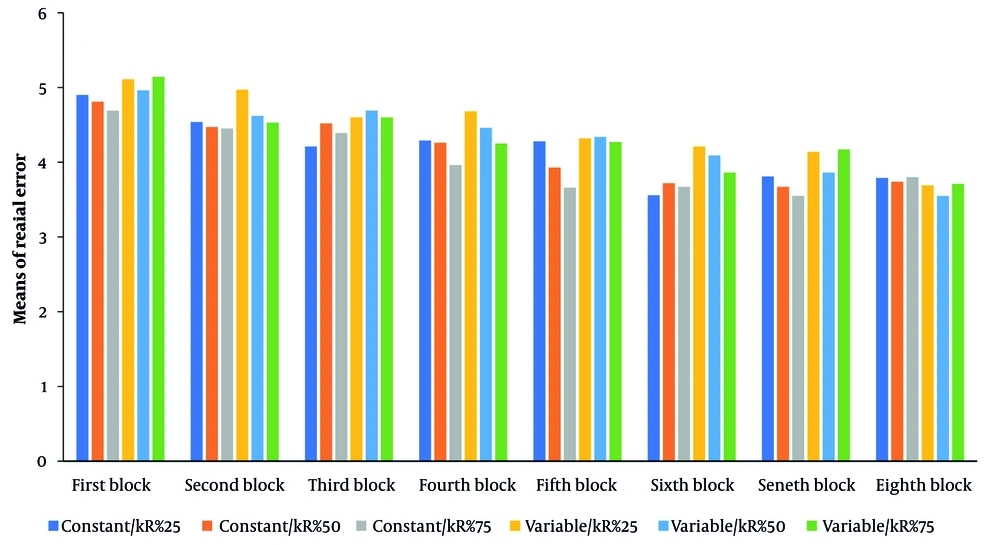
Figure 1.
Mean radial error of the experimental groups in evaluation blocks
The results from Table 2 indicate that the main effect of evaluation phases is significant. Bonferroni's post hoc test results reveal a significant difference in subjects' performance between the eighth block evaluation phase and the 30-minute and 24-hour retention tests. Subjects performed best in the eighth practice block (M = 3.71) and worst in the 30-minute retention test (M = 4.15).
Table 2.
Compare the Mean Performance of Groups in the Evaluation Phases
| Effects | Sum of Squares | df | F | P-Value | ɳ2 |
|---|---|---|---|---|---|
| Evaluation phases | 6.18 | 1.78 | 12.54 | 0.001 | 0.173 |
| Practice type | 3.18 | 1 | 30.92 | 0.001 | 0.34 |
| Feedback | 0.01 | 2 | 0.07 | 0.932 | 0.002 |
| Evaluation phases × practice | 8.07 | 1.78 | 16.37 | 0.001 | 0.214 |
| Evaluation phases × feedback | 0.92 | 3.56 | 0.93 | 0.43 | 0.03 |
| Feedback × practice | 0.43 | 2 | 0.07 | 0.93 | 0.002 |
| Evaluation phases × practice × feedback | 1.14 | 3.56 | 1.15 | 0.33 | 0.037 |
The main effect of practice type is also significant. Mean comparisons show that subjects in the constant practice arrangement performed the best (M = 3.72), while those in the variable practice arrangement had the weakest performance (M = 4.16). The interaction effect of evaluation phases and practice type is significant.
A one-way analysis of variance with repeated measures was utilized to compare radial error in the elderly for the eighth training block and retention tests at 30 minutes and 24 hours in each group (Table 3).
Table 3.
Comparison of the Radial Error Results in the Evaluation Phases in Each of the Test
| Statistics Greenhouse–Geisser | Sum of Squares | df | f | P-Value | ɳ2 |
|---|---|---|---|---|---|
| Constant (feedback) % | |||||
| 25 | 1.098 | 1.19 | 1.46 | 0.25 | 0.117 |
| 50 | 0.139 | 1.24 | 0.246 | 0.67 | 0.024 |
| 75 | 0.306 | 1.75 | 1.137 | 0.33 | 0.102 |
| Variables (feedback) % | |||||
| 25 | 5.76 | 1.98 | 24.62 | 0.001 | 0.71 |
| 50 | 6.40 | 1.319 | 13.138 | 0.002 | 0.59 |
| 75 | 2.08 | 1.98 | 3.33 | 0.057 | 0.25 |
The results presented in Table 3 show a significant difference between the three phases of evaluation in groups with variable arrangements. Bonferroni's post hoc test results indicate that the pairwise differences in radial error between the eighth practice block and the 30-minute retention test (P = 0.001) were significant, as well as between the eighth practice block and the 24-hour retention test (P = 0.008). In the eighth evaluation block, the elderly had the lowest mean radial error (M = 3.69) and the highest radial error (M = 4.81) in the 30-minute retention test (Figure 2).
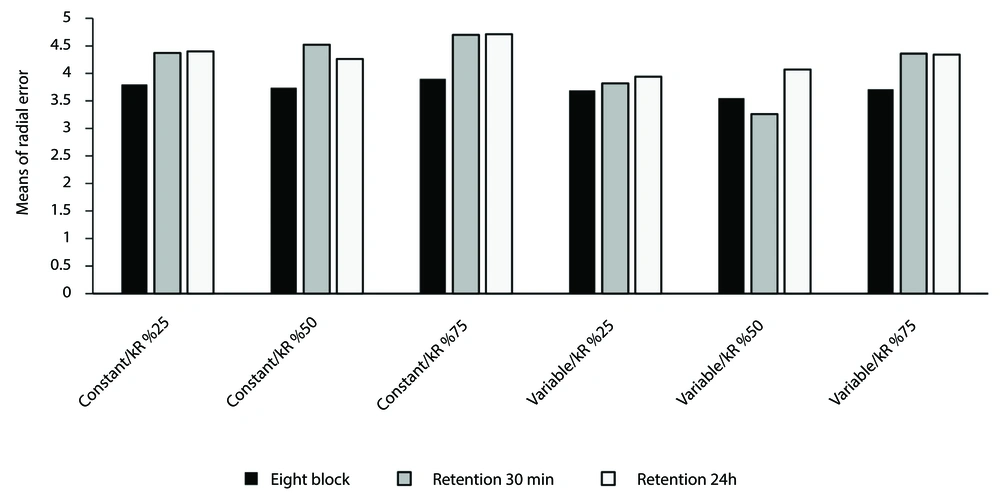
Figure 2.
Means radial error of groups in evaluation phases; Abbreviation: KR, knowledge of result feedback.
The results of the one-way ANOVA in Table 4 showed that there was no significant difference between the performance of the groups in the eighth training block (P = 0.80). In the 30-minute retention test, significant differences were observed between the mean radial error of the elderly in the practice groups with constant practice and feedback of 25%, 50%, and 75%, compared to the practice groups with variable practice and feedback of 25%, 50%, and 75%. The mean radial error in the practice groups with constant practice and 25%, 50%, and 75% feedback was better than in the other groups, while the elderly in the practice group with variable practice had the weakest performance. In the 24-hour retention test, a significant difference was found between the mean radial error of the elderly in the constant practice groups with feedback of 25%, 50%, and 75%, and the practice groups with variable arrangement and feedback of 25%, 50%, and 75%. The mean radial error in the constant practice groups with 25%, 50%, and 75% feedback was better than in the other groups. The elderly had the weakest performance in the variable practice groups with 50% and 75% feedback (Figure 2).
Table 4.
Comparison of the Mean Radial Error of the Elderly in the Experimental Groups in Evaluation Phases
| Effects | Sum of Squares | df | Mean of Squares | f | P-Value |
|---|---|---|---|---|---|
| Eighth block | 0.462 | 0.80 | |||
| Between groups | 0.45 | 5 | 0.091 | ||
| Inter group | 11.84 | 60 | 0.197 | ||
| 30 min retention | 7.77 | 0.001 | |||
| Between groups | 10.06 | 5 | 0.013 | ||
| Inter group | 15.54 | 60 | 0.259 | ||
| 24h retention | 12.6 | 0.001 | |||
| Between groups | 10.56 | 5 | 2.11 | ||
| Inter group | 60 | 0.35 |
5. Discussion
This study examined the effects of variable versus constant practice and feedback frequency (KR) on motor memory consolidation in older adults. Results demonstrated that during evaluation, the constant practice group with 75% feedback showed optimal performance, while the variable practice group with 25% feedback performed poorest. These findings align with Schmidt et al. (18) and Tassignon et al. (19), confirming significant differences between practice types during evaluation. Specifically, low contextual interference combined with high feedback frequency yielded better performance than high interference with low feedback. However, our results contrast with Travlos (20) and Gaspar et al. (6), who reported no significant performance differences between practice types during evaluation (6, 20). Notably, Tassignon et al. (19) found minimal differences between practice types in their review study, suggesting the need for further investigation into these divergent findings. Magill and Hall (as cited by Schmidt et al.) (18) posit that contextual interference increases during random practice conditions. However, when skill variations involve only parameter changes within a motor program, the contextual interference effect does not emerge. The current study demonstrates that both practice type and feedback frequency significantly influence motor memory consolidation. Notably, offline periods of 30 minutes and 24 hours proved particularly effective for consolidation. Older adults showed superior retention test performance after 24 hours compared to 30-minute intervals. These findings corroborate Kim and Wright (5), Robertson and Takacs (21), and Lugassy et al. (22), who established that skill improvement occurs not only during practice sessions but also during offline rest periods when memory consolidation enhances the learned skill. Motor skill learning involves two distinct phases: Active practice and subsequent rest periods. Following training, the nervous system implicitly processes and encodes the activity patterns of brain regions engaged during practice. These skill representations develop in the motor cortex, leading to enhanced skill memory. Our results indicate that older adults perform best in constant practice conditions and weakest in variable practice (5). This aligns with Travlos's (20) findings that constant practice groups outperformed others when test conditions matched training conditions (20), supporting the principle of practice specificity. The similarity between training and testing environments appears crucial for optimal performance, as it maintains consistent spatial-motor integration patterns in the central nervous system. Therefore, environmental consistency between practice and retention tests serves as a key factor in enhancing memory performance for older adults. In this study, the spatial conditions during the evaluation sessions for the constant practice groups were similar to those during the retention test. Therefore, the improved performance of the constant practice groups can be attributed to the specificity of practice. The discrepancy in findings can be attributed to the task's inherent characteristics. The results of this research show that practicing with a constant arrangement and receiving feedback more frequently leads to better performance on the retention test. The study found that a practice interval of 30 minutes and 24 hours was most effective. These findings align with the research conducted by Lugassy et al. (22). In their research, the researchers stated that reducing the frequency of feedback reduces skill learning (22). They explained that a higher frequency of feedback improves performance and memory. When a person actively processes their movements to recognize errors while performing, receiving more feedback leads to increased learning. This is because actively engaging in trial and error allows for more accurate adjustments to be made. In their research, the researchers stated that reducing the frequency of feedback reduces skill learning. In explaining the effect of a higher frequency of feedback on performance and memory, it can be said that when a person performs a movement, if they are actively involved in the processing process to recognize their errors, the more feedback they receive, the more learning will occur. This is because the individual will be engaged in trial and error, leading to a more accurate response (15). Several researchers have stated that the brains of elderly individuals are unable to revise the information and memories recorded during the day at night, unlike the brains of young people. In fact, the memory of the elderly does not improve at night. Burgan et al. (23) compared the brains of a group of old rats with a group of young rats. The rats had to learn a spiral route during the day, and their brains were scanned at night. The findings of this study demonstrate that constant practice combined with frequent feedback (75%) significantly enhances motor memory consolidation in older adults. This improvement likely stems from increased cognitive effort and the development of error assessment mechanisms, enabling learners to refine their internal performance models through feedback. Although dart throwing, as a structured skill, may have limitations in generalizability to more dynamic tasks, the results indicate that mere repetition is less effective for learning than cognitively engaging feedback-driven practice. These findings can inform the design of rehabilitation programs and motor training protocols for older adults and individuals with physical limitations, as enhancing cognitive function through targeted feedback may improve quality of life and reduce dependence on caregivers. Future research should investigate the effects of these variables in more complex skills requiring higher adaptive demands.