The patient was a 40-year-old married woman with irregular lower abdominal pain and dysmenorrhea for more than 5 months. The patient felt that the lower abdominal pain was worse than before recently, accompanied by frequent urination. Tumor marker evaluations revealed a high level of AFP (1210 ng/mL), premenopausal Roman index (PI) (40.5) and human epididymis protein 4 (HE4) (121.2 pmol/mL). The levels of carbohydrate antigen (CA) 125 (23.95 u/mL), CA 19 - 9 (11.11 U/mL), and carcinoembryonic antigen (CEA) (1.48 ng/mL) were normal.
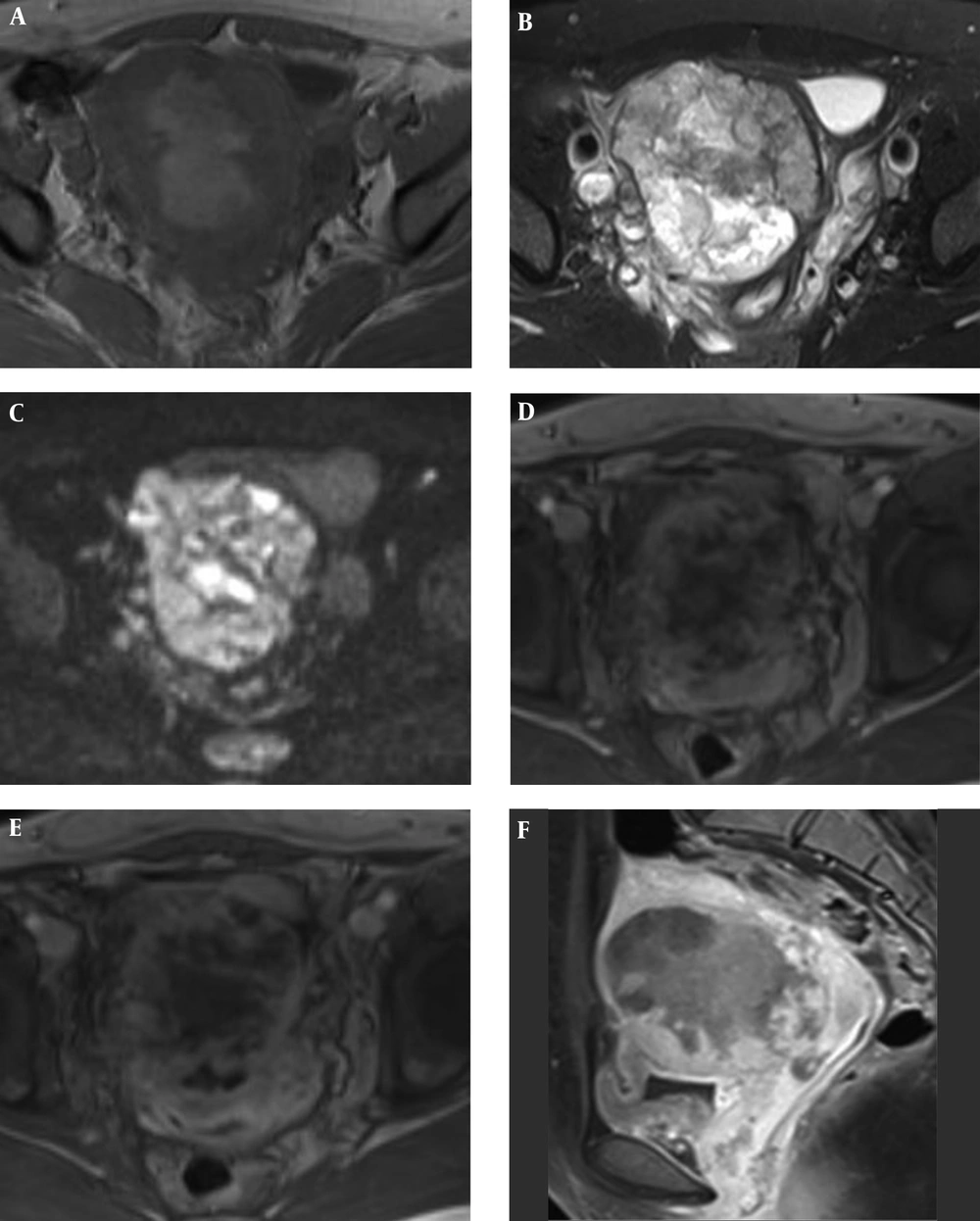
Pelvic MRI and CE-MRI was performed using the Siemens Avanto 1.5 T system before surgery. MRI showed that the uterus was enlarged, the lesion located in the right side wall of the uterus, and the boundary was unclear, the serosal layer of the anterior wall of the uterus was unclear, and the tumor size was 7.7 cm × 6.6 cm × 8.2 cm. T1 weighted imaging (WI) showed the lesion is equal and slightly higher signal (
Figure 1A). T2WI was equal, slightly lower and slightly higher signal (
Figure 1B). Diffusion weighted imaging (DWI) indicated that the lesion was diffusion restricted (
Figure 1C), and the average apparent diffusion coefficient (ADC) value of the solid component was 0.735 × 10
-3 mm
2/s, partially broke through the serosa layer, invaded the right side wall of the vagina and the paravaginal space, and the right uretera was dilated. CE-MRI showed that the lesions showed uneven and mild enhancement in the early stage (
Figure 1D), and continued to strengthen in the venous phase (
Figure 1E), and strengthened close to the myometrium in the delayed phase (
Figure 1F). No enlarged lymph nodes were present in the pelvis.
The patient underwent an extensive uterus, and bilateral accessory resection, total cystectomy, and bilateral ureteral abdominal wall external surgery under general anesthesia. Postoperative pathological results showed: (1) tumor in the right side of the uterus, positive lymphatic invasion, positive vascular invasion, negative nerve invasion, positive bilateral uterine and its cutting edge invasion, positive vascular invasion of vaginal wall; (2) focal adenomyosis; (3) bladder invasion. (4) endometrium showed a proliferative phase reaction; (5) left ovary showed ovarian corpus luteum combined with bleeding; (6) right ovary showed ovarian inclusion cyst; (7) bilateral fallopian tubes showed no abnormalities. Serial AFP decreased to 2.42 ng/mL. Postoperative chemotherapy (cisplatin + vinblastine + bleomycin, PVB) chemotherapy for three courses. The patient is still alive after two years.
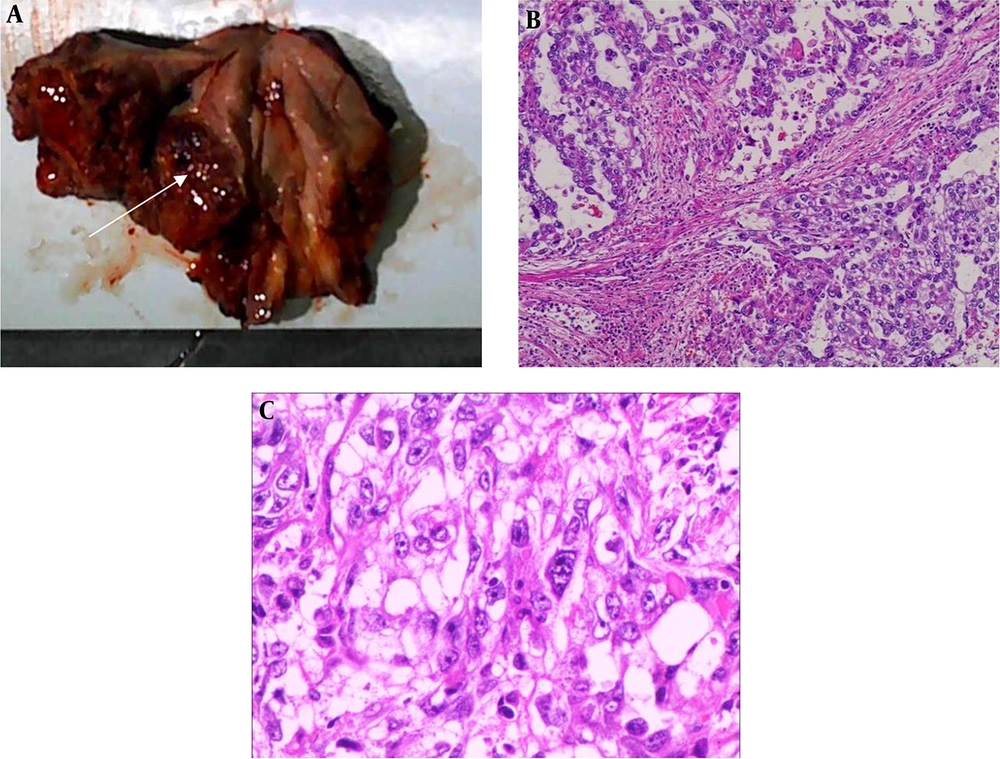
This case is in stage IV of FIGO (International Federation of Gynecology and Obstetrics). Postoperative pathological examination showed tumor in the right side of the uterus (
Figure 2A). Tumor cells are dense and have an atypical network structure. Some tumor cells grow around the blood vessel wall, invade the surrounding muscular tissue, accompanied by a large amount of bleeding and necrosis (
Figure 2B). The tumor cell nuclei are deeply stained, the nucleoli are obvious, and the nuclear membrane is irregular (
Figure 2C).