


1. Background
2. Objectives
3. Patients and Methods
3.1. Statistical Analysis
4. Results
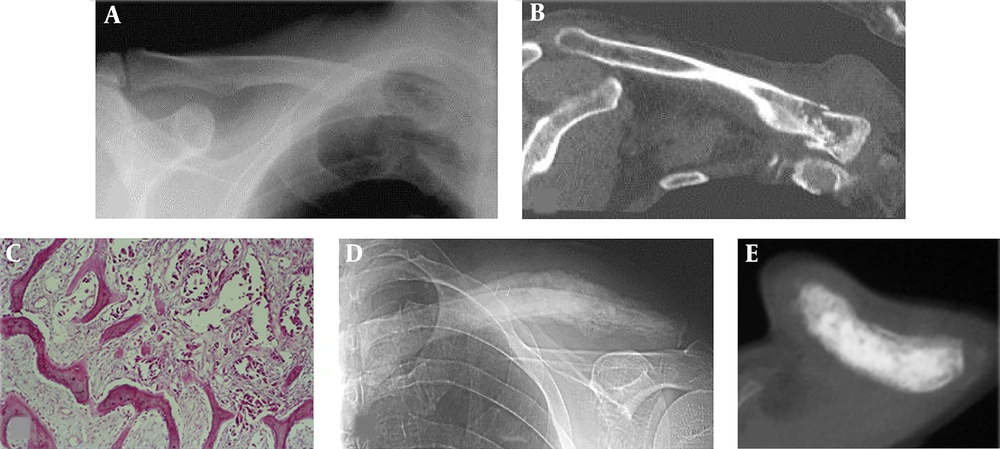
Metastatic tumors. A and B, At the sternal end of the right clavicle, osteolytic bone destruction is revealed with ill-defined margins, pathologic fracture and a soft tissue mass; C, Microscopy of the clavicle in (A) and (B) reveals metastatic adenocarcinoma of the lung with cancer cells forming an adenoid structure surrounded by reactive new bone; D and E, At the middle segment of the left clavicle, osteosclerotic bone destruction is shown with ill-defined margins, apparent periosteal reaction but no soft tissue masses.
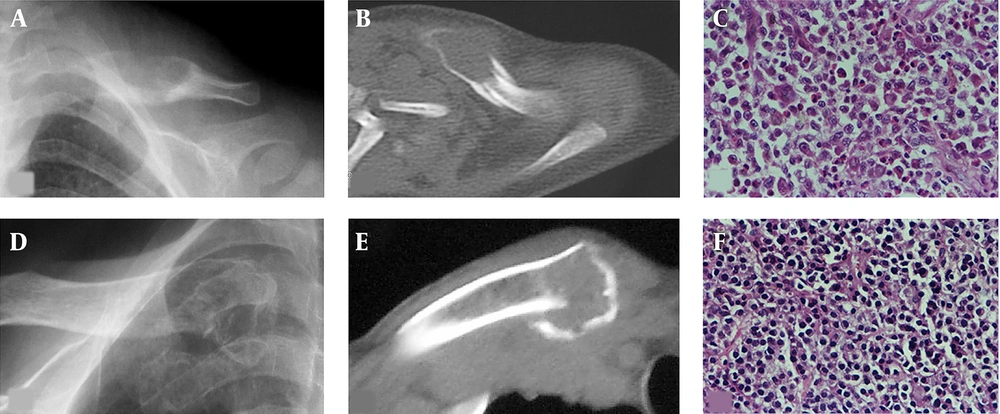
A-C, Eosinophilic granuloma. D-F, plasma-cell myeloma; A-C, An eosinophilic granuloma lesion is demonstrated at the middle segment of the left clavicle with osteolytic bone destruction, ill-defined margins, apparent periosteal reaction but no soft tissue masses (A and B); C, Microscopy of the eosinophilic granuloma shows many Langerhans cells of medium size with eosinophilic cytoplasm and round or oval nuclei which had nuclear groove. Scattered or clustered eosinophils are seen in the background; D-F, A plasma-cell myeloma is shown near the sternal end of the right clavicle with osteolytic, expansile bone destruction, ill-defined margins and pathologic fracture (D and E); F, Microscopically, the lesions of the plasma-cell myeloma are composed of tumor plasmocytes with deviated nuclei.
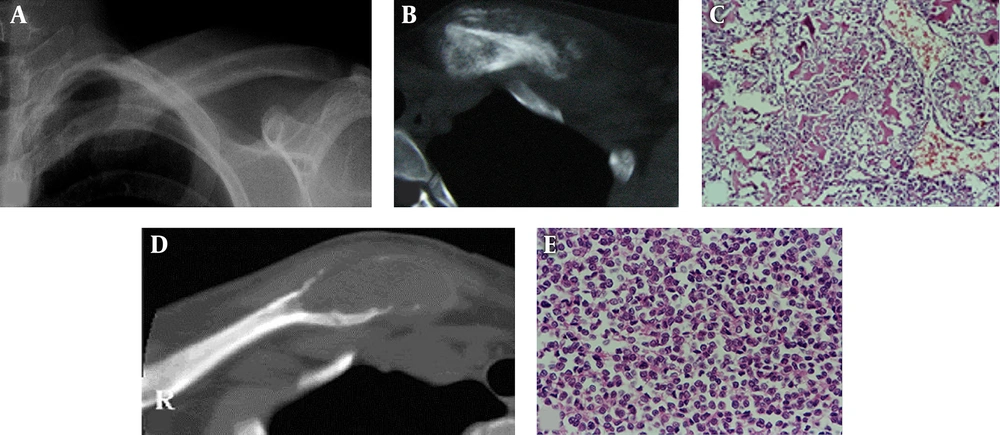
A-C, Osteosarcoma; D and E, Ewing’s sarcoma; A and B, An osteolytic destruction is demonstrated at the sternal end of the left clavicle with ill-defined margins, periosteal reaction, a lot of tumorous bone and soft tissue masses; C, Microscopically, the osteosarcoma is composed of tumor cells and tumor-like bone tissue which is produced directly by the tumor cells; D, An osteolytic, expansile destruction lesion is shown at the sternal end of the right clavicle with ill-defined margins, but no periosteal reaction and soft tissue masses; E, Microscopically, the Ewing’s sarcoma is composed of small round cells of the same size and shape, with few cytoplasm and fine nuclear chromatin.
| Disease | Percentage | M:F | Age range (mean) | Proximal Third | Middle Third | Distal Third |
|---|---|---|---|---|---|---|
| Malignant tumor | ||||||
| Metastatic (n = 31) | 38.3 | 19:12 | 4 - 76 (56.5) | 26 | 3 | 2 |
| PCM (n = 10) | 12.3 | 8:2 | 29 - 67 (57.3) | 6 | 1 | 3 |
| Osteosarcoma (n = 4) | 4.9 | 2:2 | 15 - 60 (39.3) | 3 | 1 | |
| Lymphoma (n = 2) | 2.5 | 1:1 | 34 - 72 (53) | 2 | ||
| Ewing’s sarcoma (n = 2) | 2.5 | 2:0 | 17 - 18 (17.5) | 1 | 1 | |
| Chondrosarcoma (n = 1) | 1.2 | 1:0 | 52 (52) | 1 | ||
| Intermediate tumor | ||||||
| Eosinophilic granuloma (n = 6) | 7.4 | 3:3 | 2 - 32 (15.6) | 3 | 2 | 1 |
| ABC (n = 3) | 3.7 | 1:2 | 15 - 45 (34.3) | 1 | 2 | |
| Giant cell tumor (n = 2) | 2.5 | 2:0 | 25 - 60 (42.5) | 2 | ||
| Chondromyxoid fibroma (n = 1) | 1.2 | 0:1 | 45 (45) | 1 | ||
| Benign tumor | ||||||
| Osteochondroma (n = 5) | 6.2 | 2:3 | 11 - 33 (19.5) | 4 | 1 | |
| Bone cyst (n = 3) | 3.7 | 1:2 | 11 - 15 (12.7) | 1 | 2 | |
| Chondroma (n = 3) | 3.7 | 2:1 | 12 - 36 (21.7) | 1 | 1 | 1 |
| Ossifying fibroma (n = 2) | 2.5 | 1:1 | 13 - 16 (14.5) | 1 | 1 | |
| Osteoid osteoma (n = 1) | 1.2 | 1:0 | 18 (18) | 1 | ||
| Hemangioma (n = 1) | 1.2 | 1:0 | 50 (50) | 1 | ||
| Fibrous histiocytoma (n = 1) | 1.2 | 0:1 | 60 (60) | 1 | ||
| Fibrous dysplasia (n = 1) | 1.2 | 1:0 | 13 (13) | 1 | ||
| Lipoma (n = 1) | 1.2 | 0:1 | 58 (58) | 1 | ||
| Osteoma (n = 1) | 1.2 | 1:0 | 22 (22) | 1 | ||
| Total | 100 | 49:32 | 2 - 76 (42.6) | 50 | 11 | 20 |
Abbreviations: ABC, aneurysmal bone cyst; F, female; M, male; PCM, plasma-cell myeloma.
| Tumor | Male | Female | Left | Right | Proximal Third | Middle Third | Distal Third |
|---|---|---|---|---|---|---|---|
| Malignant tumor (n = 50) | 66.0% (33/50) | 34.0% (17/50) | 56.0% (28/50) | 44.0% (22/50) | 76% (38/50) | 8.0% (4/50) | 16% (8/50) |
| Intermediate tumor (n = 12) | 50.0% (6/12) | 50.0% (6/12) | 58.33% (7/12) | 41.67% (5/12) | 33.3% (4/12) | 25.0% (3/12) | 41.7% (5/12) |
| Benign tumor (n = 19) | 52.63% (10/19) | 47.37% (9/19) | 42.11% (8/19) | 57.89% (11/19) | 42.1% (8/19) | 21.05% (4/19) | 36.8% (7/19) |
| P value | 0.464 | 0.464 | 0.565 | 0.565 | 0.003 | 0.173 | 0.074 |
aFisher exact probability test was used. More malignant tumors occurred in the inner area than either the intermediate malignant (P = 0.013) or the benign tumors (P = 0.011). No other significant (P > 0.05) difference existed between any other two features.
| Lytic destruction | Expansile destruction | Sclerotic destruction | Mixed destruction | IDR | PR | PF | STM | |
|---|---|---|---|---|---|---|---|---|
| Metastatic (n = 22) | 15 | 14 | 1 | 6 | 17 | 2 | 4 | 15 |
| PCM (n = 5) | 5 | 4 | - | - | 5 | - | 3 | 3 |
| Osteosarcoma (n = 2) | 1 | 1 | - | 1 | 2 | - | - | 2 |
| Ewing’s sarcoma (n = 1) | 1 | 1 | - | - | 1 | - | - | - |
| EG (n = 4) | 4 | 4 | - | - | 2 | 4 | - | - |
| ABC (n = 2) | 2 | 2 | - | - | - | - | - | - |
| Bone cyst (n = 1) | 1 | 1 | - | - | 1 | - | - | - |
| Osteochondroma (n = 1) | - | - | - | - | - | - | - | - |
| Chondroma (n = 1) | 1 | 1 | 1 |
Abbreviations: ABC, aneurysmal bone cyst; EG, eosinophilic granuloma; IDR, ill-defined rim; PCM, plasma-cell myeloma; PF, pathologic fracture; PR, periosteal reaction; STM, soft tissue mass.
| Tumor | Lytic | Sclerotic | Mixed | Expansile | IDR | PR | PF | STM |
|---|---|---|---|---|---|---|---|---|
| Malignant tumor (n = 30) | 73.33% (22/30) | 3.33% (1/30) | 23.33% (7/30) | 66.67% (20/30) | 83.33% (25/30) | 6.67% (2/30) | 23.33% (7/30) | 66.67% (20/30) |
| Intermediate tumor (n = 6) | 100% (6/6) | 0 | 0 | 100% (6/6) | 33.33% (2/6) | 66.67% (4/6) | 0 | 0 |
| Benign tumor (n = 3) | 66.67% (2/3) | 33.33% (1/3) | 0 | 66.67% (2/3) | 33.33%(1/3) | 0 | 0 | 0 |
| P value | 0.391 | 0.170 | 0.463 | 0.193 | 0.013 | 0.005 | 0.463 | 0.000 |
Abbreviations: IDR, ill-defined rim; PF, pathologic fracture; PR, periosteal reaction; STM, soft tissue mass.
aFisher exact probability test was used. Malignant tumors had a significantly (P = 0.003) lower incidence in PR but a significantly higher incidence in STM than intermediate malignant tumors. No other significant (P > 0.05) difference existed between any other two features.


