Fulltext
The full text is available in PDF
International Cardiovascular Research Journal
The Official Annually Journal of Cardiovascular Research Center, Shiraz University of Medical Sciences
Authors
Using Electrocardiographic criteria is usual for determining the best site for ablating accessory pathways. Many algorithms are present in this regard, but there are still many facts to be found. The present study aimed to reduce fluoroscopic time by using a special electrocardiographic sign. This study was performed on a young lady with palpitation, negative delta wave in V1 and V3, and positive delta wave in V2. Positive delta in V2 intervened with negative delta in V1 and V3 localized in the crux area for accessory pathway. This might help reduce the procedure time and increase the success rate. This exceptional electrocardiography could be used to locate the site of ablation, increase the rate of success, and reduce radiation exposure.
© 2016, Author(s). This open-access article is available under the Creative Commons Attribution 4.0 (CC BY 4.0) International License (https://creativecommons.org/licenses/by/4.0/), which allows for unrestricted use, distribution, and reproduction in any medium, provided that the original work is properly cited.
Aslani A, Kazemi Asl S, Moradi M, Kafi M, Kheirkhah J. Frequency of Syncope in Patients with Accessory Atrioventricular Connection. Int Cardiovasc Res J. 2010;4(1):e67667. doi:
Akbarzadeh MA. His Bundle Extrasystole or A Dual Atrioventricular Nodal Response. Int J Cardiovasc Pract. 2018;3(1):e130260. doi: https://doi.org/10.21859/ijcp-03104
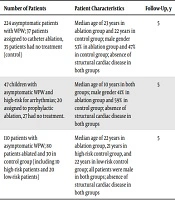
Ong LT. Prophylactic Ablation in Asymptomatic Patients with Wolff-Parkinson-White Syndrome. J Kermanshah Univ Med Sci. 2020;24(4):e107589. doi: https://doi.org/10.5812/jkums.107589
Majauskienė E, Aucina G, Semeniene P, Jurkuvenas P, Serpytis P. Myocardial infarction caused by active-fixation atrial pacing lead screwed into the anterior descending coronary artery. Int Cardiovasc Res J. 2018;12(4):e68816. doi:
Peters S. The Role of Lead aVR and Lead V1 in the Diagnosis of Arrhythmogenic Cardiomyopathy in Apparently Normal Hearts. Multidiscip Cardio Annal. 2017;8(2):e11078. doi: https://doi.org/10.5812/mcardia.11078
More by these authors
Last Update: 3 weeks ago
Last Update: 3 weeks ago
Last Update: 3 weeks ago
Last Update: 4 days ago