Fulltext
The full text of this article is available on PDF.
Journal of Clinical Research in Paramedical Sciences
The Official Journal of Paramedical School, KUMS
Authors
Introduction: : A child with cerebral palsy is a serious challenge for families. It is essential to determine the coping style adopted by these families. The purpose of this study was to translate a family coping questionnaire “personal evaluation scales relevant to family crisis” into Persian and to determine its reliability and validity.
Methods: After obtaining permission from the designers of the tool, localization process was initiated. At first, English version was translated into Persian by two translators and then summarized into one translation. The final Persian version was translated into English, revised, modified, and summarized. To determine validity of the tool, it was given to 208 mothers of children with cerebral palsy who referred to Kermanshah rehabilitation centers in 2015. The participants were selected through convenience sampling. Face validity and content validity were examined. construct validity was determined by using confirmatory factor analysis. Internal consistency and reliability of the Persian version were also determined. The data were analyzed in SPSS (ver. 16) and EQS (ver. 6.1).
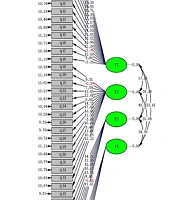
Results: Content validity of all the items was higher than 0.78. Confirmatory factor analysis confirmed five-factor structure of the tool. Cronbach’s alpha of the whole tool was 0.84. Intraclass correlation coefficient for the whole tool was 0.89.
Conclusion: The Persian version of “personal evaluation scales relevant to family crisis” had good validity indices so that it can be used to examine family coping in the mothers of children with cerebral palsy.
© 2017, Journal of Clinical Research in Paramedical Sciences. This open-access article is available under the Creative Commons Attribution-NonCommercial 4.0 (CC BY-NC 4.0) International License (https://creativecommons.org/licenses/by-nc/4.0/), which allows for the copying and redistribution of the material only for noncommercial purposes, provided that the original work is properly cited.
Kosari F, Esmaeilinasab M, Mirabile S, Speranza M. Psychometric Properties of the Persian Version of the Coping with Children’s Negative Emotions Scale. Iran J Psychiatry Behav Sci. 2022;16(3):e121951. doi: https://doi.org/10.5812/ijpbs-121951
Noori M, Akbarfahimi N, Hosseini SA, Vahedi M. Psychometric Properties of the Persian Version of the 47-item Mobility Questionnaire in Children with Cerebral Palsy. Iran J Psychiatry Behav Sci. 2022;16(4):e123340. doi: https://doi.org/10.5812/ijpbs-123340
Mirshoja MS, Salehi K, Keshavarz Afshar H, Shahmoradi S, Alibakhshi H. Psychometric Characteristics of Researcher-Made Resilience Questionnaire in Iranian Mothers with Children with Cerebral Palsy. koomesh. 2025;27(2):e151727. doi: https://doi.org/10.69107/koomesh-151727
Karamali Esmaili S, Alizadeh Zarei M, Saei S, Bagherzadeh F. Psychometric Properties and Cultural Adaptation of the Persian Version of the Family Functioning Questionnaire in Rehabilitation (FFQR) in Parents of Children with Disabilities. Middle East J Rehabil Health Stud. 2025;12(1):e152351. doi: https://doi.org/10.5812/mejrh-152351
Behnamifard N, Posht Mashhadi M, Pourshahbaz A. Validity and Reliability of the Persian Version of the Parenting and Family Adjustment Scales (PAFAS) in an Iranian Sample. Middle East J Rehabil Health Stud. 2025;12(4):e162385. doi: https://doi.org/10.5812/mejrh-162385
Last Update: 2 weeks ago
Last Update: 2 weeks ago
Last Update: 2 weeks ago
Last Update: 4 days ago