


1. Background
Water is an essential component of the environment that can determine the pattern of population distribution. Water resources, in particular, groundwater sources are being used for drinking, industrial, agricultural, and recreational desires (1). However, human-made activities such as industry, agriculture, and household influence the quality of groundwater sources (2). Analyzing the quality of water sampling will carry a range of water sample tests out in compliance with water quality requirements to assess the concentration of component properties from sources (3). Also, legislation has controlled the standards of concentration of different water quality parameters throughout the world (4, 5). In the last decades, the use of freshwater resources has been risen due to population growth, economic growth, changing lifestyles and changing the patterns of consumption (1, 6).
Contamination can be entered into the water sources from agricultural activities, livestock, rural industrial units, and urbanization (7, 8). Specific sources for aquifer contamination include agricultural fertilizers and pesticides, industry, domestic waste, landfill leaks, and pit latrines (9). Such fecal pathogens as Cryptosporidium parvum, Campylobacter spp., and rotavirus can grow in water distribution systems and can be harmful to water drinking (10). The potential consequences of being contaminated with pathogenic microorganisms by a drinking water source make such an occurrence critical to prevention (11). In developing countries, most of these infectious diarrheal diseases affect children. These enterotoxin pathogens mainly are Campylobacter jejuni, enterotoxic E. coli, the spp of ShigellaV. O1 cholerae, and perhaps enteropathogenic E. coli, spp of Aeromonas, and enterotoxigenic Bacteroides fragilis (11, 12). Water consumption for purposes such as drinking, food, and beverage preparation, or personal hygiene should not contain human-pathogenic agents (13, 14). Various microorganisms such as bacteria, fungi, algae, and viruses have a great potential role in water pollution, resulting in a variety of discharge and death outbreaks (8). Existence of Fecal Coliforms in drinking water sources, as an indicator of pathogenic microorganisms, could contribute to waterborne diseases (15).
Amadiya district, located in the north of Iraq, has plenty of water sources such as rivers, springs, and wells. Peoples living in this district always use spring sources for drinking and agricultural desires. Comprehensive and good information about the qualities of spring water is necessary for the suitability of these sources for use. Various characteristics of water sources such as physical, chemical and biological are vital for monitoring parameters and determine the degree of suitability of a water resource. Therefore, the present study has attempted to test and analyze the quality of spring water sources in the Amediye district. This study analyzes the physicochemical indicators such as pH, turbidity, EC, TDS, hardness, calcium, magnesium, nitrate, etc. It also provides data on the sources of spring water by comparing it in order to show the suitability for drinking.
2. Methods
2.1. Case Study
Amadiya is a district in northern central Dohuk Governorate within the Kurdistan Region of Iraq. The administrative center is the city of Amadiya with the latitude of 37° 05’ 33”N and longitude 43° 29’ 14” E. The location of the study area and water sample sites are shown in Figure 1. Also, Figure 2 shows the land use/land cover types of the study area. Forest is the most dominant land-use type in the study area where most of the district is covered by forest. Mountain and rock have the second portion of land-use type in this region. The population of the district is approximately 130000 inhabitants. The climate of the region is hot and dry in summers and pretty cold in winter. Amadiya has a hot-summer Mediterranean climate with long, hot summers and cold, wet winters. The annual averages rainfall is about 600 mm per year, where most of the precipitation is in winter months. The annual temperature varies from 5°C to 30°C.
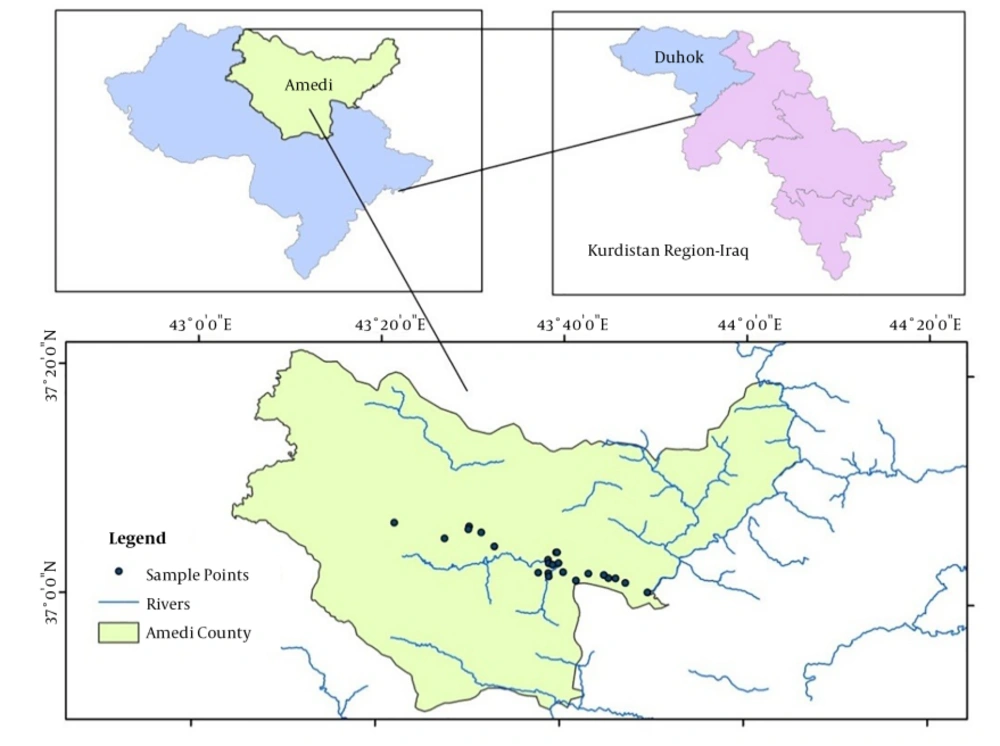
Figure 1.
Location of the study area
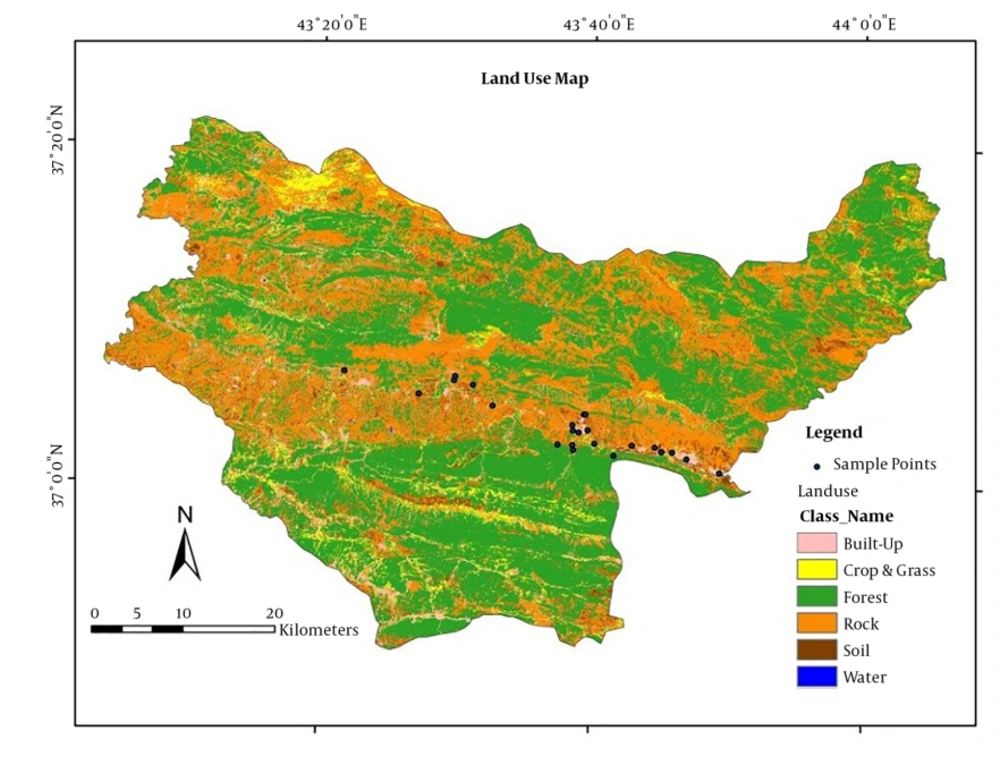
Figure 2.
Land use map of the study area
2.2. Sample Collection
The monthly variations of physicochemical characteristics of water were studied from February to October in 2017. The spring water samples were collected from twenty-two springs across the study area. The water samples were collected in clean plastic containers of two liters capacity, which were pre-cleaned with concentrated hydrochloric acid and distilled water. Before sampling, the bottles three times with sample water before being filled with the sample were rinsed; then, water from each spring and labeled in the field at the time of sample collection were taken.
2.3. Measuring and Analyzing Parameters
The temperatures and pH of the samples were measured in the field. In a fridge, we stored all water samples to exclude bacterial activity and an unnecessary chemical reaction until we did the test within four days. Determinations of other physicochemical properties of water samples such as conductivity, total solid, dissolved oxygen, total alkalinity, total hardness, CaCO3, Ca, Mg have been performed in the laboratory and by using the electrometric method.
Recorded data were analyzed using a Past3 software program (PAleontological Statistics,), version 3.17. Additionally, we got the summary statistics from the software program Past3 (16). Residual plots confirmed by a normality test of the Shapiro-Wilk showed that all data were parametric.
3. Results and Discussion
Statistical summary of minimum, maximum, and mean of 12 water quality parameters including temperature, pH, DO, BOD, electrical conductivity, EC, TDS, total hardness, calcium, magnesium, turbidity, Total Alkalinity, and nitrate is provided in the Table 1.
Table 1.Statistical of Minimum, Maximum, and Mean of Water Quality Parameters in the Study Area
| Parameter | Minimum | Maximum | Average | WHO Standard |
|---|---|---|---|---|
| Temperature (°C) | 11.8 | 24.1 | 16.7 | - |
| pH | 6.8 | 7.8 | 6.81 | 6.5 - 8.5 |
| DO (mg/L) | 4.1 | 7.8 | 5.51 | - |
| BOD5 (mg/L) | 11.9 | 18.7 | 14.8 | - |
| EC (μs/cm) | 454 | 1504 | 635 | - |
| TDS (ppm) | 290 | 731 | 389.9 | 500 |
| Total hardness (mg/L) | 346 | 574 | 393.9 | 200 |
| Ca hardness (mg/L) | 260 | 485 | 308.4 | 75 |
| Mg hardness (mg/L) | 75 | 120 | 82.5 | 50 |
| Turbidity (NTU) | 4.7 | 12.8 | 7.3 | 1 |
| Total alkalinity (mg/L) | 87 | 268 | 142 | - |
| Nitrate (mg/L) | 3 | 6.8 | 4.01 | 10 |
Table 2.Mean ± SEM Values of the Physio-Chemical Analysis of Springs in the Study Area
| Data | Time (Months) | P Value | ||||||||
|---|---|---|---|---|---|---|---|---|---|---|
| Feb. | Mar. | Apr. | May | June | July | Aug. | Sep. | Oct. | ||
| Temperature (°C) | 13.2 ± 0.3 | 14.8 ± 0.4 | 15.9 ± 0.6 | 17.5 ± 0.7 | 18.6 ± 0.8 | 19.7 ± 0.8 | 20.3 ± 0.9 | 20.1 ± 0.9 | 19.7 ± 0.8 | ** |
| pH | 7.7 ± 0.1 | 7.6 ± 0.1 | 7.6 ± 0.1 | 7.5 ± 0.1 | 7.5 ± 0.1 | 7.4 ± 0.1 | 7.4 ± 0.1 | 7.4 ± 0.1 | 7.4 ± 0.1 | * |
| DO (mg/L) | 6.1 ± 0.2 | 6.1 ± 0.2 | 6.1 ± 0.2 | 5.9 ± 0.2 | 5.8 ± 0.2 | 5.6 ± 0.2 | 5.7 ± 0.2 | 5.7 ± 0.3 | 5.9 ± 0.2 | n.s |
| BOD5 (mg/L) | 14.4 ± 0.4 | 15.0 ± 0.4 | 15.8 ± 0.4 | 16.1 ± 0.4 | 16.8 ± 0.4 | 17.2 ± 0.4 | 16.8 ± 0.4 | 16.3 ± 0.3 | 15.6 ± 0.3 | ** |
| EC (μs/cm) | 575 ± 30 | 601 ± 33 | 650 ± 42 | 655 ± 43 | 875 ± 102 | 684 ± 47 | 891 ± 90 | 679 ± 46 | 659 ± 44 | * |
| TDS (ppm) | 368 ± 19 | 385 ± 21 | 416 ± 27 | 419 ± 27 | 429 ± 29 | 437 ± 30 | 439 ± 30 | 435 ± 29 | 422 ± 28 | ** |
| Total hardness (mg/L) | 410 ± 15 | 417 ± 15 | 420 ± 14 | 426 ± 13 | 427 ± 14 | 435 ± 14 | 434 ± 13 | 436 ± 13 | 429 ± 12 | n.s |
| Ca hardness (mg/L) | 319 ± 15 | 332 ± 14 | 327 ± 14 | 333 ± 14 | 334 ± 13 | 332 ± 14 | 336 ± 14 | 338 ± 14 | 345 ± 13 | n.s |
| Mg hardness (mg/L) | 91 ± 2 | 85 ± 3 | 93 ± 3 | 93 ± 3 | 93 ± 3 | 104 ± 3 | 98 ± 3 | 98 ± 3 | 84 ± 3 | * |
| Turbidity (NTU) | 6.6 ± 0.2 | 7.0 ± 0.2 | 7.3 ± 0.2 | 7.5 ± 0.3 | 8.0 ± 0.3 | 8.2 ± 0.2 | 8.4 ± 0.5 | 8.2 ± 0.4 | 8.9 ± 0.5 | ** |
| Total alkalinity (mg/L) | 141 ± 10 | 146 ± 9 | 147 ± 8 | 153 ± 10 | 149 ± 9 | 146 ± 9 | 153 ± 9 | 160 ± 10 | 167 ± 10 | ** |
| Nitrate (mg/L) | 4.1 ± 0.2 | 4.2 ± 0.2 | 4.3 ± 0.2 | 4.2 ± 0.2 | 4.1 ± 0.2 | 4.1 ± 0.2 | 4.0 ± 0.2 | 4.0 ± 0.2 | 4.3 ± 0.2 | n.s |
Abbreviations: n.s, no significant; *, significant at level 0.05; **, significant at level 0.01.
3.1. Temperature
Temperature is an important factor and affects the function of all organisms in the environment. Temperature not only influences the solubility of gases and salts in water, but also affects the chemical equilibria such as ionized and unionized, hydrogen cyanide, and hydrogen sulfide (17). The average temperature of drinking water is usually between 5 and 15°C. However, groundwater sources have a lower temperature than surface water. Here, the water temperature of the groundwater recorded 11.8 to 24.1°C. While meat temperature is acceptable, the recorded temperature in some samples was higher than an acceptable rate.
3.2. pH
Measurement of pH is one of the most essential tests in water quality. pH determines the rate of acidity of the water resources and matter in the chemical and biological properties of water. pH can affect the chemical substances in water and influence volatility and toxicity to an aquatic environment (17). The analysis showed that the pH of groundwater resources (springs) in the study area was neutral with an average pH of 6.81 and did not exceed the limit of WHO standard (6.5 - 8.5) (18, 19). Increasing pH also led by organic pollution and the discharged domestic wastewater into the water resources.
3.3. TDS
The total dissolved solids (TDS) is another import factor in order to determine the quality of the water resources and can be attributed to the trend of the surface quality or salinity of the water bodies. Urban runoffs are the potential sources for changing TDS (20). In this study, the minimum and maximum values of TDS were recorded 290 and 731 respectively. The average rate of the TDS in the study was 389.86 that is an acceptable rate.
3.4. Hardness, Calcium, and Magnesium (Ca2+, Mg2+)
Dissolved calcium, magnesium and other mineral salt such as iron and aluminum determine the hardness of the water. Hard water is water that contains higher levels of these components. Higher levels of drinking water hardness will cause digestive disorders, kidney stones, and cardiovascular disease (17). The analysis showed that the total Hardness ranged from 346 to 574 mg/L, with the Mean rate of 394. The hardness rate in the study area is higher than standards and it might be for the dissolution of the land-derived carbonates and bicarbonates in the water. The concentration of Ca2+ and Mg2+ is changed from 260 to 485 and 75 to 120 mg/L, which exceed the standard limit of 75 and 50 mg/L for the groundwater resources, respectively.
3.5. Dissolved Oxygen (DO) and Biological Oxygen Demand (BOD)
Dissolved oxygen (DO) matter in the assessment of water quality since it leads to guar and palate. All living organisms require oxygen in different ways to perform metabolism and provide energy for growth and reproduction. The DO mainly depends on the temperature, a surface is exposed, and the pressure. The degradation of organic matter can consume dissolved oxygen in water (21). The amount of DO in pure water varies from 6.14 mg/L at to 7 mg/L under atmospheric conditions. In the present study, the mean value of DO was 5.51 and fluctuated from 4.1 mg/L to 7.8 mg/L.
BOD is an indicator of the water resources that organic pollution in aquatic systems. The water bodies are unpolluted if BOD5 has 2 mg/L or less (22). The average recorded biochemical oxygen demand is 14.8 mg/L and varied from 11.9 to 18.7 mg/L in the underground water resources of the study area.
Table 3.The Mean Monthly of the Physio-Chemical Parameters of Springs in the Study Area
| Places | Temperature (°C) | pH | DO (mg/L) | BOD5 (mg/L) | EC (μs/cm) | TDS (ppm) | Total Hardness (mg/L) | Ca Hardness (mg/L) | Mg Hardness (mg/L) | Turbidity (NTU) | Total Alkalinity (mg/L) | Nitrate (mg/L) |
|---|---|---|---|---|---|---|---|---|---|---|---|---|
| Enishke | 17.4 ± 1.1 | 7.8 ± 0.1 | 7.8 ± 0.1 | 13.8 ± 0.6 | 560 ± 5 | 358 ± 3 | 458 ± 3 | 337 ± 2 | 120 ± 3 | 6.7 ± 0.1 | 87 ± 1 | 3.3 ± 0.1 |
| Ashke dere | 18.4 ± 1.4 | 7.1 ± 0.1 | 5.5 ± 0.2 | 15.0 ± 0.4 | 473 ± 4 | 302 ± 5 | 399 ± 3 | 305 ± 2 | 93 ± 3 | 6.8 ± 0.3 | 113 ± 2 | 4.5 ± 0.3 |
| Chapa ghishke | 19.3 ± 1.3 | 7.4 ± 0.1 | 4.9 ± 0.2 | 16.5 ± 0.2 | 460 ± 7 | 295 ± 5 | 384 ± 4 | 295 ± 3 | 89 ± 4 | 7.6 ± 0.2 | 117 ± 3 | 3.0 ± 0.1 |
| Baroshki | 20.8 ± 1.7 | 7.5 ± 0.1 | 5.9 ± 0.2 | 15.6 ± 0.3 | 647 ± 12 | 413 ± 8 | 466 ± 3 | 358 ± 2 | 108 ± 3 | 7.3 ± 0.2 | 137 ± 2 | 3.5 ± 0.1 |
| Moghbara deralok | 24.1 ± 1.8 | 6.8 ± 0.1 | 4.8 ± 0.3 | 18.7 ± 0.5 | 1142 ± 43 | 731 ± 27 | 547 ± 3 | 464 ± 2 | 83 ± 4 | 12.8 ± 0.9 | 268 ± 4 | 5.8 ± 0.2 |
| Ashghale | 23.4 ± 1.5 | 7.5 ± 0.1 | 6.1 ± 0.1 | 15.7 ± 0.3 | 964 ± 30 | 616 ± 19 | 497 ± 3 | 412 ± 5 | 84 ± 5 | 6.7 ± 0.1 | 160 ± 3 | 3.8 ± 0.1 |
| Galak | 12.9 ± 0.3 | 7.5 ± 0.1 | 7.3 ± 0.1 | 15.5 ± 0.3 | 599 ± 24 | 383 ± 15 | 375 ± 3 | 283 ± 11 | 92 ± 11 | 4.7 ± 0.1 | 102 ± 3 | 5.0 ± 0.1 |
| Gira | 16.5 ± 0.9 | 7.7 ± 0.1 | 7.3 ± 0.1 | 11.9 ± 0.2 | 546 ± 9 | 349 ± 6 | 376 ± 2 | 287 ± 3 | 89 ± 3 | 5.9 ± 0.4 | 222 ± 4 | 6.7 ± 0.1 |
| Mahide | 14.7 ± 0.5 | 7.5 ± 0.1 | 6.6 ± 0.1 | 16.4 ± 0.2 | 729 ± 10 | 467 ± 7 | 452 ± 2 | 375 ± 3 | 76 ± 4 | 7.8 ± 0.2 | 178 ± 4 | 4.1 ± 0.1 |
| Chalke | 18.7 ± 1.1 | 7.5 ± 0.1 | 7.1 ± 0.1 | 18.6 ± 0.2 | 580 ± 10 | 371 ± 6 | 397 ± 3 | 301 ± 2 | 95 ± 3 | 8.3 ± 0.2 | 160 ± 3 | 3.9 ± 0.1 |
| Gali rashava rojava | 17.0 ± 0.9 | 7.7 ± 0.1 | 6.2 ± 0.1 | 15.5 ± 0.3 | 1504 ± 63 | 322 ± 3 | 357 ± 2 | 282 | 75 ± 3 | 8.0 ± 0.3 | 129 ± 4 | 3.5 ± 0.1 |
| Shiv chnark | 17.8 ± 0.8 | 7.5 ± 0.1 | 4.5 ± 0.1 | 17.6 ± 0.4 | 767 ± 13 | 491 ± 8 | 466 ± 2 | 382 ± 2 | 83 ± 2 | 7.9 ± 0.3 | 141 ± 3 | 3.9 ± 0.1 |
| Banistan | 19.9 ± 0.8 | 7.5 ± 0.1 | 5.9 ± 0.1 | 17.0 ± 0.3 | 688 ± 15 | 440 ± 10 | 449 ± 5 | 355 ± 3 | 93 ± 3 | 8.4 ± 0.3 | 147 ± 3 | 3.7 ± 0.1 |
| Kolan | 19.9 ± 1.1 | 7.6 ± 0.1 | 7.2 ± 0.1 | 18.3 ± 0.2 | 615 ± 12 | 394 ± 8 | 417 ± 5 | 326 ± 3 | 91 ± 3 | 8.1 ± 0.3 | 149 ± 2 | 3.9 ± 0.1 |
| Kaniya betle | 16.2 ± 0.3 | 7.5 ± 0.1 | 5.6 ± 0.1 | 17.5 ± 0.3 | 611 ± 15 | 391 ± 10 | 414 ± 5 | 311 ± 2 | 103 ± 4 | 8.6 ± 0.4 | 183 ± 4 | 4.2 ± 0.1 |
| Gizka | 19.2 ± 0.9 | 7.2 ± 0.1 | 5.1 ± 0.1 | 16.0 ± 0.3 | 704 ± 9 | 450 ± 6 | 495 ± 4 | 398 ± 3 | 98 ± 2 | 7.8 ± 0.3a | 223 ± 5 | 4.7 ± 0.1 |
| Gali rashava rojhalat | 16.9 ± 0.6 | 7.7 ± 0.1 | 7.0 ± 0.1 | 16.0 ± 0.2 | 454 ± 6 | 290 ± 4 | 357 ± 6 | 253 ± 4 | 104 ± 3 | 7.9 ± 0.2 | 126 ± 2 | 3.7 ± 0.1 |
| Shiv chinark sheladize | 19.7 ± 0.7 | 7.5 ± 0.1 | 5.8 ± 0.1 | 15.9 ± 0.3 | 651 ± 10 | 416 ± 6 | 411 ± 5 | 313 ± 3 | 98 ± 3 | 7.7 ± 0.2 | 138 ± 3 | 4.3 ± 0.1 |
| Biawe | 11.8 ± 0.2 | 7.8 ± 0.1 | 4.1 ± 0.1 | 13.2 ± 0.4 | 525 ± 8 | 336 ± 5 | 374 ± 6 | 263 ± 6 | 111 ± 4 | 8.1 ± 0.2 | 117 ± 3 | 3.7 ± 0.1 |
| Aqidi | 16.9 ± 0.5 | 7.5 ± 0.1 | 4.6 ± 0.1 | 17.7 ± 0.3 | 1110 ± 39 | 710 ± 25 | 574 ± 3 | 485 ± 2 | 89 ± 5 | 8.4 ± 0.3 | 182 ± 4 | 4.7 ± 0.1 |
| Silav | 15.3 ± 0.6 | 7.4 ± 0.1 | 5.0 ± 0.1 | 15.0 ± 0.3 | 534 ± 11 | 342 ± 7 | 352 ± 6 | 267 ± 5 | 85 ± 3 | 7.4 ± 0.2 | 127 ± 3 | 3.5 ± 0.1 |
| Sarokani | 14.4 ± 0.5 | 7.8 ± 0.1 | 5.5 ± 0.1 | 14.3 ± 0.2 | 457 ± 5 | 293 ± 3 | 346 ± 6 | 260 ± 4 | 86 ± 3 | 8.3 ± 0.2 | 116 ± 3 | 3.7 ± 0.1 |
| P value | ** | * | ** | ** | ** | ** | ** | ** | * | * | * | * |
Abbreviations: *, significant at level 0.05; **, significant at level 0.01.
3.6. Nitrate (NO3-)
Nitrate is often present in drinking water because of human activities such as overuse of fertilizers (potassium, ammonium nitrate, and nitrate), inadequate septic systems, and inappropriate disposal of solid waste. Nitrate is soluble in water and enters drinking groundwater. A higher rate of nitrate in water is a causative factor in cancers (23). The analysis of the current study showed that the maximum concentration of NO3- was 6.8 acceptable.
In order to quantitatively analyze and confirm the relationship among physicochemical parameter contents in groundwater samples, we applied statistical analysis for physicochemical parameters. Based on Tables 2 and 3, the P value was calculated as a means to present the significant findings at three levels of 0.05, 0.01 and no significant. The result illustrates that DO, hardness, Ca2+ hardness, and nitrate have no significant correlation, while other parameters were significant at the levels of 0.05, 0.01.
3.7. Conclusions
The analysis of the physicochemical parameters of drinking springs water showed that most of the springs were within the permissible limits for drinking usage according to WHO standards, total hardness (TH), calcium (Ca2+), and magnesium (Mg2+) in the study area were higher than those determined by the WHO. Reporting the higher level of these parameters might be because of the dissolution of carbonates and bicarbonates in the water springes emitted from the surrounding areas. The way may conclude that preserving the water sources in our study area is necessary by considering the dry continental situation of Iraq and especially the amount of rainfall in this area.
This study was carried out to analyze the quality of the physical and chemical parameters of spring sources drinking in Amadiya district. Although various parameters were analyzed that led to a comprehensive investigation of the suitability of spring sources, it is also important to analysis other potential water contaminations such as chemicals, microbial and radiological materials for a more extended period, in order to assess the overall of the spring water quality. Also, more detailed studies for measuring other parameters such as heavy metals and toxins are necessary to provide a management plan to improve the groundwater sources of the study area.
