
1. Context
Despite technological advances in health care, post-surgical palliation methods are still inadequate. Therefore, the need for interventions and complementary treatments is felt. In recent years, complementary therapies have been felt (1), and complementary medicine treatments such as massage, music therapy, touch therapy, herbal medicines, mind-body-based techniques, and reflexology (REFL) have been used to reduce pain (2).
Labor pain (LP) is one of the most severe pains that women experience throughout their lives. The intensity of LP is more than the pains, including arthritis pain and cancer pains (3). The feeling of LP is entirely individual and complex, and women request cesarean section for reasons such as concerns about the ability to have a normal birth, the baby's health, the effect of childbirth on the future marital relationship, as well as choosing the date of birth of the baby. However, one of the essential reasons for wanting to have a cesarean section is mothers' fear of the pain of natural labor (4). The leading cause of LP includes uterine contractions, dilatation of the cervix, and stretching of the perineum and is probably influenced by factors such as the mother's expectations of the birth process, age, preparation for childbirth, emotional support, tension, anxiety, fear, and other factors (5, 6).
Uncontrolled LP causes complications such as hyperventilation (very fast breathing), increased metabolism, increased cardiac output and vascular resistance, increased blood pressure, the release of catecholamines, the release of stress hormones such as cortisol and beta-endorphins in the mother with some risk for the health of mother and fetus (7, 8).
Due to the importance of pain relief during childbirth, extensive studies have been conducted to reduce LP with pharmacological and non-pharmacological methods. Inhaled nitrous oxide and regional analgesia (including pudendal, paracervical, and neuraxial blocks such as spinal, epidural, or combined spinal-epidural techniques) are used to relieve LP, injectable drugs (including meperidine and promethazine butorphanol, nalbuphine, fentanyl, remifentanil) (9, 10). Opioids prescribed to the mother during labor may weaken the baby's breathing. Although the use of nitrous oxide in childbirth is safe, it is associated with nausea and vomiting. The regional analgesia methods also have potential side effects such as hypotension, fever, headache after dural puncture, unwanted intracranial, subdural, or intravascular injection of local anesthetics, and neurological damage (11-15). Opioids prescribed to the mother during labor may weaken the baby's breathing. Although the use of nitrous oxide in childbirth is safe, it is associated with nausea and vomiting. The use of regional analgesia methods also has potential side effects such as hypotension, fever, headache after dural puncture, unwanted intracranial, subdural, intravascular injection of local anesthetics, and neurological damage (12-14).
Considering the side effects of medicinal methods in pain relief and women's reluctance to invasive methods, researchers have paid particular attention to the use of herbal and complementary medicine treatments. Evidence shows that non-drug methods such as yoga, hypnosis, massage, aromatherapy, acupressure, and topical cold therapy positively reduce LP (9, 10, 16). Another method used in complementary medicine is REFL. In the science of REFL, the soles of the feet and hands represent a map of the entire body, and deep pressure is placed on the reflex points of the feet, which causes changes in the body parts corresponding to the same point by using the thumb and forefinger (Figures 1 and 2) (17-21). Reflexology creates electrochemical messages due to stimulating specific nerve points, which reduces stress and balances the body. Some of the theories proposed about the function of REFL include the release of some neurotransmitters such as serotonin, creating vasodilation in peripheral vessels and improving blood flow, removing toxins, improving the immune system, affecting sensory receptors, and affecting the gate control mechanism of pain, sedative effect on the autonomic nervous system and increases the release of endorphins and enkephalins, which are five times more effective than morphine (22-26).
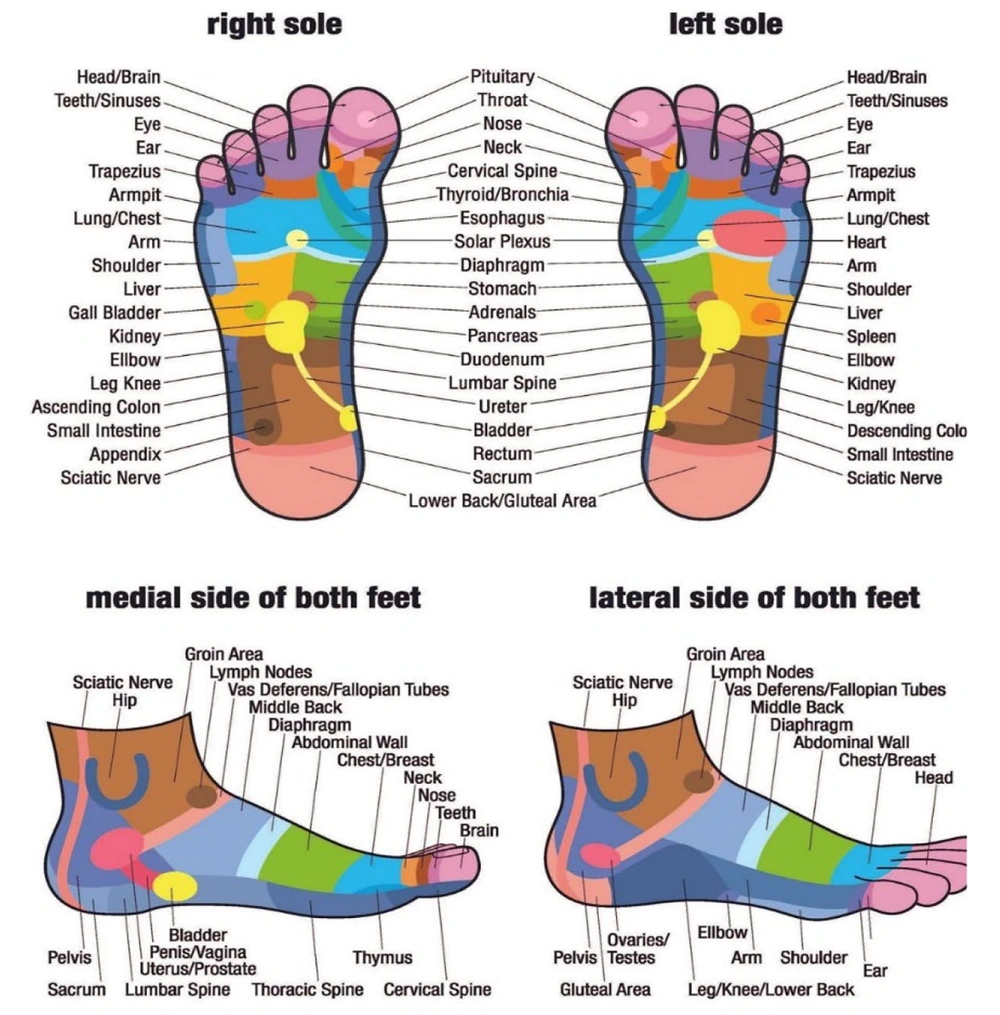
Figure 1.
Foot reflexology chart (21).
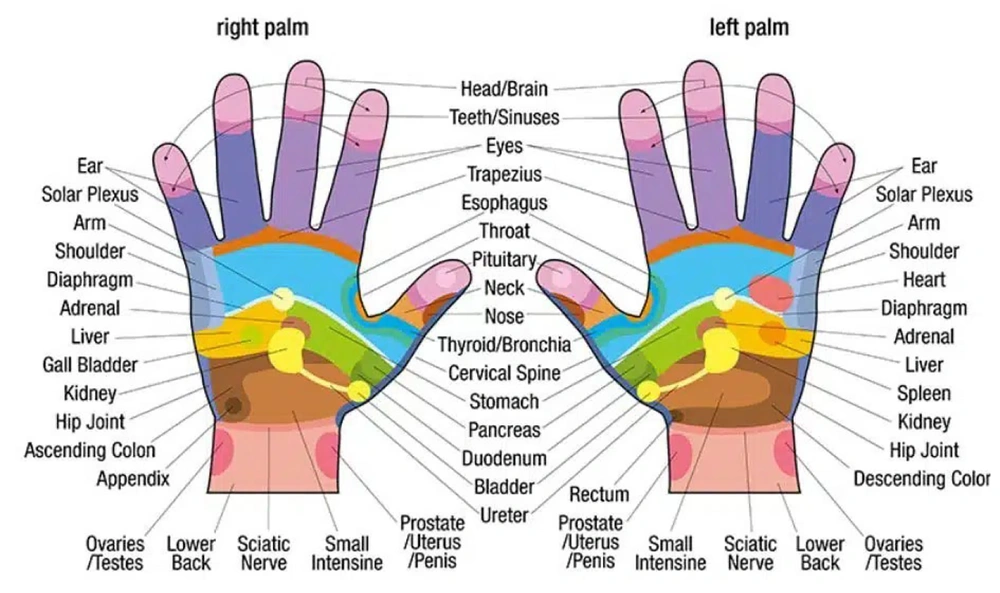
Figure 2.
Hand reflexology chart (21).
The massage of reflex points affects different body parts and is used to treat various diseases such as depression, fatigue, and side effects of chemotherapy (19-21, 26-28). In addition, this method has been used to treat some gynecological diseases and complications during pregnancy, and its application range includes reducing pain and anxiety after hysterectomy, pain after cesarean section, fatigue during pregnancy, anxiety during childbirth, and the duration of the first stage of labor (25, 29-31).
The mechanism of REFL's effect on labor outcomes includes reducing the intensity of LP and the duration of the active phase of labor. Reflexology effectively induces the release of oxytocin, initiating and regulating uterine contractions, LP, and childbirth anxiety (CA) and shortening the length of labor (25, 31, 32). Considering the importance of the abovementioned issue, this study was designed to evaluate the effect of foot reflexology (F-REFL) on reducing the level of CA and LP by reviewing past studies.
2. Evidence Acquisition
The findings of this study are based on reviewing similar studies from the last three decades. The most important and common Medical Subject Headings (MeSH) terms related to the topic under discussion were identified to conduct this study. Then, the most relevant studies were searched in the most reliable and essential international databases, including Google Scholar, Scopus, PubMed, and Web of Science, and 226 studies were identified at this stage. In the following, considering the inclusion and exclusion criteria, 26 studies were finally identified to extract the results and analyze their findings. The words "AND" and "OR" were used to perform an advanced search and combine words. The references of the final selected articles were also checked to ensure the extraction of all possible articles related to the topic under discussion. According to the most essential criteria for selecting studies, the research that evaluated the objectives was chosen as the final study.
- Studies that only focused on foot reflexology were selected.
- Studies that only evaluated LP and CA were considered.
- Studies whose target group was only women were selected.
- Studies with low sample sizes were excluded.
- Studies that were published in non-reputable journals and scientific databases were removed.
- Articles presented on public websites were not considered.
3. Results
According to the documentation, REFL is a branch of complementary medicine and an old and non-invasive method used as a treatment method for over five thousand years. In addition to stimulating the reflexes, REFL also stimulates the soft tissue of the feet (33). In REFL, deeper pressure is applied compared to acupressure, and more of the surface of the foot is stimulated. This method reduces patients' stress and pain by stimulating nerves, increasing blood flow, and releasing hormones such as endorphins (34).
3.1. The Effect of Foot Reflexology on Labor Pain
Reviewing the previous studies showed that all the studies conducted on the effect of F-REFL on LP reduction were clinical trial studies. The severity of LP was measured by the Visual Analogue Scale (VAS), and the Short Form-McGill Pain Questionnaire (SF-MPQ) was used in some studies. The findings from previous studies showed that the duration of massage of both legs varied from 20 to 60 minutes to evaluate the effect of REFL on pain intensity, and the intervention started at the beginning of the labor phase in most studies.
The overall results of this review study showed that REFL positively affects reducing LP. The findings of a semi-experimental study by Mattew and Francis on 30 people (15 people in the intervention group and 15 people in the control group) showed that F-REFL caused a significant decrease in LP in the intervention group compared to the control group in the dilation of 3 – 4 cm (P < 0.05) (35). Mostafa Ahmed Gamel et al. reported that F-REFL for 30 minutes, 1 and 2 hours, can cause a significant reduction in LP in the intervention group compared to the control group (P < 0.05) (21). The relationship between prenatal reflexology and intrapartum outcomes was studied by McNeil et al., which showed that REFL effectively reduces pain intensity (36). A study by Bahri et al. about the effect of F-REFL on postoperative pain and bleeding in the fourth stage of labor revealed that reflexology positively reduces postoperative pain. Labor pain in the fourth stage of labor and pain intensity after the intervention in the intervention group was lower than in the control group, indicating the positive effect of F-REFL on reducing LP (37). The findings of Goweily, which evaluated the effectiveness of reflexology on the pains of the first stage of labor, presented a significant difference in the severity of LP between the intervention group and the control group (38). Mohan & Varghese found that F-REFL significantly relieved primiparous mothers' LP (39); they were all comfortable with the procedure, and more than half were very satisfied with F-REFL during labor (40). The high level of satisfaction with the positive impact of F-REFL on reducing LP and other aspects of labor was also reported by Baljon et al. and Mostafa Ahmed Gamel et al. (21, 41).
Most studies on evaluating F-REFL's impact on LP reduction have been conducted in Iran. In the clinical trial study of Dolatian et al., F-REFL was performed for 20 minutes in each foot for the intervention group. The results showed that the LP intensity in the intervention group was significantly lower than in the control group after the intervention (P < 0.001) (42). Valiani et al. conducted a semi-experimental type that evaluated 88 people (44 people in the intervention group and 44 people in a control group) and performed F-REFL for 30 minutes on each foot for the intervention group. The study's results showed a significant difference in the LP score before and after the intervention for the intervention group. In addition, the pain score in the intervention group was significantly lower than the control group after the intervention (P < 0.001) (43). In the clinical trial of Mirzaei et al., the severity of LP was evaluated in 70 people (including 39 people in the intervention group and 31 people in the control group) after performing the F-REFL intervention for 10 minutes per foot. The study's findings showed that the intensity of LP was the same in both groups before the intervention (P = 0.14). At the same time, the amount of LP in the intervention group was significantly reduced compared to the control group (P < 0.001) (44). Jenabi et al. evaluated the effectiveness of F-REFL for 15 minutes per foot in the intervention group (35 people) in comparison with the control group (35 people). The study's results showed that F-REFL in the intervention group had a significant relationship with the reduction of LP score (P = 0.001) (45). In another similar study by Moghimi Hanjani et al., a total of 80 people divided into two groups (including 40 under the intervention with F-REFL and 40 people as a control group) were evaluated based on LP severity. The findings showed that the severity of LP before the intervention was not different for both study groups (P > 0.05). However, half, one, and two hours after the intervention, the intensity of LP in the intervention group was significantly lower than in the control group (P < 0.001) (46). Hajighasemali et al. compared the amount of LP in two intervention groups, including the acupressure group (28 people), the F-REFL group (30 people), and the control group (34 people). The results showed the intensity of LP was obtained from the highest to the lowest in the order of control group>F-REFL group>acupressure group after the intervention (47).
3.2. Effect of Foot Reflexology on Childbirth Anxiety
Childbirth is one of the essential life events that pregnant women experience. Anxiety and stress during childbirth reduce the contractile activity of the uterus and, as a result, increase the duration of labor and increase the probability of giving birth through cesarean section (18). Therefore, the effective control of pain and anxiety related to childbirth is one of the critical issues in the health and treatment of women and childbirth (18-20). There are various methods to reduce CA, which are divided into two general categories: pharmacological and non-pharmacological methods (10, 48). Non-pharmacological measures are often simple and inexpensive and can be used as an alternative treatment or adjunctive treatment along with drugs. Since non-pharmacological treatments rely on the pregnant woman to make her own decisions, she develops a sense of self-control and solidity, which benefits labor progress (9, 10, 48).
Today, one of the most critical and common non-pharmacological methods to reduce CA is REFL. As mentioned before, the interventionist applying pressure on F-REFL in the REFL method restores balance throughout the body and promotes relaxation sometimes by creating pressure on the palms that correspond to each part of the body (18, 19, 21, 25, 27). de Dios reported that such pressure on the soles of the feet affects psychological responses in the patient and causes relaxation in different organs of the patient's body (49). During childbirth, it is possible to benefit from stimulating points related to the pituitary, hypothalamus, solar plexus, and centers related to the uterus and appendages to reduce anxiety and stress (23). Reflexology has been used during pregnancy to relieve nausea, vomiting, constipation, fatigue, and headache and even to facilitate breastfeeding after delivery (50-52).
Various studies have been conducted on the effect of F-REFL on the CA level, which contains multiple results. The results of Mc Vicar's study showed that REFL can reduce anxiety (53). The results of Moghimi Hanjani et al. showed that F-REFL for 40 minutes can significantly reduce CA levels in primiparous women (P = 0.002) (54). Mirzaee et al. reported that REFL reduces anxiety levels in pregnant women (55). The results of Oleson and Flocco's study showed that REFL improves mood and reduces anxiety in women (56). The study by Lee was conducted to evaluate the effect of F-REFL on depression and stress of middle-aged women and concluded that there is a significant difference between before and after F-REFL regarding depression and stress variables (57). In Yılar Erkek and Aktas, F-REFL was performed for 15 minutes on each foot (30 minutes total) when cervical dilation was in the 3 - 4 cm range. The study above showed that F-REFL positively and significantly reduces CA (32). The main aim of Kaur et al. was on the impact of F-REFL on anxiety, LP, and delivery outcomes in 60 primiparous women. The results showed that F-REFL can effectively reduce the level of CA, relieve LP, and improve the normal outcome of labor in primiparous women (58). According to Omara et al., F-REFL caused a significant reduction in the Hamilton anxiety scale in the intervention group compared to the control group (P = 0.001) (59). In addition to the studies mentioned above, other research results showed that F-REFL can effectively reduce CA levels (25, 41, 60).
The mechanism of action of REFL is poorly understood, but the type of touch and pressure applied in REFL appears to have an effect beyond a simple touch. Reflexology induces systemic and localized physiological changes in the body and causes a deep state of relaxation and mind/body balance, as well as reducing stress-related symptoms. Fingers and toes are sensitive to touch and pressure because many nerve receptors transmit touch impulses to the brain. Then, the message is sent back through the ganglia, nerve cord, and motor neurons to the muscle groups, and REFL affects the body and muscles and causes them to relax (22, 61)
Fear and anxiety increase the release of adrenaline and noradrenaline, which work against oxytocin, causing disturbances in uterine contractions and prolonged labor. Reflexology causes regular contractions of the uterus by reducing the amount of adrenaline and noradrenaline and increasing endorphin and oxytocin, which can effectively shorten labor duration (62).
4. Conclusions
Based on the results, F-RFLE significantly reduced the level of CA and severity of LP. The number of cesareans among pregnant mothers in some countries of the world, which is mainly due to the fear and anxiety caused by LP, has increased. Therefore, F-RFLE, an easy, cheap, and non-invasive method to reduce LP, can effectively minimize cesarean. Foot reflexology is simple and does not require specialized personnel, and it can be easily implemented for mothers during childbirth by training midwifery personnel. In addition, F-RFLE improves positive birth experiences by reducing pain and anxiety experienced during childbirth and protects mothers' postpartum mental health.