Journal of Inflammatory Diseases
The Official Journal of Qazvin University of Medical Sciences
Situation analysis of the health of Ab-Gilack slum area of Qazvin
Authors
Abstract
Background: During the past two decades the slum areas around Qazvin city has grown and the health-care of these areas is of great importance. Objective: To analyze the health condition of Ab-Gilack slum area of Qazvin during 1998-99. Methods: The data regarding 288 families, settling in this area were collected using direct observation and interview with the people. The data were recorded in structured questionnaires. Findings: The average family size in the area is 6 and 43.8% of the population were under 15 years of age. About 71.5% of the houses are in normal health condition. Only 43.7% of married women use contraceptive methods. Findings indicated rather bad environment of sanitation and swage. Conclusion: Seeking ways for the community’s participation to improve their living environment and health should be prioritized in the health planning of these areas.
Copyright
© 2024, Journal of Inflammatory Diseases. This open-access article is available under the Creative Commons Attribution-NonCommercial 4.0 (CC BY-NC 4.0) International License (https://creativecommons.org/licenses/by-nc/4.0/), which allows for the copying and redistribution of the material only for noncommercial purposes, provided that the original work is properly cited.
Similar Articles
Comparing determinants of fertility behaviour among Kurdish women living in rural areas of Ravansar and Gilangharb cities
Hosseini G, Hosseini H. Comparing determinants of fertility behaviour among Kurdish women living in rural areas of Ravansar and Gilangharb cities. J Kermanshah Univ Med Sci. 2013;17(5):e77061. doi:
Education-based needs assessment: a step toward effective prevention of AIDS
Salehi L, Salehi F, Shakibazadeh E. Education-based needs assessment: a step toward effective prevention of AIDS. J Inflamm Dis. 2024;13(1):e155457. doi:
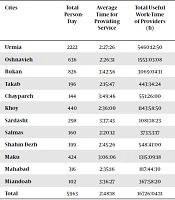
Assessing the Workload of Health Care Practitioners (Moraghebe Salamat) in Urban Health Posts of West Azarbaijan Province in 2017
Yosefi M, EntezarMahdi R, Jafari R. Assessing the Workload of Health Care Practitioners (Moraghebe Salamat) in Urban Health Posts of West Azarbaijan Province in 2017. J Clin Res Paramed Sci. 2020;9(1):e95839. doi: https://doi.org/10.5812/jcrps.95839
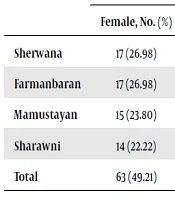
Comparison of the General Health Outcomes of Individuals Considering Various Environmental Incivilities in Kalar City, Iraq
Ali KW, Rasooli SB, Seidi PA, Ali HN, Talib JT. Comparison of the General Health Outcomes of Individuals Considering Various Environmental Incivilities in Kalar City, Iraq. J Kermanshah Univ Med Sci. 2020;24(3):e106278. doi: https://doi.org/10.5812/jkums.106278
Prevalence of domestic violence and its related factors in women referred to health centers in Khuzestan Province
Nouhjah S, Latifi SM, Haghighi M, Eatesam H, Fatholahifar A, et al. Prevalence of domestic violence and its related factors in women referred to health centers in Khuzestan Province. J Kermanshah Univ Med Sci. 2011;15(4):e79308. doi:
- Scopus by DOI: 0
Last Update: 1 month ago
- Scopus by Title: 0
Last Update: 1 month ago
- Scopus by Title (Ref): 1
Last Update: 1 month ago
- CrossRef: 0
Last Update: 5 days ago