1. Background
Hypertension is a major risk factor for many disorders, including cardiovascular disease, stroke, and chronic renal failure (1). According to a world health organization (WHO) estimation, hypertension was one of the top 10 causes of death in the world in 2012 (2). The prevalence of hypertension in different regions of the world ranges from 3.4% to 72%, and in some developing countries such as Iran, the prevalence is trending upward. Prevalence of this disease is currently approximately 42.7% in Iran (3, 4).
Being overweight increases the risk of many diseases, including hypertension, cardiovascular disease, dyslipidemia, and diabetes (5). The prevalence of overweight and obese individuals is rapidly increasing in both developing and industrialized countries (6). It is estimated that over 72 million adults in the United States are overweight or obese (7). There is an increased prevalence of overweight or obese women compared to men, and this prevalence increases with age. It is estimated that approximately 48% of Iranian adult women are overweight or obese; beginning at the onset of menopause, the rate of being overweight or obese increases over time (5, 8).
Green tea is one of the three main types of tea (oolong and black being the others) from the plant Camellia sinensis (9, 10). Green tea is obtained from unfermented fresh, non-oxidized leaves, and has a higher content of the monomeric polyphenols known as flavonoids. The amount of flavonoids in green and black tea is 80% and 20% - 30%, respectively. The reduction in flavonoids in black tea occurs due to the oxidation process (11). High consumption of black tea leads to increased serum levels of homocysteine; this disorder is not associated with the consumption of green tea. Increased levels of homocysteine in the serum has a significant association with hypertension (12). Green tea has been used since ancient times to improve blood flow, eliminate alcohol and toxins from blood, improve immune function, reduce joint pain, and to clear urine and improve its flow (13). In recent years, the effects of green tea on many chronic diseases including cancers, cardiovascular disease, and neurodegenerative diseases (Alzheimer and Parkinson) have been documented, including beneficial effects that improved some of these diseases (11, 14).
The major flavonoids in green tea are the catechins. Catechins primarily consist of: -epigallocatechin-3-gallate (EGCG), -epigallocatechin (EGC), -epicatechin-3-gallate (ECG), and -epicatechin (EC). EGCG is the most abundant catechin in green tea (15). The catechin content in green tea leaves is variable. These catechin levels are based on the amount of sunlight and heat while the tea leaves grow (16, 17). Clinical, experimental, and epidemiological studies have revealed that catechins have anti-inflammatory and antioxidant effects (4, 14). It has been reported that the antioxidant effects of catechins are more potent than that of the well-known antioxidants vitamins C, E, and B-carotene (14, 18, 19).
In addition to the catechins, green tea also consists of many chemical compounds, including proteins, carbohydrates, lipids, sterols, vitamins (B, C, E), pigments, volatile compounds (aldehydes), xanthic bases (caffeine and theophylline), minerals, and trace elements. These compounds potentiate the antioxidant potential of the catechins (20, 21). The effect of green tea on blood pressure and weight in humans is still controversial. The results from animal experimental models have indicated that consumption of green tea could reduce blood pressure, however, this effect was not observed in clinical trials (7, 21, 22). Taken together, the documented reports suggest that green tea may or may not be beneficial.
Since very few studies have been conducted examining the effects of Iranian green tea on weight and blood pressure, in the present study we examined the effect of Iranian green tea extract in the modulation of blood pressure and body mass index (BMI). As hypertension and being overweight are the most prevalent medical issues faced by women, particularly near the age of menopause, we examined these syndromes in postmenopausal women (3, 23).
2. Objectives
The purpose of this study was to evaluate the effect of green tea on blood pressure and BMI in postmenopausal women.
3. Patients and Methods
3.1. Study Subjects
One hundred postmenopausal women were enrolled in a double blind randomized controlled trial conducted from October 2013 to March 2014 in Ahvaz, in the southwest part of Iran. This study was registered in the Iranian registry for randomized controlled trials (Reference code: IRCT2014021816625). The sampling method used in our study was non-probability sampling (convenient sampling). One hundred women were selected from women who attended the single public health center in the Eastern of Ahvaz, Iran.
The inclusion criteria were as follows: age 45 to 65 years; women who experienced menopause 1 year ago with no history of hypertension; and a blood pressure < 140/90 mmHg as a baseline measurement. Menopausal women with hypertension and women with thyroid disorders, diabetes, kidney or liver disease, a history of heart disease, cancer, smoking, drugs, or alcohol abuse, those using supplements containing antioxidants or medication such as aspirin, or on hormone replacement therapy were excluded from the study. All women signed an informed written consent prior to data collection.
3.2. Measurements
Screening was conducted, based on the inclusion and exclusion criteria of the study, to determine eligible women to participate in the study. An analog medical manometer (brand: ALPK2, Japan, with an accuracy of ± 3 mmHg) was used to measure blood pressure. Demographic characteristics were collected using a questionnaire. Anthropometric indices were measured as follows: weight was measured using an analog scale (Seca, Germany, ± 0.5 kg error), and height was measured using a stadiometer (China). Blood pressure was measured after 10 minutes rest, while in the sitting position. The data collection was carried out by a midwife.
3.3. Intervention
Capsules, containing either green tea extract (GTE) or a placebo, were prepared by the Medicinal Plant and Natural Products Research Center at the Ahvaz Jundishapur University of Medical Sciences. Iranian green tea leaves were used to obtain the green tea extract. Each green tea capsule contained 400 mg of GTE (including 40 to 47 mg of polyphenols). Placebo capsules contained starch, and had a similar appearance to the green tea extract capsules. Subjects were asked to take two capsules of GTE or placebo per day, one after breakfast, and one after dinner, for 1 month. The researchers and participants were blinded regarding the ingredients in each capsule.
Participants were asked maintain their normal diet and physical activity during the study period. Blood pressure was checked at baseline, and 2 and 4 weeks after the intervention, while weight and BMI were checked at baseline and 4 weeks after intervention.
3.4. Statistical Analyses
Data entry and analysis was done using SPSS version 19 software. An independent t-test was used to compare the continuous data, such as age, age of menopause, years past menopause, weight, and BMI between the two groups. The chi-square and Mann-Whitney tests were used to analyze categorical data such as occupation, education, and economic situation. A repeated measures test was used in the comparison of blood pressure obtained during the three measurements. A P value of less than 0.05 was considered significant.
4. Results
Seventy-nine women completed the study (39 in the intervention group and 40 women in the control group), while 21 women withdrew from the study. The reasons for withdrawing are stated in Figure 1. The mean ages of the patients in intervention and control groups were 53.7 and 52.9 years, respectively. The average systolic blood pressure was 116.9 and 119.8 mmHg in the intervention and control groups, respectively. There were no significant differences between the two groups regarding demographic characteristics (Table 1). Comparison between the control and intervention groups regarding the 2- and 4-week follow up blood pressure measurements showed no significant difference between the two groups (Table 2). Interestingly, there was a statistically significant increase in the diastolic blood pressure in the control group after 2 and 4 weeks (P = 0.012). We also observed significant decreases in the BMI and weight in the GTE group after 4 weeks of treatment (P = 0.029 for BMI and P = 0.047 for weight) (Table 2).
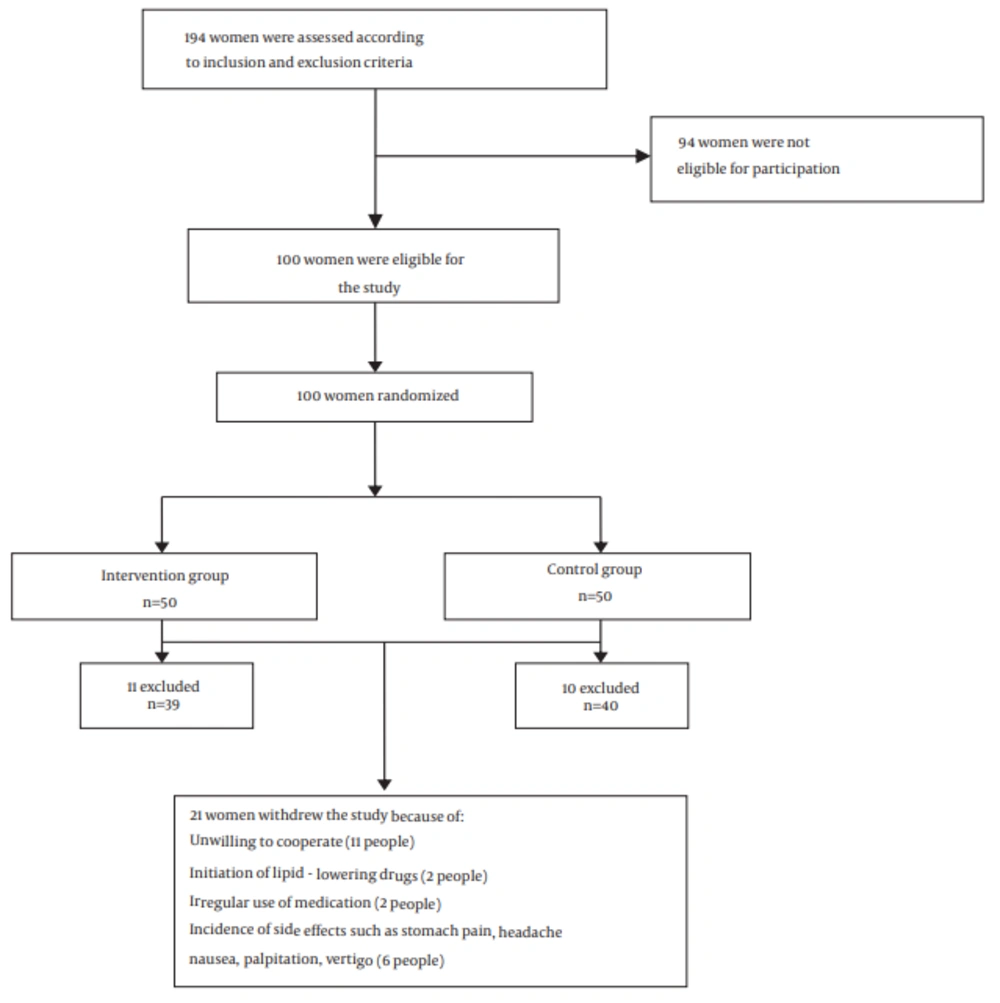
Figure 1.
Flow Diagram of the Recruitment and Retention of Participants in the Study
| Variables | GTE Group (N = 39) | Placebo Group (N = 40) | P |
|---|---|---|---|
| Age, y | 53.7 ± 4.1 | 52.9 ± 3.6 | 0.3 |
| Years post-menopause | 2.8 ± 2.7 | 2.8 ± 3.2 | 0.9 |
| Age at menopause, y | 50.9 ± 3.3 | 50.1 ± 2.5 | 0.2 |
| Body mass index, kg/m2 | 29.6 ± 4.3 | 30.1 ± 3.9 | 0.2 |
| Weight, kg | 70.8 ± 12.8 | 71.7 ± 10.7 | 0.6 |
| Systolic blood pressure, mmHg | 116.9 ± 12.4 | 119.8 ± 12.8 | 0.7 |
| Diastolic blood pressure, mmHg | 78.5 ± 10.4 | 78.2 ± 10.7 | 0.3 |
| Occupation | 0.5 | ||
| Employed | 1 (2.56) | 2 (5) | -- |
| Housekeeper | 38 (97.44) | 38 (95) | -- |
| Education | 0.2 | ||
| Illiterate | 13 (33.33) | 8 (20) | |
| Primary | 25 (64.1) | 31 (77.5) | |
| High school and university | 1 (2.56) | 1 (2.5) | |
| Economic situation | 0.2 | ||
| Good | 9 (23.08) | 5 (12.5) | |
| Average | 16 (41.03) | 17 (42.5) | |
| Poor | 14 (35.9) | 18 (45) |
a Differences were tested using chi-square tests and Mann-Whitney tests for the categorical variables, and independent sample t-tests for the numerical variables.
b The values are presented as mean ± SD or No. (%).
Table 2.
Comparison of Blood Pressure, Weight, and BMI between GTE and Control Groups
| Variables | GTE Group (N = 39) | Placebo Group (N = 40) | |||||||
|---|---|---|---|---|---|---|---|---|---|
| Before | 2 Weeks After Intervention | 4 Weeks After Intervention | P Value Within Group | Before | 2 Weeks after intervention | 4 Weeks After Intervention | P Value Within Group | P Value Between Groups | |
| SBP, mmHg a | 116.9 ± 12.4 | 119.4 ± 13.3 | 118.8 ± 15 | 0.5 | 119.8 ± 12.8 | 122.1 ± 12.7 | 118.5 ± 17 | 0.3 | 0.9 |
| DBP, mmHg b | 78.5 ± 10.4 | 80.1 ± 10.9 | 80.7 ± 7.4 | 0.4 | 78.2 ± 10.7 | 82.4 ± 9.5 | 82.4 ± 9.5 | 0.01 | 0.4 |
| BMI, kg/m2c | 29.6 ± 4.3 | - | 29.4 ± 4.1 | 0.02 | 30.1 ± 3.9 | -- | 30 ± 3.9 | 0.1 | 0.5 |
| Weight, kg | 70.8 ± 12.8 | - | 70.3 ± 12.4 | 0.04 | 71.7 ± 10.7 | -- | 71.4 ± 10.7 | 0.2 | 0.6 |
a Systolic blood pressure.
b Diastolic blood pressure.
c Body mass index.
5. Discussion
In this study, we tested the hypothesis that short duration GTE intake reduces blood pressure and BMI in healthy post-menopausal women. This study demonstrates that short-term consumption of green tea does not significantly alter the blood pressure and weight between the control and intervention groups. Interestingly, there was a significant increase in diastolic blood pressure in the control group over the course of the study. In addition, weight and BMI both decreased significantly in the GTE group after 4 weeks of treatment.
The hypotensive effect of GTE was previously observed by Bogdanski et al. in 2011 on 56 obese hypertensive patients. They reported that consumption of GTE for 3 months resulted in significant decreases in systolic and diastolic blood pressures (11). Our results regarding systolic and diastolic blood pressures do not agree with what Bogdanski et al. (11) reported. This discrepancy may be explained by the fact that we followed participants for only 1 month, while Bogdanski et al. followed their participants for 3 months. Another possible explanation is that Bogdanski et al. (11) recruited people with obesity-related hypertension, while we recruited only normotensive women. Additionally, Ihm et al. demonstrated a favorable effect of green tea on blood pressure in 2011 (21). A systematic review that included 20 randomized controlled trials and 1,536 participants was conducted by Onakpoya et al. in 2013; it reported that green tea significantly reduced systolic blood pressure, but did not alter diastolic blood pressure. There was a relatively small effect of green tea on systolic blood pressure (4). Our results were nearly in agreement with Onakpoya et al. (4).
Yang et al. studied 1,507 Chinese people, and in 2004 showed that in the individuals who had a history of drinking tea for the past decade (120 to 599 mL/d), the risk of developing hypertension decreased by 46%; a 65% reduction in the risk of developing hypertension was observed in those drinking 600 mL/day or more (24). In the present study, the green tea consumption did not reduce the blood pressure; however, the diastolic blood pressure significantly increased in the control group who consumed placebo pills for 4 weeks.
Several mechanisms have been proposed to explain the effects of GTE on the blood vessels, including: 1) GTE improved endothelial dysfunction by attenuating oxidative stress and scavenging free radicals; 2) GTE suppressed several inflammatory factors; 3) GTE decreased the concentrations of kallikrein and prostaglandin E2, and then produced vasodilatation; and 4) GTE modulated neurotransmission by modulating gamma-aminobutyric acid (GABA) release (4, 20).
The weight and BMI of women in our study decreased significantly in the green tea group; however, we did not observe any differences between groups. Studies exploring the anti-obesity properties of green tea treatment showed a reduction in body weight, compared to the baseline. Thielecke et al. stated in 2009, in his review article, that: increasing the duration of intervention with green tea to 12 weeks can result in better effect size on obesity (13). In contrast to the statement of Thielecke et al., our participants in the intervention group had a significant decrease in weight and BMI in only 4 weeks. Maki et al. in 2009 showed that 12 weeks of green tea consumption reduced abdominal fat significantly (7). Khan et al. showed in 2007 that green tea consumption results in a gradual, but non-significant reduction in body weight during 25 days (25). Stendell-Hollis et al. reported in 2010 that 6 months’ intake of green tea did not significantly reduce weight and BMI (26). In the present study, we did not measure the abdominal fat.
Regarding the effect of green tea on weight loss, it has been observed that green tea elevates metabolism by preventing the breakdown of norepinephrine (27). It has also been suggested that green tea inhibits adipocyte differentiation and proliferation, and causes a reduction of fat absorption (15).
A systematic review by Baladia et al. which included five randomized controlled trials and 301 participants, showed that green tea treatment did not result in significant weight loss (-0.78 kg, 95% CI: -2.31 - 0.75, P = 0.32). In addition, there was a non-significant reduction in the BMI (-0.31 kg/m2, 95% CI: -0.88 - 0.27, P = 0.3) (28). Our results are largely in agreement with Baladia et al. (28), as we did not observe any significant differences between the two groups regarding weight and BMI; however, weight and BMI decreased significantly in the green tea group.
5.1. Strengths and Limitations of Study
For the first time in Iran, the effect of green tea on blood pressure, weight, and BMI were evaluated. This study followed women intensively for 4 weeks. As we relied on the participant reporting concerning their compliance in taking green tea or placebo capsules, this may have introduced recall bias. In this study, we treated women for a 1-month period. As a result, we only evaluated the short-term effects of GTE on blood pressure, weight, and BMI. Further studies, including ones with long-term treatments, a wide range of volunteers, and long observation durations are needed to support our data.
5.2. Conclusion
This study suggests that short-term treatment with GTE has no effect on normal blood pressure. However, green tea has been linked to slow but non-significant weight loss. Further research evaluating the effect of green tea on blood pressure, weight, and BMI in postmenopausal women over a longer duration is recommended.