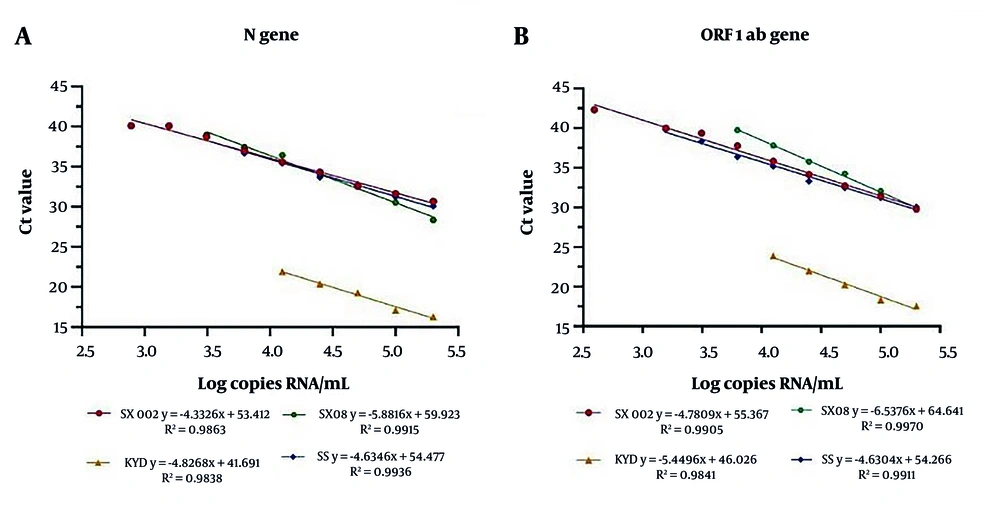
Several studies have reported comparative analyses of the detection performance indicators of different SARS-CoV-2 nucleic acid kits. Results have shown that the efficiency of various nucleic acid extraction methods can affect test outcomes, and the Ct values obtained from different detection kits can vary significantly. In addition, some kits may fail to detect samples with low viral loads (
6,
16-
18). This study investigated the linear quantification of four SARS-CoV-2 detection kits. All four kits demonstrated good linear regression. The Ct values obtained for the two target genes were highly correlated, with correlation coefficients greater than 0.99. Among the three RNA extraction-free kits, SX08 exhibited the highest R² and r-values.
The SS kit had the lowest CV, indicating the most stable results. The SS kit utilized magnetic beads for nucleic acid extraction, and previous reports have highlighted that this method provides higher stability compared to methods without nucleic acid extraction (
18). The KYD had the highest CV, indicating greater variability. Among the three RNA extraction-free kits, SX08 showed the lowest CV and the highest stability for Z0. The SX002 and SX08 demonstrated the highest accuracy in detecting the N and ORF1ab genes, respectively. The SX08 also had the lowest LOD among the RNA extraction-free kits.
The KYD kit failed to detect the ORF1ab gene, likely due to an interaction gap in its primer/probe design that hindered the detection of the target region covered by the pseudovirus particles used in the Z0 sample. In the analysis of clinical samples, the qualitative results of the SS and SX08 kits showed 100% agreement with the actual results. The KYD exhibited strong detection ability for samples with high viral loads but weaker detection ability for samples with low viral loads. In the detection of the Omicron variant, all kits tested positive for both target genes, except for KYD, which only tested positive for the ORF1 gene of the BA.5 variant at 7.5 × 10² copies/mL.
The SARS-CoV-2 genome has undergone evolutionary mutations since the COVID-19 outbreak. Although these RNA extraction-free SARS-CoV-2 detection kits were in clinical use before the emergence of the Omicron variant, they were still able to detect different Omicron variants, indicating a high degree of conservation in the primer/probe regions recognized by these kits. However, some RNA extraction-free SARS-CoV-2 nucleic acid detection kits may not efficiently detect low virus concentration samples of the Omicron variants. Similar results have been reported in other studies. Visseaux et al. (
17) found that different extraction-free SARS-CoV-2 RT-PCR assays exhibited lower sensitivity for low viral load samples. Morecchiato et al. (
12) also reported a loss of accuracy for extraction-free protocols in samples with low viral loads, leading to false-negative results in cases where conventional tests yielded high Ct values.
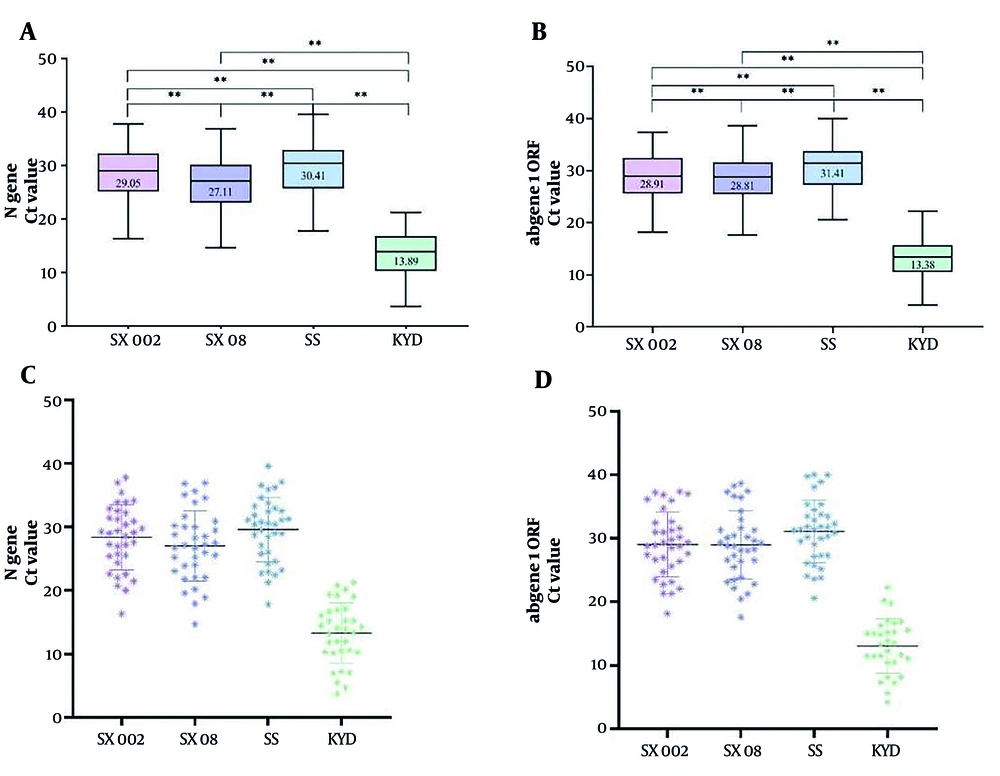
Multiple SARS-CoV-2 detection kits demonstrate good agreement in terms of qualitative results, although their Ct values differ significantly (
19,
20). The present study indicates that although the RNA extraction-free nucleic acid test kits and the magnetic bead extraction nucleic acid test kit yielded consistent qualitative results, their Ct values varied. Specifically, the KYD test exhibited significantly lower Ct values compared to the other kits. The KYD test is primarily designed for rapid screening, featuring a shortened detection time of only 30 minutes with a rapid reaction program. Although the program includes 45 cycles, the first 15 cycles are pre-amplification cycles during which no fluorescence signals are collected.
The Ct values serve as a valuable parameter for the semi-quantitative assessment of viral load. However, the use of Ct values in the management of COVID-19 remains controversial due to variations across different test systems (
21). RNA extraction maximizes the delivery of RNA from clinical samples into the RT-PCR reaction system while minimizing potential “interference” that may negatively affect the performance of the PCR reaction.
The main disadvantages of the three RNA extraction-free kits lie in the lower concentration and purity of the RNA samples. Fewer RNA copies are added to the reaction, and potential PCR interferences remain. Consequently, the overall detection performance is inferior to that of the magnetic bead extraction method. However, RNA extraction-free kits are easy to use, have shorter detection times, lower economic costs, and provide reliable qualitative results, making them convenient and practical.
Nonetheless, large Ct values and single-gene amplification results should be carefully considered in clinical applications to avoid false-negative results. For RNA extraction-free nucleic acid detection kits, further optimization of RNA concentration is crucial to improve detection accuracy. Additionally, continuous monitoring of the SARS-CoV-2 genome sequence and timely optimization of detection kits are essential to ensure that the primer and probe sequences in different RT-PCR detection systems adequately cover the target genes.
5.1. Conclusions
Many laboratories have chosen to utilize multiple nucleic acid detection methods, including nucleic acid extraction and RNA extraction-free approaches. However, testing systems may exhibit variations in performance indicators due to differences in testing principles and techniques. Therefore, laboratories should comprehensively consider factors such as specimen source, instruments, reaction detection systems, and applicable scenarios when selecting the appropriate detection kit. Although Ct values obtained from SARS-CoV-2 nucleic acid detection are valuable for clinical diagnosis and treatment, they can vary across different assays. Hence, variations in the performance indicators of assay kits should be carefully considered when making clinical decisions based on Ct values.