1. Background
Pseudomonas aeruginosa is an opportunistic pathogen, which infects patients with cystic fibrosis (1), burning wounds (2), ophthalmic traumas and immunodeficiency. This organism also infects transplant recipients (3). P. aeruginosa is widely distributed, mostly in the hospital field and is one of the most important agents of hospital-acquired infections among Gram-negative bacilli (4). Apart from the inherent drug resistance present in this organism, the acquired simultaneous resistance to several antibiotics (multi drugs resistant) has caused serious problems for control of infections by this organism.
Usually most laboratories use conventional microbiological methods such as culture and biochemical procedures for identification of P. aeruginosa in clinical samples. On the other hand, conventional microbiological methods are time-consuming and take several days for identification and confirmatory testing, which is a problem for controlling fatal infections (5). Also some P. aeruginosa strains are auxotrophs and their isolation results a false negative culture result which is fatal for patients susceptible to infection of this pathogen, such as patients with cystic fibrosis. Isolation of these strains needs selective and special culture media for growth and isolation, which are not routinely used in most laboratories (6). In some countries, serological methods are used to identify P. aeruginosa, however they are not reliable (7, 8). Recently the polymerase chain reaction (PCR) technique has been used as a molecular method to detect bacteria in clinical samples, yet this method needs to be improved, regarding sensitivity, specificity and expenses (9, 10).
2. Objectives
The aim of this study was to assess and compare the sensitivity and specificity of the conventional PCR technique by using two kinds of primers: specific primers published in previous articles (and designed highly specific precise primers for detecting the frequency of exoA (exotoxin A) found in 90% of P. aeruginosa strains (4), oprL (responsible for synthesis of a protein of the external membrane) and algD gene (responsible for alginate synthesis) (11).
3. Materials and Methods
3.1. Clinical Samples
In this cross-sectional descriptive study, 150 clinical samples during a one-year period (February 2012 - February 2013) were collected from patients admitted in the ICU of Ashayer hospital (Khoramabad, Iran). The clinical samples consisted of: swabs from wounds 70 (46.6%), sputa 20 (13.3%), blood 5 (3.3%), urine 5 (3.3%), abscess 12 (8%), Biopsy 3 (2%), cerebrospinal fluid 5 (3.3%), pulmonary secretion 27 (18%) and synovial fluid 3 (2%).
3.2. Samples Preparation
The samples were collected in two sterile microtubes for culture and PCR. For the PCR test 1000 µL of PBS (phosphate buffer salts) was added in to the microtubes containing the patient’s direct samples and the tubes were stored at -70°C. Microbiological culture of the samples was performed in the bacteriology lab using a suitable culture media such as MacConkey (Merck, Germany) agar and selective agar for isolation of organism and biochemical differential test reactions for identification of the isolates.
3.3. Diagnosis of Pseudomonas aeruginosa Using Previously Published Primers
Type of primers for amplification of the exoA and algD/oprL genes: two sets of primers were used for amplification of the exoA and algD/oprL genes, which had already been published in previous articles (6, 11, 12), while newly designed primers based on the bioinformatics method were also examined. Characteristics of the previously published primers of the exoA, oprL and algD genes such as size and nucleotides sequences, annealing temperature and available references are shown in Table 1.
Table 1.
Characteristics of Published Primers and Nucleotide Sequences
| Target | PCR Program | Primer | Amplicon Size | Reference |
|---|---|---|---|---|
| rRNA S16 | 40 cycles: 1 min 94°C,1 min 55°C, 2 min 72°C | F:5-GGGGGATCTTCGGAACCTCA-3 | 312 bp | (6, 11-14) |
| R:5-TCCTTAGAGTGCCCAAACCCG-3 | ||||
| exoA | 40 cycles: 1 min 96°C,1 min 55°C, 1 min 72°C | F:5-GACAACGCCCTCAGCATCACCAGC-3 | 396 bp | (6, 11-14) |
| R:5-CGCTGGCCCATTCGCTCCAGCGCT-3 | ||||
| oprL | 30 cycles: 40s 94°C, 40 s 57°C, 50 s 72°C | F:5-ATGGAAATGCTGAAATTCGGC-3 | 504 bp | (6, 11-14) |
| R:3-CTTCTTCAGCTCGACGCGACG-3 | ||||
| algD | 30 cycles: 1 min 94°C,1 min 60°C, 1 min 72°C | F:5-TTCCCTCGCAGAGAAAACATC-3 | 520 bp | (6, 11-14) |
| R:5-CCTGGTTGATCAGGTCGATCT-3 |
To determine the sensitivity of the test, in addition to using the negative and positive controls, a couple of primers related to a conserved gene concerning the 16SrRNA, which are universally present in all strains, were used.
3.4. Designing the Specific New Primers
Three sets of P. aeruginosa specific primers were designed in this study. One set amplified a 125 bp region of the exoA gene and the other two sets amplified a 105 and 126 bp region of the oprL and algD genes, respectively. The available sequences of these three genes were obtained from NCBI and multiple alignments were performed to find conserved sequences of each gene for primer design. Both multiple alignment and primer design steps were carried out by the AlleleID software, version 7.0 (Premier Biosoft International, Palo Alto, CA, USA). The primers were synthesized by TAG Copenhagen (Denmark). The sequence and position of each primer set is reported in Table 2.
Table 2.
Nucleotides Sequences and the Situation of the Designed Primers
| Bacterial Target | Sequence 5` to 3` | Primer Length (bp) a | Amlicon Size (bp) |
|---|---|---|---|
| exoA | 125 | ||
| Sense Primer | ACATCAAGGTGTTCATCC | 18 | |
| Anti-sense Primer | GACGAAGAAGGTGGCATC | 18 | |
| oprL | 105 | ||
| Sense Primer | TGCGATCACCACCTTCTACTTC | 22 | |
| Anti-sense Primer | CGCTGACCGCTGCCTTTC | 18 | |
| algD | 126 | ||
| Sense Primer | ACGAAGTGGTGGCGAGTTC | 19 | |
| Anti-sense Primer | TGGTGTGCGGCATGAAGC | 18 |
a base pair
3.5. Extraction and Purification of Bacterial DNA
To prevent contamination of the samples with the pre-existed DNA in the laboratory and to avoid creating false positive results, DNA extraction of samples, were performed under a biological, class II laminar flow cabinet. To extract bacterial DNA from the clinical samples, the DNA minikit (Invitec, Germany) was used according to manufacturer`s instructions. Samples were directly enrolled in PCR or stored at - 80°C for future analysis. P. aeruginosa (ATCC 27853) was used as positive control in the PCR assay. DNA concentration and purity was determined by running the samples on 0.8% agarose gel based on the intensities of bands.
3.6. PCR Reaction for Designed Primers
3.6.1. PCR Reaction for exoA Gene
The reaction mixture of PCR was 25 µL in a total volume containing 12.5 µL of master mix (Cinaclone, Iran), 0.1 μL of each primer, 2 µL of genomic DNA, 0.5 µL of 50 mM MgCl2 and 9.8 µL of distilled water (dH2O). PCR was carried out with an initial denaturation step of two minutes at 95°C, followed by 35 cycles of denaturation (1 minutes at 95°C), annealing (30 seconds at 56°C) and extension (1 minutes at 72°C); the reactions were finalized by an elongation step for five minutes at 72°C.
3.6.2. PCR Reaction for oprL Gene
PCR was carried out in a total volume of 25 µl with an initial denaturation step of two minutes at 95°C, followed by 35 cycles of denaturation (two minutes at 95°C), annealing (30 seconds at 56°C), and extension (1 minute at 72°C); the reactions were finalized by polymerization for five minutes at 72°C.
3.6.3. PCR Reaction for algD Gene
PCR was carried out in a total volume of 25 µl with an initial denaturation step of two minutes at 95°C, followed by 35 cycles of denaturation (one minute at 95°C), annealing (30 seconds at 55°C) and extension (one minute at 72°C); the reactions were finalized by polymerization for five minutes at 72°C. Finally, the extracted DNA from Escherichia coli and standard strain of P. aeruginosa were used as negative and positive controls. In addition, a couple of specific primers for universal gene (16SrRNA) were used for all extracts to reconfirm the presence of P. aeruginosa.
4. Results
In the current study, of the 150 cultured clinical samples, 70 samples were positive for P. aeruginosa. Sensitivity and specificity of the results of the PCR method by using the designed primers and the published primers were compared with the results of the culture method as the gold standard. The positive results of the culture method and the positive and/or negative results of the PCR using designed and published primers are shown in Tables 1 and 2.
All of the clinical isolates were diagnosed as negative through culture method were found to be negative using PCR with designed primers. However, PCR was able to detect 68 out of 70 samples were positive by culture method. The results of PCR for oprL gene were positive for all 70 culture positive samples. However, PCR results for algD gene were positive for 69 out of 70 culture positive samples. By using the published primers for negative culture samples, the PCR results were also negative. PCR results for exoA gene were positive for 57 samples from 70 culture positive samples. PCR results of oprL gene were positive for 49 samples.
PCR results for algD gene were only positive for 28 out of 70 culture positive samples. Sensitivity of the PCR by using the designed primers was calculated as 97.2% for exoA gene, 100% for oprL gene and 98.6% for algD gene. Sensitivity of the PCR by using the published primers was 81.5%, 70% and 40% for the exoA, oprL and algD genes, respectively. The gel pictures of amplified genes are shown in Figure 1. According to the result of the negative and positive controls and by using the protected universal primers of rRNA, the specificity of the PCR tests for all cases was 100%. From each PCR product of the designed primer, one sample was sequenced (Genfanavaran, Iran) to verify the amplified fragment. All of the obtained sequences were correctly verified.
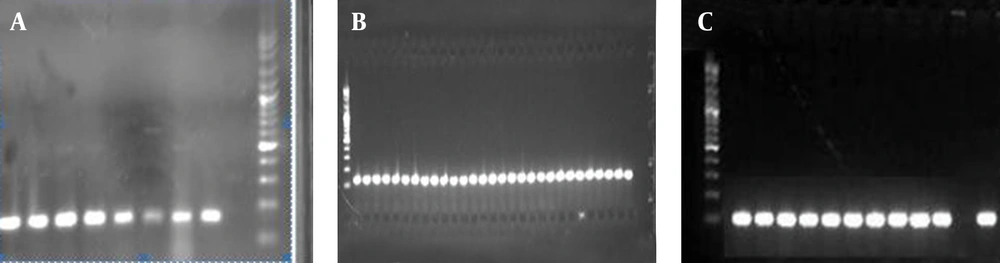
Figure 1.
A) exoA gene (125 bp), B)algD gene (126 bp), C) OprL gene (105 bp). 100 bp ladder was used (Cinna clone, Iran).
Table 3.
Result of PCR Using Designed Primers
| Sample | 16SrRNA | algD | oprL | exoA | Culture | No. of Isolates |
|---|---|---|---|---|---|---|
| Swab | + | + | + | + | + | 32 |
| Sputum | + | ـ | + | ـ | + | 1 |
| Sputum | + | + | + | + | + | 9 |
| CSF | + | + | + | + | + | 3 |
| Abscess | + | + | + | + | + | 10 |
| Biopsy | + | + | + | + | + | 1 |
| Pulmonary secretion | + | + | + | ـ | + | 1 |
| Synovial | + | + | + | + | + | 1 |
| Exoda of pulmonary | + | + | + | + | + | 12 |
Table 4.
Results of PCR Using Already Published Primers
| Sample | 16SrRNA | algD | oprL | exoA | Culture | No. of Isolates |
|---|---|---|---|---|---|---|
| Wound swab | + | + | _ | + | + | 15 |
| Wound swab | + | _ | + | + | + | 18 |
| Sputum | + | _ | + | + | + | 5 |
| Sputum | + | _ | + | _ | + | 3 |
| CSF | + | + | + | + | + | 3 |
| Biopsy | + | _ | _ | + | + | 1 |
| Pulmonary secretion | + | _ | _ | + | + | 5 |
| Pulmonary secretion | + | + | + | _ | + | 10 |
| Abscess | + | _ | + | + | + | 10 |
5. Discussion
P. aeruginosa is an opportunist pathogen which during the recent decades, has been considered as a common agent of hospital acquired infections. The main reason for this condition is potential colonization factors like alginates and pilli and wide distribution of multi-drug resistance strains of this organism in hospital environments (4). P. aeruginosa is the most important cause of infection in patients with cystic fibrosis (CF). More than 80% of patients with CF are infected by this pathogen (15).
Identification of this bacterium in most laboratories is through conventional culture methods and isolation procedures, but culture from initial colonization in patients with cystic fibrosis is negative, however early detection of the organism in initial colonization is vital for these individuals (12). In addition, in patients admitted to the ICU and patients with level 3 burning, which have entered in the bacteremia phase, rapid identification of the bacteria via the conventional culture method and biochemical tests in a short time if not impossible, is very difficult (6). In addition, this bacterium is able to exist as auxotroph strains, which need special selective culture media for growth, and this makes its diagnostic more difficult. Therefore, false negative culture of patients sensitive to infection such as cystic fibrosis patients might be life threatening (13).
Another problem is that in most cases of burning patients there might be co-infection with other bacteria, thus repeated subcultures to isolate P. aeruginosa takes about 5-6 days. In this condition, only using a careful and rapid method can overcome the problems (6). In some European countries in order to identify these bacteria in patients with cystic fibrosis they use serological methods such as ELISA to detect antibodies (16), but the price of these methods depends on the kit and manufacturer and it sometimes could be more expensive. False positive results due to reactions with other bacteria including the Enterbacteriacae family are the other limitations of serological methods (17). Therefore, using the PCR method has priority to culture for detection of organisms at the beginning of the colonization especially in CF infections. Moreover PCR is more efficient than the culture method (18).
Various follow up studies during the recent years have shown that the PCR method has been able to detect bacteria at the beginning of colonization in CF patients, while the culture results are negative at the beginning of colonization in the above mentioned patients (14). In most of these follow ups, a positive culture is reported several weeks after organism colonization. Consequently, PCR is able to show the colonization of Pseudomonas, earlier than culture. It is obviously clear that having early information about colonization of the organism in high-risk patients is important for interventions by antibiotic therapy (14). Secondly, regarding patients with CF, throughout their life-time, they are often infected with a PA clone; surveying clone transfer among CF patients is impossible by the culture method (19, 20). In this study, DNA was extracted directly from clinical samples such as lung secretions, cystic fibrosis patients’ sputum or swab from sever burning wounds, then by using two sets of specifically designed primers in this study and published in articles, the sensitivity and specificity of the PCR reaction was assessed.
Khan and Cerniglia used the PCR assay for identification of P. aeruginosa from clinical samples by designing specific primer for the exoA gene (21). Their results showed that this method has high specificity and is more suitable than biochemical methods. In 2000 Song et al, performed the same method using the exoA gene and confirmatory results were obtained (22). Another study was performed by Lanotte et al., in 2004 for detection P. aeruginosa using a couple of primers for oprL and exoA genes. The results illustrated that PCR with oprL gene produced higher sensitivity and specificity than the exoA gene; this is in accordance with our research (23). However the results of De Vos et al. research, which compared the oprL and oprI genes for detection of P. aeruginosa, demonstrated that the sensitivity of the PCR method using oprL gene is higher than oprI (24). Beside, Feizabadi et al. performed a real time PCR using the oprL gene. The sensitivity and specificity of this method was 100% and 98.85%, respectively (4).
In addition Billard-Pomare et al. showed that qPCR of oprL gene has high specificity and it is more suitable than culture to show bacterial colonization (18). Moreover, Logan et al. compared PCR and conventional culture for colonization determination. They concluded that, compared to culture; PCR has higher sensitivity and specificity (14). In this study, several sputum samples were found positive through the PCR method while their cultures were negative. In most of our cases PCR samples become positive earlier once compared with culture investigations that their samples converted to positive during the time of hospitalization. This finding indicates that our method has sufficient sensitivity and specify to detect colonized patients (14). This could be considered as the advantage of this study.
In conclusion, the results of the present study showed that the PCR assay was able to detect P. aeruginosa infection in clinical samples earlier than conventional bacterial culture methods. It was also shown that by using newly designed primer sets for algD, oprL and exoA genes it is possible to detect infection more efficiently than previously published primer sets. This finding suggests that appropriately designed primers can increase both the sensitivity and specificity of a PCR assay. The results also emphasize that the PCR method has a great advantage over conventional culture in cases that timely treatment is important for patients’ outcome.