


1. Background
Acute infectious diarrhoea is a common disease in young children throughout the world. The mortality rate has been estimated to be 1.6–2.5 million cases per year, the majority of which occur in developing countries (1).
Rotavirus is the most important cause of severe dehydrating diarrhoea in early childhood (2). In developed countries, rotaviruses are detected in 35–50% of children hospitalized with acute diarrhoea (3, 4). Enteric adenotviruses are ubiquitous. They are considered the primary cause of epidemic diarrhoea and onset of diarrhoeal disease in hospitals and day-care centres (5, 6). The rate of enteric adenoviruses varies from 1–8% in developed countries (7, 8) to 2–31% in developing countries (9-11).
2. Objectives
Considering the high prevalence of gastroenteritis in our region and absence of regional epidemiological data on aforementioned viruses, we performed this study to determine the relative frequency of rotavirus and adenovirus in children hospitalized with acute gastroenteritis in Abuzar Hospital at Ahvaz, in southwest Iran. Epidemiological aspects such as sex, age, and season were assessed.
3. Patients and Methods
This descriptive epidemiological study was carried out in Ahvaz, southwest Iran, from September 2009 to August 2010. The study population included children aged 1–60 months who were admitted to Abuzar Hospital with a diagnosis of acute diarrhoea. Acute diarrhoea was defined as 3 or more occurrences of watery or loose stool daily, lasting for 3 to 13 days (12). All subjects were selected by simple random sampling. The collection of fecal samples was carried out in the first 24 h of hospitalization, after written informed consent was obtained from parents or legal guardians. Patients with negative RBC and WBC in their stool examination and no evidence of food poisoning were included. Children with a previous history of immunosuppressive therapy or documented significant background diseases such as immunodeficiency syndromes were excluded. Only 1 fresh stool sample was collected per child. The faecal specimens were obtained at the time of admission and transferred to the virology laboratory, where the samples were stored at -70°C.
Sample size was calculated as z2p(1-p)/d2 where d = 0.07, z = 1.96, and P = 0.3 (according to the other studies) [8,12] , and the specimens were tested for the presence of rotaviral and adenoviral antigens by ELISA(ELISA kit: Diaplus, Inc., North York, Ontario, Canada). The assay was performed according to manufacturer’s instructions. The sensitivity and specificity of ELISA test for faecal specimens has been established previously (13). Patients’ demographic data including age, sex, type of nutrition (breast-fed vs. formula-fed) were recorded.
Statistical analysis of the collected data was performed with SPSS v.13 software. The differences in proportions were compared using the Chi-square test and a P value less than 0.05 was considered statistically significant.
4. Results
Of 180 children with acute gastroenteritis admitted to the hospital, 104 (57.8%) were male and 76 (42.2%) were female. Rotavirus was detected in the faeces of 63 (35%) patients and adenovirus in 6 (3.3%). The frequency of diarrhoea was significantly higher in males (P = 0.044). Fisher’s t-test showed no significant relationship between gender and type of diarrhoeal virus (P = 0.21). The mean age of patients with acute diarrhoea was 12.86 ± 13.02 months (range, 1-60 months). The highest prevalence was observed in 7-12 months children (37.2%). The distribution according to age is shown in Figure 1.
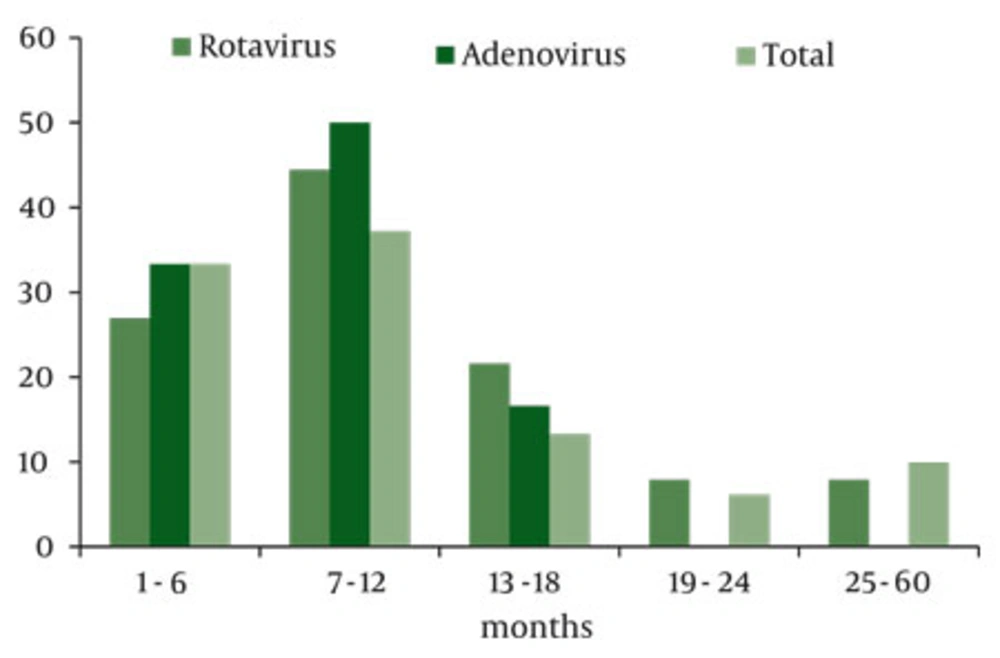
Figure 1
Distribution of Infections Caused by Adenovirus and Rotavirus, by Age
In rotavirus-infected group, the mean age was 11.57 ± 9.21 months (range, 2-48 months). In adenovirus-infected group, the mean age was 8.17 ± 4 months (range, 2-14 months) (Figure 1).
Rotavirus was detected throughout the year. The prevalence of rotavirus gastroenteritis was 19% in spring, 17.5% in summer, 38.1% in autumn, and 25.4% in winter (Figure 2). Accordingly, the relative frequency of rotavirus gastroenteritis was highest in autumn. Adenovirus-infected group (n = 6) had 4 patients in spring (66.7%), no patients in summer, 1 in autumn (16.7%), and 1 in winter (16.7%). A significant difference was observed between incidence of rotavirus in cold season and rest of the year, as demonstrated by the Chi-square test (P = 0.012). Sixty-five (36.1%) patients were exclusively breast-fed, 69 (38.3%) were formula-fed, 29 (16.1%) patients were fed with both formula and breast milk, and 17 (9.4%) were on a family diet. There was no significant difference between the type of feeding and prevalence of diarrhoea (P > 0.05).
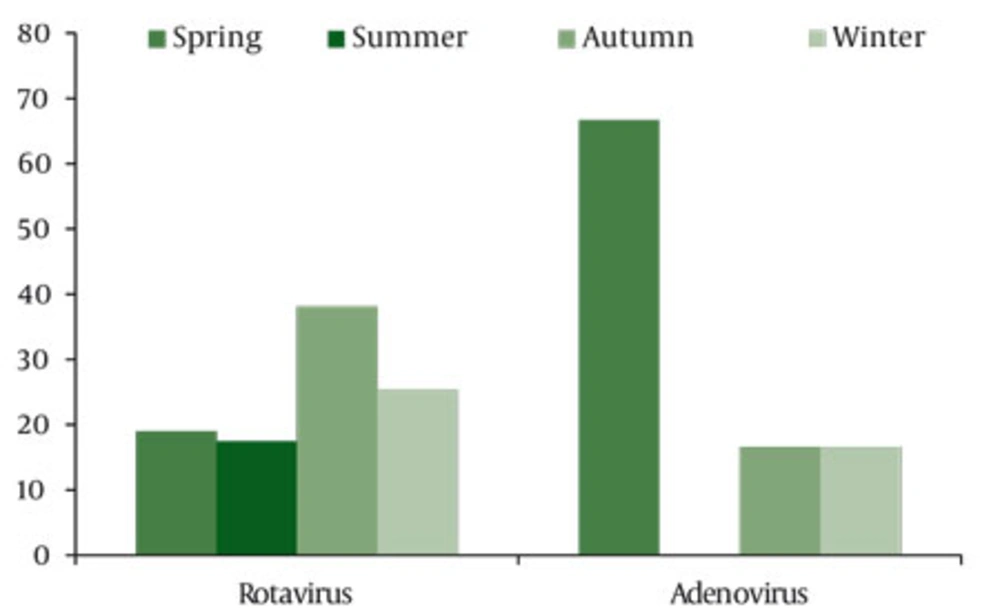
Figure 2
Seasonal Distribution of Infections Caused by Adenovirus and Rotavirus
5. Discussion
Acute gastroenteritis is one of the most common causes of admission to health centres, and viral diarrhoea is a major cause of morbidity and mortality in developing countries (1, 14). This study showed that rotaviruses are important aetiological agents of acute gastroenteritis in children less than 5 years of age in Ahvaz (35%), accounting for one-third of all cases with acute diarrhoea. A similar prevalence (30.8%) was obtained in a study performed in Iran (15). Our results reinforced the previous finding that rotavirus is responsible for 20–60% of severe diarrhoeal illnesses requiring hospitalization of children in developed and developing countries (4, 15-17). Lower prevalence (9%) also has been reported from Nigeria and Gaborone (3, 18).
The prevalence of adenovirus infection in this study was 3.3%, much lower than the rates reported in north-western Nigeria (22.3%) (19). A similar prevalence (3.3%) was obtained in studies in Korea and Brazil (20, 21)and in a study performed in another city of Iran, Babul (2.9%) (22). A lower prevalence of 1.5% was reported in Argentina (23).Such divergence may be observed due to epidemiological condition of the virus in regions with different climates or be attributed to study design. Our study population was consisted of 180 children with acute diarrhoea, of which 104 were male (57.7%) and 76 (42.2%) were female; according to our results, the prevalence of acute diarrhoea was higher in males than in females (P = 0.04), but no significant relationship between gender and causative virus was observed (P = 0.96). This result is similar to other studies performed in Iran (22, 24).
In our study, 92% of the patients positive for rotavirus were under 2 years of age, with the highest prevalence between 7–12 months (44.4%). This age distribution is comparable to previous reports (22, 24). The low rate of rotavirus disease in infants under 7 months of age has been attributed to a higher rate of breast feeding in this age group, providing partial protection due to presence of maternal antibodies in the breast milk.
Rotavirus cases were more common between the months of October and March. The highest prevalence was seen in autumn (38.1%) and winter (25.4%). In studies carried out in our country, rotavirus cases are more frequently seen in winter (12, 22) ,but in another study, the detection rate was highest in spring (25). In the Asian rostavirus surveillance study, rotavirus cases were observed with higher frequency between December and March in northern regions, but a seasonal increase was not observed in countries with tropical climates (26). In similar studies in the U.S (14), the highest prevalence was in winter, but in the Busu study in South Africa (9), the highest prevalence of rotavirus was in autumn and winter, which is consistent with our results. Geographical location seems to be important for determining the seasonal variability of rotavirus-related gastroenteritis. The seasonal distribution of adenovirus gastroenteritis showed a greater prevalence of infection in spring (66.7%). Unfortunately, the number of cases was too small to draw any significant conclusion about the seasonality or other epidemiological data of adenovirus infection.
In our study, 38.3% of the children were formula-fed and 36.1% were breast-fed with no significant difference (P > 0.05), a result that is not consistent with another study performed in Iran, in which formula-fed infants were more frequently afflicted with diarrhoeal diseases (12). Few reports are available on epidemiology of viral gastroenteritis in various parts of Iran. Further investigations are needed to provide more accurate data on the epidemiology and serotypes of rotaviruses and other viral agents causing acute diarrhoea in this country.
As limitation, because ELISA method vs. PCR (polymerase chain reaction) could result in a false positive result, over estimation in our study is a possibility. This study showed a high prevalence of rotavirus infection in patients less than 2 years of age with acute diarrhoea (35%); it seems rational to use rotavirus vaccine in this population in our region to reduce prevalence of acute diarrhoea.
