1. Background
Toxoplasma gondii is an obligate, intracellular parasite which is widely spread in the world (1). Toxoplasmosis is listed as the third-biggest cause of life-threatening food-borne infections (2). The parasite is able to infect all warm-blooded hosts such as human. The infection has various clinical symptoms in immunocompetent or immunocompromised patients and pregnant women. T. gondii has three ways of transmission: 1) consuming food or water containing oocytes, 2) eating undercooked meats containing tissue cysts, and 3) transmission via placenta (1). Consumption of undercooked meat is one of the most important ways (28 %) of transmission among pregnant toxoplasmosis patients (3) and has been regarded as the most significant risk factor of primary infection during pregnancy (4, 5, 6 ,7).
T. gondii prevalence in Iran is said to be up to 50 % which increases from dry to humid provinces in north of Iran (8). It has been reported that up to 63 % of seroconversion during pregnancy happens after undercooked or raw meat consumption (6). In Norway, raw or undercooked meat consumption has been reported as the major risk factor for toxoplasmosis in pregnant women (7) and has also been responsible for 50 % of congenital toxoplasmosis (9). Serological surveys indicat that Toxoplasma infection exists largly among animals used for meat production, such as pigs, sheep, and goats (10). High seropositivity scores (26.6 % - 88.7 %) for T. gondii have been reported in slaughtered animals (11, 12). These meats all fall into the risk profile category of red meat and apart from chicken and birds. While raw meats have been most commonly implicated, cured meats such as ham have also been found to contain T. gondii cysts occasionally (13). T. gondii was isolated from only one of 40 swine sausage samples commercialized in the city of Erechim-RS (Brazil) (14). An explanation for difficulty to isolate the agent is salt (in a 3% concentration) which inactivates the parasite for at least three days (14).
2. Objectives
This study was conducted to determine T.gondii prevalence in slaughtered animals and meat products in Ahvaz using molecular methods. There were no molecular study on meat and meat products in this Province.
3. Materials and Methods
3.1. Sample Collection
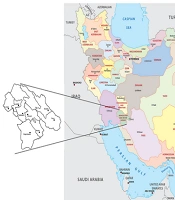
The samples were collected from abattoirs and retailers in Ahvaz city, including: 100 lamb and beef samples (50 samples each type) were collected from tongue, heart and muscles, and 90 meat product samples (sausages, hamburgers and salami) each one 30 samples. A 50 gram meat sample was cut. Knives were thoroughly rinsed with hot water and soap to prevent cross-contamination. The sample tissues were stored at -20ºC until used.
3.2. DNA Extraction
The samples were minced by an electric meat grinder and 25-30 mg of each minced tissue was used following the manufacturer’s instructions of a commercial DNA extraction kit (Qiagen,Valencia, CA, USA) the samples were resuspended in 180μL ATL buffer and 20 μL proteinase K (supplied in the QIAamp DNA Mini Kit), and the protocol recommended for tissue samples was followed. All DNA extracts were stored at -20ºC until used. This product was used as a template for PCR.
3.3. PCR Amplification
B1 gene was selected for PCR because of being highly conserved among Toxoplasma strains with 35-fold repeat gene and 2214 nucleotides in each repeat. This gene was targeted to generate specific primers Tg1, Tg2 and amplified 469-bp DNA fragment of the B1 gene (15). The positive control was obtained from Parasitology department of Shiraz University of Medical Sciences. Primers Tg1 (5’AAAAATGTGGGAATGAAAGAG 3’) and Tg2 (5’ACGAATCAACGGAACTGTAAT 3’) were used for PCR amplification (15).The PCR mixture contained 1 μM of each primer (Tg1 and Tg2), 5 mM of 10 × PCR Gold buffer, 1.5 mM of MgCl2, 1 mM of deoxynucleoside triphosphate (CinnaGen), 0.3 U of Taq DNA polymerase (CinnaGen) and 20.2 μl D.W. The reaction volume was 50 μl containing 20 μl of DNA extracts. Reactions were preheated in thermal cycler (Bio Rad-USA) for 10 min at 95º C, followed by 35 cycles of 94º C for 1 min, 52°C for 30 s and 72°C for 1 min, with a final extension step at 72°C for 7 min (15). 10 μl of amplified products were run in1 % agarose gel. Two control samples were used for each PCR cycle including T. gondii DNA as positive and distilled water as negative control.
4. Results
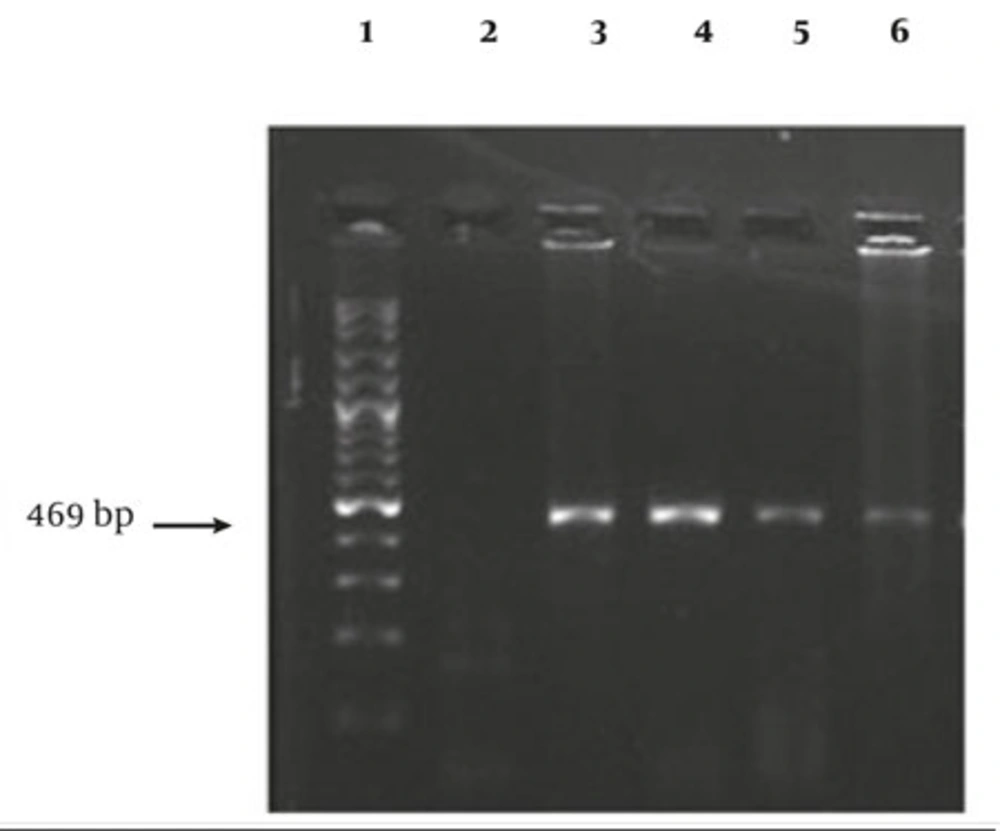
A total of seven lamb out of 50 (14 %) and two beef out of 50 (4 %) were found as positive for T. gondii. The parasite was not isolated from any of the meat product samples. Total positivity rate was 4.7 % in 190 samples. The results of PCR are indicated in Figure 1.
Figure
1: Marker (100 bp), 2: Negative control, 3: Positive control, 4,5,6: Positive specimens.
5. Discussion
Toxoplasma infects cover a large variety of hosts including human, animals and birds. In this study, seven lambs out of 50 (14 %) were found positive for T. gondii. Asgari et al. presented the total prevalence Toxoplasma infection as 33.3 % among 22 goats (22.7 %) and 56 sheep (37.5 %) by PCR (16). It has been assumed that infected sheep, will remain persistently infected for their whole life (17). Ghorbani et al. have reported the Serological prevalence of toxoplasmosis in sheep in Kuzestan (southwest of Iran), Mazandaran and Gilan (Notrh of Iran) were 12.6 %, 32.5-35.8 % and 29-31 % respectively (18). Sharif et al. found 30 %, 35 % sero-positivity in goats and sheep respectively by IFA test from Mazandaran Province (19). These different results indicate that animals were exposed to different environmental contamination with T. gondii oocytes.
In this study 4 % of cattle were found positive for T. gondii and the infection was more frequent in sheep compared with cattle which was similar to other studies. In serological study, antibodies against T. gondii were found in goats, sheep, cattle, 23.7 %, 22.5 % and 4.8 %, respectively (20). Dubey and Thulliez have reported that the Toxoplasma infection in cattle dose not usually cause clinical symptoms because of high natural resistance to the parasite (21). Aspinall detected by PCR, 19 positive out of 57 samples of pork, six out of nine lamb, and one out of four beef (22). In our study the parasite was not isolated from any of the meat product samples. These results indicate that meat products probably have low importance as a source of infection for human toxoplasmosis in the studied region.
arnekulasuriya detected one positive sample out of 67 cured meat samples, including dried and semi-dried sausages and hams using PCR in UK. The author suggested that the detected level of parasite contamination would be sufficient to establish human infection following the consumption of a typical meal portion of cured meat (13). Prevalence of Toxoplasma infection indicated that from 164 meat product samples including salami, sausages, hamburgers, and kebab samples were 16.6 %, 19.1 %, 15 and 56.6 % respectively, in Tabriz (23). In this study primers specific for T. gondii SAG2 locus was used to detect the parasite in samples. In Falah study, samples (sausages, hamburgers) have been picked from the factories in Tabriz province. Despite the dramatic differences in pollution levels in different areas of Iran due to different weather conditions, especially favorable temperature for the maintenance of parasite oocytes, it seems that high pollution in Fallah study is justifiable. Besides, beef supplies are used more in the preparation of these products and based on studies in Iran and the world, contamination of cattle is much lower than sheep. Da silva reported that T. gondii DNA was found in 27.14 % of 70 sausage samples examined in Brazil (24). T. gondii was isolated from only one of 40 swine sausage samples in Brazil (14). Among food animals, pigs are considered to be the major source of T. gondii for humans, so probably one reason for different results, in different regions, could be using meat products that contain pork meat (25). These findings may be related to various ways of infection prevalence in meat-producing animals, or different eating habits; it has alsobeen indicated that T. gondii is killed by many of the salting, curing, freezing, or heating procedures that are used in meat processing, these products are not a likely source of human exposure to the infection. It is difficult to find T. gondii tissue cysts in large animal species for several reasons, including sampling bias and preferred parasite sites. Dubey has estimated that less than 1 tissue cyst/50 g of tissue is likely to be found in T. gondii-infected pigs (26). Thus, it is possible that when performing any test for tissue cyst detection, false-negatives can result from insufficient sample size or improper sample acquisition. Therefore in this study 50 gram of meat from different parts of carcass and meat products was selected to increase the chance of finding parasite in the samples. Overall, a low prevalence of T. gondii was found in meat and meat products in Khuzestan.
The results of this study confirm existence of T. gondii in slaughtered animals. Although the infection risk in lamb is greater than beef, but beef also has remarkable importance regarding the transmission of T.gondii to humans. Therefore, the potential risk of the disease transmission by consumption of contaminated meat should still be considered as a public health problem. Based on the obtained results, it is suggested that not only pregnant women and immunocompromised patients should be addressed but also the whole population should be informed on how to prevent infection.