RNA Polymerase II Second Largest Subunit Molecular Identification of Boletus griseipurpureus Corner From Thailand and Antibacterial Activity of Basidiocarp Extracts

Authors

Amornrat Aung-aud-chariya1, 2, 3,*, Phuwadol Bangrak3, Saisamorn Lumyong4, Worrapong Phupong3, Nelly Siababa Aggangan5, Niyom Kamlangdee3
1Center of Excellence on Agricultural Biotechnology, Science and Technology, Bangkok, Thailand
2Rajamangala University of Technology, Srivijaya Trang Campus, Thammarat, Thailand
3School of Science, Walailak University, Nakhon Si Thammarat, Thailand
4Department of Biology, Faculty of Science, Chiang Mai University, Chiang Mai, Thailand
5National Institutes of Molecular Biology and Biotechnology, University of the Philippines Los Banos, Laguna, Phillippines
*Corresponding Author: Corresponding author: Amornrat Aung-aud-chariya, School of Science, Walailak University, Nakhon Si, P. O. Box: 80161, Thammarat, Thailand. Tel: +66-81929544, Fax: +66-75672004, E-mail: Email: [email protected]

Jundishapur Journal of Microbiology:Vol. 8, issue 3; e15552
Published online:Mar 21, 2015
Article type:Research Article
Received:Oct 26, 2013
Accepted:May 24, 2014
How to Cite:Aung-aud-chariya A, Bangrak P, Lumyong S, Phupong W, Aggangan NS, et al. RNA Polymerase II Second Largest Subunit Molecular Identification of Boletus griseipurpureus Corner From Thailand and Antibacterial Activity of Basidiocarp Extracts. Jundishapur J Microbiol. 2015;8(3):e15552. doi: https://doi.org/10.5812/jjm.15552

Abstract

Background:

Boletus griseipurpureus Corner, an edible mushroom, is a putative ectomycorrhizal fungus. Currently, the taxonomic boundary of this mushroom is unclear and its bitter taste makes it interesting for evaluating its antibacterial properties.

Objectives:

The purpose of this study was to identify the genetic variation of this mushroom and also to evaluate any antibacterial activities.

Materials and Methods:

Basidiocarps were collected from 2 north-eastern provinces, Roi Et and Ubon Ratchathani, and from 2 southern provinces, Songkhla and Surat Thani, in Thailand. Genomic DNA was extracted and molecular structure was examined using the RNA polymerase II (RPB2) analysis. Antibacterial activities of basidiocarp extracts were conducted with Escherichia coli ATCC 25922, Staphylococcus aureus ATCC 29523 and methicillin-resistant Staphylococcus aureus (MRSA) 189 using the agar-well diffusion method.

Results:

All the samples collected for this study constituted a monophyletic clade, which was closely related with the Boletus group of polypore fungi. For the antibacterial study, it was found that the crude methanol extract of basidiomes inhibited the growth of all bacteria in vitro more than the crude ethyl acetate extract.

Conclusions:

Basidomes collected from four locations in Thailand had low genetic variation and their extracts inhibited the growth of all tested bacteria. The health benefits of this edible species should be evaluated further.

1. Background

Boletus griseipurpureus (Boletaceae) is a wild edible ectomycorrhizal mushroom, rich in protein and low in fat (1). The taste of this mushroom is bitter (1, 2). An analysis of the internal transcribed spacer (ITS) region for B. griseipurpureus from the south of Thailand revealed a monophylogenetic clade (1). However, Only ITS sequences cannot indicate the differences among its populations at the subspecies level. The second largest subunit of RNA polymerase II (RPB2) is more variable and more informative than the ITS region (3) and has been used to constitute phylogenetic trees of genera, such as Cortinarius and to resolve the species concepts in Strobilomyces (4). Therefore, this marker has the potential to discriminate the subspecies (3) and thus it was chosen in this study.
Mushroom extracts are generally used in dietary supplements and in combination with herbs (5) for their potential health benefits. Bioactive compounds have been recognized in a few species (6). Ethanolic extracts of Pleurotus and Russula inhibited both the Gram-positive and the Gram-negative bacteria (7). For this reason, the antibacterial properties of B. griseipurpureus Corner extracts were assessed in this study.

2. Objectives

This study aimed to identify the genetic variation of B. griseipurpureus and also to evaluate any antibacterial activities.

3. Materials and Methods

Basidiomes were collected under Acacia magium in Surat Thani and Songkhla Provinces and under eucalypts in Roi Et and Ubon Ratchathani Provinces, in Thailand. Additional basidiomes were purchased from markets in Songkhla and Ubon Ratchathani. Basidiomes were assigned to the B. griseipurpureus Corner taxon on the basis of the morphological features (2).

3.1. Molecular Identification

Genomic DNA was extracted from five basidiomes per collection and purified (8). Similar to another study (1), amplification was performed in a 50 µL reaction mixture, fRPB2-5F (Fungal RPB2-5Forward) and bRPB2 7.1R (Basidiomycete RPB2 7.1 Reward) (Biodesign, Thailand) used as primers. Sequences were then edited using BioEdit and MEGA (Molecular Evolutionary Genetics Analysis) (version 5.05) was applied to analyze the aligned sequences carried out by the Clustal W analysis. Bootstrapping was performed with 1000 replicates of the neighbor-joining (NJ) analyses using 1000 replicates.

3.2. Basidiocarp Extracts

Basidiomes were dried at 40°C for 16 hours before 70 g was blended and soaked in 500 mL of either methanol or ethyl acetate at room temperature for 1 week. Extraction was performed twice and samples were replicated. The residue was re-extracted twice with 500 mL of the solvent, reduced to dryness, dissolved in the respective solvent to a concentration of 200 mg/mL and stored at 4°C. The antibacterial activity against Escherichia coli ATCC 25922, Staphylococcus aureus ATCC 29523 and methicillin-resistant Staphylococcus aureus (MRSA 189) inoculated as compared with McFarland standard No. 0.5, was evaluated using the agar well diffusion method on Mueller Hinton Agar (Becton Dickinson and Company, France). The extracts (80 µL) were placed in 6 mm wells; the plates in triplicate were incubated at 37 + 2°C for 24 hours and the diameter of inhibition zones was determined. Positive controls were 313.16 µmol/L Norfloxacin. The inhibition diameter of the control solvent was subtracted from the corresponding fungal extract. Data were analyzed by ANOVA. The best extract was determined by the minimal inhibition concentration (MIC) (9).

4. Results

The polymerase chain reaction (PCR) products from the amplified rDNA were 1,100 bp in size on 1.5% agarose gels. The rDNA RPB2 regions were cloned and the nucleotide sequences were used to constitute a phylogenetic tree (Figure 1) together with 13 GenBank sequences. B. griseipurpureus from Ubon Ratchathani and Roi Et had a greater sequence identity than that from the southern provinces of Thailand (Surat Thani and Songkhla). Overall, the B. griseipurpureus sequences were closely related to the B. edulis and B. satanus sequence data in GenBank. The basidiome crude extracts showed a significant antagonistic effect against the growth of the Gram-positive and Gram-negative bacteria (P < 0.05) and the crude methanol extract exhibited a stronger antibacterial activity than the crude ethyl acetate extract (P < 0.01, Table 1). The MIC of the crude methanol extract was 31 g/L.
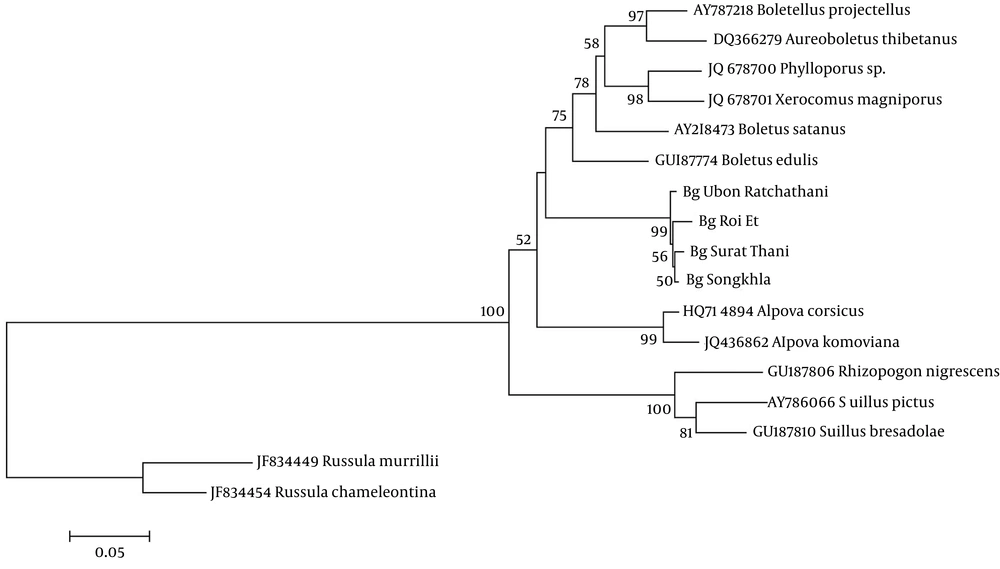
Numerals beside internal branches indicate bootstrap probabilities ≥ 50% based on 1000 replicates. Scale indicates expected number of substitutions per site. GenBank accession numbers are shown. <i>B.</i><i>griseipurpureus</i> Corner from Ubon ratchathani = Bg Ubon ratchathani (KC887325), <i>B. griseipurpureus</i> from Roi Et = Bg Roi Et (KC887326), <i>B. griseipurpureus</i> from Surat Thani = Bg Surat Thani (KC887327), <i>B. griseipurpureus</i> from Songkhla = Bg Songkhla (KC887328).
Figure 1.
Numerals beside internal branches indicate bootstrap probabilities ≥ 50% based on 1000 replicates. Scale indicates expected number of substitutions per site. GenBank accession numbers are shown. B.griseipurpureus Corner from Ubon ratchathani = Bg Ubon ratchathani (KC887325), B. griseipurpureus from Roi Et = Bg Roi Et (KC887326), B. griseipurpureus from Surat Thani = Bg Surat Thani (KC887327), B. griseipurpureus from Songkhla = Bg Songkhla (KC887328).
Table 1.
Inhibition of two Basidiome Extracts on Three Species of Bacteria
Inhibition Zone, mmStaphylococcus aureus ATCC 29523Escherichia coli ATCC 25922Staphylococcus aureus MRSA 189Average diameter of inhibition zone
Methanol extract a16.6 ± 1.517.0 ± 1.015.0 ± 1.716.2 ± 1.6
Ethyl acetate extract b12.0 ± 2.013.6 ± 2.312.6 ± 2.012.7 ± 1.9
a Data are presented as Mean ± SD.
b Values are not different by Duncan’s Multiple Range Test (P < 0.05).

5. Discussion

The sequences which contained the RPB2 region suggest a monophylogenetic clade among basidiomes of B. griseipurpureus and the phylogenetic tree suggests that B. griseipurpureus has affinity in the Boletus group. These findings are in contrast with the ITS results that showed B. griseipurpureus was more closely related to Tylopilus than the Boletus group (1). In the future, the RPB2 region should be analyzed in parallel with other molecular markers for the phylogenetic study such as LSU, ATP6, RPB1, nuc-lsu and mtSSU sequences in order to better define the taxa boundaries (3, 4, 10, 11). This will require a more extensive collection of B. griseipurpureus in the region than what was possible in this study.
Lastly, the antimicrobial activities of the basidiome extracts suggest that this edible species may have attributes other than food nutrients. As for the extracts of Daedalea elegans, the methanol extracts had a greater biological activity (5). A crude methanol extract from Auricularia polytrica was able to inhibit both S. aureus and E. coli (9). The crude methanol extracts of Tylopilus neofelleus basidiomes were active against the Gram-positive but were inactive for the Gram-negative bacteria (12). However, a crude ethanol extract of Russula delica was more effective in inhibiting the growth of the Gram-positive than the Gram-negative bacteria (13). The higher activities of the crude methanol extracts are in concordance with a previous study with Strobilomyces (14). For this study, the crude methanol extract of B. griseipurpureus displayed a stronger antibacterial activity than the crude ethyl acetate extract. The minimal inhibition concentration of the crude methanolic extract from the basidiocarp of this species (31 g/L) was high, compared to the extracts from Tricholoma lobayensis (9). Moreover, the basidocarp extracts also available in some plant extracts, such as the crude ethanolic extract of Zataria multiflora was able to inhibit 75 strains of MRSA at the concentration 2-16 mg/L.
The replacement of antibacterial agents with extracts of medicinal mushrooms and herbs may overcome bacterial activities (5, 9, 12-16). B. griseipurpureus might be applied in dietary supplements in combination with herbs (5) and bioactive compounds for potential health benefits. A further study of this species will help enhance its values and widen its cultivation opportunities.

Acknowledgments

Footnotes

  • Authors’ Contributions:The work forms part of the PhD of Amornrat Aung-aud-chariya who conducted the study under the guidance of the Thai coauthors. Amornrat Aung-aud-chariya undertook part of her research in the laboratory of Nelly Siababa Aggangan in the Philippines, which is specialized in the production of mycorrhizal mycelium in vitro. Amornrat Aung-aud-chariya and Phuwadol Bangrak made substantial contributions to the conception and design of the experiments. Amornrat Aung-aud-chariya acquired, analyzed, and interpreted the data. Niyom Kamlangdee, Phuwadol Bangrak, Nelly Siababa Aggangan, and Worrapong Phupong provided general supervision of the research and acquisition of funding. Saisamorn Lumyong contributed to drafting the manuscript.

  • Funding/Support:The research is partially supported by the Center of Excellence on Agricultural Biotechnology, Science and Technology, Postgraduate Education and Research Development Office, Commission on Higher Education, Ministry of Education (AG-BIO/PERDO-CHE). The research was partially supported by a grant from the Ministry of Education, a graduated school grant from Walailak University and a grant from Rajamangkala University Technology of Srivijaya Trang campus.

References

  • 1.
    Lumyong S, Kamlangdee N. Preliminary molecular identification of Boletus griseipurpureus Corner from Thailand and its nutritional value. J Agric Technol. 2012;8(6):1991-8.
  • 2.
    Corner EJH. Boletus in Malaysia. Botanic Gardens; 1972.
  • 3.
    Drehmel D, James T, Vilgalys R. Molecular phylogeny and biodiversity of the boletes. Fungi. 2008;1(4):17-23.
  • 4.
    Desjardin DE, Binder M, Roekring S, Flegel T. Spongiforma, a new genus of gastroid boletes from Thailand. Fungal Divers. 2009;37:1.
  • 5.
    Kavitha D, Balakumar R, Sivaprakasam E, Sridhar S, Suresh J. Antibacterial and antifungal potential of fruit body extracts from daldinia concentrica (bolton) cesati & de notaris. Int J Pharm Sci Res. 2011;2(9):2376-9.
  • 6.
    Hirata Y, Nakanishi K. An antibiotic from a basdiomycete. J Biol Chem. 1950;184(1):135-43.
  • 7.
    Nwachukwu E, Uzoeto HO. Antimicrobial activity of some local mushrooms on pathogenic isolates. J Med Plants Res. 2010;4(23):2460-5.
  • 8.
    Lian B, Zang JP, Hou WG, Yuan S, Smith D. PCR-based sensitive detection of the edible fungus Boletus edulis from rDNA ITS sequences. Electronic Jf Biotechnol. 2008;11(3):102-9.
  • 9.
    Gbolagade J, Fasidi I. Antimicrobial activities of some selected Nigerian mushrooms. Afr J Biomed Res. 2006;8(2):83-7.
  • 10.
    Dentinger BT, Ammirati JF, Both EE, Desjardin DE, Halling RE, Henkel TW, et al. Molecular phylogenetics of porcini mushrooms (Boletus section Boletus). Mol Phylogenet Evol. 2010;57(3):1276-92. [PubMed ID: 20970511]. https://doi.org/10.1016/j.ympev.2010.10.004.
  • 11.
    Froslev TG, Matheny PB, Hibbett DS. Lower level relationships in the mushroom genus Cortinarius (Basidiomycota, Agaricales): a comparison of RPB1, RPB2, and ITS phylogenies. Mol Phylogenet Evol. 2005;37(2):602-18. [PubMed ID: 16085431]. https://doi.org/10.1016/j.ympev.2005.06.016.
  • 12.
    Lee SJ, YUN BS, Cho DH, Yoo ID. Tylopeptins A and B, new antibiotic peptides from Tylopilus neofelleus. J Antibiot. 1999;52(11):998-1006.
  • 13.
    Türkoğlu A, Duru ME, Mercan N. Antioxidant and antimicrobial activity of Russula delica Fr: An Edidle wild mushroom. Eurasian J Anal Chem. 2007;2(1):54-67.
  • 14.
    Sato H, Hattori T, Lee SS, Murakami N. Two species of Strobilomyces (Boletaceae, Boletales), S. seminudus and S. hongoi sp. nov. from Japan. Mycologia. 2011;103(3):598-609.
  • 15.
    Motevasel M, Okhovat MA, Zomorodian K, Farshad S. A Study of the Effect of Zataria multiflora Extract on Methicillin Resistant Staphylococcus aureus. Jundishapur J Microbiol. 2013;6(5):543.
  • 16.
    Thenmozhi M, Sivaraj R. In-vitro evaluation of the antibacterial activity of Petunia leaf and callus extracts. J Agric Technol. 2011;7(2):321-30.

Copyright

Copyright © 2015, Ahvaz Jundishapur University of Medical Sciences. This is an open-access article distributed under the terms of the Creative Commons Attribution-NonCommercial 4.0 International License (http://creativecommons.org/licenses/by-nc/4.0/) which permits copy and redistribute the material just in noncommercial usages, provided the original work is properly cited.

Similar Articles

31
Oct
2012

Mushrooms as Possible Antioxidant and Antimicrobial Agents

Marijana Kosanić,
Branislav Ranković,
Marko Dašić

Kosanić M, Ranković B, Dašić M. Mushrooms as Possible Antioxidant and Antimicrobial Agents. Iran J Pharm Res. 2012;11(4):e125907. doi: https://doi.org/10.22037/ijpr.2012.1201

20
Nov
2010

Activity of Some Plant Extracts AgainstMulti-Drug Resistant Human Pathogens

Mustafa Oskay,
Dilek Oskay,
Fatih Kalyoncu

Oskay M, Oskay D, Kalyoncu F. Activity of Some Plant Extracts AgainstMulti-Drug Resistant Human Pathogens. Iran J Pharm Res. 2022;8(4):e128652. doi: https://doi.org/10.22037/ijpr.2010.825

3
Sep
2016

Chemical Composition and Antimicrobial Activity of Essential Oils of Ballota nigra Subsp. kurdica From Iran

Mohammad Majdi,
Dara Dastan,
Hossein Maroofi

Majdi M, Dastan D, Maroofi H. Chemical Composition and Antimicrobial Activity of Essential Oils of Ballota nigra Subsp. kurdica From Iran. Jundishapur J Nat Pharm Prod. 2017;12(3):e36314. doi: https://doi.org/10.5812/jjnpp.36314

12
Aug
2025

Comparison of the Essential Oil and the Purified Thymoquinone in Different Varieties of Nigella sativa L. Cultivated in the Different Regions of Iran and Investigation of Their Antibacterial Activity

Ashkan Hajinourmohammadi,
Jamil Zargan,
Mir-Morteza Sadat Ebrahimi

Hajinourmohammadi A, Zargan J, Sadat Ebrahimi M. Comparison of the Essential Oil and the Purified Thymoquinone in Different Varieties of Nigella sativa L. Cultivated in the Different Regions of Iran and Investigation of Their Antibacterial Activity. koomesh. 2025;27(4):e149278. doi: https://doi.org/10.69107/koomesh-149278

13
Feb
2013

The Evaluation of Antibacterial, Antifungal and Antioxidant Activity of Methanolic Extract of Mindium Laevigatum (Vent.) Rech. F., From Central Part of Iran

Masoud Modaressi,
Roia Shahsavari,
Farhad Ahmadi,
Mehdi Rahimi-Nasrabadi,
Ramin Abiri,
Ali Mikaeli
,et al.

Modaressi M, Shahsavari R, Ahmadi F, Rahimi-Nasrabadi M, Abiri R, et al. The Evaluation of Antibacterial, Antifungal and Antioxidant Activity of Methanolic Extract of Mindium Laevigatum (Vent.) Rech. F., From Central Part of Iran. Jundishapur J Nat Pharm Prod. 2013;8(1):34-40. doi: https://doi.org/10.17795/jjnpp-7730

More by these authors

Amornrat Aung-aud-chariyaPubMedScholar
Phuwadol BangrakPubMedScholar
Saisamorn LumyongPubMedScholar
Worrapong PhupongPubMedScholar
Nelly Siababa AgganganPubMedScholar
Niyom KamlangdeePubMedScholar
Share
Cited by
Metrics