


1. Background
Diabetes is one of the global problems, especially in developing countries. Diabetes mellitus (DM) as a chronic metabolic disease is one of the most prevalent causes of mortality in low-income and middle-income countries (1). Patients with diabetes are more sensitive to certain infections. Today, it has been proven that oral cavity can act as a primary site for dissemination of microorganisms including Candida species (2). Oral candidiasis is one of the most common opportunistic infections in patients with diabetes and immunodeficiency (3). According to a report by Mohammadi, et al. in Iran, from 855 yeast strains isolated from different clinical specimens, Candidaalbicans was the predominant species (58.6%) followed by C. parapsilosis (11.0%), C. glabrata (8.3%), C. tropicalis (7.0%), C. kefyr (5.8%), C. krusei (4.4%), C. orthopsilosis (2.1%) and C. guilliermondii (0.6%). A few strains of C. lusitaniae, C. rugosa, C. intermedia, C. inconspicua, Cryptococcus neoformans and Saccharomyces cerevisiae were isolated (4).
Although C. albicans is the most common cause of candidiasis, but 12 to 14 species of non-albicans Candida are known to cause such infections. Recent epidemiological studies have shown that non -C. albicansCandida species (NACs) such as C. tropicalis, C. parapsilosis, C. krusei and C. glabrata have repeatedly emerged as human pathogens (4). Candida species, especially C. albicans tend to colonize oral cavities, secrete hydrolytic enzymes and cause inflammation and hyperplasia of the gums and mouth, which can lead to discomfort, pain and disseminated infection in patients with impaired immune system. Candida species secrete different lytic enzymes such as phospholipases, esterases and hemolysin factor which digest surface membrane of the host cells, facilitate binding and penetration of microorganisms into the host tissue and contribute to tissue invasion, thus play important roles in Candida pathogenicity (5). They also attack host immune cells and molecules and prevent their antimicrobial activity.
Hemolysin of Candida species is amidst the most frequently studied enzymes produced by fungi, which is released during iron acquisition and facilitates the hyphal invasion in disseminated candidiasis (6). To our knowledge, secretion of hemolysin by Candida isolates from patients with diabetes had not been studied before. Detection of secretory enzymes in Candida strains isolated from DM can be an important step for management of these patients. Additionally, most previous researches focused on C. albicans.
2. Objectives
We aimed to:
1) Isolate, identify and compare enzymatic activities in Candida species isolated from diabetic and non- diabetic patients referred to Imam Sajjad Diabetes Center
2) Evaluate enzymatic activity in both C. albicans and NACs, especially C. glabrata, C. tropicalis and C. krusei.
3. Patients and Methods
3.1. Patients
Ninety-five patients with diabetes mellitus (35 men and 60 women) and 95 healthy volunteers (42 men and 53 women) were included in the study and matched for age, sex, dental status and smoking habits. The study protocol was approved by the research ethics committee (Ahvaz Jundishapur University of Medical Sciences). Selected patients from local outpatient diabetes clinics aged 10 to 85 years. After getting informed consent, patients referred to Imam Sajjad Diabetes Center (Dehdasht-Iran, 2013) were sampled using sterile swabs.
3.2. Candida Isolates
Swab samples were dispensed onto CHROMagar media (CHROMagar Candida, Paris, France) and incubated at 37°C for 48 hours. Candida species were determined by colony color on CHROMAgar medium, germ tube test, growth at 45°C and microscopic morphology after growing on corn meal agar medium.
3.3. Esterase Assay
Esterase activity was measured using the Tween 80 opacity test medium, which was prepared with 10 g of bacteriological peptone (Merck, Germany), 5 g of sodium chloride, 0.1 g of calcium chloride, 15 g of agar and 1000 mL of distilled water. After, the medium was autoclaved; it was cooled to about 50°C and was added 5 mL of autoclaved Tween 80 (Merck, Germany). The inoculated agar plates were incubated at 30°C and examined daily for 10 days. All inoculations were performed in duplicate. The colony diameter (a) and the diameter of colony plus precipitation zone (b) were measured. The esterase activities were expressed as Ez Value (a/b) as described by Price et al. (7).
3.4. Hemolysin Assay
Hemolysin production was evaluated using a modification of the plate assay described by Manns et al. (8). In brief, the isolates cultured on Sabouraud glucose agar were spot inoculated on a sugar-enriched sheep blood agar medium to yield a circular inoculation site of about 5 mm in diameter. The latter medium was prepared by adding 5 - 7 mL of fresh sheep blood (Darvash Co. Iran) to 100 mL of Sabouraud glucose agar supplemented with 3% glucose (Merck, Germany). The plates were incubated at 37°C in 5% CO2 for 48 hours. The ratio of the diameter of the colony to that of the translucent zone of hemolysis (in mm) was used as the hemolytic index (Hz Value) (9).
4. Results
Candida spp. were isolated from 57 patients with diabetes (60%) and 24 non-diabetic persons (25.5%). The oral carriage of C. albicans in the diabetic group (n = 42; 66.7%) was significantly greater than that in the control group (n = 16; 57.1%) (Chi-square test, P = 0.05). Other Candida species isolated included C. glabrata (9 isolates from DM and four from control groups), C. dubliniensis (eight isolates from DM and four from control groups), C. krusei (four isolate from DM and the control group) (Table 1).
Table 1. Prevalence of Candida Species in Diabetic and Non-Diabetic Groups a
| Variable | C. albicans | C. dubliniensis | C. krusei | C. glabrata |
|---|---|---|---|---|
| Diabetic | 42 (66.7) | 8 (12.7) | 9 (14.3) | 4 (6.4) |
| Non-Diabetic | 16 (57.1) | 4 (14.3) | 4 (14.3) | 4 (14.3) |
a Data are presented No. (%).
Hemolytic activity was detected in 100% and 52% of the isolates from diabetic and non-diabetic groups. Although 75% of C. albicans isolates from non-diabetic group produced hemolysin, the total hemolysin activity of Candida species was significantly higher in diabetic group than non-diabetic group (Table 2).
Table 2. Hemolytic Activity (Hz Value) of Oral Candida Species Isolates From Diabetic and Non-Diabetic Subjects
| Variable | C. albicans | C. dubliniensis | C. krusei | C. glabrata | Total |
|---|---|---|---|---|---|
| Diabetic | 0.72 | 0.59 | 0.65 | 0.72 | 0.67 |
| Non-Diabetic | 0.78 | 0.93 | 1 | 0.94 | 0.91 |
After grading esterase activity in various Candida species, it was found that only C. glabrata and C. albicans were able to demonstrate esterase activity at + 3 level. In non-diabetic, 50% of C. glabrata and C. krusei produced esterase at + 1 level, although all of C. dubliniensis and 87.5% of C. albicans produced it at + 2 level (Figure 1 and Table 3).
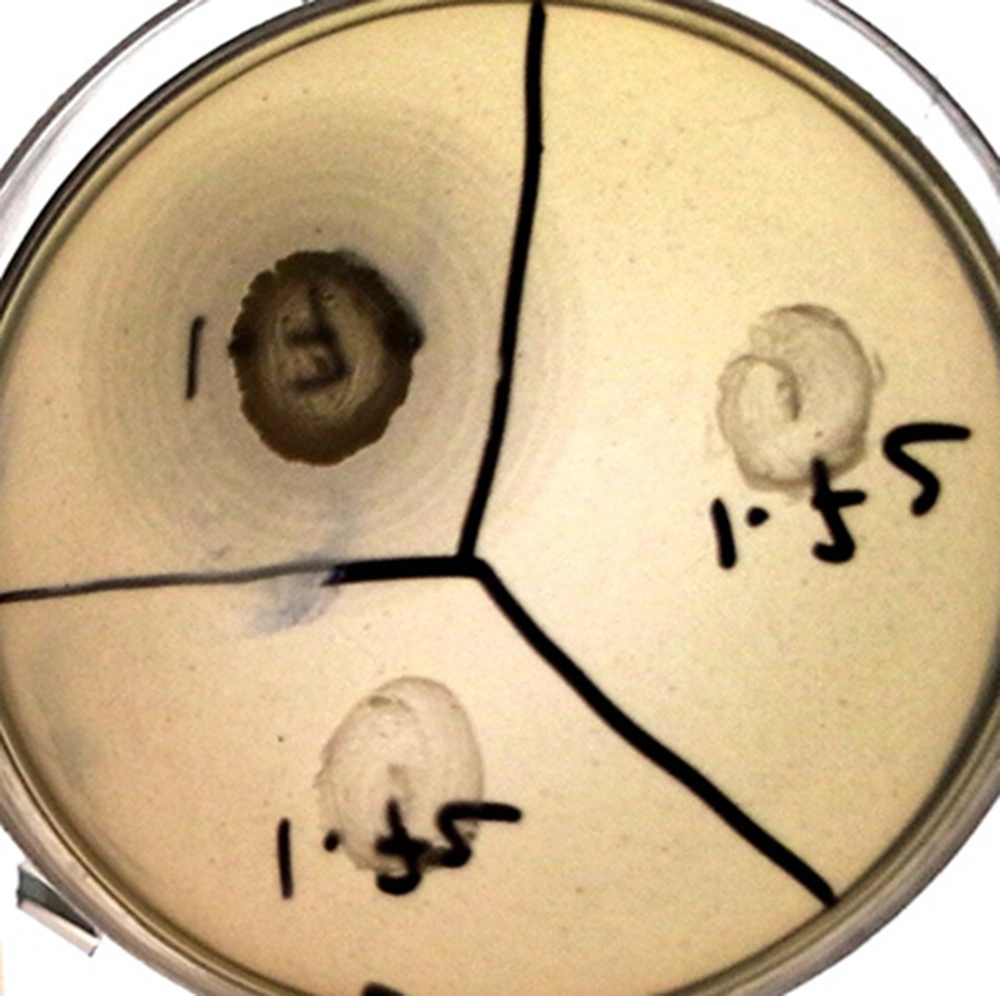
Figure 1.
Esterase Activity of Candida Species
| Variables | Diabetic | Non-Diabetic |
|---|---|---|
| C. krusei | ||
| 1 | - | 50 |
| 2 | 100 | 50 |
| 3 | - | - |
| C. glabrata | ||
| 1 | - | 50 |
| 2 | 66.7 | 50 |
| 3 | 33.3 | - |
| C. dubliniensis | ||
| 1 | 25 | - |
| 2 | 75 | 100 |
| 3 | - | - |
| C. albicans | ||
| 1 | 8.1 | 12.5 |
| 2 | 70.3 | 87.5 |
| 3 | 21.6 | - |
a Score of esterase: + 1 = 0.7 - 0.99; + 2 = 0.4 - 0.69; +3 = 0.1 - 0.39.
bData are presented as %.
5. Discussion
The purpose of this research was to identify and assess various species of Candida in oral cavity of diabetic and non-diabetic individuals and to compare their virulence factors such as esterase and hemolysin enzymes with the assumption that virulence factors of Candida species isolated from diabetic patients are higher than the control group. In this research, Candida was isolated from 60% of diabetic patients versus 25.5% of normal subjects. In patients with DM, due to reduced salivary flow, increased blood glucose concentration and decreased saliva pH the possibility of adherence and colonization of Candida is increased in mouth. The results of this study confirmed previous studies (2, 10, 11).
The most frequent oral yeast isolates from the study subjects was C. albicans. 66.7% of diabetic patients and 57.1% of normal subjects had C. albicans. Based on previous studies, the most common pathogen obtained in adults with oral mucosal was C. albicans (11). The oral carriage of C. albicans in the diabetic group (n = 42; 66.7%) was significantly greater than the control group (n = 16; 57.1 %) (Chi-square test, P, 0.05). Manfredi et al. reported that Candida grew out from the oral of diabetic subjects and non-diabetics by 60.5% and 57.3%, respectively (11). The highest growth rates related to C. albicans from the oral cavity of diabetic subjects (83.3%) and normal group (76.9%).
In our study, the percentage of C. albicans isolates from both groups was lower than report of Manfredi et al. (11). These results may be due to lower average age of our subjects, living conditions and some host dietary habits. However, Soysa et al. in a study on diabetic patients reported isolation of C. albicans between 18 - 80%, which is in accordance with our results (12). In this research, C. dubliniensis was isolated from eight of 95 patients with diabetes (8.4%). Willis et al. in a study isolated 18.2% C. dubliniensis from insulin-dependent diabetics (13), while Manfredi (11), showed it 3.5%. Previously, it was thought that this species of Candida is only separated from patients with HIV.
Four C. glabrata isolates were isolated from each of the two groups of patients and controls. Isolation of these species was higher in healthy subjects than patients with diabetes (Table 1). Studies on hemolysin activity of Candida species isolated from patients with diabetes are limited. Hemolysin activity in our study was significantly higher in the diabetic group than the control group. Hemolytic activity was assayed in C. albicans, C. dubliniensis, C. glabrata and C. krusei as 0.72, 0.59, 0.65 and 0.79, respectively. Hemolytic activity was detected in 100% of the Candida species in diabetic group, while only 52% of Candida isolates in non-diabetic group showed hemolytic activity. Of course, 75% of C. albicans isolated from non-diabetic group produced hemolysin factor. The hemolytic activity of C. albicans was significantly higher than that of non-C. albicansCandida isolates (P = 0.0001) in control group, but was not in the diabetic group (Table 2).
Our findings indicated that non-C. albicans isolates in patients with diabetes may possess greater virulence potential than non-albicans species in the control group. Manns et al. found that C. albicans does not show any hemolytic activity when there is no glucose available in the medium. They stated that adding glucose to the culture medium increases the hemolytic activity. Therefore, it can be predicted that increasing glucose concentrations in saliva would enhance hemolysin production, adhesion and colonization of Candida species in oral cavity of diabetic subjects (8). In this study, each of the Candida species in diabetic group significantly showed higher hemolytic activity the same as normal subjects. The differences in the hemolytic activities of non-albicans species were further. Perhaps these species in abnormal conditions such as diabetes had more pathogenicity. Shimizu et al. injected them into mice and examined the virulence of different strains and confirmed that production of extracellular enzymes by Candida isolated from patients with diabetes is higher than normal individuals (14). Luo et al. examined the hemolytic activity of 14 species of Candida separately. They showed the ability of Candida species in production of one or both hemolysins, but there was no quantitative report regarding the hemolytic activity of Candida species in patients with diabetes (15) and our research was the first in this regard. Aktas et al. evaluated esterase activity in different species of Candida qualitatively. In this study, almost all species produced sediment in Tween 80 opacity test medium after 2 - 10 days (16). This test is confirmed by other researchers, because it is convenient, economical and easy to perform (17). Kumar et al. qualitatively surveyed the esterase activity of Candida species isolated from immunocompromised hosts (18). Slifkim believed that due to lack of esterase production on Tween 80 opacity test medium by C. dubliniensis could identify C. dubliniensis from C. albicans, whereas in our study 100% of C. dubliniensis produced esterase (17). In our study, esterase activity was quantitatively evaluated. 21.6% of C. albicans strains and 33.3% of C. glabrata strains isolated from patients with diabetes produced esterase at level + 3, whereas these two species in the control group showed esterase activity at levels + 1 and + 2 (Table 3).
It is concluded that esterase and hemolytic activities of Candida in patients with diabetes are higher than healthy subjects, but some species such as C. glabrata act similar to C. albicans in diabetes.
