1. Background
Escherichia coli and Klebsiella pneumoniae are two important members of Gram-negative rods (Enterobacteriaceae), which belongs to a part of human gastrointestinal normal flora (1, 2). These organisms are substantial human pathogens which lead to a wide spectrum of hospital and community-acquired infections such as urinary tract infection (UTI) (3), septicemia, pneumonia, peritonitis, meningitis, etc. (4, 5). In the lack of appropriate treatment of infections by these organisms, noticeable morbidities and mortalities will occur (6).
The most important problem of patients with Enterobacteriaceae infections is the emergence of antimicrobial resistance (7, 8). The development of antibiotic-resistant strains begun shortly after the universal use of antibiotics in 1940s and it has reached a peak, with the emergence of resistant Enterobacteriaceae families to all antimicrobials in the last decade (9). Multidrug-resistant (MDR) isolates are resistant to at least three antibiotics (10). The evaluation of epidemiological data concerning MDR E. coli and K. pneumoniae in different parts of the world indicates their increased prevalence with noticeable varieties in many countries (11-13). These differences necessitate regional surveys about their resistance patterns and risk factors.
2. Objectives
Our investigation was carried out to determine the antimicrobial resistance patterns and associated risk factors for MDR E. coli and K. pneumoniae in Kashan, Iran.
3. Patients and Methods
3.1. Study Design and Population
This cross-sectional study was performed from February 2012 to March 2013 in Shahid Beheshti Hospital, affiliated to Kashan university of medical sciences. Totally, 250 clinical samples, culture-positive for E. coli and K. pneumoniae from the admitted patients in various wards (intensive care unit (ICU), pediatric, internal medicine, surgery, infectious and gynecology), were selected nonrandomly in the microbiology laboratory of the hospital. Following taking informed consents from the culture-positive patients, their demographic data such as age, gender, admission ward, clinical sample, history of medical disorders, history of admission in previous three months, and antibiotic or corticosteroid use during the last month were filled in questionnaires. All the stages of study were supervised and approved by the ethical committee of Kashan university of medical sciences (code: 2736).
3.2. Sample Collection and Microbial Detection
Clinical specimens including urine, blood, stool, peritoneal and pleural fluids were cultured on blood agar and MacConkey agar plates (Merk, Germany) at 37°C for 24 hours. The grown isolates were identified by the morphology of colonies, Gram staining, and biochemical test characteristics. On blood agar medium, E. coli colonies are round, with flat surface, have diameters of 1-2 mm, juicy consistency and grayish color, whereas K. pneumoniae colonies are large, dome shape, mucoid, and tend to coalesce. On MacConkey medium, E. coli colonies are red due to lactose fermentation, but K. pneumoniae colonies are large, mucoid dark pink, which indicates the fermentation of lactose. Escherichia coli biochemical characteristics include indole production, positive methyl red (MR), negative Voges-Proskauer (VP), negative Simmons’ citrate agar, negative urease and motile. The biochemical tests for K. pneumoniae are negative indole, positive urease, variable MR, positive VP, positive Simmons’ citrate agar and nonmotile. Microscopy by itself cannot differentiate the two organisms (14).
3.3. Antibiotic Susceptibility
The evaluation of specimens for antibiotic resistance was conducted according to the clinical and laboratory standards institute (CLSI) guidelines (15). By a sterile loop, the cultured colonies of E. coli and K. pneumoniae were inoculated directly onto Mueller-Hinton agar (Merk, Germany) by streak method. Screening test for the detection of antibiotic susceptibility was performed by Kirby-Bauer disk diffusion test (MAST, UK). Antibiotic disks impregnated with amikacin (30 µg), ampicillin (10 µg), amoxicillin-clavulanic acid (20/10 µg), ceftriaxone (30 µg), ceftazidime (30 µg), ciprofloxacin (5 µg), gentamycin (10 µg), and imipenem (10 µg) were plated on Mueller-Hinton agar and incubated for 24 hours at 37°C. The inhibition zones of ≤ 12 mm around gentamycin, ≤ 13 mm around ampicillin, amoxicillin-clavulanic acid, imipenem and ceftriaxone, ≤ 14 mm around ceftazidime and amikacin, and ≤ 15 mm around ciprofloxacin were considered resistant.
The confirmation of antimicrobial resistance was done by minimal inhibitory concentration (MIC) which was measured by epsilometer test (E-test) (Liofilchem, Italy). MICs ≥ 32 µg/mL for ampicillin and amikacin, ≥ 32/16 µg/mL for amoxicillin-clavulanic acid, ≥ 64 µg/mL for ceftriaxone, ≥ 32 µg/mL for ceftazidime, ≥ 16 µg/mL for imipenem, and ≥ 8 µg/mL for gentamycin were considered resistant. MDR was described as resistance to at least three antibiotics. E. coli ATCC 25922 and K. pneumoniae ATCC 7006039 were used as control isolates (Mast, UK) (15).
3.4. Statistical Analysis
Data were analyzed by SPSS software version 16. The description of the results was performed by frequencies. The distribution of continuous data was evaluated by Kolmogorov-Smirnov test. Independent T-test was used to determine the mean age of patients. Chi-squared test with estimation of the odds ratio (OR) and 95% confidence interval (CI) compared the characteristics of cases and also the antibiotic resistance patterns between the two groups (E. coli and K. pneumoniae). The association of risk factors for MDR was analyzed by two-step logistic regression test. Risk factors with P values < 0.2 in univariate logistic regression were entered in multivariate logistic regression analysis. Two-sided P values less than 0.05 were considered statistically significant.
4. Results
Totally, 250 clinical samples were culture-positive, of which 116 (46.4%) were K. pneumoniae and 134 (53.6%) were E. coli. The prevalence rates of culture-positive specimens for E. coli included 54.5% for urine, 27.6% for stool, 7.5% for blood, 6.7% for pleural fluid, and 3.7% for ascitic fluid; for K. pneumoniae, in urine, stool, blood, pleural and ascitic fluids the rates were 52.6%, 33.6%, 5.2%, 2.6%, and 6%, respectively (P = 0.39). The age range of patients was 2-81 (34.9 ± 24.5) years. The mean ages of culture-positive cases for E. coli and K. pneumoniae were 33.39 ± 24.42 and 36.54 ± 24.66 years, respectively (P = 0.31). One hundred thirty seven (54.8%) cases were male and 113 (45.2%) were female. No significant statistical differences were found in gender between the two microbial groups (P = 0.53). The characteristics of subjects are indicated in Table 1.
| Variables | Organisms | P Value | |
|---|---|---|---|
| E. coli (N = 134) | K. pneumoniae (N = 116) | ||
| Gender | 0.53 | ||
| Male | 71 (53.0) | 66 (56.9) | |
| Female | 63 (47.0) | 50 (43.1) | |
| Age, y | 0.6 | ||
| ≤ 10 | 28 (20.9) | 23 (19.8) | |
| 11-20 | 33 (24.6) | 21 (18.1) | |
| 21-60 | 44 (32.8) | (37.1) | |
| >60 | 29 (21.6) | 29 (25.0) | |
| Admission wards | 0.6 | ||
| ICU | 20 (14.9) | 19 (16.4) | |
| Pediatric | 34 (25.4) | 21 (18.1) | |
| Internal medicine | 19 (14.2) | 16 (13.8) | |
| Surgery | 23 (17.2) | 17 (14.7) | |
| Infectious | 21 (15.7) | 21 (18.1) | |
| Gynecology | 17 (12.7) | 22 (19.0) | |
| Admission duration, d | 0.96 | ||
| ≤ 7 | 87 (64.9) | 75 (64.7) | |
| > 7 | 47 (35.1) | 41 (35.7) | |
| Diabetes | 0.8 | ||
| No | 114 (85.1) | 100 (86.2) | |
| Yes | 20 (14.9) | 16 (13.8) | |
| Renal failure | 0.18 | ||
| No | 127 (94.8) | 114 (98.3) | |
| Yes | 7 (5.2) | 2 (1.7) | |
| History of admission | 0.4 | ||
| No | 109 (81.3) | 99 (85.3) | |
| Yes | 25 (18.7) | 17 (14.7) | |
| History of antibiotic use | 0.76 | ||
| No | 88 (65.7) | 74 (63.8) | |
| Yes | 46 (34.3) | 42 (36.2) | |
| History of steroid use | 0.03 | ||
| No | 127 (94.8) | 101 (87.1) | |
| Yes | 7 (5.2) | 15 (12.9) | |
a Abbreviations: E. coli, Escherichia coli; K. pneumoniae, Klebsiella pneumoniae; ICU, intensive care unit.
bAll the values are present as No. (%).
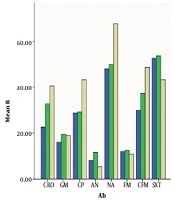
Escherichia coli resistance rates to ampicillin, co-amoxiclav, ceftazidime, gentamycin, amikacin, ceftriaxone, ciprofloxacin and imipenem were 76.1%, 26.9%, 30.6%, 38.8%, 26.9%, 26.9%, 21.6%, and 0%, respectively. The K. pneumoniae antimicrobial resistance rates were as follows: 77.6% for ampicillin, 28.4% for co-amoxiclav, 28.4% for ceftazidime, 35.3% for gentamycin, 31% for amikacin, 29.3% for ceftriaxone, 23.3% for ciprofloxacin, and 0% for imipenem. Nineteen (14.2%) E. coli and 12 (10.3%) K. pneumoniae isolates were sensitive to all the evaluated antibiotics.
MDR was observed in 67 (50%) E. coli and 54 (46.6%) K. pneumoniae strains (P = 0.59, OR = 0.87, CI: 0.53 - 1.43). The antibiotic susceptibility patterns among MDR strains are shown in Table 2. Using logistic regression test for the analysis of the associated risk factors of MDR organisms indicated that admission history during the prior three months and antibiotic use in a month before were risk factors for MDR E. coli isolates. Admission wards, admission duration more than seven days and antibiotic use in the last month were the associated risk factors for MDR K. pneumoniae isolates. The independent associated risk factors for MDR isolates are depicted in Tables 3 and 4.
| Antibiotics | E. coli (N = 67) | K. pneumoniae (N = 54) | P Value | ||
|---|---|---|---|---|---|
| S | R | S | R | ||
| Amikacin | 37 (55.2) | 30 (44.8) | 28 (51.9) | 26 (48.1) | 0.7 |
| Ampicillin | 2 (3.0) | 65 (97.0) | 2 (3.7) | 52 (96.3) | 0.83 |
| Ceftazidime | 30 (44.8) | 37 (55.2) | 27 (50) | 27 (50) | 0.59 |
| Ceftriaxone | 41 (61.2) | 26 (38.8) | 26 (48.1) | 28 (51.9) | 0.15 |
| Ciprofloxacin | 41 (61.2) | 26 (38.8) | 29 (53.7) | 25 (46.3) | 0.46 |
| Co-Amoxiclav | 36 (53.7) | 31 (46.3) | 29 (53.7) | 25 (46.3) | 0.9 |
| Gentamycin | 21 (31.3) | 46 (68.7) | 22 (40.7) | 32 (59.3) | 0.3 |
| Imipenem | 67 (100) | 0 (0) | 54 (100) | 0 (0) | - |
a Abbreviations: E. coli, Escherichia coli; K. pneumoniae, Klebsiella pneumoniae; S, sensitive; R, resistant.
bAll the values are present as No. (%).
Table 3.
Univariate and Multivariate Analysis of Potential Risk Factors for Multidrug-Resistant Escherichia colia
| Variables | MDR E. coli (n = 134) | P Value | Logistic Regression | ||
|---|---|---|---|---|---|
| Negative, No. (%) | Positive, No. (%) | OR (95% CI) | P value | ||
| Gender | 0.86 | ||||
| Male | 35 (52.2) | 36 (53.7) | |||
| Female | 32 (47.8) | 31 (46.3) | |||
| Age, y | 0.016 | ||||
| ≤ 10 | 20 (29.9) | 8 (11.9) | - | ||
| 11 - 20 | 19 (28.4) | 14 (20.9) | 0.68 | ||
| 21 - 60 | 19 (28.4) | 25 (37.3) | 0.44 | ||
| > 60 | 60 | 9 (13.4) | 20 (29.9) | 0.94 | |
| Admission wards | 0.019 | ||||
| ICU | 5 (7.5) | 15 (22.4) | - | ||
| Pediatric | 24 (35.8) | 10 (14.9) | 0.56 | ||
| Internal medicine | 6 (9) | 13 (19.4) | 0.42 | ||
| Surgery | 14 (20.9) | 9 (13.4) | 0.21 | ||
| Infectious | 10 (14.9) | 11 (16.4) | 0.5 | ||
| Gynecology | 8 (11.9) | 9 (13.4) | 0.68 | ||
| Admission duration, d | 0.007 | ||||
| ≤ 7 | 51 (76.1) | 36 (53.7) | - | ||
| > 7 | 16 (23.9) | 31 (46.3) | 0.07 | ||
| Diabetes | 0.15 | ||||
| No | 60 (89.6) | 54 (80.6) | - | ||
| Yes | 7 (10.4) | 13 (19.4) | 0.76 | ||
| Renal failure | 0.09 | ||||
| No | 66 (98.5) | 61 (91) | - | ||
| Yes | 1 (1.5) | 6 (9) | 0.7 | ||
| Admission history | < 0.001 | ||||
| No | 65 (97) | 44 (65.7) | - | ||
| Yes | 2 (3) | 23 (34.3) | 6.2 (1.06-36.4) | 0.043 | |
| Antibiotic use history | < 0.001 | ||||
| No | 57 (85.1) | 31 (46.3) | - | ||
| Yes | 10 (14.9) | 36 (53.7) | 3.3 (1.1-9.5) | 0.03 | |
| Corticosteroid use history | 0.7 | ||||
| No | 64 (95.5) | 63 (94) | |||
| Yes | 3 (4.5) | 4 (6) | |||
a Abbreviations: E. coli, Escherichia coli; MDR, multidrug resistant; CI, confidence interval; OR, odds ratio; ICU, intensive care unit.
Table 4.
Univariate and Multivariate Analysis of Potential Risk Factors for Multidrug-Resistant Klebsiella pneumoniaea
| Variable | MDR K. pneumoniae (N = 116) | P Value | Logistic Regression | ||
|---|---|---|---|---|---|
| Negative, No. (%) | Positive, No. (%) | OR (95% CI) | P value | ||
| Gender | 0.63 | ||||
| Male | 34 (54.8) | 32 (59.3) | |||
| Female | 28 (45.2) | 22 (40.7) | |||
| Age, y | 0.21 | ||||
| ≤ 10 | 16 (25.8) | 7 (13) | |||
| 11-20 | 13 (21) | 8 (14.8) | |||
| 21-60 | 20 (32.3) | 23 (42.6) | |||
| > 60 | 13 (21) | 16 (29.6) | |||
| Admission wards | 0.001 | ||||
| ICU | 3 (4.8) | 16 (29.6) | - | ||
| Pediatric | 16 (25.8) | 5 (9.3) | 0.11 (0.02 - 0.67) | 0.016 | |
| Internal medicine | 6 (9.7) | 10 (18.5) | 0.44 | ||
| Surgery | 12 (19.4) | 5 (9.3) | 0.12 (0.02 - 0.7) | 0.019 | |
| Infectious | 9 (14.5) | 12 (22.2) | 0.35 | ||
| Gynecology | 16 (25.8) | 6 (11.1) | 0.11 (0.02 - 0.6) | 0.012 | |
| Admission duration, d | < 0.001 | ||||
| ≤ 7 | 50 (80.6) | 25 (46.3) | - | ||
| > 7 | 12 (19.4) | 29 (53.7) | 4.2 (1.5 - 11.6) | 0.006 | |
| Diabetes | 0.06 | ||||
| No | 57 (91.9) | 43 (79.6) | - | ||
| Yes | 5 (8.1) | 11 (20.4) | 0.9 | ||
| Renal failure | 0.99 | ||||
| No | 62 (100) | 52 (96.3) | |||
| Yes | 0 (0) | 2 (3.7) | |||
| Admission history | 0.11 | ||||
| No | 56 (90.3) | 43 (79.6) | - | ||
| Yes | 6 (9.7) | 11 (20.4) | 0.9 | ||
| Antibiotic use history | < 0.001 | ||||
| No | 49 (79) | 25 (46.3) | - | ||
| Yes | 13 (21) | 29 (53.7) | 3.2 (1.09 - 9.8) | 0.04 | |
| Corticosteroid use history | 0.01 | ||||
| No | 59 (95.2) | 42 (77.8) | - | ||
| Yes | 3 (4.8) | 12 (22.2) | 0.74 | ||
a Abbreviations: K .pneumoniae, Klebsiella pneumoniae; MDR, multidrug resistant; CI, confidence interval; OR, odds ratio; ICU, intensive care unit.
5. Discussion
The emergence of MDR E. coli and K. pneumoniae is a noticeable problem in different parts of the world and many investigations with various findings has been conducted in recent years (16). In this study, the prevalence of multidrug resistance was 50% among the E. coli isolates and 46.6% among the K. pneumoniae isolates. During a survey in Iran by Shams et al. (17) on 134 culture-positive clinical samples for E. coli and K. pneumoniae, the prevalence of MDR isolates was reported 83% and 74%, respectively, which is more than our results. Rezaee et al. (16) reported 84.2% MDR E. coli from different specimens in Iran. The MDR rates in the two previous studies were substantially higher than ours and the probable explanation may be improper antibiotic prescription and genetic variations in different parts of Iran.
During a study in Egypt on E. coli isolated from urine samples, the MDR isolates prevalence was 87% and resistance to ampicillin, amoxicillin, cephalexin and chloramphenicol was 100%. Resistance to ampicillin-sulbactam, co-amoxiclav and imipenem was 67.1%, 45.7% and 10.64%, respectively (18). The multidrug resistance and all antimicrobial resistance rates were more than our results. In northern Ethiopia, culture-positive clinical specimens for E. coli such as urine, purulent otorrhea, wound and eye drainage were studied and the prevalence of MDR was reported 74.6%. The highest resistance to erythromycin (89.4%), amoxicillin (86%), tetracycline (72.6%) and the most sensitivity to nitrofurantoin (96.4%), norfloxacin (90.6%) and gentamycin (79.6%) were documented (19). Resistance to gentamycin was less than that of our findings. Similar results about MDR rate were reported in Sudan and Nigeria (20, 21).
During a study in Pakistan on positive urine cultures for K. pneumoniae, 71% were MDR and high resistance rates to ampicillin (100%), co-trimoxazole (93%) and cefaclor (80%) were detected. Eighty seven percent and 93% of isolates were sensitive to imipenem and meropenem, respectively (22). MDR, ampicillin and imipenem resistance rates were dramatically higher compared to our findings. Lina et al. (23) detected MDR rates of 86% and 85% among E. coli and K. pneumoniae, respectively, from urine samples. E. coli strains had resistance rates of 85% to ampicillin, 72% to co-trimoxazole, 84% to ciprofloxacin and 50% to gentamycin, and K. pneumoniae isolates showed resistance rates of 100%, 54%, 54% and 27% to ampicillin, ciprofloxacin, co-trimoxazole and gentamycin, respectively. Both isolates were 100% susceptible to imipenem. The resistance rates of isolates to ampicillin and ciprofloxacin were more than ours, but E. coli resistance rate to gentamycin was lower and K. pneumoniae resistance rate to gentamycin was higher in our findings. Subha et al. (24) reported 100% MDR Klebsiella strains compared to 46.6% in our study.
Oteo et al. (25) did a survey in Spain on 7098 positive E. coli cultures and showed increase of MDR rate from 13.8% in 2001 to 20.6% in 2003, which in spite of this increment, was substantially less than our results. Moreover, they reported high resistance rates to amoxicillin (59.9%), co-trimoxazole (32.6%) and ciprofloxacin (19.3%). MDR and ciprofloxacin resistance rates in our survey were higher. An investigation in the United States on 38835 positive urine cultures for E. coli reported 7.1% MDR rate, and high resistance rates to ampicillin (97.8%), co-trimoxazole (92.8%) and cephalothin (86.6%) were detected (26).
In the present study, among the MDR strains, high resistance rates to ampicillin, third-generation cephalosporins and aminoglycosides, especially gentamycin were determined, but despite of MDR rates of 50% and 46.6% among E. coli and K. pneumoniae isolates, there was an overall relatively acceptable susceptibility to oral antimicrobial agents such as co-amoxiclav and ciprofloxacin. The comparison of our results with the aforementioned surveys stated more MDR and antibiotic resistance rates in developing countries, which may be attributable to inappropriate use of antimicrobial agents, geographic and social variations, sampling biases, and different patients’ characteristics. In our survey, ampicillin resistance rates of E. coli and K. pneumoniae were 76.1% and 77.6% respectively, which showed more favorable condition, despite of Ullah et al. (22) who reported ampicillin resistance rate of 100%. Fortunately, in our investigation all the isolates were sensitive to imipenem.
In contrast to lesser antimicrobial resistance rates of the present study compared to the majority of other investigations, judicious antibiotic prescription is mandatory to prevent the emergence of severe resistances in future. Our research revealed that antibiotic usage during a month before and admission during three months prior to the study were risk factors for MDR E. coli. Moreover, the present study detected admission more than seven days, antibiotic use in recent month, and admission wards as the potential associated risk factors of MDR K. pneumoniae. Serefhanoglu et al. (27) in Turkey determined that duration of admission was the only risk factor for the bacteremia caused by MDR E. coli. According to Park et al. (28), antibiotic use, implementation of peripheral catheter and neutropenia were the associated risk factors for MDR bacteremia by E. coli and Klebsiella. In other studies, hospitalization, attending to residential care centers, antimicrobial use, and increase of age were mentioned as the risk factors for multidrug resistance (29-32).
According to the present study, gender was not known as a risk factor of MDR strains, whereas Ibrahim et al. (20) documented the male gender as the MDR risk factor, which is inconsistent with our investigation. Moreover, no significant differences were found in MDR rates between age groups according to Ibrahim et al. (20), which is congruent with the current research. Based on the aforementioned results, antibiotic use can be considered as an important risk factor of MDR infections; so, the rational prescription of antimicrobial agents is mandatory. The strong point of the current study was the evaluation of independent associated risk factors for MDR E. coli and K. pneumoniae, which has been evaluated in a few surveys.
The limitations of our study included the following: molecular detection was not conducted and is recommended for further investigations; MDR-extended spectrum beta lactamase (ESBL) E. coli and K. pneumoniae were not evaluated; thus, more surveys are needed in future; finally, larger sample size studies in different centers are necessary to achieve more comprehensive results about other risk factors of multidrug resistance.
In conclusion, the present study revealed high antimicrobial resistance rates among MDR isolates, but totally, there was a relatively acceptable antibiotic susceptibility among the isolates. No imipenem-resistant strains were found. Furthermore, the MDR rate compared to developed countries was high and its risk factors included history of hospitalization, admission duration, antimicrobial use, and admission wards. Periodic surveillance of drug resistance and epidemiological data collection from patients can assist to develop the strategies to manage antibiotic resistance.