
1. Background
Women constitute half of the world's population, and 90% of this population has reached the age of 65 years (1). According to the reported of the Statistical Center of Iran, women aged 60 - 64 years will constitute approximately 17 million of the country's population by 2036 (2). Menopause is one of the most crucial periods of a woman’s life, which could permanently impact their health and wellbeing (3). It is a gradual procedure normally occurring at the age of 47 - 55 years (4). In a review study, the average age at menopause was reported to be 48.26 years in Iranian women (5).
The stages of reproductive aging workshop (STRAW) has defined seven steps in the chain of reproductive aging, which start from the reproductive years until the transition to menopause, during the menopause stage, and in the post-menopause period (6). According to the literature, reduced estrogen during the transition to menopause causes various symptoms in women (7), such as urinary difficulties (8), vasomotor alterations (9), changes in the bleeding pattern (10), nocturnal fatigue, cheerlessness, anxiety, headaches, loss of memory, insomnia (11), night sweats, reduced sexual activity, and reduced social/leisure activities (12). The effects of these symptoms on the health and the quality of life of postmenopausal women often become apparent before entering the menopause stage (10, 13, 14). Some studies have indicated that the transition to menopause is a one of most challenging stages of life for woman and is associated with severe life changes (15).
Quality of life is a direct outcome of health and has been the cornerstone of research and health interventions (16). Extensive research suggests that proper training and consultation could improve the quality of life of the women experiencing menopause (3, 17, 18).
As mentioned earlier, women are vital members of the community and account for half of the world's population. Since the transition to menopause and the associated symptoms in this period affect the mental health and wellbeing of women and lead to decreased quality of life (19-22), special attention must be paid to women’s life by healthcare providers to adopt the most effective strategies in this regard. Midwives have an important responsibility to consult and train these women, as well as their families and the community (19).
2. Objectives
The present study aimed to evaluate the role of midwives in the quality of life of the women experiencing the transition to menopause.
3. Methods
This cross-sectional was conducted at the main health centers of Javanrood, located in Kermanshah province, Iran during 2019 - 2020. Initially, a list of the women referring to these centers was prepared (n > 45), and their profiles were obtained from the health system of Javanrood. Following that, the women were contacted via phone to determine whether they met the inclusion criteria of the study to narrow down the primary list. Finally, the research objectives were explained to the candidates, and they were invited to the health center of their region in case of willingness to partake in the study.
The inclusion criteria of the study were as follows: (1) female gender; (2) age of > 45 years; (3) experiencing fluctuations in menstruation (cycle intervals of longer than 60 days) due to no specific diseases/medications (i.e., late menopause); (4) no hormone therapy within the past six months; (5) basic literacy; and (6) living with a spouse. The exclusion criteria were using medications for menopausal difficulties and incomplete questionnaires. After sample selection, arrangements were made for the individuals to attend the health centers. The participants provided written informed consent, instructed on the proper completion of the questionnaires.
Specific quality of life was measured using the menopause-specific quality of life questionnaire, the validity of which has been confirmed by Fallahzade et al. and a panel of experts. In addition, the reliability of this tool has been confirmed at the Cronbach's alpha of 0.85 (15). BMI was calculated using the self-report data on weight and height.
Data analysis was performed in SPSS version 24. The quantitative variables were expressed as mean and standard deviation, and the qualitative variables were expressed as percentages. Univariate linear regression was used to determine the BMI (independent variable) and predict the severity of menopausal symptoms and quality of life dimensions. In addition, multivariate linear regression was employed to determine the predictive factors of the quality of life of the women. In all the statistical analyses, the value of less than 0.05 was considered significant.
4. Results
In total, 136 women were enrolled in the study with the mean age of 49.94 ± 4.16 years. Table 1 shows the demographic and midwifery characteristics of the participants.
Table 1.
Demographic and Midwifery Characteristics, Quality of Life, and Health Satisfaction of Subjects
| Variables | No. (%) |
|---|---|
| Age (y) | |
| < 50 | 76 (55.9) |
| ≥ 50 | 60 (44.1) |
| Education level | |
| Below diploma | 110 (80.9) |
| Diploma | 22 (16.2) |
| Academic | 4 (2.9) |
| Education level of spouse | |
| Below diploma | 50 (36.8) |
| Diploma | 65 (47.8) |
| Academic | 21 (15.4) |
| Occupation status | |
| Housewife | 132 (97.1) |
| Employed | 4 (2.9) |
| Occupation status of spouse | |
| Self-employed | 103 (75.7) |
| Employed | 33 (24.3) |
| Economic status | |
| Well | 21 (15.4) |
| Moderate | 95 (69.9) |
| Poor | 20 (14.7) |
| Contraception method | |
| Hormonal | 25 (18.4) |
| Non-hormonal | 31 (22.8) |
| None | 80 (58.8) |
| Quality of life | |
| Very low | 1 (0.7) |
| Low | 18 (13.2) |
| Moderate | 89 (65.4) |
| High | 24 (17.6) |
| Very high | 4 (2.9) |
| Health satisfaction | |
| Low | 15 (11) |
| Moderate | 96 (70.6) |
| High | 22 (16.2) |
| Very High | 3 (2.2) |
| Volume of menstrual bleeding | |
| Decreased | 73 (53.7) |
| Increased | 24 (17.8) |
| Unchanged | 29 (28.7) |
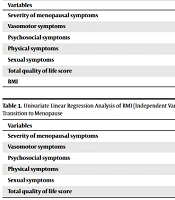
Table 2 shows the descriptive characteristics of the subjects, including menopausal severity scale, dimensions of quality of life, and BMI during menopause.
Table 2.
Descriptive Characteristics of Women During Transition to Menopause (Menopausal Severity Scale, Dimensions of Quality of Life, and BMI)
| Variables | Minimum | Maximum | Mean | SD |
|---|---|---|---|---|
| Severity of menopausal symptoms | 12 | 44 | 23.77 | 7.49 |
| Vasomotor symptoms | 3 | 18 | 8 | 4.31 |
| Psychosocial symptoms | 7 | 40 | 17.36 | 6.36 |
| Physical symptoms | 19 | 77 | 43.23 | 14.3 |
| Sexual symptoms | 3 | 16 | 7.27 | 3.15 |
| Total quality of life score | 33 | 141 | 75.88 | 24.91 |
| BMI | 19.5 | 33.91 | 25.03 | 2.85 |
According to the findings, BMI could significantly predict the severity score of menopausal symptoms and the dimensions of quality of life (vasomotor symptoms, psychosocial symptoms, physical symptoms, sexual symptoms), as well as the total quality of life score, during transition to menopause (P < 0.05) (Table 3).
Table 3.
Univariate Linear Regression Analysis of BMI (Independent Variable) for Prediction of Severity of Menopausal Symptoms and Dimensions of Quality of Life during Transition to Menopause
| Variables | Coefficient | SE | t | P-Value a |
|---|---|---|---|---|
| Severity of menopausal symptoms | 0.813 | 0.271 | 2.99 | 0.004 |
| Vasomotor symptoms | 0.303 | 0.128 | 2.375 | 0.019 |
| Psychosocial symptoms | 0.594 | 0.186 | 3.2 | 0.002 |
| Physical symptoms | 1.421 | 0.415 | 3.425 | 0.001 |
| Sexual symptoms | 0.232 | 0.093 | 2.48 | 0.014 |
| Total quality of life score | 2.55 | 0.721 | 3.53 | 0.001 |
a Univariate linear regression analysis.
The obtained results demonstrated that the variables of age, education level, education level of the spouse, and BMI could separately and significantly predict the quality of life the subjects during transition to menopause (P < 0.05) (Table 4).
Table 4.
Univariate Linear Regression Analysis of Predictive Factors of Quality of Life in Women During Transition to Menopause
| Variables | Coefficient | SE | t | P-Value a |
|---|---|---|---|---|
| Age | 3.184 | 0.437 | 7.28 | < 0.001 |
| Education level | -17.89 | 4.18 | 7.27 | < 0.001 |
| Education level of spouse | -10.72 | 2.96 | 3.61 | < 0.001 |
| Occupation status | -21.51 | 12.55 | 1.71 | 0.089 |
| Occupation status of spouse | 1.16 | 5.002 | 0.233 | 0.816 |
| BMI | 2.55 | 0.721 | 3.53 | 0.001 |
a Univariate linear regression analysis.
Our findings showed that the variables of age, education level, and BMI could significantly predict the quality of life the subjects during transition to menopause (P < 0.05) (Table 5).
Table 5.
Multivariate Linear Regression Analysis of Predictive Factors of Women's Quality of Life During Transition to Menopause
| Variables | Coefficient | SE | t | P-Value a |
|---|---|---|---|---|
| Constant | -77.05 | 2.45 | 2.74 | 0.007 |
| Age | 2.45 | 0.449 | 5.46 | <0.001 |
| Education Level | -9.4 | 4.64 | 2.02 | 0.045 |
| Education Level of Spouse | -5.02 | 3.62 | 1.38 | 0.169 |
| Occupation Status | 1.62 | 11.56 | 0.14 | 0.889 |
| Occupation Status of Spouse | 7.19 | 5.11 | 1.4 | 0.162 |
| BMI | 1.74 | 0.617 | 2.82 | 0.006 |
a Multivariate linear regression analysis.
5. Discussion
According to the results of the present study, the quality of life and severity of menopausal symptoms were moderate in the subjects. In addition, BMI could significantly predict the severity of menopausal symptoms, the dimensions of quality of life (vasomotor, psychosocial, physical, and sexual symptoms), and the total quality of life score during the transition to menopause. In another study, Sun et al. reported the correlation of quality of life and menopausal stages, and a gradual decrease was observed in the quality of life of women from the premenopausal to the menopausal transition, followed by the menopausal period (19). Furthermore, a meta-analysis conducted by Sharifi et al. indicated that the mean total quality of life score of 3,413 menopausal women in Iran was 57.87 ± 12.8, which is slightly above average. In the mentioned study, the relatively low quality of life was attributed to the physical and more the sexual activities of the subjects. In the current research, the mean total score of quality of life was 75.8 (average), and the dimensions with the lowest and highest scores were the physical and sexual dimensions, respectively. Therefore, it could be inferred that women in Iran have a moderate quality of life and may experience physical problems before and after menopause (20).
According to the findings of Masjoudi et al., the severity of menopausal symptoms could affect the quality of life of women, and the severity of menopausal symptoms in women differed in various stages of menopause. Correspondingly, the severity of symptoms in women in perimenopausal and postmenopausal stages was higher compared to the premenopausal stage (17), which is consistent with the results of the present study. Other findings in this regard are also in line with our study, indicating that obese women have a lower quality of life. For instance, Shobeiri et al. stated that menopause minimized the quality of life of women depending on their age, occupation status, BMI, financial status, and number of children (21).
Moilanen et al. conducted a research on a group of menopausal women, reporting that women with a constant weight for eight years had a desirable quality of life compared to those who gained weight (22); this is consistent with the findings of the current research. Conversely, the study by Jones et al. demonstrated that thin women had a low quality of life (23), while Souza Guerra et al. observed the correlations between quality of life and its dimensions (vasomotor, psychosocial, and physical symptoms) with the BMI of menopausal women receiving primary health care, which is in line with our findings in this regard. In addition, the regression analysis of the study by Souza Guerra et al. showed that BMI was significantly associated with the quality of life, severity of vasomotor symptoms, and the physical issues of the menopausal women (14).
Obese individuals often experience poor physical and mental health, particularly in the form of poor physical and social wellbeing (24). Obesity could be considered a chronic disorder, which leads to disability and affects daily activities, individual life, and quality of life (25, 26). Nevertheless, some studies have not confirmed the correlation between the BMI and quality of life of menopausal women. For instance, Llaneza et al. claimed that BMI had no effect on the total score of quality of life in obese women, while it affected the physical and sexual dimensions of quality of life (27). Moreover, Fallahzade et al. observed no significant associations between the quality of life and different levels of BMI, and the only significant correlation in the mentioned study was between the physical dimensions of quality of life and BMI (15).
In a study conducted by Golmakany et al., BMI had no effect on the quality of life of menopausal women. With increased age, the quality of life was reported to improve, and the women who exercised had a desirable quality of life as well. Based on the linear regression in the mentioned research, variables of age, marital status, smoking habits, exercise, and housing were correlated with the quality of life of menopausal women (28). In the study by Golmakany et al., the mean age of the women was 55.4 years, and the mean duration of menopause was seven years. The obtained results indicated that age and exercise could be among the influential factors in this regard, and an inverse correlation was also denoted between age and quality of life as the quality of life decreased with increased age (28). The present study indicated that the women in the transition to menopause stage had a lower mean age. Therefore, extensive research on larger sample sizes is required to assess the effects of factors such as age, BMI, and menopausal stages. The mentioned findings show that the association between the quality of life and BMI is rather complex and multifactorial, particularly in the transition stage to menopause.
Although obesity is a recognized risk factor for impaired quality of life, few studies have investigated the underlying biological mechanisms of this correlation. Some researchers have argued that obesity has numerous long-term physiological effects, which often potentiate each other (29). For instance, Park explored the potential causal pathways and mediating effects of the pathologic conditions that may explain this association, as well as the differences between gender groups (30), concluding that obesity was directly correlated only with the quality of life of women, while it was indirectly associated with health-related quality of life in men through diabetes mellitus, hypertension, dyslipidemia, and self-rated health (31).
The key strength of the current research was examining the women in the transition stage to the menopause period as most of the studies in this regard have investigated women in the postmenopausal period. Our study was carried out in one of the Kurdish cities of Iran, and it is recommended that similar research be conducted in other areas with different ethnicities. On the other hand, the mean BMI of the in the current research was within the overweight range, and the obtained results indicated that higher BIM led to decreased quality of life, as well as the intensified severity of menopausal symptoms. Therefore, further investigations are required to clarify the association between the BMI the quality of life of overweight and obese menopausal women.
5.1. Conclusion
According to the results, BMI was a significant predictor of quality of life and the severity of menopausal symptoms in women during menopause.