


1. Background
The experience of war and violence increases the risk for psychological distress and the development of psychiatric disorders among people, especially children. It is an enormous challenge and a complex situation for refugee children and families to escape from their home country after being engaged in such a terrible war as a fight with Islamic State of Iraq and Syria (ISIS) and to adopt the norms of the new society in which they seek shelter. The available literature shows consistently increased levels of psychological morbidity among refugee children, especially post-traumatic stress disorder, depression, and anxiety disorders (1, 2).
A review of 22 studies on refugee children revealed substantial variation in the definitions used and measurements of children’s problems and reported levels of post-traumatic stress disorder, ranging from 19% to 54% (3). Depression is one of the most common mental health outcomes of exposure to war-related traumatic stressors in refugee children. Depression in children as well as adults, in its most severe cases, can lead to suicide (2). Anxiety disorders, like depression, are among the most prevalent psychiatric disorders in refugee children. Anxiety in children often translates to poor mental health in adults (4).
Some identifiable groups are at higher psychological risk than the general public: for example, migrants and refugees; unaccompanied minors; former child soldiers; victims of violence; abused women; the neglected elderly; and minority children (5), where children of religious and ethnic minorities are the most vulnerable in wars with religious roots, such as the crimes of ISIS against the Yazidis. In addition to such calamities as losing parents and displacement, these children also face more complicated problems such as previous instances of violence, less social support, challenging religious beliefs, brain washing, forceful conversion of religion, and different kinds of child abuse.
Êzîdîsm, Yezidism or Yazidism is an ancient religion dating back to the Sumerian period of Mesopotamia. The Yazidis population numbers are close to 600,000. In terms of “ethnicity,” the majority of them identify themselves as Kurds. The Yazidis primarily settle in the Sinjar district on the western part of Nineveh Province, north of Iraq. There are other Yazidis living in Iraq’s Kurdish-administrated region (6). Throughout history the Yazidis, as a confessional minority, have suffered armed campaigns aimed at destroying them (7). In August 2014, the so-called “Islamic State” (henceforth “IS”) slaughtered the Yazidis, allegedly because they “were not Muslims.” The 2014 attack on Sinjar attracted global attention, as it was marked by utmost violence up to genocidal acts against the Yazidis population.
Although the mental health of refugee adults, adolescents, and children is investigated in the literature, most of these studies concentrate on PTSD and depression while some of these studies assert that refugee children and adolescents do not just suffer from PTSD but from various other problems as well (8). There are also very limited studies on psychological and mental problems of minority refugee children, especially in Iraq. Since the initial assessment of the problems in the target group is the first step in any clinical and supportive intervention, this study aims to investigate psychological problems of Yazidi displaced children and adolescents as a minority group.
2. Methods
The present study was a descriptive cross-sectional study conducted in 2016 - 2017. The area of the study was Dohuk, one of the largest provinces of Iraqi Kurdistan in the northern part of Iraq. There are 27 refugee camps in this city, 18 of which are devoted to Yazidis. Khank Camp was selected from these camps due to the objectives of the study, greater number of children, and cooperation of the camp supervisor. At the time the research was conducted, more than 8000 children from different age groups lived in various camps of the city. The target population was made up of all displaced Yazidi children aged 9 - 15 years old in Khanak Camp of Dohuk. After informing the authorities and the supervisor of the objectives of the study and receiving the required permits, the first researcher, accompanied by several Yazidi colleagues, started the study in Dohuk Camp. Yazidi assistants were selected due to their familiarity with the characteristics of Yazidis. Yazidi people are introverted and do not make contact with people of other sects. The initial sample included 100 children selected on the basis of their characteristics and existing sensitivities. The participants were divided into four groups of 25 children each. Each subject was asked to fill out the checklist separately. After being briefed on the objectives of the study, they were asked to voluntarily participate in the study and individually fill out the checklists. It was emphasized that participation was not obligatory. Then, the checklist was described and it was emphasized that there were no right or wrong answers; they were only required to choose the items that were true about them. The assistants also clarified that participants were allowed to raise hands for more assistance in case of any question or ambiguity.
From 100 children, 51 participants were omitted due to their reluctance or to incomplete checklists. Most of these subjects were aged under 10. Ultimately 49 subjects (30 females and 19 males) participated in the study. The ages ranged from 8 to 15 years old with a mean and standard deviation of 12 and 1.86, respectively. One questionnaire and one checklist were employed to collect the data:
1) A questionnaire to collect demographic data was composed of five questions regarding gender, age, school grade, year fleeing from their homeland, and time spent in the camp.
2) Youth Pediatric Symptoms Checklist-17 (PSC-Y), which is extensively used as a valid tool to evaluate psychological dysfunctions in children. The original Pediatric Symptoms Checklist is used for parents but PSC-Y, which is similar to the original version, enables children to answer the questions by themselves. The original version of the checklist contains 35 items, but based on the characteristics of the participants a version with 17 items was developed. The answers to these 17 items vary from “never” to “sometimes” or “often” with scores of 0, 1, and 2, respectively. The total score equals the sum of scores obtained for each item. The checklist includes three subscales: the internalizing subscale with a cut-off line of five or above; the externalizing subscale with a cut-off line of seven or above; and the attention subscale with a cut-off point of seven or above. A total score of 15 or above reflects behavioral or emotional problems. According to the reported studies, the 17-item questionnaire correlates well with the original version, and the same subscales and cut-off points can be discerned (9).
Although Yazidi inhabitants of Iraq speak the Kurmanji variety of Kurdish, an Arabic checklist was administered in the study since the formal education is in Arabic. To this end, the Arabic version previously employed in an Egyptian study (10) was utilized, but due to variations in Arabic dialects, it was converted into an Iraqi version. This was conducted by a team of experts in Arabic and English languages, as well as by experts of behavioral sciences. To this end, the English version of the checklist was translated into Arabic, and then the Arabic translation was retranslated back into English. Ultimately, the obtained version was compared to the original checklist and experts did not discern any discrepancies. Finally, SPSS 23 software was used to analyze the data. Cronbach’s alpha was also consistent.
3. Results
The descriptive data show that from 49 children participating in the study, 38.8 % were male and 61.2 % were female. Twenty-four point five per cent were aged 8 - 10, 46.9% were aged 11 - 13, and 28.6% were aged above 13 years old. The mean age and standard deviation were 12.18 and 1.86, respectively. The average for total score was 15.57 with a standard deviation of 4.73. The findings indicated that 65.3% of participants scored above the cut-off line and scores for 34.7% of them were below the cut-off line. Consequently, it can be stated that more than half of participants scored above the cut-off line. Since a score of 15 or above indicates emotional and behavioral disorders, our findings attest to the research hypothesis that psychological problems are prevalent in displaced Yazidi children and adolescents. Diagram 1 represents the ratio of participants with high risk of disorders to the subjects who were less risky, based on the cut-off line (score of 15) (Figure 1).
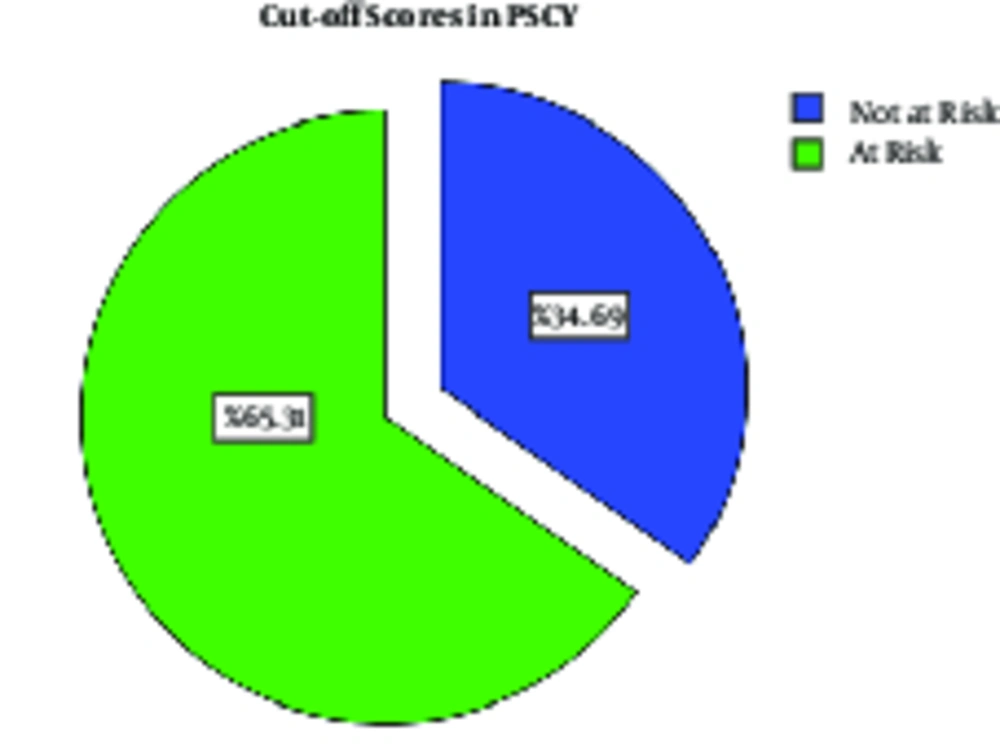
Figure 1.
Percentages of high-risk and low-risk participants
Since the PSY checklist is composed of three subscales (internalizing, externalizing, and attention), each subscale is also an analysis. The results are represented in Table 1 and Figure 2.
Table 1.The Mean and Standard Deviation of Total Scores Obtained by Participants, As Well As the Three Subscales of I, E, and Aa
| Gender | Ages Group, y | |||||
|---|---|---|---|---|---|---|
| Boys | Girls | Total | 8 - 10 | 11 - 13 | Above 13 | |
| Internalizing | 11.89 ± 4.24 | 14.70 ± 14.70 | 13.61 ± 4.30 | 9.53 ± 3.99 | 14.75 ± 3.32 | 16.36 ± 2.40 |
| Externalizing | 8.68 ± 3.41 | 8.33 ± 2.51 | 8.47 ± 2.86 | 5.53 ± 2.41 | 9.20 ± 1.76 | 10.57 ± 1.98 |
| Attention | 8.37 ± 3.38 | 9.50 ± 2.80 | 9.06 ± 3.05 | 6.40 ± 2.87 | 9.65 ± 2.15 | 11.07 ± 2.40 |
| Total scores | 14.47 ± 5.22 | 16.27 ± 4.35 | 15.57 ± 44.73 | 10.73 ± 4.33 | 16.80 ± 2.96 | 19.00 ± 2.80 |
aValues are expressed as mean ± SD.
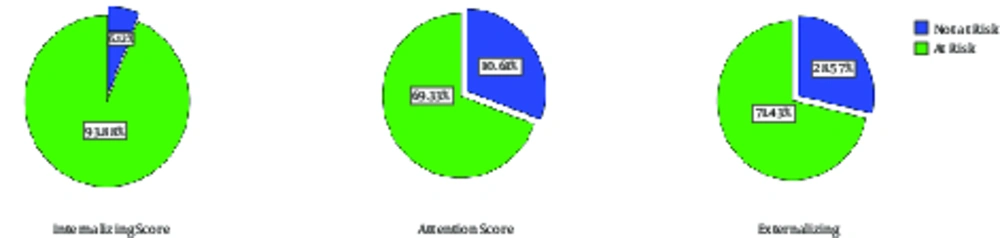
Figure 2.
Percentages of high-risk and low-risk participants in subscales
As witnessed in the above females females scored higher than males in total scores, as well as all subscales. Boys only scored higher in externalizing. The mean score also increased with age in all items.
As can be seen in all subscales, more than half of participants scored above the cut-off line (I = 93.88, A = 69.39, E = 71.43). Also, in the internalization scale which deals with the probability of anxiety and depression, participants are more vulnerable.
A one way analysis of variance (ANOVA) was employed to study the statistical significance of these discrepancies in total scores, as well as the scores for all subscales of the checklist. The results are reported in Tables 2 and 3.
Table 2.The ANOVA Results for PSC Scores (Total and Subscales), Based on Gender
| Sum of Squares | df | Mean Square | F | Sig. | |
|---|---|---|---|---|---|
| Total | 1.689 | 0.200 | |||
| Between groups | 37.396 | 1 | 37.396 | ||
| Within groups | 1040.604 | 47 | 22.141 | ||
| Total | 1078.000 | 48 | |||
| I | 5.391 | 0.025 | |||
| Between groups | 91.543 | 1 | 91.543 | ||
| Within groups | 798.089 | 47 | 16.981 | ||
| Total | 889.633 | 48 | |||
| A | 1.613 | 0.210 | |||
| Between groups | 14.895 | 1 | 14.895 | ||
| Within groups | 433.921 | 47 | 9.232 | ||
| Total | 448.816 | 48 | |||
| E | 0.171 | 0.681 | |||
| Between groups | 1.432 | 1 | 1.432 | ||
| Within groups | 392.772 | 47 | 8.357 | ||
| Total | 394.204 | 48 |
Table 3.The ANOVA Results for PSC Scores (Total and Subscales), Based on Age Group
| Sum of Squares | df | Mean Square | F | Sig. | |
|---|---|---|---|---|---|
| Total | 23.594 | 0.000 | |||
| Between groups | 545.867 | 2 | 272.933 | ||
| Within groups | 532.133 | 46 | 11.568 | ||
| Total | 1078.000 | 48 | |||
| I | 17.223 | 0.000 | |||
| Between groups | 380.935 | 2 | 190.468 | ||
| Within groups | 508.698 | 46 | 11.059 | ||
| Total | 889.633 | 48 | |||
| A | 13.989 | 0.000 | |||
| Between groups | 169.738 | 2 | 84.869 | ||
| Within groups | 279.079 | 46 | 6.067 | ||
| Total | 448.816 | 48 | |||
| E | 24.134 | 0.000 | |||
| Between groups | 201.842 | 2 | 100.921 | ||
| Within groups | 192.362 | 46 | 4.182 | ||
| Total | 394.204 | 48 |
Although females scored higher than males, both in total and subscales I and A, the ANOVA test revealed significant differences only in subscale I. Thus, it can be concluded that on the internalization scale which deals with the probability of anxiety and depression disorders, the females are more vulnerable. The same analysis was also conducted based on age. The results are presented in Table 3.
Based on results obtained from the ANOVA analysis of total scores and scores obtained in subscales of the PSC checklist, significant differences were observed among all four age groups. To spot the exact points of these differences, Scheffe post-hoc test was employed. The results indicate that total score of age group 8 - 10 years was significantly different from age groups 11 - 13 and +13. Based on the obtained mean, we can claim that the probability of emotional and behavioral disorders in age group 8 - 10 years is less than that of other participants. The same relationship was also documented in all three subscales of I, E, and A. Children aged 8 - 10 reported less psychological problems. Difference between age groups 11 - 13 and +13 was not significant.
4. Discussion and Conclusions
The present study aimed to study the psychological problems of displaced Yazidi children who had settled in Dohuk City (2016 - 2017). To this end and based on specific cultural characteristics of the participants as well as on the targeted age group and number of participants required for the PSC checklist, 100 children and adolescents were selected, of whom 49 participated in the study. The findings show that psychological problems are common in participants, with 65% of them scoring higher than the cut-off line. Our findings are in line with the results of relevant literature on displaced and refugee children and adolescents. Many reports on the prevalence of psychological symptoms among refugee children have been published by several researchers (1, 8, 11-15).
After the invasion of the ISIS in different Iraqi cities, Sinjar in northern Iraq, wherein a minority Yazidi group lived, was the focus of the heaviest of the attacks for ideological reasons. Subsequent to the mass slaughter of the non-military Yazidi minority and the slaving of the women and children, another refugee group wandered across Turkey and Iraqi Kurdistan. They settled in camps provided for them. Although these camps provide much safer conditions than living under the threat of ISIS, there are still many factors which threaten the mental health of camp settlers. Such factors as escape shock, sudden separation from already familiar environments, losing relatives, acquaintances, and family members can drastically threaten these children and teens. Many of them especially had witnessed the death, slavery, and selling of their close relatives and friends, or had suffered from pressure and torture to denounce their religion. Some of these children sheltered in mountains isolated from their family members and relatives for a long time, and walked for several days to find a safe place.
Moreover, camp life also imposed several difficulties. The camps were overpopulated and there was a deficit in educational and hygiene facilities which seriously threatened the physical and psychological health of camp inhabitants. In any war, children and senior citizens are the most vulnerable groups due to their physical and mental condition. They witness violence, terror, and slaughter of their family members and relatives. Most of them have not experienced educational environments, or their experience has not been pleasing (16). Even when settled in the safe environment of advanced countries, the prevalence of psychological problems is still high (14).
The effect of gender on psychological problems was not significant in this study, but in internalizing disorder (which includes anxiety and depression), females scored higher than males. Previous studies have reported the prevalence of psychological problems in females, whether in refugees (11) or in the public (17). Most of the studies reported higher prevalence of psychological disorders, especially depression, in females (18). In almost half of studies devoted to children, psychological disorders (especially depression) are more common in females than in males (14). In a study on the outbreak of depression and post-traumatic stress in Yazidi refugees, it turned out that women and girls experienced higher stress and scored higher on depression tests (11).
To explain this, it can be stated that depression is more frequent in females, as a whole, than in males. Yazidi women and girls suffered from sexual violence. They experienced slavery or they knew acquaintances who were slaves. Moreover, it seems that, even prior to ISIS attacks, life in a rural, closed, male-dominated culture predisposed Yazidi women to depression.
On the other hand, and based on our findings, the scores for all three subscales increased with age. Thus, we may witness an overlap between age and gender. It is possible that puberty, along with greater social responsibilities of Yazidi women, indirectly leads to an increase in depression scores of females.
Although it is difficult to establish a correlation between age and psychological problems, the literature provides examples of an increase in psychological problems as people grow older (16, 19, 20). For instance, a study by Nasergol and Sherry (11) showed that most psychological problems are experienced in ages 13 - 17 years. Similarly, in the present study, age group 8 - 11 years scored higher in psychological problems.
It is not easy to explain the relationship between age and the intensity of the disorder, since such factors as age of children when leaving their homelands and time spent in the camp interact with age and affect the incidence of psychological disorders. Moreover, it can be stated that older children have a better understanding of events, thus they think more about their unsatisfactory condition (11). Compared to younger peers, these children are more in charge of their relatives, and sometimes accept roles which they are not ready for. Moreover, children aged 11 and above, who scored the highest, are on the verge of puberty. This is another factor leading to psychological pressures. All of these factors may lead to higher prevalence of psychological problems. Displaced Yazidi children are a silent group who are easily overlooked. It is urgently required to take care of the mental health of children in this vulnerable group.
Although our findings showed greater probability of psychological disorders in Yazidi children and adolescents (especially internalization disorder in females), there is a series of constraints which should be taken into account before making any generalizations, e.g., research is a screening tool and more research or better tools are required to attest psychological infections. To this end, we recommend supplementing screening tools with such tools as clinical interviews. Moreover, due to lack of studies on non-displaced samples or to lack of other minorities, like Assyrian, and Yarsanis, we recommend a comparison between displaced and non-displaced Iraqi counterparts. Hereby, we would like to thank all children and adolescents who participated in the study, as well as the authorities of Khanaki Camp. We would like to thank Dr. Turkan Akkaya-Kalayci for guidance in this study. Last but not the least, we feel indebted to all people who aided us during this study.
