Fulltext
The full text of this article is available on PDF
Journal of Kermanshah University of Medical Sciences
Peer-reviewed Medical Quarterly
Authors
Introduction: Cerebral autoregulation (CA) and Mean Cerebral Blood Flow Velocity in males and females are still under controversy. The present study was scheduled to address the effect of sex on these parameters.
Materials and Methods: The Present study was interventional and performed on 30 healthy volunteers (15 males aging from 20-30 yrs and mean age of 23.9±3 years old and 15 females aging from 20 to 30 yrs and mean age of 24.2±2.5 years old). Flow velocity in middle cerebral artery (MCA) was assessed using transcranial Doppler (TCD) ultrasonography with a 2MHz probe. Eckberg’s neck suction device was utilized to stimulate carotid baroreceptors and a standard electrocardiograph, which recorded lead Π ECG traces, demonstrated carotid baroreflex response. In this study mean blood flow velocity in MCA represented the amount of brain blood flow. To analyze the data ANOVA and t-test were employed.
Results: There was a significant reduction in the heart rate after carotid baroreceptors stimulation in both sexes (P<0.001). The difference between the mean blood flow velocity oscillations of both groups in MCA during carotid baroreceptors stimulation was not statistically significant. However this was significantly higher in females both in baseline state and during stimulation (P<0.05).
Conclusion: The results indicated the high efficacy of cerebral blood flow autoregulation and higher cerebral blood flow velocity in females which is probably due to estrogen hormone.
© 2005, Journal of Kermanshah University of Medical Sciences. This open-access article is available under the Creative Commons Attribution-NonCommercial 4.0 (CC BY-NC 4.0) International License (https://creativecommons.org/licenses/by-nc/4.0/), which allows for the copying and redistribution of the material only for noncommercial purposes, provided that the original work is properly cited.
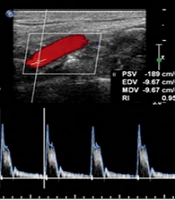
Sultan SR. Compensatory Hemodynamics in Severe Unilateral Internal Carotid Artery Stenosis: A Case Report. Int Cardiovasc Res J. 2025;19(1):e158776. doi: https://doi.org/10.5812/icrj-158776

Heroabadi A, Azimaraghi O, Nadjafi Semnani A, Saliminia A, Atefyekta R, et al. Effect of Gender Related Differences on Cerebral Oxygen Saturation. Arch Neurosci. 2018;5(3):e65492. doi: https://doi.org/10.5812/archneurosci.65492
Pan J, Zhou J, Liu P, Gu Y, Luo B. Use of Transcranial Doppler Ultrasound to Assess Leptomeningeal Collateral Flow in Patients with Severe Occlusive Internal Carotid and Middle Cerebral Artery Disorders: Correlation with Cerebral Angiography. I J Radiol. 2017;14(2):e36738. doi: https://doi.org/10.5812/iranjradiol.36738
Sarrami-Foroushani A, Nasr Esfahany M, Saligheh Rad H, Firouznia K, Shakiba M, et al. Effects of Variations of Flow and Heart Rate on Intra-Aneurysmal Hemodynamics in a Ruptured Internal Carotid Artery Aneurysm During Exercise. I J Radiol. 2016;13(1):e18217. doi: https://doi.org/10.5812/iranjradiol.18217
Zaheri S, Tadibi V, Monazami A, Naleini F. Effect of a Continuous Aerobic Exercise Session on Flow-Mediated Dilation in Women with Prehypertension. J Kermanshah Univ Med Sci. 2017;21(2):e69287. doi: https://doi.org/10.22110/jkums.v21i2.3421
Last Update: 1 month ago
Last Update: 1 month ago
Last Update: 1 month ago
Last Update: 1 day ago