
1. Background
Nursing is the most vital foundation of providing health services (1), constituting the largest workforce among medical staff and playing a central role in patient care (2). Nursing is a dynamic, caring, and supportive relationship in which nurses assist patients and their families in regaining optimal health (3). Given the common clinical duties of nurses, it is expected that they possess skills such as technical proficiency, communication abilities, and critical thinking tailored to each unique patient (4).
Psychiatric nursing involves the diagnosis and treatment of human reactions to potential and actual mental health problems (5). In addition to therapeutic care, psychiatric nurses are responsible for specific competencies, often including anger management and calming aggressive patients with suicidal thoughts (5). Research conducted in Japan on psychiatric nurses indicates that these professionals face numerous challenges, such as managing aggressive behavior in inpatients, navigating special psychiatric treatment relationships, providing psychiatric nursing care, and evaluating patients' psychological issues (6). Managing these challenges, alongside performing specific clinical tasks, requires clinical competency (7).
Clinical competence is a series of necessary and essential abilities required to fulfill roles in designated positions (5). It is described as the ability to combine skills, knowledge, and attitude in specific performance situations (8). In nursing, clinical competence involves applying ethics and beliefs about the knowledge and skills learned in university, along with the critical application of technical and communication skills and clinical reasoning in the clinical environment (4). Nurses should apply the main competencies of bedside nursing, which include professional roles, responsibility, and accountability, in all clinical competency issues (3). Clinical competence is a complex concept, and recognizing it requires understanding its dimensions and factors (5).
Personality traits significantly influence individuals' clinical professional behaviors and values. A fit between personality and occupational and organizational characteristics can lead to greater job satisfaction, critical thinking in the workplace, increased efficiency, and improved morale (2). Conversely, a lack of fit can result in job dissatisfaction, decreased quality of nursing care, and reduced professional commitment (9). Studies have shown that factors such as sex, education level, work experience, and personality characteristics affect nurses' clinical competence and quality improvement (8). Therefore, evaluating clinical competence is crucial because high-quality nursing care leads to increased safety and prevention of medical errors, such as medication errors, and in the psychiatric department, reduces frequent recurrences of the disease phase (10).
Evaluating nurses' clinical competence is essential for identifying areas needing improvement and determining the academic and clinical educational needs of nurses. This evaluation can highlight skill and cognitive deficiencies, especially among psychiatric nurses (4). It helps managers understand the quality of care services, skills, and cognitive problems, providing opportunities for development, improvement of the nursing profession, and elimination of deficiencies (5). In general, there is a close relationship between the clinical competence of psychiatric nurses and the quality of care provided. However, there have been no recent studies on the factors affecting the clinical competence of nurses in psychiatric wards (11). Therefore, this study aims to determine the relationship between personality traits and the clinical competence of nurses working in the Psychiatric Departments of Qazvin and Zanjan provinces in 2023.
2. Objectives
The present study was conducted to determine the predictive role of personality traits in psychiatric nursing clinical competence among psychiatric nurses.
3. Methods
3.1. Setting and Study Design
The current correlational study was conducted in 2023 among nurses in the psychiatric departments of hospitals in the Qazvin and Zanjan provinces of Iran, using a descriptive-analytical approach. The study was conducted as a census, with 50 nurses from psychiatric hospitals in Qazvin province and 221 from Zanjan province, totaling 271 participants. Qazvin province has two psychiatric hospitals: Qazvin 22 Bahman Specialized Psychiatric Hospital of Medical Sciences, which has three clinical departments for men, women, and emergency, and Qods Specialized Children's Hospital, which has a pediatric psychiatric department. Zanjan province also has two psychiatric hospitals: Dr. Shahid Beheshti, the dedicated psychiatric hospital of Zanjan Medical Sciences, which has four clinical departments for men, women, emergency, and neurotic patients, and Abhar Emdadi Hospital, which has clinical departments for men, women, and emergency.
The criteria for entering the study included a willingness to participate and employment in the psychiatry department. Incomplete questionnaires were excluded. After obtaining the necessary permits from the relevant authorities and coordinating with hospital management, the questionnaire was provided to the nurses in printed form. To increase the participation rate, sufficient explanations were given about the study's objectives, the confidentiality of the information, and the importance of their participation. Nurses were assured that their responses would be used solely for research purposes and would not impact their job status. The questionnaires were distributed in person during the nurses' breaks, and they were requested to answer all questions with the assurance of confidentiality.
The sampling model was a census, and the sample size formula was calculated as follows: The formula was based on the minimum correlation between personality type dimension scores and cognitive tools, estimated for 191 people (r = 0.2, α = 0.05, β = 0.80).
Where:
To estimate the clinical psychiatric nursing competency of working nurses, a minimum of 167 samples were required based on the results of a similar study, with a standard deviation (SD) of 14.47, a Z-score of 1.96, and a margin of error (d) of 2.2, using the following formula.
Therefore, in the present study, the minimum sample required was 191 people, of which 271 were included due to the availability of samples.
3.2. Data Collection Tools
3.2.1. First Part: Demographic Questionnaire
The first part consists of a demographic questionnaire that includes a checklist of questions regarding personal, educational, and occupational characteristics. These include:
- Personal characteristics: Sex, age, and marital status.
- Educational background: Level of education, field of study, and any specialized courses completed, whether related to psychiatry or unrelated to psychiatric nursing.
- Occupational information: General work experience, work experience in the psychiatric department, employment status, job position, type of shift, department of employment, and the extent of overtime and multitasking involved.
3.2.2. Second Part: Self-Assessment Questionnaire of Psychiatric Nursing Clinical Competency
This questionnaire was developed by Mohtashami et al., demonstrating proven validity and reliability (1). For this study, the researcher confirmed its validity and reliability. The Content Validity Index (CVI) was 85.0, and the content validity ratio (CVR) was 87.0, indicating strong content validity. The Cronbach's alpha was 0.821, and the intra-class correlation coefficient (ICC) for repeated assessments of the self-assessment questionnaire was 0.992, confirming its reliability.
The questionnaire comprises 36 statements scored on a five-point Likert scale. The first 8 questions assess general clinical competence, while the next 26 questions evaluate specific clinical competence. The minimum score is 36, and the maximum score is 180.
Nurses are classified into different levels of clinical competence based on their scores: (1) 36 - 72 (0 - 25% of the maximum score): Low or weak level of clinical competence; (2) 73 - 108 (25 - 50% of the maximum score): Medium level of clinical competence; (3) 109 - 144 (50 - 75% of the maximum score): Good level of clinical competence; (4) 145 - 180 (75 - 100% of the maximum score): Very good level of clinical competence (1, 10, 12).
3.2.3. Third Part: HEXACO Personality Traits Questionnaire
The HEXACO personality traits questionnaire was developed by Ashton and Lee in 2000. It consists of 24 trait scales across six personality factors and contains 60 questions (13). In subsequent research in 2004, Ashton and Lee introduced the term "HEXACO", an acronym representing Honesty-Humility, Emotionality, Extraversion, Agreeableness (versus Anger), Conscientiousness, and Openness to Experience (13, 14). Each factor comprises four scales or sub-dimensions, totaling 24 sections, with each scale containing eight questions.
One advantage of this model is its suitability for organizational processes, such as recruitment, retention, and development, due to its well-defined factors and explanatory power.
Breakdown of Questions for Each Factor:
- Honesty-Humility: Questions 6, 12, 18, 24, 30, 36, 42, 48, 54, 60
- Emotionality: Questions 5, 11, 17, 23, 29, 35, 41, 47, 53, 59
- Extraversion: Questions 4, 10, 16, 22, 28, 34, 40, 46, 52, 58
- Agreeableness: Questions 3, 9, 15, 21, 27, 33, 39, 45, 51, 57
- Conscientiousness: Questions 2, 8, 14, 20, 26, 32, 38, 44, 50, 56
- Openness to Experience: Questions 1, 7, 13, 19, 25, 31, 37, 43, 49, 55
To calculate the score for each subscale and the overall score for the questionnaire: (1) The scores for each item related to a specific subscale are summed; (2) the total score for the questionnaire is obtained by summing all item scores.
3.3. Ethical Consideration
The study, derived from a master's thesis in psychiatry, began with the review and approval of the ethics committee of Qazvin University of Medical Sciences (IR.QUMS.REC.1401.300). Participants were provided with detailed explanations regarding the purpose, methodology, and confidentiality of the study. Written informed consent was obtained from all students. All research procedures were conducted in accordance with the Helsinki Declaration.
3.4. Data Analysis
Data analysis was conducted using SPSS version 25 (Armonk, NY: IBM Corp). Frequency and percentage were used to describe qualitative variables, while mean and standard deviation were used for quantitative variables. The independent t-test was used to compare quantitative variables between two groups, one-way ANOVA was applied for comparisons among more than two groups, and post hoc tests were used for pairwise comparisons. The chi-square test was used to compare qualitative variables between two or more groups. The relationship between personality characteristics and nurses' clinical competence in psychiatric nursing was analyzed using the Pearson correlation coefficient. A P-value of < 0.05 was considered statistically significant for all tests.
4. Results
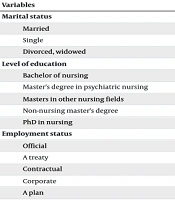
Of the 271 nurses participating in the study, 105 (38.7%) were male, while the remaining participants were female. Additionally, 195 (72%) were married, and the rest were unmarried. The mean age of psychiatric nurses was 36.55 ± 7.13 years. A total of 81.54% of the psychiatric nurses were from Zanjan province (Tables 1 and 2).
Table 1.
Demographic Qualitative Variables of Psychiatric Nurses
| Variables | No. (%) |
|---|---|
| Marital status | |
| Married | 195 (72.0) |
| Single | 70 (25.8) |
| Divorced, widowed | 6 (2.2) |
| Level of education | |
| Bachelor of nursing | 227 (83.7) |
| Master's degree in psychiatric nursing | 7 (2.6) |
| Masters in other nursing fields | 33 (12.2) |
| Non-nursing master's degree | 3 (1.1) |
| PhD in nursing | 1 (0.4) |
| Employment status | |
| Official | 116 (42.8) |
| A treaty | 20 (7.4) |
| Contractual | 57 (21.0) |
| Corporate | 22 (8.1) |
| A plan | 56 (20.7) |
| Department of employment | |
| Clinic | 12 (4.4) |
| Emergency | 58 (21.4) |
| Inpatient department | 195 (72.0) |
| Nursing office | 6 (2.2) |
| Shift status | |
| Work morning | 29 (10.7) |
| Work evening | 2 (0.7) |
| Night worker | 3 (1.1) |
| Rotating shift | 237 (87.5) |
| Working in several hospitals | |
| No | 185 (68.3) |
| Double work | 78 (28.7) |
| Three jobs | 8 (3.0) |
Table 2.
Demographic Quantitative Variables of Psychiatric Nurses
| Quantitative Variables | Mean ± SD | Minimum - Maximum |
|---|---|---|
| Age (y) | 36.55 ± 7.13 | 22 - 53 |
| Work experience (y) | 10.84 ± 6.91 | 0.2 - 30.0 |
| Work experience in the psychiatric department (y) | 4.18 ± 3.83 | 0.1 - 21 |
| Working overtime (h) | 85.51 ± 57.80 | 0 - 205 |
Data analysis showed that the total clinical competency score was 116.49, with a mean score of 26.40 for general clinical competency and 90.08 for specific clinical competency (Table 3). According to the results of the present study, the personality trait value was 174.20 ± 22.4, with a range of 106 - 228, indicating an average level. The component of openness to new experiences had the highest mean score (29.98), while the component of honesty and humility had the lowest mean score (27.15).
Table 3.
Mean of General and Specific Clinical Qualifications of Psychiatric Nurses
| Variables | Mean ± SD | Minimum - Maximum |
|---|---|---|
| General clinical competency | 26.40 ± 3.13 | 14 - 32 |
| Specific clinical competency | 90.08 ± 9.60 | 58 - 112 |
| Total score | 116.49 ± 11.80 | 73 - 144 |
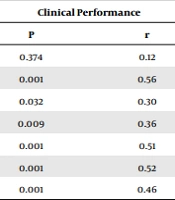
To explore the relationship between personality dimensions and clinical competence, Pearson’s correlation coefficient test was utilized. The results indicated that none of the personality traits showed significant correlations with general clinical competence (P > 0.05). Similarly, no significant relationships were found between personality traits and specific clinical competence (P > 0.05). Furthermore, total clinical competence also did not show any significant correlations with personality traits (P > 0.05).
Additionally, the study examined the relationship between personality characteristics and clinical competence in psychiatric nurses. Significant differences were found between the average and good clinical competence groups in honesty and humility (P = 0.003), agreeableness (P = 0.001), conscientiousness (P = 0.001), openness to new experiences (P = 0.023), and the total clinical competence score (P = 0.001). However, no significant differences were observed in emotional stability (P = 0.094) and extraversion (P = 0.089). These findings suggest that certain personality traits are associated with varying levels of clinical competence among psychiatric nurses (Table 4).
Table 4.
Relationship Between Personality Characteristics and Components of Clinical Competence in Psychiatric Nurses
| Personality Characteristics and Total Clinical Competence | Number | Mean ± SD | P-Value |
|---|---|---|---|
| Honesty and humility | 0.003 | ||
| Average | 59 | 28.81 ± 4.19 | |
| Good | 212 | 26.69 ± 4.95 | |
| Emotional | 0.094 | ||
| Average | 59 | 30.49 ± 4.07 | |
| Good | 212 | 29.33 ± 4.85 | |
| Extroversion | 0.089 | ||
| Average | 59 | 30.11 ± 3.77 | |
| Good | 212 | 29.07 ± 5.23 | |
| Agreement | 0.001 | ||
| Average | 59 | 30.10 ± 4.05 | |
| Good | 212 | 28.02 ± 5.08 | |
| Conscientious | 0.001 | ||
| Average | 59 | 31.18 ± 3.46 | |
| Good | 212 | 29.27 ± 5.25 | |
| Openness to new experiences | 0.023 | ||
| Average | 59 | 31.25 ± 3.89 | |
| Good | 212 | 29.63 ± 5.01 | |
| Total score | < 0.001 | ||
| Average | 59 | 181.96 ± 15.94 | |
| Good | 212 | 172.04 ± 23.88 |
Finally, multiple linear regression analysis showed that among personality traits and other factors, only openness to experience significantly predicted clinical competence in psychiatric nurses (β = 0.173, P = 0.029). None of the other variables, including honesty-humility, emotionality, extraversion, agreeableness, conscientiousness, age, work experience, work experience in the psychiatric department, overtime work, head nurse status, or supervisor/matron roles, showed significant effects on clinical competence.
5. Discussion
The present study was conducted to determine the predictive role of personality characteristics in the clinical competence of psychiatric nurses in the provinces of Qazvin and Zanjan, Iran. According to the results, the mean score of general clinical competency was 26.40 ± 3.13 with a range of 14 - 32, while the mean score of specific clinical competency was 90.08 ± 9.60 with a range of 58 - 112. The total clinical competency score was 116.49 ± 11.80 with a range of 73 - 144, indicating a good level of competency. Based on the classification, 59 participants (21.8%) had an average level of clinical competence, while 212 participants (78.2%) demonstrated good clinical competence.
In Karaminia et al.'s study, the clinical competence of nurses working in psychiatric departments of selected hospitals affiliated with the University of Welfare and Rehabilitation Sciences was examined. The results showed that the overall level of clinical competency among the study participants was at a good level (10), which is consistent with the findings of the present study. Similarly, a study conducted by Cheng reported a high level of clinical competency in nurses (17). The study by Mahdavisaeb et al. found that the clinical competence of nurses was excellent in both self-evaluation and supervisor evaluation methods (18). Additionally, in Adib Hajibagheri and Eshraghi Arani's study, the clinical competency of nurses, as evaluated by the nurses themselves, had a mean score of 67.08, indicating a good level, while supervisors rated it higher, with a mean of 78.24, reflecting an excellent level of competence (19). The findings of these studies align with the results of the present study.
The results also showed that the mean personality characteristics score was 174.20 ± 22.4, with a range of 106 - 228, placing it within the average range. Among personality components, openness to new experiences had the highest mean score (29.98), while honesty and humility had the lowest mean score (27.15). In Nadi Ravandi et al.'s study, which utilized the Neuroticism, Extraversion, Openness to Experience (NEO) Questionnaire, the mean score for conscientiousness was 28.80 with a standard deviation of 3.84. Among coping styles, problem-oriented and emotion-oriented styles had the highest mean and maximum scores. Additionally, perceived physical stress had the highest mean and maximum score (20). These findings are in line with the present study in terms of the conscientiousness factor, while inconsistencies in other aspects may be attributed to differences in the questionnaires used.
In the 2018 study by Khorashadizadeh et al., titled "Reviewing the Clinical Competence of Nurses at Imam Hassan Hospital (Bojnord) Using the ASCI Test: A Case Study", clinical competence was found to have a significant relationship with years of service, gender, and the university where the nurses studied. However, variables such as place of employment (clinical department) and type of employment showed no significant relationship with clinical competence (21). These findings contrast with the results of the present study, which may be due to differences in the study period and the type of test used. Additionally, this discrepancy may be explained by the non-psychiatric target population in the previous study and the lack of a specific questionnaire to assess clinical competence.
In Fattah Ahar et al.'s study, a significant difference was found in clinical competence between male and female nurses. One possible reason for the higher clinical competence observed in female nurses may be their attitude toward the nursing profession, which influences their ability to provide better patient care. Additionally, Ahar’s study found no significant relationship between independent variables such as age, academic grade point average, total nursing experience, psychiatric nursing experience, self-evaluation of clinical qualifications, and assessment of clinical qualifications by supervisors (22).
According to the results of the present study, the clinical competence of all supervisors and matrons in psychiatric hospitals was significantly higher than that of other personnel, with a score of 128.40 ± 11.32. In contrast, project staff, night shift workers, and nurses working rotating three shifts had the lowest clinical competence scores, with 115.13 ± 12.81, 103.0 ± 8.19, and 113.13 ± 7.97, respectively, although the differences between the groups were not statistically significant. The clinical competence of emergency department nurses was higher than that of nurses in other departments, demonstrating a considerable difference.
The results also showed a significant relationship between quantitative variables such as age, work experience, and overall clinical competency score. However, there was a significant inverse relationship between overtime hours and clinical competence score, indicating that as overtime hours increased, clinical competence decreased.
The findings further suggest that with increasing age and overtime hours, the average moral/emotional competence significantly declines. Prolonged working hours not only pose risks to health and safety but also lead to reduced alertness, competence, and productivity.
Additionally, the study found that nurses with an average total personality score and higher scores in honesty-humility, agreeableness, and conscientiousness had higher clinical competence than those with an overall good personality score. According to the regression test results, nurses who scored higher in openness to new experiences exhibited significantly higher clinical competence.
Overall, clinical competence is not solely influenced by personality traits; organizational, cultural, and environmental factors also play a significant role. Therefore, future research should examine the interaction between personality traits and environmental factors to provide more practical solutions for improving the clinical competence of psychiatric nurses.
5.1. Conclusions
According to the results of this study, a significant relationship was found between clinical competence and personality traits in psychiatric nurses. These findings can be valuable in assessing the educational needs of psychiatric nurses and helping nursing managers understand the clinical competence levels of nurses working in psychiatric wards. This knowledge can facilitate better classification of nurses based on their clinical competence levels, ensuring a more effective distribution of personnel across different wards for improved patient care and workforce management.
5.2. Limitations
One of the main limitations of this study was the self-report nature of the findings, which may introduce bias. To minimize this limitation, efforts were made to explain the study objectives clearly and provide participants with sufficient time to complete their responses.